
Silver Linings Playbook: strong story, humor and Jennifer Lawrence

In the rewarding family dramedy Silver Linings Playbook, Bradley Cooper plays Pat, a guy who is trying to conquer his mental illness without medication, and it’s not working out well for him.  Although his mom springs him from a locked psychiatric facility, he is prone to violent meltdowns.  Worse, he still has the delusion that he can get back with his estranged wife; but it’s clear that his marriage and his teaching career have been irretrievably wrecked by his past behaviors (and there is the matter of restraining orders).  He meets a young widow (Jennifer Lawrence) who also has enough issues to know her way around the menu of psych meds, and his life changes in ways that he can’t anticipate.

The fine filmmaker David O. Russell (The Fighter, Three Kings, Flirting with Disaster, I Heart Huckabees) invests the first half of the film is establishing the seriousness of Pat’s disorder and the impact on his family.   Russell applies enough humor to keep this part bearable, but it can discomfort folks expecting a regular rom com.  But this is the key to the film’s success, because he makes the illness realistic and the opposite of cute.  If the plot followed the usual rom com arc and pacing, the film would be phony and insulting.

It’s difficult to describe the brilliance of Jennifer Lawrence’s performance.  Her Tiffany is at once volatile, damaged and enticing.  Lawrence demands the focus of the audience in every scene.  She was justifiably nominated for a Best Actress Oscar for Winter’s Bone, my pick for 2010’s top movie.  This performance is as least as good.

We also see Robert DeNiro playing Cooper’s father as a guy who is just as crazy as his son, but neither diagnosed or medicated.  In another outstanding performance, Jacki Weaver (Oscar nod for Animal Kingdom), plays the strong and long-suffering mom who must steer her hair-trigger son and tinderbox husband away from self-inflicted disasters.  John Ortiz is wonderfully appealing as Pat’s henpecked buddy.

It’s worth seeing Silver Linings Playbook for Jennifer Lawrence’s performance alone, but I recommend the film overall for its strong story, topicality and humor.
Stream of the Week: Troll 2 – really the worst movie?

I love movies that are unintentionally hilarious – at once both undeniably bad and entertaining.  Troll 2 has recently gotten some buzz as the worst movie of all time”, largely because of Best Worst Movie, a 2009 documentary about how horrible and funny Troll 2 is.  It may not be the worst, but Troll 2 belongs in the conversation and has earned a place in my Bad Movie Festival.

A white bread suburban family vacations in the mountain village of Nilbog (“Goblin” spelled backwards, get it?) in which all the locals are vegetarian predator goblins who can take the form of regular humans.  The goblins are able to turn humans into vegetative matter (a green slime) that the goblins can ingest.

The movie was made with very primitive production values by a non-English speaking Italian crew and a non-Italian speaking Z-list American cast.  Inept acting and directing aside, the screenplay is probably the source of the most laughs.  There’s the dead grandpa Seth who keeps appearing to the boy, the boy’s saving his family by urinating on the family dinner, the make out scene so “hot” that it pops popcorn and so much more. Another of the funny aspects of Troll 2 is that it is completely unrelated to the movie Troll and has no trolls in it.

Troll 2 is available on Netflix Streaming.  You can see some of the finer bits of Troll 2 by doing a YouTube search for “You can’t piss on hospitality” and “Troll 2 O my God”.  Here’s the trailer.


As to Best Worst Movie, it’s very entertaining.  There are some squirmy scenes with cast members whose mental health issues have since worsened.  The Italian director is a jerk who, although happy to bask in Troll 2‘s new found cult status,  is narcissistically unwilling to acknowledge its badness.  But the goodhearted goofiness of star George Hardy, a cast of good sports and Troll 2‘s cult following dominates, and Best Worst Movie is fun to watch.  Best Worst Move is available on DVD.

A Royal Affair: Denmark sticks its toe into the Age of Enlightenment

The historical costume drama A Royal Affair begins when a teenage noblewoman is married off to a mad king.  The king benefits from the companionship of a new doctor.  The doctor is a man of the Enlightenment, and finds a kindred spirit in the young queen, which leads to… Amazingly enough, all this actually happened in late 18th century Denmark.

It’s a romance and tragedy of operatic depth, and, unfortunately, operatic length.  It would make a gripping 90-minute film, but A Royal Affair slogs through 137 minutes.   As a result the sharpness of the tragedy becomes dulled into mere grimness.

A Royal Affair is a showcase for the charismatic Danish actor Mads Mikkelsen (After the Wedding), who plays the doctor.  Mikkelsen is probably best known as the James Bond villain with the tears of blood.  Newcomer Mikkel Boe Folsgaard cleverly plays the mad king by focusing on his lack of impulse control and his involuntary giggle and growls.

A Royal Affair won the Silver Bear at the Berlin Film Festival and is considered a contender for the Foreign Language Oscar.

A Late Quartet: gripping drama

A Late Quartet is a compelling character-driven drama about the individuals that make up an elite and successful classical string quartet.  After twenty-five years, the cellist and leader develops Parkinson’s and must consider retirement.  This development takes the lid off an array of long-simmering issues and triggers personal and interpersonal crises.

What makes A Late Quartet so gripping is the level of performance – not surprising considering the top shelf cast.  Christopher Walken plays a man of uncommon dignity and stateliness, without the creepiness or even the eccentricity that his characters are usually imbued.  Philip Seymour Hoffman is superb as a man who unleashes deeply buried resentments and vulnerabilities.  Catherine Keener is also striking as a woman who cannot answer the question, “Do you love me?”.  Mark Ivanir (who I didn’t remember from Schindler’s List and who often plays Russian gangsters) is excellent as a callous perfectionist brought literally to his knees by something he never expected.  Imogen Poots (Solitary Man) also shines as the prodigy daughter who drops her youthful playfulness when it’s time to settle a score with her mother.

One more note:  I relished the delightful homage to Dinner with Andre when we suddenly see Wallace Shawn holding forth in a New York restaurant.

We aren’t surprised by any of the plot points, but we are continually surprised by the reactions of the characters, so masterfully delivered by the actors.

Lincoln: Spielberg introduces us to Lincoln the man

At the moment of Abraham Lincoln’s death, Secretary of War Edwin Stanton, standing at the foot of Lincoln’s bed, said “Now he belongs to the ages”.  Indeed, Lincoln became immortalized as moral icon, martyr and master of language (all of which he was).  But, because we didn’t see Lincoln campaign and govern on the nightly television news (or even on newsreels), there has been no popular familiarity with Lincoln in the flesh.  With Lincoln, Steven Spielberg has pushed aside the marble statue and re-introduced us Lincoln the man.

The great actor Daniel Day-Lewis becomes the man Lincoln.  We see him as the genius of political strategy who is always several moves ahead of the other players.  We see him as the pragmatist who will do what is necessary to accomplish his goals.  We see him fondly cajoling his wife but gingerly avoiding her outbursts.  We see him as a complex father – grieving one son, doting to a second, distant to another.  And we see Lincoln as a very funny guy –  both a master communicator who tells anecdotes to make his point and a raconteur who enjoys laughing at his own bawdy stories.  Day-Lewis brings all of these aspects to life in a great performance.

Besides Day-Lewis, Tommy Lee Jones, as a key Congressional leader, and James Spader, as a political fixer, get the best lines.  Sally Field is perfectly cast as Mary Todd Lincoln.  Bruce McGill, David Straithern, Hal Holbrook, Joseph Gordon-Levitt, Jared Harris (Mad Men) and Jackie Earle Haley (Little Children) are all excellent, too.

Spielberg and screenwriter Tony Kushner chose to focus on the few months at the end of the Civil War when Lincoln was trying to get Congress to pass the 13th Amendment to ban slavery.   Lincoln knew that, once the Civil War ended, his earlier Emancipation Proclamation was unlikely to withstand legal and political challenges and act to permanently ban slavery.  He also gauged that passage of the 13th Amendment was only viable before the end of the war, which was within sight.  His only recourse was to try to rush a successful vote over both the obstructionism of the opposing party and attempted sabotage by the Confederacy while both wings of his own party refused to join in collaboration.  It’s a horse race.

So we have a political thriller – one of the best depictions of American legislative politics ever on film.  Lincoln retains a team of lobbyists played by Tim Blake Nelson, John Hawkes and Spader.  These guys know that appealing to the principles of the targeted Congressmen is not going to get enough votes, so they enthusiastically plunge into less high minded tactics.  Spader’s character operates with unmatched gusto and is one of the highlights of the movie.  Lincoln’s lawyerly parsing of a note to Congress would put Bill Clinton to shame.

All of this really happened.  Lincoln, based on Doris Kearns Goodwin’s absorbing Team of Rivals: The Political Genius of Abraham Lincoln, is utterly historically accurate. Lincoln buffs will especially appreciate small touches like Lincoln’s pet name for his wife, Stanton’s aversion to Lincoln’s endless stream of anecdotes, Thaddeus Stevens’ wig, Ben Wade’s scowl, Lincoln’s secretaries (the White House staff) sharing a bed and the never ending flood of favor-seekers outside the door of the President’s White House office.  I think that Mary Lincoln is portrayed a bit too sympathetically, but that’s a tiny quibble.  One more fun note:  the 1860s were to male facial hair what the 1970s were to apparel – a period when everyone could make the most flamboyant fashion choices, mostly for the worse.

Lincoln is one of the year’s best films, and like Lincoln himself, timeless.

Skyfall: updating the Bond franchise

Daniel Craig returns as Her Majesty’s Action Hero, James Bond in Skyfall, an updating of the Bond franchise.   The core of the franchise is still the Bond character – impossibly suave, sexy and insurmountable.  Daniel Craig pulls it off as only Sean Connery could.  Craig’s 007 is more shopworn this time, with a drinking problem and a battled scarred (albeit Adonis-like) body.  But Craig’s Bond can still jump inside a moving train and then reach inside his jacket sleeve to adjust his cuff.

This episode’s Bond supervillain is played by an especially menacing Javier Bardem plus peroxide.   When filmmakers change Bardem’s hairstyle, something just happens to make him extra creepy.

It’s tough to impress an audience these days with cool gizmos, when we have guys sitting in Nevada watching SUVs in Afghanistan on satellite transmission and then  blowing them up by remote control.  So in Skyfall, Bond goes retro and brings back the Aston Martin with the ejector seat and the machine gun headlights.

Skyfall also sets up the changing of the guard for franchise, retiring Judi Dench and adding Ralph Fiennes, Ben Whishaw and Naomie Harris.  Naomie Harris is an especially welcome addition – beautiful, engaging and able to pull off an action scene.

But the real reason to watch Skyfall is for the action.  It’s tough to top the first sequence, which features a motorcycle chase on the rooftops of Istanbul’s Grand Bazaar turning into a fight on top of a moving train.  Skyfall is one of the better pure action flicks this year.

Chasing Mavericks: awesome waves, OK movie

Chasing Mavericks is the true story of Santa Cruz teen surfing prodigy Jay Moriarty being mentored by a veteran surfer so he can challenge Mavericks, the mythic surf spot near Half Moon Bay, California.  Moriarty was a kid left with just one unreliable parent who developed his passion with the help of a surrogate father, himself a damaged soul.  It’s a good story and heartwarming, if predictable – but exceptional in two respects.

First, the scenes of Mavericks are awe-inspiring.  Michael Apted took over when director Curtis Hanson became ill.  Whichever one of them shot the scenes at Mavericks deserves significant recognition.  As anyone has taken an amateur snapshot of the Grand Canyon knows, it’s tough to convey colossal scale in a photograph without a person or familiar object for comparison.  In Chasing Mavericks, we do see the surfers, tiny against the 30 foot faces of the waves.  But we also see the massive swells alone, erasing the coastline as they rise – and it is an unforgettable experience.  My one criticism of the surfing scenes is that almost every shot is less than 4 seconds, which doesn’t allow for full appreciation of long rides.

Second, the movie was shot on location at Mavericks and at many Santa Cruz locations, including Lighthouse Point, Steamer Lane and Seacliff.  The depiction of the locale and the local surfing culture will especially resonate with anyone familiar with the area.

Surfing is a sport that has inspired superb documentaries (Riding Giants, Step into Liquid, and the Endless Summer films) and generally putrid life action fictional films (Blue Crush and the Beach Party drek).  For all of its limitations, Chasing Mavericks may be the best ever non-documentary surfing feature.

Chasing Mavericks is just OK for most movie-goers , but if you’re into surfing and/or have an interest in the Santa Cruz and San Mateo coast, it’s a Must See.

Flight: a battle against gravity, then another against alcoholism

Denzel Washington stars in this top rate thriller about an airline pilot who becomes a hero after saving his passengers in a miraculous crash landing, but then falls into legal jeopardy when alcohol is found in his blood.  The plane crash is thrilling, but the high stakes suspense in the final 90 minutes is about whether he can get his drinking under control.

What makes Flight singular is that the hero can take control of a crisis at 35,000 feet and rise to superhuman performance, but is completely out of control when he spots a mini bottle of Ketel One.

And what a hero Denzel Washington makes!  The guy is among our very best actors, and here, his edginess and bluster mask the pilot’s achingly vulnerable loneliness and self-loathing.  And the charisma and confidence in Denzel’s screen presence makes him totally credible as an action hero.

Director Robert Zemeckis (Back to the Future) delivers a plane crash scene for the ages, and he does an excellent job of keeping up the suspense.  Flight is pedal-to-the-metal intensity until the final ten minutes, when the ending didn’t quite work for me.  For me, only the ending keeps Flight from being a Must See and one of the year’s best.

The English actress Kelly Reilly is really, really good as a trashy southern heroin addict whose life intersects with the pilot’s, and who must make the same choice between recovery and demise.  John Goodman is hilarious as a gonzo enabler right out of Hunter S. Thompson.  The rest of the cast shines, too, especially Don Cheadle, Bruce Greenwood and Tamara Tunie.

Cloud Atlas: more may not be better, but more is fun

The filmmakers of Cloud Atlas clearly believe that more is better.  They give us not one, not two – but six stories spanning six centuries. They give us lots of movie stars: Tom Hanks, Halle Berry, Jim Broadbent, Hugo Weaving, Jim Sturgess, Susan Sarandon, Hugh Grant and more.  The actors each play multiple roles, with Hanks, Berry, Weaving and Sturgess playing at least six each – sometimes playing characters of different genders and different races.  There are costume dramas on the high seas of the 1840s and in 1930s England, plus two sci-fi settings – one recalling the high-tech, high-speed Tron and also a post-apocalyptic tribal future.   There are even two references to the sci-fi cult classic Soylent GreenCloud Atlas even had three directors.

Whew.

The six story lines are threaded together so we follow them until all six climax in the final hectic thirty minutes.  The six stories are each a series of cliff hangers.  As a character in one story falls into peril, the screenplay jumps to another thread, and on and on.

As it manically jumps from story to story, Cloud Atlas touches upon some Big Themes (good and evil, kindness and control, freedom, reincarnation), and we get the brush strokes of a New Agey theology (as if the world needs another theology).  This is where Cloud Atlas gets fuzzy.   Fortunately, the movie is so rapidly paced, that it never gets pretentious as we jump from story to story.

Is Cloud Atlas fun to watch?  Yes, there’s just too much fast-paced action going on, too much eye candy and too many engaging actors for Cloud Atlas to fail the fun test.  Is Cloud Atlas a great movie?  No, there just isn’t enough coherent substance in there to hook us emotionally.  Is it a Must See?  No.  Would I see it again?  No, but I’m glad I saw it once.

A World Without Women: an amusingly awkward but vulnerable guy

A WORLD WITHOUT WOMEN

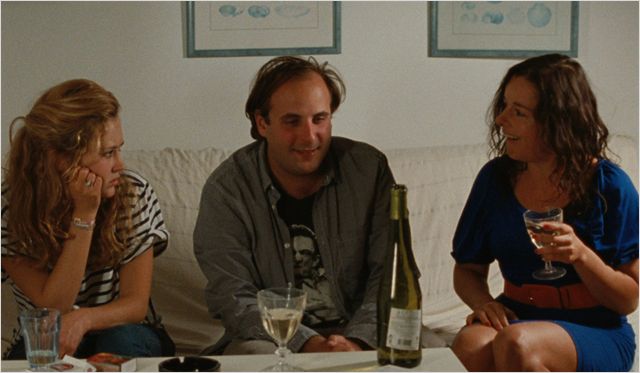
In the French film A World Without Women (Un monde sans femmes), Vincent Macaigne plays a lovable loser who manages holiday rentals in a northern French beach town.  He is amiable and good-hearted, but lonely and painfully socially inept.  A good timing single mom brings her college age daughter for a week on the beach and teases him out of his protective shell and into a position of maximum vulnerability.

Macaigne’s characterization is outstanding.  We really care for him and don’t want him to get hurt.  But Macaigne brilliantly employs little touches to illustrate his character’s utter lack of savoir-faire.  For example, at one point he and the mom are leaning shoulder to shoulder against a fence.  She has her arms crossed, and she’s leading him on.  He grasps her her nearest hand with his nearest hand.  But since he’s now holding her left hand with his left, he has pinned her left arm awkwardly across her body like a pretzel, which drains all of the sexual spark out of the situation.  And he can’t put his arm around her because he’s already using that arm to hold her hand.  It’s such a simple action, yet so meaningful.

Laure Calamy is also very good as the fortyish gal who dresses too young and flirts with every available man, leaving male carnage in her wake.

Writer-director Guillaume Brac shows a real command of characters and dialogue in this film.  I’m looking forward to his first feature.  A World Without Women is only 56 minutes long, and plays with Brac’s 24 minute Stranded, which also stars Macaigne as essentially the same character  The two films played together in Paris to surprising popularity.  Fortunately, Brac decided not to bloat the two screenplays into two bad 90-minute features.  Good for him.

I saw both Stranded and A World Without Women at the San Francisco Film Society’s French Cinema Now series.  A World Without Women is not available now on any platform (DVD, Stream, VOD) that I can find, but when it is, I’ll make it a Stream of the Week.  This trailer is in French without subtitles.