Go for Sisters: three more great characters from John Sayles

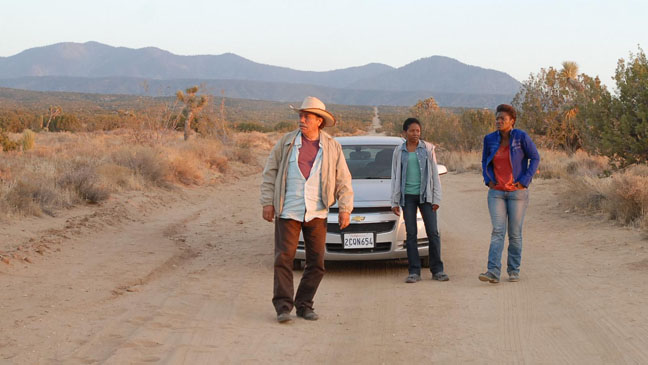
go for sistersMy favorite indie writer-director John Sayles has created three more wonderful characters in Go for Sisters.  Bernice (LisaGay Hamilton from Men of a Certain Age and Jackie Brown) is a no-nonsense parole officer. Fontayne (Yolonda Ross) is an ex-con fighting to maintain her sobriety through minimum wage jobs in a drug-filled neighborhood.  Freddy (Edward James Olmos) is an unfairly disgraced cop who is almost blind from macular degeneration.  Bernice and Fontayne were high school friends who took different paths.  Bernice’s adult son has gotten involved in some illegal activity, and when he disappears, Bernice need Fontayne’s street connections to help find him.  Soon they need to enlist Freddy, and soon the three are off on chase back and forth through the under world on both sides of the US-Mexico border.  All three characters are emotionally damaged from personal loss – and all three are fighting through their pain.

Go for Sisters is in the construct of a thriller, but it’s not the greatest thriller around, although Sayles gets what he can from a radio tracking device and an attempted miggung in a Tijuana dildo shop.  What makes Go for Sister – and all of Sayles’ films – worthwhile is the characters.  We’ve never met these individuals before, but they are believable and we care about them.  Excellent acting from the three stars helps a lot.  (And there’s a nice scene with Hector Elizondo.)

This is minor Sayles – it doesn’t compare to Eight Men Out, Passion Fish, The Secret of Roan Inish, City of Hope or his 1996 masterpiece Lone Star.  Still, it’s a solid character driven film (and will be a good video choice in 2014).
Inside Llewyn Davis: unlovable loser

INSIDE LLEWYN DAVIS

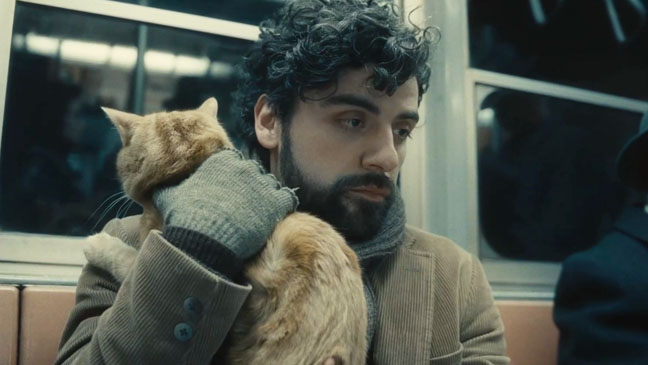
In Inside Llewyn Davis, the Coen Brothers take us back to the Greenwich Village folk scene just before the emergence of Bob Dylan. Oscar Isaac plays a talented folk singer who is always a day late and a dollar short – and it’s all his own fault.  His self-absorption sabotages his career and his relationships. Unfortunately, to paraphrase The Wife leaving the theater, we don’t care enough about the protagonist to root for him, and he’s not hateful enough to make us root against him.  And that’s why Inside Llewyn Davis isn’t a great movie.  (In contrast, Sideways is a great movie about another guy who is making his own bad luck – but we care about THAT guy.)

What Inside Llewyn Davis does right is to take us back to the Village in 1961 – the music is great and so are all the period details,  Oscar Isaacs is quite good, and there are some stellar turns by Justin Timberlake, F. Murray Abraham and character actor Stan Carp as Llewyn’s senile dad.  And Inside Llewyn Davis is often very, very funny.

Inside Llewyn Davis was perhaps the most critically praised film at this year’s Cannes International Film Festival and is on the Best of 2013 lists of most critics – but not mine.  It’s watchable for the period and the humor, but the main character just doesn’t engage us enough.

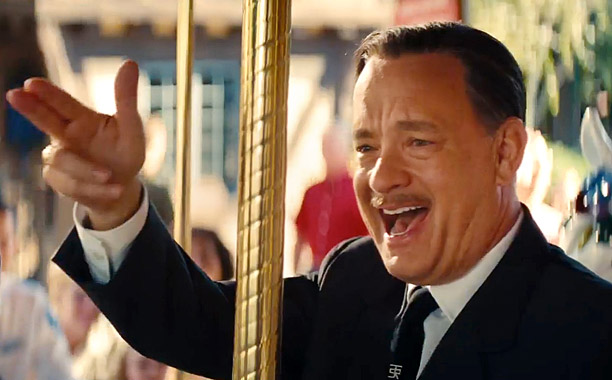
Saving Mr. Banks: Hanks as Disney, slathered with sentimentality

SAVING MR. BANKS - TRAILER NO. 1 -- Pictured: Tom Hanks (Screengrab)

Saving Mr. Banks is Disney’s story of the making of Mary Poppins, centering on the conflict between the avuncular Walt Disney (Tom Hanks) and the harshly fastidious author of the source material, P.L. Travers (Emma Thompson).  It’s a pleasing and satisfying movie, albeit sentimental, predictable and emotionally manipulative.  (I saw this with The Wife, who found the movie to be deeper than I did.)

From top-to-bottom, Saving Mr. Banks is quite well-acted.  It’s great to see Hanks bring alive Walt Disney – such an icon, especially to the Baby Boomers who watched him introduce the most imaginative family entertainment every Sunday night on television. Colin Farrell is very good as the playful and loving but unreliable father. Kathy Baker and Paul Giamatti are good in particularly unchallenging roles.  Emma Thompson does just fine, too, although her role has been written to be somewhat one-dimensional.

Here’s a pet peeve of mine – the trailer gives away the heart of story (and the reason for the title).  If you’re interested in Walt Disney and/or Mary Poppins – and you have two hours – skip the trailer and see the movie.  Otherwise, just watch the trailer.

American Hustle: gloriously entertaining

american hustleWhy is American Hustle so gloriously entertaining?  It’s certainly successful as a con man movie, as a 70s period piece and as a fast-paced (sometimes almost screwball) comedy.  But I think the key is that writer-director David O. Russell develops such compelling characters – lots of them – and they’re so endearingly wacky, we just need to see what happens next.  That’s the recipe he used in last year’s triumph Silver Linings Playbook (and in his under-appreciated 1996 Flirting with Disaster).

American Hustle opens with the wonderfully sly disclaimer “Some of this actually happened”, and then we see Christian Bale assembling the worst comb-over in cinematic history – and we’re hooked.  The story follows the arc of the real-life Abscam scandal with the FBI forcing con artists to sting elected officials in an outlandish bribery-by-phony-sheik scheme.  Bale plays an unattractive yet magnetic con man.  Amy Adams is his tough and sexy partner.  Bradley Cooper is their hyper-ambitious FBI handler.

As we would expect, Bale, Adams and Cooper are all fun to watch with this material.  But Russell ‘s cast is very deep – the secondary and tertiary characters are just as fun.  Jennifer Lawrence is a force of nature as Bale’s estranged wife, who takes passive aggressiveness to an entirely unforeseen level.  Jeremy Renner (The Hurt Locker) almost steals the picture as an extremely sympathetic and good-hearted local pol who doesn’t see what’s coming.  And Louis C.K. is hilarious as Cooper’s put-upon boss;  as he did so successfully in Blue Jasmine, C.K. plays the character completely straight and lets the material generate the laughs; many comedians make the mistake of trying to act funny in movie comedies, but C.K. has a real gift for the lethal dead pan.

American Hustle plants us firmly in the late 1970s with an especially evocative score and very fun costumes and hair.   Besides Bale’s comb-over, we enjoy the tightly permed curls of Adams and Cooper, along with Lawrence’s Jersey updo.  And Adams and Lawrence sport an unceasing series of dresses with severely plunging necklines.

Funny and gripping at the same time, with scads of movie stars at their very best, American Hustle is a surefire good time at the movies.

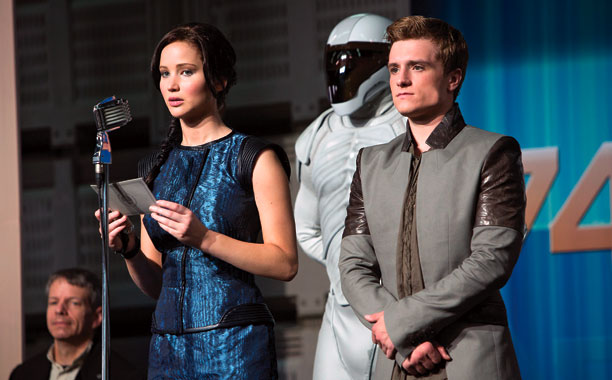
The Hunger Games: Catching Fire – smart, fast-paced and Jennifer Lawrence

The Hunger Games: Catching Fire is another gripping episode from the popular and acclaimed young adult fiction trilogy by Suzanne Collins. Just like The Hunger Games, it’s a well-paced, well-acted and intelligent sci-fi adventure fable.  And it’s yet another showcase role for Jennifer Lawrence.

To review, the story is set in the future, where several generations after a rebellion, an authoritarian government plucks teenagers from the formerly rebellious provinces to fight to the death in a forest. It’s all broadcast on reality TV for the entertainment of the masses. Children killing children – it doesn’t get much harsher than that.

This time, the malevolent tyrant picks his gladiators from the winners (i.e., survivors) of the past Games.  Because they have survived by killing off the other children, they could constitute their own PTSD support group; they range from emotionally fragile to raging bonkers.  This adds a particularly flavorful set of roles, acted especially deliciously by Jeffrey Wright, Amanda Plummer and Jena Malone.

The main purpose of a second act is to tee up the third, and Catching Fire is very successful, with the help of a new character played by Philip Seymour Hoffman.  Francis Lawrence (no relation to Jennifer) does a fine job directing his first Hunger Games movie – and he’s set to direct the final chapter in the trilogy (which will actually be two movies –  The Hunger Games: Mockingjay – Part 1 and – Part 2).

[Gary Ross, the director of the original The Hunger Games, is in pre-production on two new Jennifer Lawrence movies – Burial Rites from the Hannah Kent novel and Steinbeck’s East of Eden (where Lawrence’s role is the one played by Julie Harris in the 1955 Elia Kazan/James Dean version).]

But, at the end of the day, it’s all about Jennifer Lawrence, who must carry the movie as the plays the determined and resourceful Appalachian heroine.  She’s an amazing screen presence, capable of believably portraying both panic attacks and action hero sequences.  She’s worth the price of admission all by herself.

The source material may be aimed at tweens, but I haven’t met an adult yet who hasn’t enjoyed and been impressed with The Hunger Games or The Hunger Games: Catching Fire.  I’ll probably go see Catching Fire again (this time with The Wife), and I’m looking forward to Mockingjay.

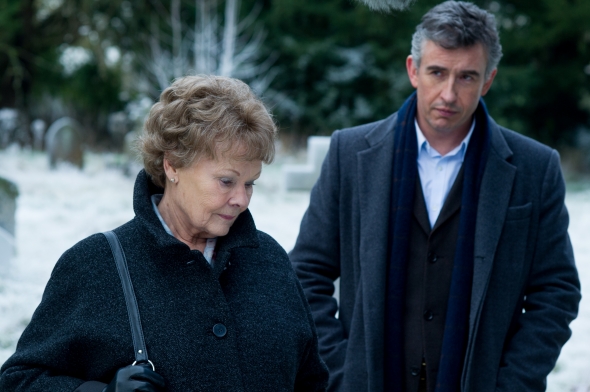
Philomena: an emotionally satisfying gem

The title character in Philomena, is an Irish woman who was shipped off to the nuns as a pregnant teen and whose toddler was adopted without her genuine consent.  Now over forty years later, she wants to find what has happened to her son.  Philomena (Judi Dench) is a simple woman, whose deep faith has been unable to resolve her sense of loss.  She enlists a British journalist (Coogan) to help her in the investigation.  The journalist takes them on a journey that finds her answers – and some of those answers are wholly unexpected.

The nuns in the 1950s flashback are cartoonishly nasty, contrasted with their modern counterparts – just as evil but with slickly modern PR skills.  Philomena’s faith enables her victimhood, but then an act of transcendence reveals her to be the most Christian character.

Of course, Dench is always excellent, but Coogan’s performance shows an unexpected range.  His character has just had his high-flying career derailed and has lost the smug confidence that Coogan’s characters usually impart.

Director Stephen Frears (High Fidelity, Dirty Pretty Things, The Queen) has a big success with Philomena, a nice rebound from his most recent efforts (Tamara Drewe, Lay the Favorite).   Philomena is an emotionally satisfying success – the unexpected gem of Fall 2013.

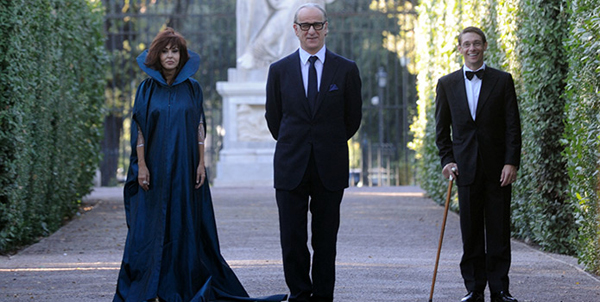
The Great Beauty: decadence, stunning imagery and the beauties of Rome itself

As The Great Beauty (La grande belleza) begins, its protagonist Gep Gambardella is celebrating his 65th birthday in a feverishly hedonistic party.  Gep authored a successful novel in his twenties, which has since allowed him the indulgent life of a celebrity journalist, bobbing from party to party among Rome’s shallow rich.  Gep is having a helluva time, but now he reflects on the emptiness of his milieu and the superficial accomplishments of his past 40 years.  As he alternates introspection and indulgence, we follow him through a series of strikingly beautiful Roman settings.  (And, because Gep  parties all night, we see lots of gorgeously still Roman dawns.)

The Great Beauty is foremost an extraordinarily beautiful art film. If you’ve been to Rome, you know that it is a generally chaotic city with unexpected islands of solitude.  The Great Beauty captures this aspect of the Eternal City better than any other film I’ve seen.  On one level, The Great Beauty is very successful Rome porn.

Writer-director Paolo Sorrentino also explores the moral vacuity of the very rich and the party life. It’s the Italy of Silvio Berlusconi, whom Sorrentino blames for enabling a national culture of escapism.  These themes, along with the main character and the movie’s structure are of course nearly identical to Fellini’s great La Dolce Vita (1960), but The Great Beauty is more accessible, funnier and a bit more hopeful – and much more of a showcase for the cityscape of Rome.  Sorrentino provides plenty of laughs, especially with a gourmet-obsessed cardinal and a cadaverous celebrity nun with a Mephistopheles-looking handler.

It’s hard to imagine an actor better suited to play Gep than Toni Servillo.  Servillo perfectly captures both the happiness Gep takes in carnal pleasure and his self-criticism for giving his entire life to it.  Servillo’s Gep is brazenly proud of his own cynicism, until we see his humanity breaking through at a funeral.  Servillo is even magnificent in wearing Gep’s impressive collection of sports jackets.

There’s so much to The Great Beauty – stunning imagery, introspection, social criticism, sexual decadence, fine performances, humor and a Rome travelogue – each by itself worth a visit to the theater.  The Great Beauty, which will be one of the favorites for the Best Foreign Language Oscar, may not be in theaters for very long – catch it while you can.

Frozen: doesn’t leave you cold

by guest bloggers The Wife and Niece #1

We went to Frozen, to see how the film would stand up against other Holiday movies as well as other classic Disney movies. This heartwarming motion picture holds its own by taking a new spin on the Disney love story, reminding us that love comes in forms other than romantic.

The uniqueness of Frozen‘s story focuses on sisterly love.  While, like most other Disney movies, it does have a good dose of romance, the relationship between the sisters in Frozen  is very refreshing.

Frozen also stands out among the Disney movies through its music. The odd, tribal intro didn’t work for us, but the majority of the score does a good job bringing classic Disney show tunes into the modern-day musical.

Overall, the movie is a great balance between modern and classic Disney. While new twists on music and a refreshing tale of love keep this story from being your boring old animated film, the characters and plot give viewers the mix of adult and kid humor expected of Disney.  This is the perfect multi-generational movie for this Holiday season.  For those who feel like splurging, it may be worth seeing in 3D.  So warm up this winter, and go see Frozen.

[Note from The Movie Gourmet:  I really appreciate The Wife and Niece #1 seeing and commenting on Frozen, because it’s an important film that I just am not going to get to (I tend to skip musicals).  I’ve read several rave reviews of Frozen by mainstream critics (Frozen has a solid MetaCritic rating of 74) that predict that Frozen will win the Best Animated Feature Oscar and that see its potential Broadway spin-off as a sure-fire hit. But – at the end of the day – what makes a good movie is ALWAYS a good story, and it was very perceptive of The Wife and Niece #1, apart from other reviews I’ve read, to point out the sister-sister theme that sets Frozen apart.]

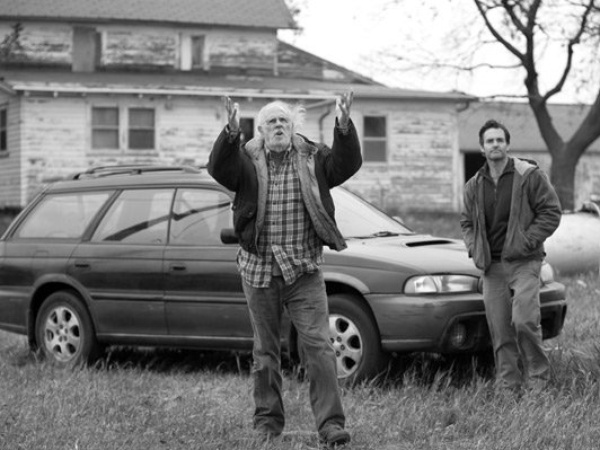
Nebraska: funny, poignant and thought-provoking

In the funny, poignant and thought-provoking Nebraska, a Montana geezer named Woody (Bruce Dern) gets a sweepstakes come on in the mail and believes that he has actually won a million dollars.  Unwilling to accept the explanations from his loved ones, Woody is determined to get to Omaha to claim his fortune – by walking if necessary.  His son David (Will Forte from Saturday Night Live) decides to drive him, and their journey takes them through Woody’s tiny Nebraska hometown.

At first, we see that Woody is bitter, drinks too much, is sometimes addled and drives his loved ones crazy.  As the story progresses, we learn that Woody’s bitterness is rooted in  frustration of his modest aspirations by both circumstance and by his own shortcomings.  And we see David longing for a relationship with his father that he had never thought possible before.  David makes a valiant effort, but Woody is long past any sentimentality.  In Nebraska, director Alexander Payne (Sideways, The Descendants) has another triumph of endearingly flawed characters.

There are many laughs in Nebraska, the funniest coming from Woody’s wife’s salty exasperation, David’s repellant cousins and the hilarious theft of a generator.

The acting is outstanding.  Bruce Dern will certainly – and deservedly – get an Oscar nomination.  It’s a character that is revealed to be more and more complex.  Is he demented, or is he in denial, or is he lying?  Some of each for sure, but it’s always hard to tell.  Dern has stated that he called upon his own experience with unsupportive parents to play the film’s most searing scene, in which David takes a reluctant Woody back to see Woody’s now abandoned childhood home.  June Squibb, who play’s Woody’s wife, has also been mentioned for an Oscar nod; indeed, she gets to deliver most of the funniest lines.

But there are two other exceptional performances that I don’t want to overlook.  As the son, Will Forte plays Woody’s straight man.  It’s a far less flashy role – and perhaps more challenging role.  But Forte lets us see past the son’s stoicism to his pain, embarrassment, frustration, determination and love.

And Actress Angela McEwan has the tiny part of the small town newspaper publisher.  She just gets one brief exchange with Forte and then a second scene where she looks at a truck driving past.  That look is one of the unforgettable moment in cinema this year.

Finally, my parents were from Nebraska, and I have spent plenty of time in the state.  I must say that I have NEVER seen such a dead on take on small town Nebraska and Nebraskans.  If you see Nebraska, you really don’t need to visit the real Nebraska to capture the full experience.

I found Nebraska to be an exceptionally evocative family portrait, and I’ve liked and admired it the more I’ve thought about it.  One of the Best Movies of 2013 – So Far.

Coming up on TV – two JFK classics

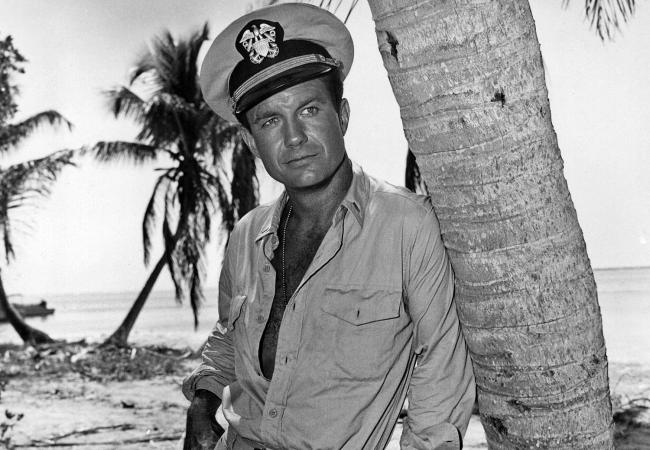
Cliff Robertson in PT 109

So it’s almost the 50th anniversary of the JFK assassination, and we’re being bombarded by Kennedybilia.  But I recommend two JFK films on Turner Classic Movies – the documentary Primary and the biopic PT 109 .  [I’m also highly recommending the 2013 day-of-the-assassination movie Parkland, available now streaming on VOD]

Primary (November 21) documents the Wisconsin Democratic primary election campaign in 1960.  This was a key stepping stone in Kennedy’s road to the White House because it was a chance for him to demonstrate that he appealed to voters outside the Northeast.  Kennedy’s rival Hubert Humphrey was favored because Wisconsin neighbors Humphrey’s home state of Minnesota.  Primary is both a time capsule of 1960 politics and an inside look at the Kennedy family unleashed in a campaign.  There’s an amazing scene where Humphrey appeals to a handful of flinty farmers in a school gym – he’s giving his all and he ain’t getting much back.  Only 60 minutes long, Primary has been selected for preservation in the National Film Registry.   The great documentarian D.A. Pennebaker, who went on to direct Monterey Pop and The War Room, shot, edited and recorded sound for Primary.

As 26-year-old PT boat commander in WWII, JFK was a real life war hero.  Some scolds deride PT 109 (November 21) as hagiography, but I don’t buy it – when things went bad, he acted heroically indeed and bore the health effects for the rest of life.  PT boats were essentially light wooden speed boats just big enough to hold some torpedoes and some depth charges on top of a tank of extremely combustible aviation fuel.  The commanders needed to maneuver the PT boat close enough to fire the torpedoes at a Japanese warship while avoiding return fire that would certainly be lethal .  No wonder the PT units were nicknamed  “They were expendable”.  It’s good history and an exciting true life action tale.  Cliff Robertson plays the young JFK.