CAROL: a tale of forbidden love

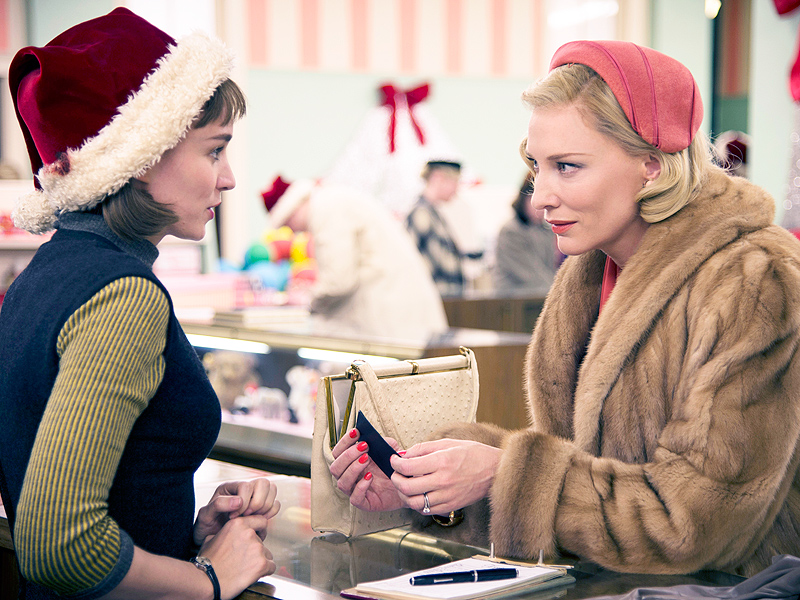
Rooney Mara and Cate Blanchett in CAROL

Carol is a beautiful and superbly acted romance of forbidden love. It is the Holiday season of 1952-53 and Therese (Rooney Mara) is a Manhattan department store clerk in her early twenties. She is smart and attractive and has come to New York to make her way in the post-war culture. She has male suitors, but it’s a middle-aged, affluent woman from suburbs that stops her in her tracks. Therese has no experience in same-sex relationships, but the older woman Carol (Cate Blanchett) has. But Carol is a wife and mother, and the risks are greater for her.

Filmmaker Todd Haynes loves Douglas Sirk’s women’s melodramas of the 1950s, and he has earned the ability to play in that sandbox with Far from Heaven, the Mildred Pierce miniseries and now Carol. Haynes evokes the period perfectly. Just like Far from Heaven, Carol is beautifully photographed by Edward Lachman. Carol uses music composed by the great Elmer Bernstein, who scored Haynes’ Far from Heaven and who died in 2004.

Both lead actresses have justifiably garnered nominations for acting awards. Rooney brilliantly embodies Therese’s confusion, yearning and excitement, her immaturity and her resolve. Blanchett, of course, nails the role of Carol, with her impulsive wilfulness, masterful charm and then panicked desperation.

Carol’s husband is played by Kyle Chandler, who after Friday Night Lights, just keeps showing up in wonderful movies: Super 8, Argo, Zero Dark Thirty, The Wolf of Wall Street, and in a dazzling performance as the alcoholic dad in The Spectacular Now. Initially, I thought that the role of Carol’s husband was pretty one-dimensional. But, upon reflection, I realized that Chandler is so good that I hadn’t recognized how complex the husband’s character is – so afraid of his mother and of social convention, yet so hopelessly drawn to Carol.

Sarah Paulson, so unforgettable as Mistress Epps in 12 Years a Slave, the mom in Mud and Miss Isringhausen in Deadwood, is striking once again as Carol’s lesbian childhood friend.

Carol may be the most well-acted film of the year. It’s a satisfying romance that most audiences will enjoy.
LEGEND: best crime film of the year

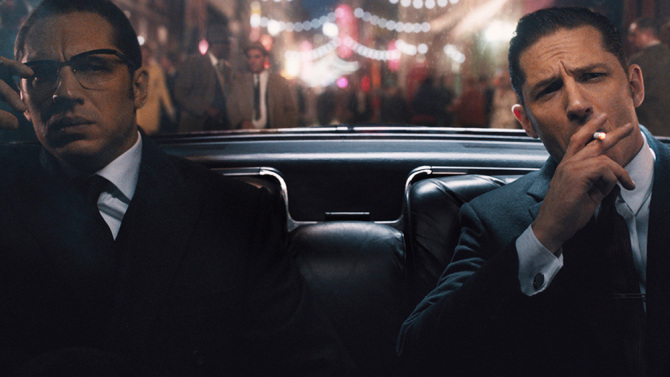
Tom Hardy and Tom Hardy in LEGEND

The best crime film of 2015, Legend, tells the true-life story of Reggie and Ron Kray, the gangster twins who ruled 1960s London.  Tom Hardy convincingly plays both guys.  Occasionally the two twins are on camera at the same time (I counted six set-ups).

Both of these East End twin thugs are tough as nails, merciless and relentless.  But besides being brutal, Reggie is crafty.  Ron is a raving psychopath, what the Brits call starkers.  Ron is also homosexual.

The rise of the Kray gang, spurred on by a combination of initiative, ruthlessness and luck, is fascinating.  But, of course, it’s just not sustainable to have someone who is certifiably insane as one of the decision-makers.  There’s plenty of humor, mostly deriving from Ron’s antics.

Legend benefits from a strong cast.  Emily Browning pulls off a major role as Reggie’s wife.  David Thewlis is really good as the brains in the Kray’s enterprise.  Even the actors playing various gang members are good, especially Reggie’s massive enforcer and Ron’s two pretty boys.  And Chazz Palminteri has a hilarious turn as an American mobster.

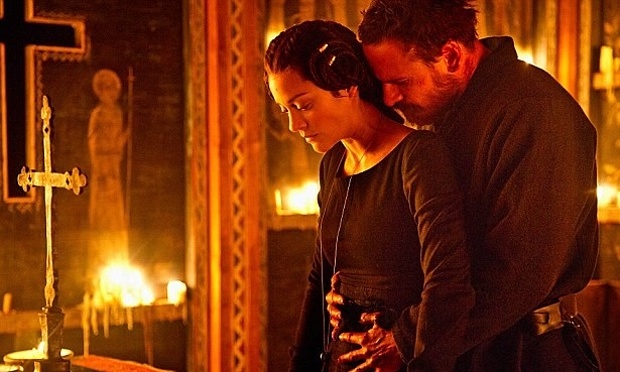
MACBETH: Shakespeare’s study of ambition, more medieval, more psychological and sexier

Marion Cotillard and Michael Fassbender in MACBETH

Michael Fassbender and Marion Cotillard star in Justin Kurzeil’s take on Shakespeare’s Macbeth – sexier and more psychological than most versions and very medieval.

In interviews, Fassbender has said that his Macbeth suffers from  battlefield PTSD.   As we see in this version of Macbeth, medieval warfare consisted of muddy guys rushing each other to hack, stab and bludgeon each other to death.  Mostly, it seems, to hack.  The soldiers wear facial warpaint that looks like it would if smeared on by men just before a battle.

Macbeth comes already damaged.  Unlike Richard III, a Shakespearean villain who is just deliciously evil to the core, Macbeth is troubled, a man whose “dreams abuse the curtain of sleep.”  But, as he is haunted by his own atrocities (especially killing his most loyal friend Banquo after Macbeth has already obtained the crown), Macbeth decompensates.

Lady Macbeth is the prototype of social climbers and strivers, pushing her hubbie to the forefront no matter the requisite carnage.  Cotillard’s Lady Macbeth uses sex to persuade him on a course of action, and he exhales a post-orgasmic “settled” in agreement with her plot.  After all, what’s sexier than power?  Hearing Macbeth’s “I have done the deed” gets Lady Macbeth breathing really hard.

Both of them have fits in which they wander the windswept highlands in their sleepwear.  Even with her over-the-top ruthlessness,  Lady Macbeth starts out more stable and functional, trying valiantly to distract the court from gauging Macbeth’s ever more tottering sanity.  But finally, the totality of their misdeeds becomes too heavy for even her to bear.  Fassbender and Cotillard are excellent.  So are Paddy Considine as Banquo and Sean Harris as Macduff.

All of the classic Macbethisms are here – “the be all and end all”, “out, damn spot!”, “unsex me here”, “the poisoned chalice” and “vaulting ambition”.  That last term – the central subject of Macbeth – is a marvel of precision because ambition requires one to vault over and past other people.  Ruthlessness is acting without or despite empathy for others.  Those who are not sociopaths can be haunted by their own vaulting acts of ruthlessness.  Kurzeil asks us to make that assessment of the two lead characters.

I really like Shakespeare movies because there are ways to advance Shakepeare’s stories that you just can’t do on stage.  Realistic medieval filth is one.  Large battle scenes, partially in slow motion is another.  And Macbeth and Banquo are able to quietly reflect on their foretold futures while bedding down on the battlefield, not while pacing the stage and speaking loud enough for a live audience to hear.  The soundtrack is filled with reedy drones that evoke bagpipes and covey dread and moral bleakness. (See my Best Shakespeare Movies – I’ll be adding this movie to that list.)

In just his second feature, Australian director Justin Kurzeil consistently make superb choices. Instead of novelties, the witches are spooky and mostly silent witnesses to the story; when Macbeth’s fortune is complete, they turn silently and melt away. I prefer the traditional way that Birnam Wood comes to Dunsinane Castle over Kurzeil’s solution, but’s that’s just me.  The final shots are wholly original and leave us with a remind of the historical consequences yet to come.

Kurzeil’s Macbeth is well-crafted and thought-provoking, and one of the very best Shakespeare movies.


HITCHCOCK/TRUFFAUT: essential for serious movie fans

HITCHCOCK/TRUFFAUT
HITCHCOCK/TRUFFAUT

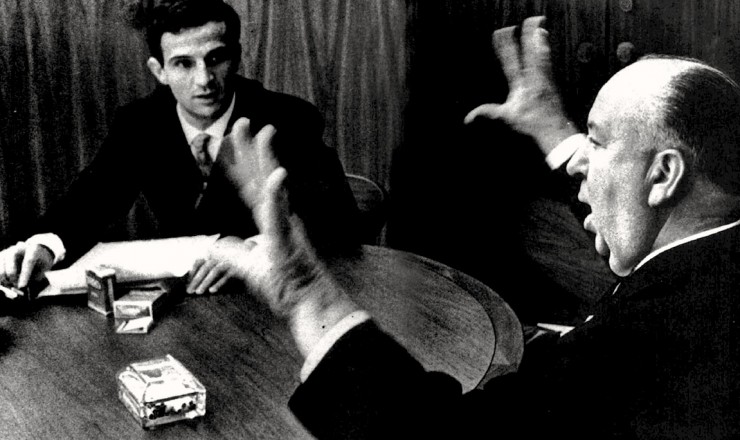
The documentary Hitchcock/Truffaut is a Must See for cinéastes.  In 1962, Francois Truffaut spent a week in Hollywood interviewing Alfred Hitchcock. These interviews formed the basis of Truffaut’s seminal 1966 book Hitchcock/Truffaut. At this moment, Truffaut was the hottest new thing in international cinema.  He was horrified that Hitchcock was viewed in the U.S. as only a genre director and pop celebrity, but not as the master of cinema that influenced Truffaut and the rest of the French New Wave. Vertigo, now rated by many as the greatest of films, had only broken even at the box office four years before.

Filmmaker Kent Jones took the audiotapes and stills from those 1962 interview sessions and adds what Truffaut could not – illustrative clips from the Hitchcock films themselves.  Because Truffaut is no longer with us, Jones also provides commentary from directors like martin Scorsese, David Fincher, Peter Bogdanovich and others. The result is an insightful celebration of Hitchcock’s body of work.

I had thought that I had a pretty fair grasp of Hitchcock, especially his love of surprise and the MacGuffin, his subversion of convention in Psycho and obsession with blonde actresses. But Hitchcock/Truffaut gave me a much richer understanding of Hitchcock’s visual sensibilities, his mastery of overhead shots, and his very limited expectations of his actors, as well as his compression and expansion of time.

Hitchcock/Truffaut will be interesting to any audience, but essential to serious movie fans.


VERY SEMI-SERIOUS: glimpsing inside The New Yorker cartoons

VERY SEMI-SERIOUS
VERY SEMI-SERIOUS

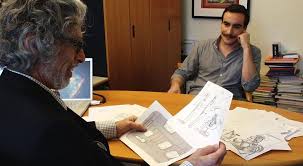
If you’re like me and you worship the cartoons in The New Yorker, then the documentary Very Semi-Serious is a Must See. Very Semi-Serious takes us inside The New Yorker for a glimpse inside the process of creating and selecting the cartoons, chiefly from the perspective of cartoonist and currently Cartoon Editor Bob Mankoff. You will know Mankoff from his cartoon with the caption, “How about never? Is never good for you?”.

We also meet rick star cartoonists that include Roz Chast and George Booth, along with The New Yorker Editor David Remnick and some aspiring cartoonist newcomers. We are boggled by the tens of cartoons each cartoonist pitches each week and the hundreds that Mankoff must review. Rejection is a major part of the cartoon life.

We also learn how Mankoff scientifically studies the eye movements of readers to see how/when/if we “get” the jokes. And we get to laugh again at HUNDREDS of cartoons.

I saw Very Semi-Serious in May at the San Francisco International Film Festival, and now you can see it beginning tonight on HBO. Set your DVRs.

THE SPYMASTERS — CIA IN THE CROSSHAIRS: Can we kill our way out of the War on Terror?

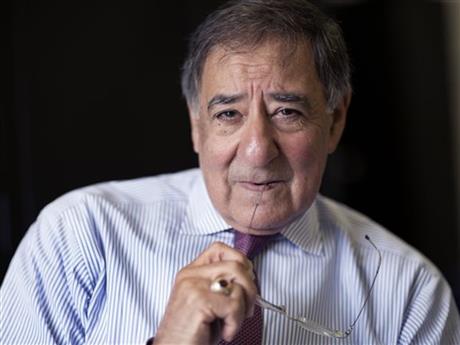
Leon Panetta in THE SPYMASTERS

In the thought-provoking documentary The Spymasters — CIA in the Crosshairs, we hear from all twelve directors of the CIA, from George H.W. Bush through current Director John Brennan.  They weigh in on the agency’s role in the War Against Terror, including harsh interrogation, drone warfare, the Kill List and “signature strikes”.  They disagree among themselves on torture, with Iraq War era directors George Tenet and Porter Goss, taking especially belligerent positions.  But there is a unified answer to this fundamental question about the War on Terror, “Can we kill our way out of it?”

The Spymasters — CIA in the Crosshairs showcases the decisions that a CIA Director must make, Leon Panetta poses one situation that he actually faced – do you take a rarely available missile shot at a terrorist who has just killed nine of your agents – when you know he is with his wife and kids? And several directors address the question, “What keeps you up at night?”

Besides the directors, we get to know a CIA operative with experience in Afghanistan, along with the agency’s chief of counter-terrorism. And we meet a most colorful character, the CIA’s former clandestine operations chief, Jose Rodriguez, who openly admits destroying the videos of CIA waterboarding.

The Spymasters echoes another talking head documentary The Gatekeepers, with the retired directors of the Shin Bet, Israel’s super-secret internal security force.  I recommend a double feature with these two companion films. The Gatekeepers is available to rent on DVD from Netflix and for streaming on Amazon Instant, iTunes, Vudu, YouTube, Google Play and Flixster.

The Spymasters — CIA in the Crosshairs is currently playing on Showtime.

CREED: superb refreshing of a storied franchise

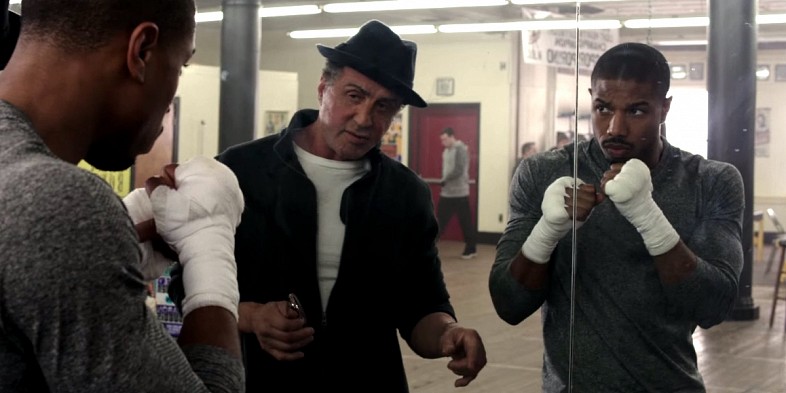
Michael B. Jordan and Sylvester Stallone in CREED

Rocky Balboa returns in writer-director Ryan Coogler’s superb CreedCreed is the story of a young man, the posthumous son of Rocky’s rival and friend Apollo Creed, who seeks out Rocky as a mentor.  Played by Michael B. Jordan (star of Coogler’s Fruitvale Station), the young Creed must face off against his own demons, as imposing as any opponents in the ring.  Stallone’s Rocky Balboa is still a lovable galoot, humble and adoring the long-dead Adrian.  Tessa Thompson (Dear White People, Selma) plays the younger man’s love interest.  Creed isn’t just about The Big Fight – all three of the main characters must overcome a distinct nemesis within each of them.

There’s not that much actual boxing in Creed, and folks who don’t like boxing will still enjoy the movie.  The boxing scenes, however, are brilliant.  The opponent in the climactic fight is played by real pro boxer Tony Bellew.

The most impressive scene, however, is mid-movie when Rocky’s protegé is tested against a local up-and-comer (the actor Gabe Rosado).  The three-minute rounds are photographed as uninterrupted action (no cuts are apparent) from WITHIN the ring.  We feel like we’re in the ring with the fighters – right at shoulder-level.  It’s a tour de force by veteran cinematographer Maryse Alberti (most of her work has been in documentaries).

Stallone’s performance is excellent. Even though it’s the zillionth time he’s played this character, he’s not just mailing this in for a paycheck, and he’s justifiably getting some award buzz.  Johnson and Thompson again prove themselves as rising talents.  Phylicia Rashad is excellent as the young fighter’s mother figure.

Coogler is the brilliant young Bay Area filmmaker whose brilliant debut was the indie docudrama Fruitvale Station, which was #8 on my Best Movies of 2013.  (Fruitvale Station is available on DVD from Netflix and Redbox and streaming from Amazon, Vudu, Google Play, YouTube and Xbox Video.)

Coogler gets lots of credit for breathing freshness and originality into a movie franchise that had grown tiresome.  Creed is an exploration into the internal struggles of three people – and it’s also irresistibly entertaining.


DON VERDEAN: money changers in the temple

DON VERDEAN
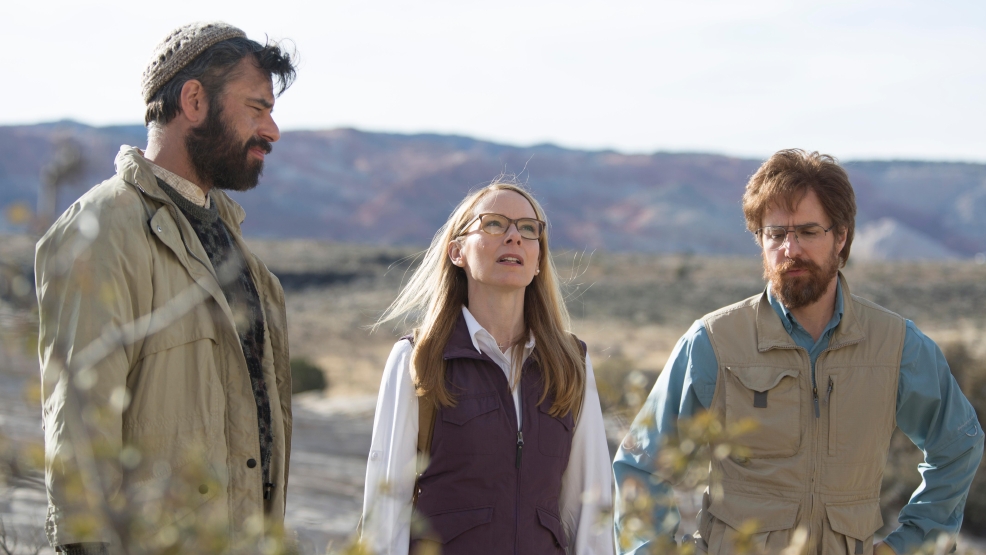
Jermaine Clement, Amy Ryan and Sam Rockwell in DON VERDEAN

Don Verdean is a dark comedy from filmmakers Jared and Jerusha Hess (Napoleon Dynamite), a smart and cynical take on the faux scientists embraced by the Christian Right.  Sam Rockwell plays the title character, a Christian “archaeologist” of dubious credentials and ethics who keeps “discovering” Biblical relics and marketing them to gullible true believers.

Verdean and his assistants (Amy Ryan and Jermaine Clement) find themselves entangled with rival pastors, both charlatans.  One is a former convict (Danny McBride) with a former hooker wife (Leslie Bibb); the other is a former Satanist (Will Forte) with his own bogus academic henchman (Sky Elobar).  The cast is all good.  Sam Rockwell sounds like he is channeling a TV preacher version of Sam Elliott.

But the real revelation is Jermaine Clement of Flight of the Conchords, who plays Verdean’s Israeli fixer, Boaz.  The Hesses start Boaz out as a footnote and then gradually develop him into one of the lead characters.  Clement imbues Boaz with an unintentional sneer, a sometimes puzzling Hebrew accent and ascendant venality.  Clement even gets a very funny dance bit (less extended and sidesplitting than the one in Napoleon Dynamite but funny nonetheless).

Jared and Jerusha Hess are the team behind Napoleon Dynamite, a pretty solid comedy credential.  The Hesses know of what they write.  They’re not just Hollywood religion-mockers – both attended BYU.

Here’s an example.  The Hesses gave Clement’s character the name of Boaz.  Those who know the Old Testament story of Ruth (we’re only talking Jews and Fundamentalist Christians here) will recognize Boaz as a major Good Guy.  Some may even know that Boaz was an ancestor of both David and Jesus, who some scholars see as a “pre-figure” of Christ.  But Boaz is a Biblical name that nobody gives their kid – so you never meet a Boaz today.  Given the arc of the Boaz character in Don Verdean, the name is brilliantly ironic.

There are more cynical chuckles here than there are gut-busting guffaws.   In one particularly inspired touch, the Hesses inserted Put Your Hand in the Hand into the soundtrack.  Don Verdean is a little movie that’s sure to be overlooked during the big Holiday movie season, but there aren’t many good comedies in theaters now, so it’s a good choice for those looking for a dark indie comedy.

CHI-RAQ: Spike’s plea for peace with justice…and a sex comedy

Teyonah Parris in CHI-RAQ

Chi-Raq is Spike Lee’s impassioned plea for peace with justice in the inner city.  The Chi-Raq of the title is Chicago, where there have been more gun deaths in the past 15 years than there have been Americans killed in Iraq and Afghanistan combined – a shocking and wholly unacceptable statistic that opens the movie.

Lee has adapted the Aristophanes play Lysistrata, where the ancient Greek women withhold sex until their men negotiate an end to war.   Here, it’s the women of today’s Chicago who suspend the sexual privileges of their gang-banging boyfriends.  Lee stays pretty close to the original Lysistrata, with lines sometimes in rap verse and with increasingly dapper Samuel L. Jackson as a one-man chorus who comments directly to the audience.

In a particularly inspired tactic, the men try to soften the woman’s resolve with Oh Girl by the Chi-Lites.

Lysistrata herself, the women’s ring leader, is played by Teyonah Parris, who pulls off the responsibility of being in virtually every scene. In her skanky outfits and massive Afro, Parris is unrecognizable as the controlled and restrained Sterling Cooper secretary Dawn Chambers in Mad Men.

John Cusack plays a bleeding heart priest, whose diatribe against the systems that breed violence is the weakest part of the movie (not Cusack’s fault – it’s the writing).   Samuel L. Jackson, Jennifer Hudson and Angela Bassett are all excellent.  Overall, Chi-Raq is pretty watchable.

ONE DAY IN AUSCHWITZ: an individual, personal testimony

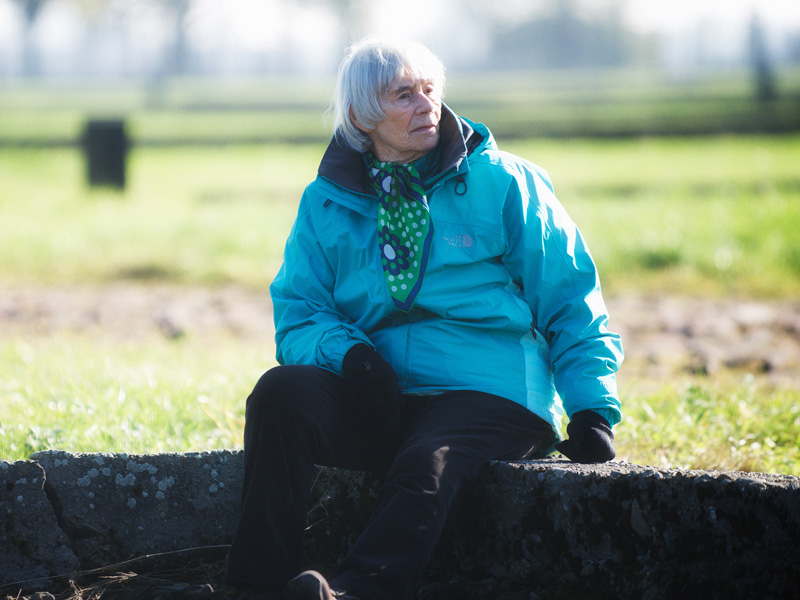
Kitty Hart-Moxon in ONE DAY IN AUSCHWITZ

Kitty Hart-Moxon is an elderly Holocaust survivor now living in the UK. In One Day in Auschwitz, she takes two seventeen-year-old girls – the same age that she entered the famed Nazi concentration camp – to Auschwitz. She guides them around the camp and narrates her experiences there.  We already know about the horrors, but her matter-of-fact testimony helps us appreciate the extra lengths that the Nazis took to dehumanize, in addition to murdering, their victims.  It’s a very personal account and a compelling one.

One Day in Auschwitz is now playing on Showtime.