The Ides of March: an engrossing story about ambition, loyalty and betrayal

Here’s a belated comment on The Ides of March, released earlier this fall.  George Clooney directed, co-wrote and stars in this contemporary political drama. It’s an engrossing story about ambition, loyalty and betrayal.  The story revolves around an up-and-coming political consultant (Ryan Gosling).  He is working under a veteran campaign manager (Philip Seymour Hoffman) in a Democratic Presidential primary.  He is wooed by the campaign manager (Paul Giamatti) for the opposing candidate, and the intrigue begins.

Two performances stand out.  Philip Seymour Hoffman perfectly captures the old school politico, now jaded, but able to access the idealism that first drove him into politics.  Ryan Gosling can soar in any kind of role.  Here he is smart, but is he smart enough?  He is well-intentioned, but can it overcome his ambition? Gosling keeps us on the edge of our seats as he navigates a snake pit of betrayals.

The rest of the cast is good, too:  Giamatti, Evan Rachel Wood as an ambitious intern and Marisa Tomei as a hard-nosed reporter.

It’s a movie that MOSTLY gets the politics right.  The fundamental truth of the movie is that an utterly cynical veteran politico can still fall in love with candidate, as Hoffman’s campaign manager does with Clooney’s candidate.

In another dead on accurate touch, Hoffman and Gosling need a room to privately pass on some bad news to Clooney.  Instead of finding a cramped office, the three men sit on folding chairs knee-to-knee in a room that could accommodate 200.  That stuff really happens.

Unfortunately, Ides gets some things wrong.  Would never happen:  A veteran strategist like Hoffman would never be surprised by the possibility of “mischief voting” in an open primary.  Real life campaign consultants would never discuss policy positions with a candidate in a room full of thirty 20-somethings, all itching to leak what they know.   And no veteran politico worth his salt would tell a reporter about a deal that is not done.

Nonetheless, it’s a movie that I recommend.
The Artist: silent yet magical

The Artist is a magical romance that writer-director Michel Hazanavicius gives us through the highly original choice of an almost silent film.  Set in Hollywood from 1927 through 1929, it is the story of a silent film star who is left behind by the startlingly immediate transition to talking pictures.

The French actor Jean Dujardin won Cannes’ best actor award as the silent star, a charismatic and ever-playful guy whose career is trapped by the shackles of his own vanity.  While on top, he treats an ambitious movie extra (Berenice Bejo) with kindness; she remembers when she becomes a star of the talkies.

Dujardin’s star, whose films resemble those of Douglas Fairbanks, Sr.,  is a joker with a knack for the grand gesture.  He also has an adorable Jack Russell terrier that serves as his companion and co-star.

Hazanavicius is so skillful that audiences that have never seen a silent film soon become enraptured by the story and invested in the fates of the characters.  It’s a visually and emotionally satisfying film.

John Goodman and James Cromwell are excellent in supporting roles. 

(BTW, in real life, Berenice Bejo has two children with Michel Hazanavicius.)

[youtube:http://www.youtube.com/watch?v=XvifS2QOun4]

The Descendants: beginning a quest, stunned and clueless

In director Alexander Payne’s first film since Sideways, George Clooney seeks to care for his daughters in Hawaii after his wife is hospitalized, but then learns that she has been cheating on him.  That news sends him on a quest that he defines along the way.  To complicate things, his daughters are cooperative to various degrees.  The heat is turned up even higher by a potential land deal that could make Clooney and his many entitled slacker cousins wildly rich, but the deal’s deadline looms and he is pressured by his VERY interested relations.

The situation is promising enough, but Payne takes the story in unanticipated directions.   And, as you would expect from Sideways, there are many funny moments in The Descendants.

Clooney’s performance is brilliant.  Here, he does not play The Coolest Man on the Planet.  Instead, Clooney is a grinding workaholic who is so clueless about his kids that he doesn’t realize how clueless he is.  He is stunned by news of the affair that he never suspected.  Perhaps for the first time in his life, he must work through his situation figuring it out as he goes along.

Shailene Woodley’s performance as the older daughter is even more essential to the success of The Descendants. It’s not just that she perfectly plays a bratty teenager, but that we can see that some of her brattiness is hormonal and some of it is entirely voluntary and manipulative. Woodley had to convincingly play a character who is at times self-centered and shallow, but who can rally and reach within herself to serve as the family glue and support her dad and little sister.

The Descendants approaches being a perfect movie but for two things: 1) the daughter’s stoner boyfriend is just too oblivious to be credible among the other colorful yet completely authentic characters; and 2)  the audience can never believe that there’s any chance that George Clooney is going to allow bulldozers on thousands of pristine Hawaiian acres.  Still, almost perfect is pretty good.

Drive: noir action in vivid LA

Drive is a movie that you haven’t seen before – a stylishly violent noir tale unfolding on a brilliantly filmed canvas.

Ryan Gosling stars as a stunt driver by day, criminal getaway driver by night.  He hardly talks and doesn’t emote.  Indeed, his character is listed in the credits as “Driver” and sometimes referred to in the dialogue as “The Kid”.  He is motivated only by his pursuit of adrenaline rushes and the opportunity to do something good for a vulnerable mom (Carey Mulligan).  Indeed, Gosling is superb.

But the real star of Drive is its Danish writer-director,  Nicolas Winding Refn.  The film has a noir plot but Refn eschews the shadowy black and white of traditional noir for especially vivid scenes of Los Angeles.  For example, early in the film, Gosling enters a convenience store and the screen is filled with the garish colors of junk food packaging.  It’s one of the most artfully lit and photographed scenes in the last year.

Drive abounds in nice touches. While being hunted by the cops, Gosling’s driver is listening to both the police scanner and a radio broadcast of the Lakers game; unexpectedly, it turns out that there is an essential reason that he’s listening to the Lakers.

This movie contains some extreme violence – violence that is intentionally extreme for its effect.

The cast is excellent, with especially memorable turns by Albert Brooks, Bryan Cranston (Breaking Bad) and Oscar Isaac.

(I admired Refn’s 2008 Bronson, the story of a Britain’s “most dangerous convict” who parlayed a seven-year sentence into 34 years (30 of them in solitary) by repeatedly taking hostages and beating up the SWAT teams that rescue them.   Roger Ebert called Bronson “92 minutes of rage”.)

2011 in Movies: documentaries

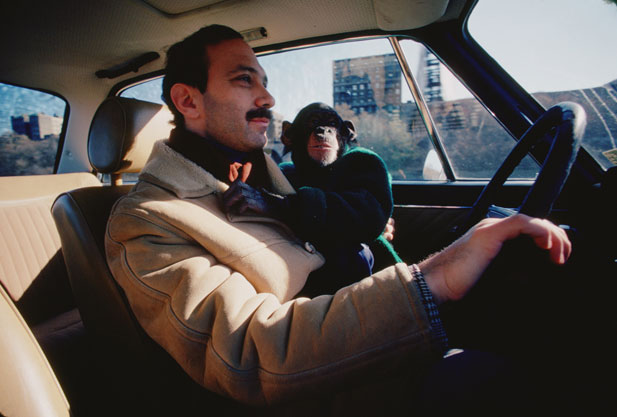
PROJECT NIM

As usual, several documentaries made my list of Best Movies of 2011Project Nim, Buck and Tabloid.

Werner Herzog gave us the wonderful 3D Cave of Forgotten DreamsPage One highlighted David Carr of the New York Times.  The Polish documentary War Games and the Man Who Stopped Them was a great find.  I also admired Thunder Soul (about a Houston high school stage band in the 60s), Magic Bus (featuring actual footage of Ken Kesey’s Merry Pranksters), American Grindhouse (about the grindhouse films of the 40s, 50s and early 60s) and These Amazing Shadows (about the National Film Registry).

PBS had stellar year, especially with Woody Allen: A Documentary, Jimmy Carter, Stonewall Uprising and Troubadours.

HBO delivered Bobby Fisher Against the World.  And ESPN has entered the documentary arena with the surprising The Marinovich Project.

Spoiler Alert: comparing the two Dragon Tattoos

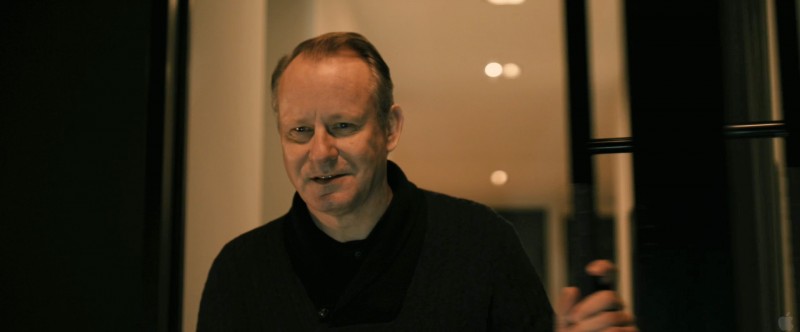
Stellan Skarsgard in THE GIRL WITH THE DRAGON TATTOO

Again – this post contains spoilers.

I liked both versions of The Girl with the Dragon Tattoo – the 2010 Swedish and the 2011 American.  Both made my top ten lists at the end of the year.  Still, they are distinctly different movies.

The best thing about the Swedish movie was Noomi Rapace’s full throttle performance as Lisbeth.  Rooney Mara’s Lisbeth is different, but just as good.   Rapace modulated her performance between sheer rage and full-out fury, and her signature was the always whirring motor.  Mara’s Lisbeth has a more stone-faced affect until the moments that she explodes into a cyclone of wrath.

The rest of the performances are far superior in the American version.  Daniel Craig is a much better Blomkvist; Craig has already played James Bond, so he is liberated here to play Blomkvist as a weary and defeated hang-dog whose confidence has been completely deflated.  The other key characters are brilliantly played by Stellan Skarsgard, Stephen Berkoff, Robin Wright and Christopher Plummer.

In both versions, Lisbeth goes to her guardian’s house, puts down her bag and is victimized.  In the Swedish version, he see her stumble home completely traumatized, wash herself and then watch the video of her own rape – OMG! She taped it! And she has it all on digital!  This discovery is a huge moment in the film (for those of us who hadn’t read the book).  But in the American version, when she puts down the bag, anyone who has seen a spy movie can tell that she’s got a camera in the bag, which takes the surprise effect away when she later plays the tape of her rape.

In the American version, some characters in the Vanger family are compressed.  That’s fine with me.  There are really only so many nasty blondes you can tell apart.

In the book (I understand) and the Swedish movie, Lisbeth ties Gottfried and Martin to the murders by plowing through the travel receipts in company’s archived expense accounts.  In the American version, Lisbeth is looking through archived records when she (and we) see news photos of Gottfried and Martin near the scenes of the crimes.  I prefer the non-dumbed down Swedish version.

The Swedish movie contains flashbacks that we learn depict 12-year-old Lisbeth burning her own father for his abuse of her mother.  This device worked very well to explain Lisbeth’s constant state of fury.  In the American film, this fact is described in dialogue and not shown.  It’s usually better to show and not tell, and it is here, too.  I prefer the approach of the Swedish film.

The American version’s opening credits depict a nightmarish montage of oiled human forms, all to a ripping version of Led Zeppelin’s Immigrant Song.  I didn’t like the montage, which does not kickstart the story and just looks the opening sequence to a TV drama series.  I do like the version of Immigrant Song, which I wrote about here.  In fact, I liked all the music in the American version, by Nine Inch Nails founder Trent Reznor.

Apparently, Scandinavian audiences don’t need filmmakers to tell them that they live in a cold clime.  But Fincher makes the unrelenting cold into a character itself, a touch that I liked very much.

On the whole, both movies are very good.  After the first Dragon Tattoo, there was a change in directors for the Swedish trilogy, so I expect that Fincher’s take on the second and third movies to be far superior to the plodding Swedish versions.

The Girl with the Dragon Tattoo: Fincher keeps the thrill in “thriller”

I loved last year’s Swedish version (it was #8 on my list of the year’s best) and had very high hopes for this film by David Fincher (The Social Network, Zodiac, Fight Club).  Those hopes have been fulfilled.

The Girl with the Dragon Tattoo tells the first part of journalist-turned-novelist Stieg Larsson’s Milenium trilogy.  The stories are centered on Larsson’s muckraker alter ego Mikael Blomkvist and the damaged and driven Goth hacker Lisbeth Salander.  Lisbeth is only 90 pounds, so she will lose a fistfight with a man; but she prevails with her smarts, resourcefulness and machine-like  relentlessness.  Lisbeth is always mad AND always gets even.

In top rate performances, Daniel Craig plays Blomkvist and Rooney Mara plays Lisbeth. Lisbeth is the key to the movie, and Mara comes through with a compelling portrayal – stone faced until she explodes into a cyclone of wrath.  The other characters are played superbly by Stellan Skarsgard, Christopher Plummer, Robin Wright and Stephen Berkoff.

Fincher is still operating at his best.   Remember – The Social Network is essentially about some annoying, immature geeks writing computer code and getting financing for a company – but Fincher made it rock!  Fight Club‘s desperate violence and Zodiac‘s whodunit relentlessness translated directly to The Girl With the Dragon Tattoo. So there couldn’t be a better director for this project than Fincher.  I’m looking forward to his versions of the next two chapters in the saga.

Fincher shot the film in Sweden and had made the country look and feel unrelentingly frigid.

The score by Nine Inch Nails founder Trent Reznor is award worthy and is a major contribution to the story.

Young Adult: a game changer of a comedy

With Young Adult, screenwriter Diablo Cody (Juno) and director Jason Reitman (Thank You for Smoking, Juno, Up in the Air) are challenging the current mode of comedy itself.  They turn many comic conventions on their heads in this nastily dark comedy.

Played by Charlize Theron, the main character is stunningly non-empathetic,  utterly self-absorbed and thoroughly unpleasant.  She was the prom goddess in her small town high school, and has moved to the city for a job with a hint of prestige.  With a failed marriage, a looming career crisis and no friends, she’s drinking too much and is in a bad place.  So she decides to return to her hometown and get her old boyfriend (Patrick Wilson) back – despite the fact that he’s gloriously contented with his wife and newborn infant.

Naturally, social disasters ensue.  Along the way, the story probes the issues of happiness and self-appraisal.

Patton Oswalt is wonderful as someone the protagonist regarded as a lower form of life in high school, but who becomes her only companion and truth teller.

Young Adult is inventive and very funny.  Its cynicism reminds me of a Ben Hecht or Billy Wilder screenplay (high praise).  Note:  This is NOT a film for someone expecting a light comedy.

2011 in Movies: comeback of the year

Woody Allen makes a movie each year, including some good recent ones like Vicky Christina Barcelona and Match Point, but Midnight in Paris is his best movie since 1986′s Hannah and Her Sisters.  Not only is Midnight in Paris a delightful and excellent film, but it’s the top indie box office performer of the year, with a $56 million gross so far.

In addition, Woody is the subject of a top rate 2011 PBS documentary Woody Allen: A Documentary.

DVD of the Week: Midnight in Paris

With Midnight in Paris, Woody Allen has made his best movie since 1986’s Hannah and Her Sisters. It’s a funny and wistful exploration of the nostalgia for living in another time and place – all set in the most sumptuously photographed contemporary Paris.

Successful but disenchanted screenwriter and would be novelist Owen Wilson accompanies his mismatched fiancée Rachel McAdams to Paris, where he fantasizes about living in the artistically fertile Paris of the 1920s. Indeed, at midnight, he happens upon a portal to that era, and finds himself hanging out with the likes of Hemingway, Fitzgerald and Stein. He meets Marion Cotillard, a 1920s gal who is herself nostalgic for the 1890s.

Midnight in Paris shines because of the perfectly crafted dialogue. McAdams’ every instinct is cringingly wrong for Wilson. She is enraptured by the pretentious blowhard Michael Sheen, who couldn’t be more insufferable.

As usual, Allen has attracted an excellent cast. Owen Wilson rises to the material and gives one of his best performances. Corey Stoll is hilarious as Hemingway and Adrien Brody even funnier as Salvador Dali. Cotillard is luminous.

It makes my list of Best Movies of 2011 – So Far.