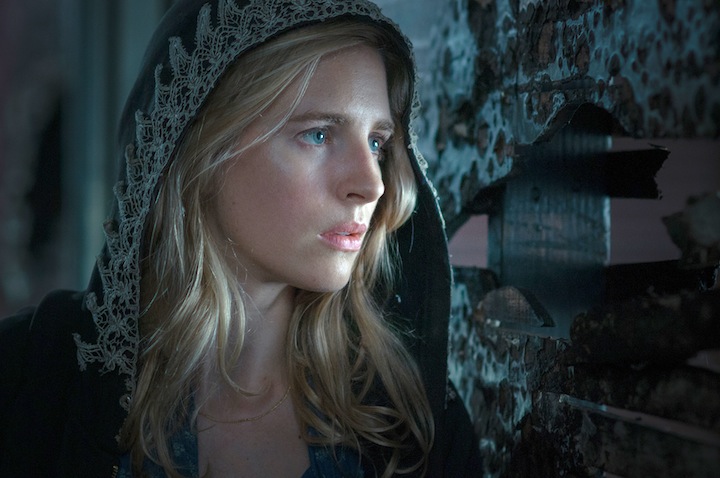
InNo, Gael Garcia Bernal stars as an ad man brainstorming the guerrilla advertising campaign that dethroned Chilean dictator Pinochet in a 1988 plebiscite. It turns out that the key was not to rehash the atrocities of the repressive Pinochet dictatorship, but to get his audience to picture the alternative democratic future. The ad man’s biggest challenge is to pitch his soft sell campaign to Pinochet’s ideologically driven opponents.
No has a grainy look and was shot in the same aspect as is television (i.e., not widescreen). This allows the transition between the filmed scenes and the inserted historical footage (including the original Yes and No campaign commercials) to be seamless.
I visited Chile in the last days of the Pinochet dictatorship, after the October 1988 plebiscite but before the new democratic government took office fifteen months later. No ably captures both the scariness of the authoritarian regime and the culture of the period. As always, Garcia Bernal is excellent. No was nominated for the 2013 Foreign Language Oscar. No is available on DVD from Netflix and streaming from Vudu.
The riveting thriller Shadow Dancer, about a young single mom in the IRA, is showing in some theaters now, but can be hard to find. It is also available streaming from Amazon, iTunes and Vudu.
Much Ado About Nothing takes the homework out of Shakespeare and puts the screwball comedy back in.
The East is an absorbing and thought-provoking eco-terrorism thriller.
Before Midnight, the year’s best romance, continuing the story of Ethan Hawke’s Jesse and Julie Delpy’s Celine from Before Sunrise and Before Sunset.
The documentary We Steal Secrets: The Story of WikiLeaks is Alex Gibney’s inside look at an improbable scandal. It’s also available streaming from Amazon, Vudu, YouTube, Google Play and other VOD outlets.
I like the unsentimental Western Dead Man’s Burden, available on DVD from Netflix and streaming from Amazon, Vudu and other VOD outlets.
The insightful HBO documentary Love, Marilyn uses Marilyn Monroe’s recently discovered letters and journals to give us a candid yet sympathetic inside look at Marilyn.
Hey Bartender, the entertaining documentary about the trend to Craft Bartending, is having a very limited theatrical run (a single showing this week in one local theater) and is available streaming from Amazon, Vudu, iTunes and other VOD outlets.
Also out right now:
Fast & Furious 6 has exciting chases, a silly story, a smoldering Michelle Rodriguez and a hard ass Gina Carano.
There’s cleverness in the psychological thriller Berberian Sound Studio, but just not enough thrills for a thriller.
My DVD/Stream of the Week is the geezer romp Quartet. Quartet is available on DVD from Netflix and Redbox and streaming from Vudu, YouTube and other VOD outlets.
Turner Classic Movies continues its June film noir festival tonight with Czar of Noir Eddie Muller presenting films from the novels of Jonathan Latimer (Nocturne, They Won’t Believe Me) and James M. Cain (Double Indemnity, The Postman Always Rings Twice).
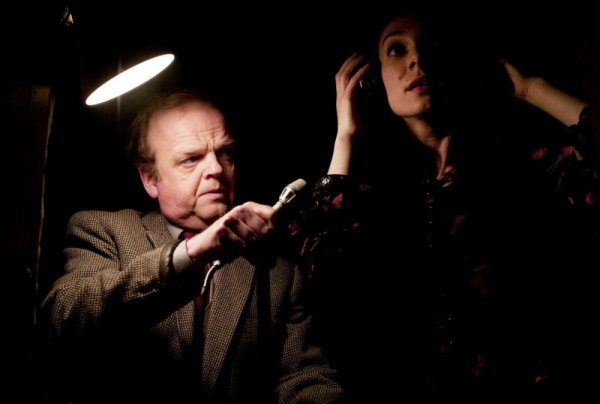
Here’s an inventive setting for a psychological thriller – the sound studio where the cheesy Italian horror movies of the 1970s were dubbed and mixed. Everyone comes to work, put on headphones and screams into a mic. Naturally, there’s plenty of droll humor, like when the two sound techs (named Massimo and Massimo) mimic the sound of stabbing human bodies by plunging butcher knives into watermelons.
A British sound engineer (Toby Jones) down on his luck, arrives for a gig and is horrified to discover that he’s working on a gory exploitation movie. His English reserve is no match for either his loud and volatile Italian coworkers or the impenetrable Italian business bureaucracy. Slowly (and this film is not quick-paced), he begins to crack.
This is not the kind of horror film with lots of on-screen gore. We only see the opening credits and one brief glimpse at the movie that is being dubbed. We hear the spinechilling screams and the scary sound effects while we are watching bored techies with headphones. The suspense is in the watching the Jones character teeter on the brink of unraveling.
Berberian Sound Studio is getting some rapturous critical praise that just seems like hyperventilating to me. It contains some clever parts, but there’s just not enough thrill there for a thriller. Toby Jones’ spiral into madness in the last 25 minutes is very good, but by that time I was struggling to stay awake.
Berberian Sound Studio is enjoying a brief theatrical release and is avaiable streaming from Amazon and other VOD purveyors.
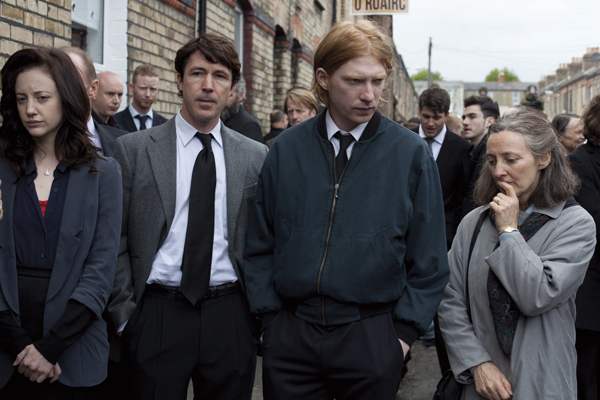
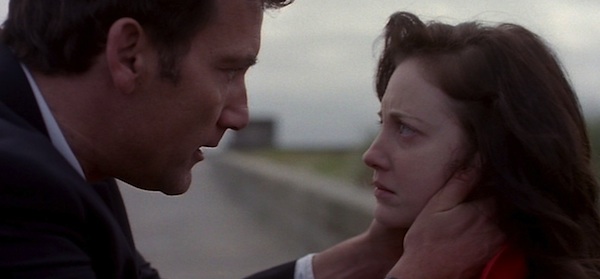
The riveting thriller Shadow Dancer takes place during The Troubles in 1990s Belfast. Thirtyish single mom Collette (Andrea Riseborough) is captured by British security while planting an IRA bomb in London. Faced with the choice of a long imprisonment with her young son snatched off to foster care, Collette reluctantly agrees to return to Belfast and inform on her IRA unit. This would make for a tense ride in any case, but Collette belongs to a crew run by her two adult brothers, and all three live with their mother.
Everyone in the cell, including the three siblings, is paranoid out of necessity. And paranoid is only a starting point in describing the IRA’s internal security chief, who soon figures out that there’s a mole in the unit, and begins a mercilessly ruthless investigation; before every interrogation, his assistant rolls out plastic sheeting on the floor – just in case an immediate execution is warranted. To make matters even more nerve-wracking, Collette’s British handler Max (Clive Owen) suspects that his superiors are making Collette expendable to protect another intelligence asset. And so we go along on Shadow Dancer’s wild ride, all the way to its noirish ending.
The heart of the film is Andrea Riseborough’s fine performance as Collette. Surrounded by suspicious friends and foes alike, she must be contained and ever watchful. She cannot reveal that the tension is ripping her apart on the inside.
All of the performances are excellent, especially Brid Brennan as Collette’s severe mother, always putting on the kettle for one of her terrorist offspring. David Wilmot is convincing as the IRA’s mole hunter, dead serious here after his comic turn in The Guard as the goon who couldn’t remember whether he was a psychopath or a sociopath.
Director James Marsh won an Oscar for his documentary Man on Wire. Marsh also directed Project Nim (one of my Best Movies of 2011) and the based-on-fact British crime drama Red Riding: In the Year of Our Lord 1980.
Here, Marsh demonstrates an excellent sense of pace. Pay attention to the scenes at the beginning with Collette’s little brother and with the London Underground. In contrast to many quick-cutting filmmakers, Marsh takes his time so dread settles in and the tension builds. It results in a top-notch thriller.
Shadow Dancer is showing in some theaters now, but can be hard to find. It is available streaming from Amazon, iTunes and Vudu.
The insightful HBO documentary Love, Marilyn uses Marilyn Monroe’s own words and those of people in her life to give us a candid yet sympathetic inside look at Marilyn. The core of the film is from a recently discovered trove of Marilyn’s own letters and journals.
Her friends Susan Strasberg and Amy Greene appear in this film. Others speak from file footage, including husband Arthur Miller, acting coach Lee Strasberg and her first Hollywood agent. For the rest, especially Marilyn herself (and biographer Norman Mailer, friends Elia Kazan and Truman Capote and frustrated director Billy Wilder), an all-star cast of readers bring their words to life.
The readers include four Oscar winners and six Oscar nominees. The most effective are Marisa Tomei reading Marilyn’s earnest efforts at educational self-improvement and Lili Taylor reading Marilyn’s struggles with a recipe she trying to put on the table for traditional hubby Joe DiMaggio. Everybody else (especially Evan Rachel Wood and Viola Davis) is really good, too, except for Ben Foster, who is mannered and overtheatrical when reading Mailer’s words.
There are some rel nuggets here. We see the book on human body movement that Marilyn used to create her signature jiggling walk. We hear Kazan’s description of how Arthur Miller made a good first impression by refusing to let Marilyn take a cab to a party. We understand how she flipped potential career-killing nude photo scandal into a huge publicity boost and better film roles. We even hear Amy Greene relate Marilyn’s assessment of DiMaggio’s most intimate skill.
Entertaining and sometimes moving, Love, Marilyn is a worthwhile contribution to our understanding of Marilyn, the person, the actress and the phenomenon.
Hey Bartender explores the new wave of Craft Bartending. This is not about watching guys cry in their boilermakers at the neighborhood dive. It’s about the new application of culinary sensibilities – fresh ingredients, creativity, presentation and hospitality – to the cocktail. If you enjoy striking a blow for liberty now and again, this movie is cocktail porn – in fact, I’ve added it to my Best Food Porn Movies.
Hey Bartender takes us to the Museum of American Cocktail, and we learn that there is such a thing as a Cocktail Historian. We spend time at the New York City’s Employees Only, recognized as the world’s best cocktail bar. We meet the nation’s current celebrity bartenders and contrast them with the proprietor of a struggling family owned joint in Westport, Connecticut. We tag along with attendees at the major craft bartending convention, Tales of the Cocktail in New Orleans. And we see the featrured bartenders mix some delectable looking concoctions.
Because I streamed Hey Bartender at home, I was able to pause it at the 55-minute mark to make myself an Ellis Island (Makers Mark, Carpano Antica and a swish of Strega, shaken and served neat in martini glass, which I discovered at San Francisco’s Poesia.).
Hey Bartender is having a very limited theatrical run (a single showing this week in one local theater) and is available streaming fro, Amazon, Vudu, iTunes and other VOD outlets.
Quartet, an ensemble geezer comedy, is really an excuse for four brilliant actors (Maggie Smith, Billy Connolly, Tom Courtenay, Pauline Collins) to show their chops. It’s set in a retirement home for retired musicians. The residents are preparing for an annual benefit performance, and the long-estranged ex-wife of a resident is moving in.
The most interesting character is the one played by Pauline Collins – a vivacious woman who may have always been ditzy and now has very little short-term memory. In 1996, Collins won a Tony and was nominated for an Oscar for the title role in Shirley Valentine.
Tom Courtenay plays a man still devastated by a bad breakup decades before. There’s a wonderful scene in which he explains opera to a class of working class teens by comparing it to rap. Courtenay is best known for The Loneliness of the Long Distance Runner (1962), Dr. Zhivago (1965), The Dresser (1983), but was excellent more recently in the overlooked Last Orders (2001).
Maggie Smith and Billy Connolly are very good in familiar roles. The irrepressible Connolly is very funny as a particularly randy old gentleman. Smith’s character is in her sweet spot – not unlike the sharp-edged but increasingly vulnerable gals she played in Gosford Park, Downton Abbey and The Best Exotic Marigold Hotel. The actors playing the other residents are delightful, including a passel of opera stars from the 70s and 80s, Sinatra’s European trumpet player and more.
This is the first movie directed by Dustin Hoffman, and he did an able job. He takes advantage of the beautiful pastoral location, paces the film well and, as one would expect, enables the actors to turn in very fine performances. Quartet is just a lark, but not a bad way to spend an hour and a half.
Quartet is available on DVD from Netflix and Redbox and streaming from Vudu, YouTube and other VOD outlets.
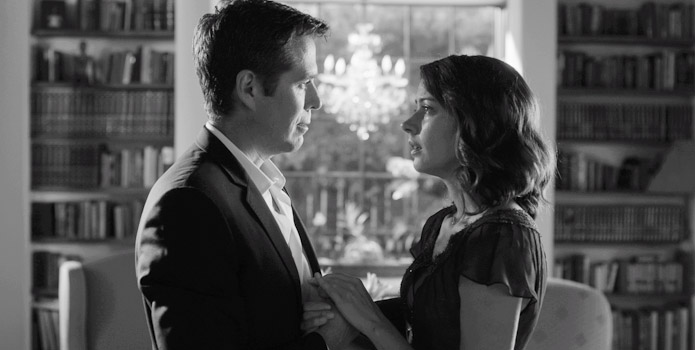
Alexis Denisof and Amy Acker in MUCH ADO ABOUT NOTHING
Director Joss Whedon (The Avengers, Buffy the Vampire Slayer) takes a break from pop with Shakespeare’s Much Ado About Nothing. It’s set in current times (with iPods and cupcakes) and filmed in black and white at Whedon’s Santa Monica home. It worked for me.
Whedon told NPR “Some people won’t see Shakespeare because they don’t believe there’s characters in them, they think it’s, you know, homework.” Whedon’s version brings out the screwball comedy sensibility of the tale. Indeed, there’s really nothing uniquely 16th century about the plot: one couple is perfectly matched but they think that they despise each other, another couple is head over heels in love and a mean, unhappy villain wants to break up the romance. As the primary couple who wage “a merry war” of wit, Alexis Denisof and Amy Acker keep up with the quickpaced barbed patter and show a gift for flopping-on-the-floor physical humor. Nathan Fillion hilariously deadpans the malapropisms of Dogberry, here the dimmest supervising rent-a-cop in English literature.
[Note: There’s also some serious home and party decorating/staging porn for the HGTV set.]
It’s all good fun, and there’s no need to review the play before enjoying it. In fact, I’m adding it to my list of Best Shakespeare Movies.
Before Midnight, the year’s best romance continuing the story of Ethan Hawke’s Jesse and Julie Delpy’s Celine from Before Sunrise and Before Sunset.
Stories We Tell, Sarah Polley’s brilliant documentary about discovering her family’s secrets; unfortunately, Stories We Tell is going to be hard to find in theaters this week, but well worth the trouble.
The absorbing and thought-provoking eco-terrorism thriller The East.
The Iceman is a solid true-life crime movie with an outstanding performance by Michael Shannon.
Mud, the gripping and thoughtful story of two Arkansas boys embarking on a secret adventure with a man hiding from the authorities – learning more than they expected about love and loyalty. Mud is also one of the best movies of 2013.
The documentary We Steal Secrets: The Story of WikiLeaks is Alex Gibney’s inside look at an improbable scandal. It’s also available streaming from Amazon, Vudu, YouTube, Google Play and other VOD outlets.
I like the unsentimental Western Dead Man’s Burden, available on DVD from Netflix and streaming from Amazon, Vudu and other VOD outlets. Other good choices on VOD:
Greetings from Tim Buckley is a film for those who want to see an actor depict interior conflict with very little external action.
PBS’ American Masters series is showing an endearing and insightful documentary Mel Brooks: Make a Noise. PBS is also broadcasting the unexpectedly beautiful documentary Detropia, about the city of Detroit’s collapse and decay.
Also out right now in theaters:
Fast & Furious 6 has exciting chases, a silly story, a smoldering Michelle Rodriguez and a hard ass Gina Carano.
HBO’s Behind the Candelabrais familiar territory but entertaining, with Michael Douglas’ all-out re-creation of Liberace.
Kon-Tikiis a faithful, but underwhelming account of a true life 5,000 mile raft trip across the Pacific.
Don’t bother with Baz Luhrman’s flashy, hollow and lame The Great Gatsby. Re-read the Fitzgerald novel instead – it’s only 192 pages.
I haven’t yet seen the contemporary Shakespeare adaptation Much Ado About Nothing, which opens this weekend. You can read descriptions and view trailers of upcoming films atMovies I’m Looking Forward To.
My DVD/Stream of the Week is the zombie romantic comedy Warm Bodies. Warm Bodies is available on DVD from Netflix and Redbox and streaming from Amazon, iTunes, Vudu and other VOD outlets.
Tonight Turner Classic Movies brings on Czar of Noir Eddie Muller to present films from the novels of David Goodis: The Burglar, The Burglars, The Unfaithful, Shoot the Piano Player and Nightfall. (You may have seen Goodis’ Dark Passage with Bogie and Bacall.)
In We Steal Secrets: The Story of WikiLeaks, master documentarian Alex Gibney, weaves together three threads, each essential to the improbable story of WikiLeaks. First, there is the hermit-like anarchistic hacker Julian Assange, whose narcissistic brashness could deliver personal fame, but not sustain a movement. Then there’s the leaker Bradley Manning, a lonely misfit with one soaring talent. Finally, there is the post-9/11 security environment, in which US government secrets are now shared between many levels of many security agencies, presuming each lowly functionary has a need to know.
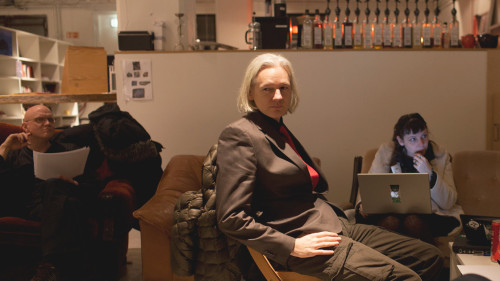
Gibney brings us interviews with Manning’s immediate supervisor in the Army, his boyfriend and the confidante who turned him in. We see footage of Assange in his hotel room before his big press conference (from another filmmaker – Assange did not cooperate with Gibney). Gibney does introduce us to Assange’s former team members at WikiLeaks, his journalistic partners and even a Swedish woman who accused him of sexually victimizing her. It all makes for a comprehensive inside perspective.
All three threads of the story are astounding, especially how anyone could keep Bradley Manning in the US Army and how the nation’s diplomatic and military secrets were all opened to a private at an isolated forward base in Iraq. Gibney could have made an equally entertaining movie, if less complete, based on Assange alone; Assange is an odd duck who had his rock star moment and left a trail of relationship carnage behind, burning every single friend, colleague and well-wisher along the way.
Gibney is remarkable prolific. After winning the 2008 Best Documentary Oscar for Taxi to the Dark Side, he has churned out Casino Jack and the United States of Money, Client 9: The Fall of Elliott Spitzer, Magic Trip, The Last Gladiators, Park Avenue: Money, Power and the American Dream and Mea Maxima Culpa: Silence in the House of God. It’s a body of work that is notable for its strong quality and even more astonishing productivity.
We Steal Secrets: The Story of WikiLeaks is in theaters and is also available streaming from Amazon, Vudu, YouTube, Google Play and other VOD outlets.