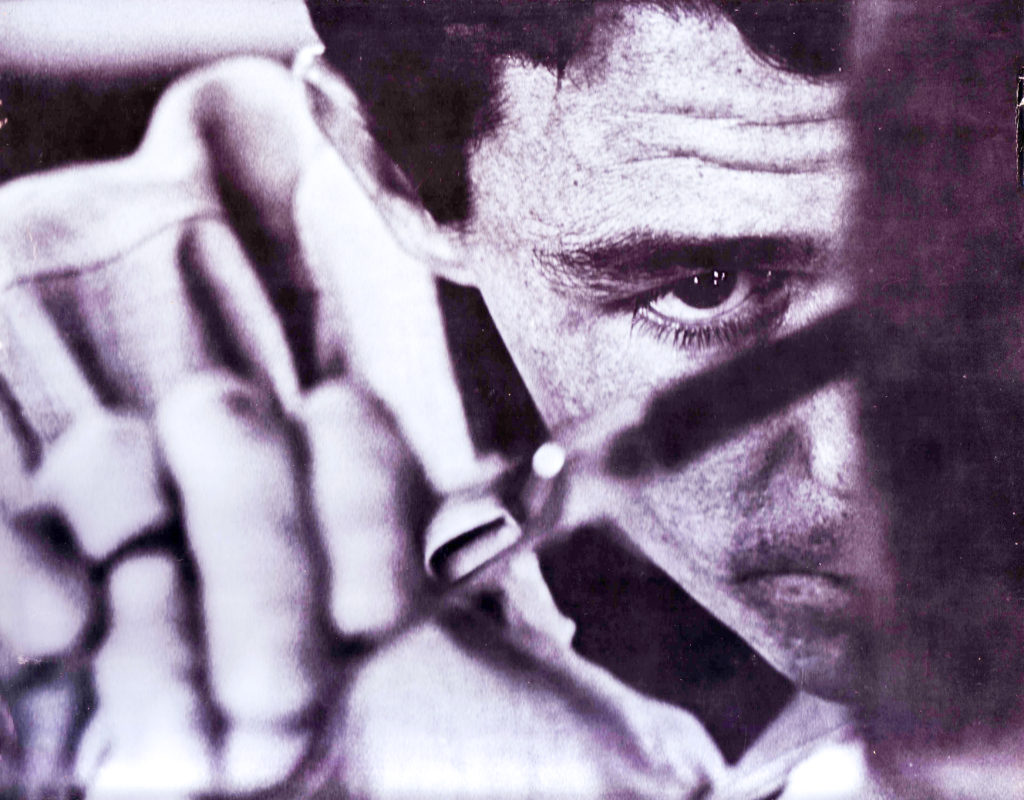
The documentaryTheremin Magicexplores that most weirdly unworldly of musical instruments, the Theremin. Documentarian Cressandra Thibodeaux took advantage of a global Theremin festival (who knew?) to film the world’s top five Theremin players.
The five are a diverse lot, and their mastery of the instrument is astonishing. Because the instrument is played by waving one’s fingers in the air next to it, the performances are visually somewhere between conducting an orchestra and dancing ballet. At the very end there’s a scene with an entire classroom full of Theremin players.
If you are interested in music and haven’t dived deeply into the Theremin, this is all interesting. Cinequest hosts the world premiere of Theremin Magic.
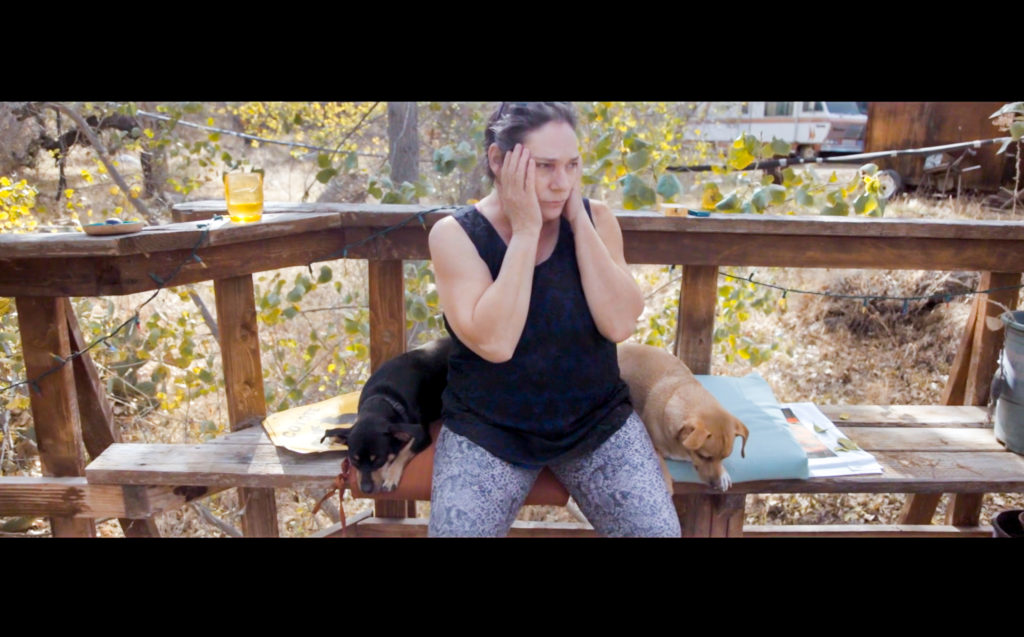
Kate Woods in THE QUICKSILVER CHRONICLES. Photo courtesy of Cinequest.
The documentary The Quicksilver Chronicles introduces us to the 60ish brother and sister Kemp and Kate Woods, who live a bohemian existence in a ghost town that they have to themselves. In other times, Kemp and Kate might have been labeled eccentrics or Free Thinkers.
Kate is raucously voluble. She is never without a cigarette, espouses her love of Mexican ballads and has an opinion on everything. Her friend, photographer Tom Chargin, has been taking pictures of Kate for decades.
Most of Kemp and Kate’s lives seem to involve dogs and cigarettes. The Quicksilver Chronicles is only 75 minutes long, which gives the filmmakers the freedom to pace the film slowly – that allows us to settle in and let these characters and their lifestyle wash over us. Just when you think we’re just watching these two putter around in the boonies, a major life event DOES happen.
They are living in Idria, California, population 2. This is the site of the long-defunct New Idria Mine, once America’s second biggest mercury mine (after San Jose’s New Almaden Quicksilver mine), In the California Gold Rush, mercury was used to extract gold from ore. There’s a mountainful of naturally occurring mercury at Idria, and the disturbances from the mining have made this a Superfund site.
As the crow flies, Idria is remarkably close to Silicon Valley. But, to get there, you first have to drive the 45 minutes to Hollister and then ANOTHER 2 hours past the tiny crossroads of Paicines, Panoche and Mercey Hot Spings.
Documentarians Ben Guez and Aleksandra Kulak shot The Quicksilver Chronicles over four years of visits to New Idria.
Cinequest hosts the US premiere of The Quicksilver Chronicles, my favorite documentary at this year’s festival.
In the Norwegian teen coming of age film Psychobitch, Marius (Jonas Tidemann) is his high school’s high achiever. Frida (Elli Rhiannon Müller Osbourne), on the other hand, is emotionally troubled and always on the verge of flaming out. To help Frida, a well-meaning teacher pairs the odd couple on a group project. Odd couple humor ensues.
Frida is more than just a misfit, a high school outcast. She is battling a serious psychiatric disorder, and she often thinks suicidal thoughts and pushes away those who could help. “Psychobitch“, the best movie title in this year’s Cinequest, is Marius’ initial assessment of Frida.
Marius is devoutly conventional, and there is nothing that Frida rejects more enthusiastically than conventionality. But both of these kids are smart and fun-loving, and being with Frida reveals a funnier and more spirited Marius than had been apparent. Frida is a bundle of vitality, and her constant defiance turns out to be a mask.
Marius learns that there’s something about himself, an aspect of his personality, that is not working out for him. For Marius to be happy and to become his own man, there’s a change he needs to make.
Of course, all of this plays out in a high school, with its classes and detentions, cliques and proms. Cinequest Director of Programming Mike Rabehl noted that it has the air of a 1980s John Hughes film. If you squint, you can almost see Pretty in Pink with a bipolar Molly Ringwald.
This an audience-pleaser. Cinequest hosts the North American premiere of Psychobitch.
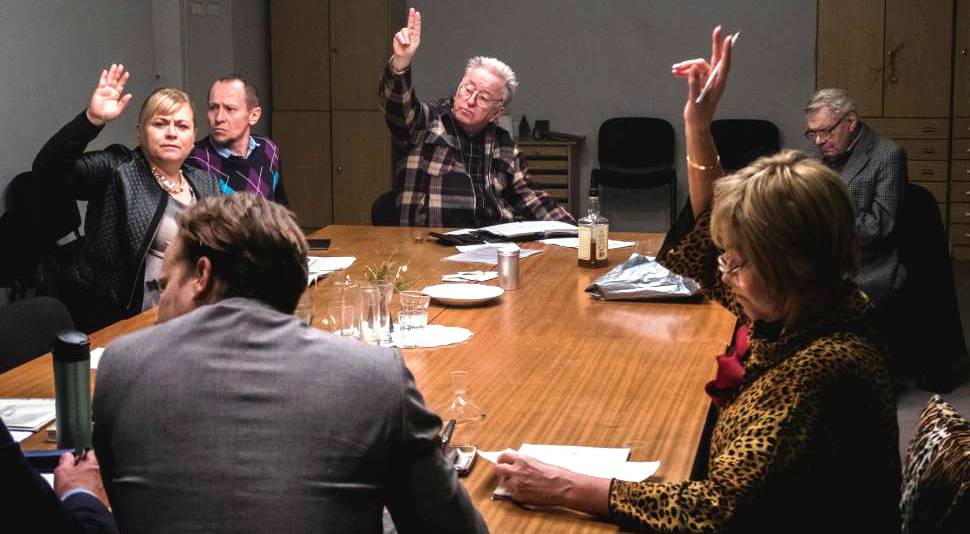
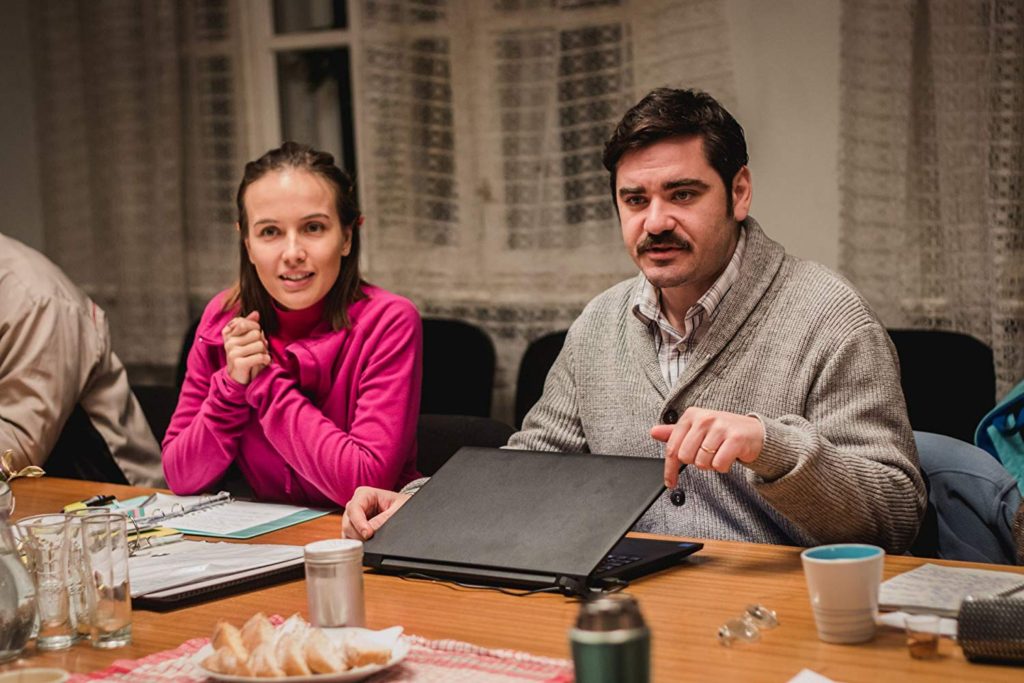
The very dark Czech comedy Owners sharply observes the foibles of the human personality. It’s the regular business meeting of the apartment owners association – but their deliberations about building improvements are anything but mundane, and things quickly get personal.
It’s a rich cast of characters, including:
the insufferable auditor who finds every nit and insists on picking it;
the couple that are self-selected officers, but are too disorganized to ever make a meeting on time; (this time their excuse is that the babysitter was late – yet they come in with their kids!) ; and
two slickster smoothies who are back in the Czech Republic after having made their way in the swashbuckling world of American finance.
It’s all a vortex of past neighborly grievances and self-interest. From the outset, one owner offers his services (I have a little company“) for everything from locksmithing to boiler repair – but his game is only the most naked. Everyone, it turns out, has an agenda. But most hold their cards close to their vests in this poker game of a negotiation.
It all results in multiple epic meltdowns.
OWNERS
It’s unexpected that this comes to mind from an Eastern European film, but Owners’ jaundiced view of human nature matches that of America’s greatest author – Mark Twain. As if Twain were time-traveled to the modern Czech Republic. One of the owner sagely avers that a “conflict of Pinterest” exists.
One element of human nature seems to be that it is easier to accept and trust the unfamiliar than it is the same folks you’ve been squabbling with for years.
Owners also comments on the post-Communist Czech Republic, with the gripes of the old commie holdovers and the onslaught of the new American-style capitalists. The old system didn’t work for everybody, and neither does the new one.
Owners is adapted from a play, and kinda like a funny 12 Angry Men, has a claustrophobic feeling from its containment in the conference room.
Owners has been recognized at this year’s best Czech film. Cinequest hosts the North American premiere of Owners. Make sure that you stay through the closing credits.
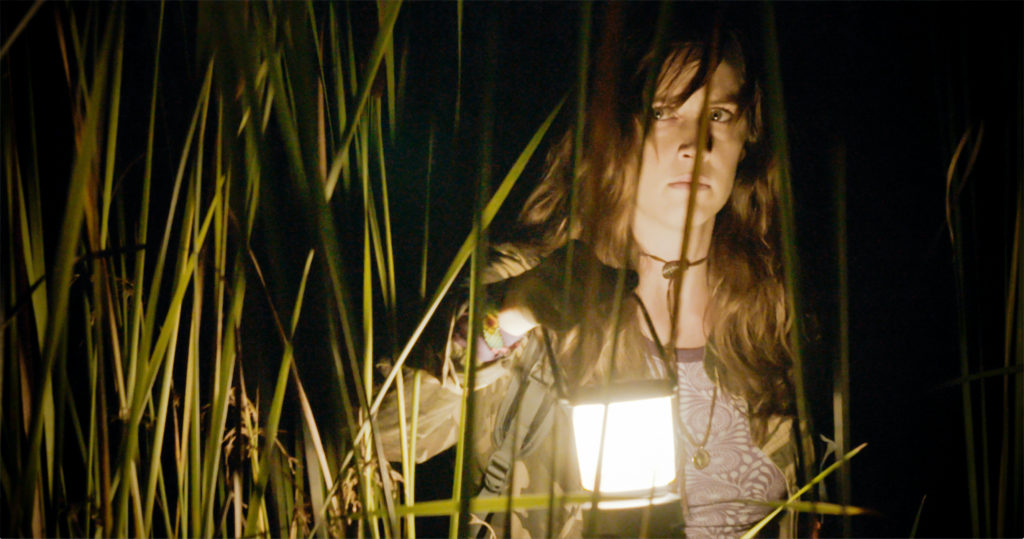
Megan Hensley in Charlie Griak’s NINA OF THE WOODS, premiering at Cinequest. Photo courtesy of Cinequest.
The supernatural thriller Nina of the Woods follows a cynical reality TV crew into a forest; the struggling actress Nina (Megan Hensley) has signed on to the gig, and the shoot happens to take place where Nina grew up. This is one of those lurid shows about the supposed supernatural – sensationalizing phenomena from aliens to Sasquatch; these guys are used to creating the ILLUSION of the supernatural, not FINDING the supernatural. Everyone gets a surprise.
The show’s on-screen host Jeremy (Daniel Bielinski) is the biggest asshole, but this is mostly a jaded bunch. As the crew sneers at the working class locals, they get some truth from Eric the camera guy (Ricardo Vázquez),
These are the people who actually watch your show. Average people. This is who you do it for…. “Reality”. This is reality. Not what we do. No one would want to watch the real thing anyway. It’s too much and too boring all at the same time. Who would care?
A local backwoods guide (Shawn Patrick Boyd) is hired; he is a very serious guy who respects the menace of this particular forest. Nina, having been raised by a father with a spiritual sense of the forest, can also sense something off kilter.
Now something happens that is unexplainable on the time/space matrix. Weird shit happens, and the party happens upon more than they bargained for.
Director and co-writer Charlie Griak unsettles us without employing gore or monsters. Nothing is as unsettling as when our reality is challenged.
In 2015, Cinequest hosted the world premiere of Griak’s debut feature (The Center), a remarkably good drama about recruitment for a Scientology-like cult. Hensley played Annika in The Center.
Griak inserts file footage of old Northwest lumberjacks at work with some very cool Foley.
Cinequest hosts the world premiere of Nina of the Woods.
JOHN PINETTE: YOU GO NOW. Photo cpurtesy of Cinequest
John Pinette: You Go Now, the biodoc of the comedian, plumbs beneath Pinette’s cherubic skin for insights into what sparked his humor – and his obesity. Let’s just say that his childhood was not the most nurturing.
The clips of Pinette’s performances are very funny, and the ones from his youth illustrate his remarkable gift at mimicry. Pinette himself thought that he had inherited genes that predisposed him to addiction, but he was clearly also born with immense talent.
Cinequest hosts the world premiere of John Pinette: You Go Now. It’s only the second time in Cinequest’s 30-year history that an open submission has been selected as the festival’s opening night film.
JAY SEBRING…CUTTING TO THE TRUTH. Photo courtesy of Cinequest.
Jay Sebring…Cutting to the Truth attacks the indignity of a person being remembered, not for his significant achievements, but for his victimhood. Jay Sebring was, along with his friend Sharon Tate, one of the Manson Family’s murder victims. But Sebring invented – by himself – the men’s hairstyling industry. And as what we now call an influencer, he led American men out of the Brylcreem Age.
This documentary is directed by Anthony DiMaria, the son of Sebring’s sister. The film is remarkably well-sourced, with Sebring’s sister, his best Navy buddy, his first wife, his first hair-cutting partner and Hollywood pals like actor Stuart Whitman. There’s even footage with Sebring’s first celebrity customer – Vic Damone (!), who introduced him to the Rat Pack and other crooners like Paul Anka; actors like Steven McQueen, Paul Newman and Henry Fonda soon followed.
Oddly, we meet Sebring himself through an industrial film he commissioned; this is as stilted as any of the industrial films of the 60s, so we don’t get any excitement coming from Sebring, only his drive and passion for hair styling. But that’s OK, because we get a sense of Sebring’s vitality and charisma through the people who knew him.
It took a substantial time it took to uncover the actual but unimaginable facts of the Manson Family’s murderous lunacy. Jay Sebring sadly reminds us that, during this period, the stories of the victims were sullied, when even mainstream media feasted on lurid speculation. Jay Sebring busts up those urban legends, adds some under-reported facts about Sebring’s actions during the Manson attack and a glimpse into what could have been a future with Sharon Tate.
Cinequest hosts the world premiere of Jay Sebring…Cutting to the Truth.
Tawny Cypress and Thalia Thiesfield in INEZ & DOUG & KIRA. Photo courtesy of Cinequest.
The devastating indie drama Inez & Doug & Kira opens with a couple, Doug (Michael Chernus) and Kira (Thalia Thiesfield), facing the recent suicide of Kira’s sister Inez (Tawny Cypress). We learn the back story through flashbacks. Doug tries to peel back the past and slips into obsession.
Who was Inez and why did she kill herself? What is up with Doug? What is up with Kira?
I’ve loved watching Chernus since I first noticed him in Higher Ground, and Chernus is the reason that I screened this movie (and I’m glad that I did). Cypress has the showiest role, but she knocks it out of the park – Inez is sexy, needy, domineering, manipulative and a red hot mess.
Inez & Doug & Kira is the first feature for writer-director Julia Kots, and it’s a very promising debut.
Cinequest hosts the Bay Area premiere of Inez & Doug & Kira, and I understand that the Cinequest audience will be only the second, after the Woodstock Film Festival, to see this film.
UPDATE: Now streaming on Amazon, AppleTV, Vudu, YouTube.
In the excellent Slovenian drama I Am Frank, the title character returns to Slovenia after years abroad. Frank has some baggage, so hardly anyone is happy to see him back, including his own mother. Frank’s brother Brane greets him warmly, but warily.
Frank is one of those opinionated, contentious and perpetually dissatisfied people who think nobody can get along with because of their unbending principles; but it’s really because he’s too self absorbed to understand any one else’s point of view. A Marxist true believer, he’s let Slovenia after the dissolution of Communist Yugoslavia, but has now left Israel in outrage after his kibbutz was privatized. Frank leaves no emotional scab unpicked and has never left well enough alone.
Frank and Barnes father has died leaving an unexpected fortune. Brane, a successful if shady entrepreneur, starts thinking about how to invest the inheritance and get richer. Frank is consumed by the fact that the windfall must have been built illegitimately. What Frank uncovers leads us into a paranoid thriller and tumult between the brothers and Brane’s dangerous business associates.
Writer-director Mitod Pevec has created a marvelous charcter in the charismtic misfit Frank, well played by Janez Skof. Valtar Gragan is equally good in the less showy part of Brane, the guy with his own business and family challenges, trying to hold it all together despite his volatile brother.
Cinequest hosts the US premiere of I Am Frank. which is one of the world cinema highlights of the festival.
In the offbeat dramedy Closet, Jin is reeling from a breakup and gets a very unusual job. The job is with a non-sexual escort service where clients pay him to cuddle with them as they try to get to sleep. It’s one of those quirky only-in-Japan things, like capsule hotels and golf in highrise buildings.
The cuddle is often preceded by a massage and/or a listening session. Cuddling is so intimate that the audience often expects sex to break out, but it doesn’t.
The service appeals to insomniacs because they can drift off to sleep with the comfort of another warm human body. Closet moves through vignettes on a varied set of customers – all differently motivated. One is a lively spirited 18-year-old student (Aino Kuribayashi).
Given his recent medical and relationship traumas and the weirdness of his new job, Jin (Yosuke Minokawa) often looks bewildered.
Cinequest will host the world premiere of Closet. Closet, with its novel premise, is a worthwhile choice.