
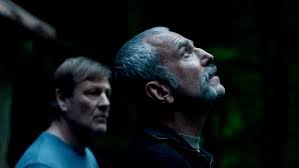
The searing drama Anemone opens with a sixtyish man leaving his home in northern England for a motorcycle ride to a remote forest, where he hides his bike and begins hiking in, heading for coordinates handwritten on a slip of paper. Eventually, he arrives at a cabin hidden deep in the woods. The man who lives there, off the grid, as a hermit, wordlessly invites him in. The two are brothers who haven’t seen each other for two decades.
Both men are retired British soldiers who served in Northern Ireland’s Troubles. Twenty years before, Ray (Daniel Day-Lewis) abandoned his pregnant wife Nessa to become a recluse. Jem (Sean Bean) assumed Ray’s role in caring for Nessa and Ray’s biological son. Now the son (Samuel Bottomley) is emotionally floundering and Nessa (Samantha Morton) has written to Ray, asking him to return and help the son resolve his issues. Anchored resolutely in his bitterness, rage, guilt and shame, returning is the last thing that Ray wants to do.
Gem delivers Nessa’s letter right away, which Ray initially refuses to read. Gem, playing the long game, stays for a few days, patiently wearing down Ray’s resistance. Gradually, Ray unloads stories from the past that explain his choices.
Ray is an intense guy, played superbly by Day-Lewis. Having suffered traumas and indignities in his military career, he has coped by spurning all human interaction and adopting a simple life that he can control. Day-Lewis, generally recognized as the world’s best living screen actor, gets to explode in several visceral monologues about his haunting experiences.
Sean Bean is really good here in a very subtle performance. The role of Jem is far less showy than that of Ray, but Bean brings a world-weary, solid decency to Gem, who is fully engaged as he listens to Ray’s charged stories with empathy. Samantha Morton is good, too, but with far less screen time.
If you already know anything about Anemone, it’s probably that Day-Lewis came out of retirement to act in the first feature directed by his son Ronan Day-Lewis. Daniel and Ronan co-wrote the screenplay.
As a director, Ronan Day-Lewis has a gift for exquisitely framing shots – the first seven or so shots could be hanging in an art museum. The soundtrack – toggling between driving rock and silence – is singular. As a storyteller, he lets his audience figure out what’s going on as facts about Jem and Ray unspool. Ronan even throws in some magical realism apparitions and a near-apocalyptic hailstorm. Ronan Day-Lewis ends the the movie perfectly, with a shot that isn’t even a half-second too long (although it took a superfluous twenty minutes to get there).
Although Anemone’s portrait of Ray is unsurpassed, the story is not deep or surprising enough to support a two-hour running time. The dramatic tension is whether Ray is going to leave the woods and meet his son. That would be the decent thing for him to do, it may be his last chance at redemption, and that’s the outcome the audience is rooting for. Well, since this IS a movie, what do you think he’s going to do? As much as I admired much of the film, I wasn’t on the edge of my seat.
Even though it’s overlong, I’m glad I watched Anemone for the superb performances by Day-Lewis and Bean and for the stunning visuals and soundtrack.