OH, CANADA: deathbed confession and so what?

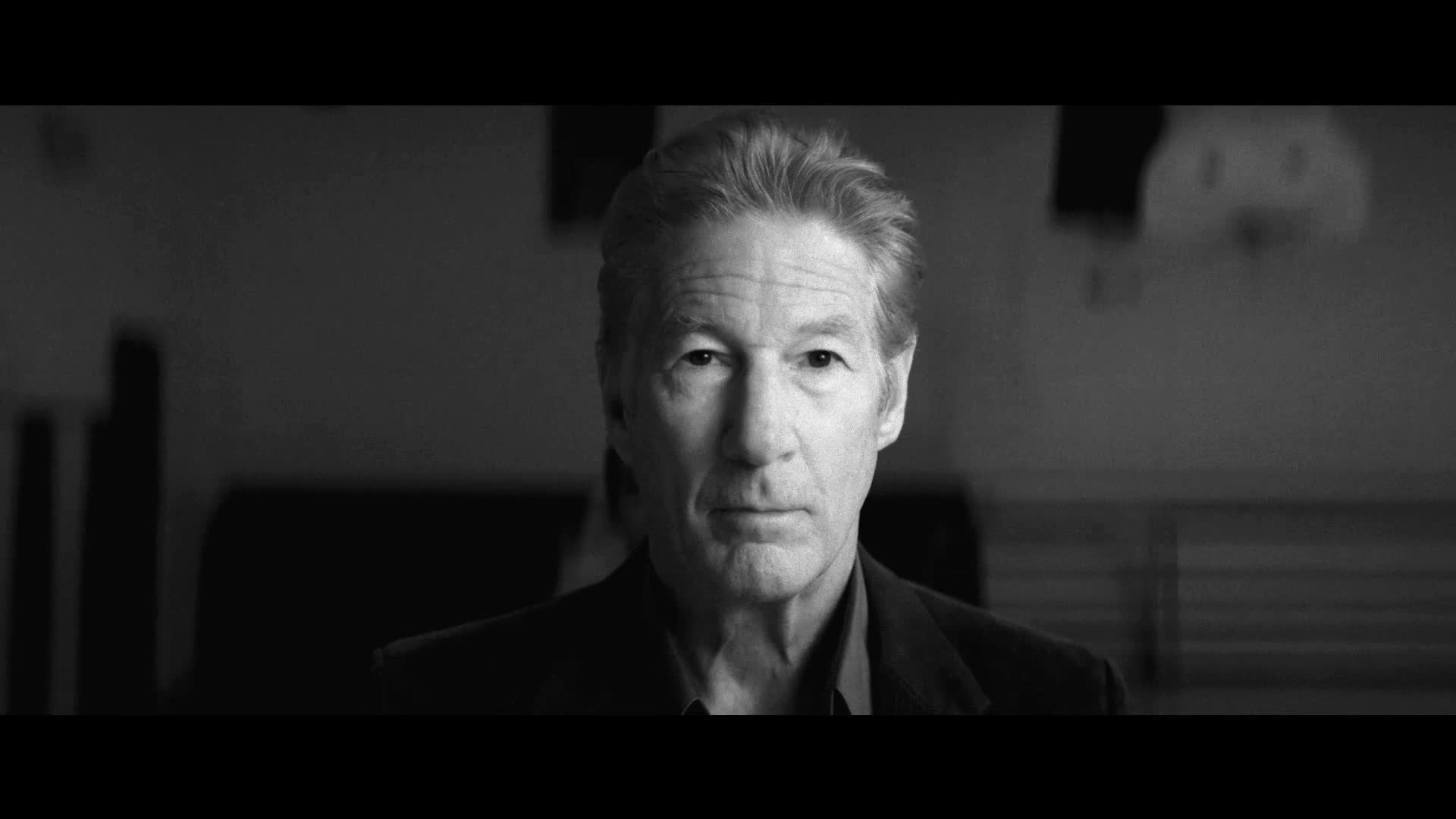
Photo caption: Richard Gere in OH, CANADA, Courtesy of Kino Lorber.

In Oh, Canada, Leonard Fife (Richard Gere) is a prominent documentarian who is dying, and one of his most successful former students (Michael Imperioli) is honoring him with a biodoc. When he is seated before an Errol Morris Interrotron, Fife demands that his wife Emma (Uma Thurman) take the position behind the camera so he can speak directly to her, and then takes over the filming with an unrestrained, blurted life story. It’s really a confession, and Leo has a lot to confess.

As Leo tells his life story, the young Leo is portrayed (mostly) by Jacob Elordi (Priscilla, Saltburn). Sometimes the older Gere shows up as the young Leo instead of Elordi, which reflects the muddling of Leo’s memory at this final stage of his life.

Besides his achievements as a filmmaker, Leo Fife has been revered as a principled American draft resister who fled to Canada to protest the Vietnam War. Leo reveals that his re-invention in Canada was anything but principled (and that Oh, Canada is a very ironic title). In fact, Leo’s adult life has been that of a weak and selfish man, a man who always takes the easy way, even if that means betrayal or thievery. It would be the life of a sociopath, except that sociopaths don’t feel guilt and the need to confess.

Oh, Canada is a Paul Schrader film. Schrader wrote Taxi Driver and Raging Bull., adapted The Last Temptation of Christ, wrote and directed American Gigolo and Affliction. All very good. All very dark.

Oh, Canada follows Schrader’s late-career, self-described ‘Man In A Room’ trilogy, following First Reformed and The Card Counter and Master Gardener  I would name it the “Man with a Code Seeks Redemption” trilogy. Likewise, Oh, Canada is about a man’s assessment of his life, but it’s not as good as the previous three, perhaps because Leo Fife never lived by a code, and it’s too late for redemption.

Oh, Canada is a searing portrait of a man confessing his sins, but too late to help anyone else, including those he has hurt. He might feel cleansed on his deathbed, but, so what?

In a nice touch, Fife’s protege shows himself to b just as vile as his mentor and visits one final indecency on Leo.

Gere and Thurman are solid. The Wife thought Jacob Elordi was appropriately smarmy, but I didn’t detect any hint of the self-loathing that the young Fife must have felt. Penelope Mitchell sparkles in a small role as an ambitious production assistant.

There’s one brilliant performance in Oh, Canada – that of Zach Shaffer as Leo’s long-abandoned adult son. Shaffer keeps his character contained in a highly charged situation, registering his emotional reaction only with his eyes. It’s a highly nuanced portrayal of a shattering experience.

I was constantly absorbed by Oh, Canada, as I learned who Leo Fife really was, but left the theater feeling indifferent.
DVD/Stream of the Week: NORMAN: THE MODERATE RISE AND TRAGIC FALL OF A NEW YORK FIXER – big deals are not for little men

NORMAN: THE MODERATE RISE AND TRAGIC FALL OF A NEW YORK FIXER
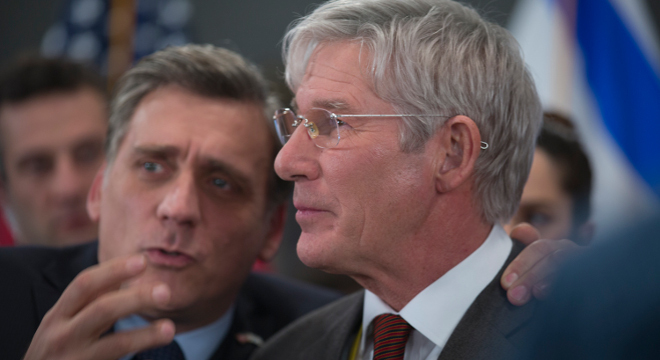
Lior Ashkenazi and Richard Gere in NORMAN: THE MODERATE RISE AND TRAGIC FALL OF A NEW YORK FIXER

In Norman: The Moderate Rise and Tragic Fall of a New York Fixer, writer-director Joseph Cedar and his star Richard Gere combine to create the unforgettable character of Norman Oppenheimer, a Jewish Willy Loman who finally gets his chance to sits with the Movers and Shakers. Norman’s gig is to find two real businessmen that he does not know, pretending to each to be the confidante of the other, and introduce them, hoping that they make a deal (a deal that he neither engineers or invests in), hoping that he can get a percentage as a finder’s fee.

Norman has not so much a ready smile as a compulsive one. Unencumbered by any sense of boundaries or propriety, he literally stalks the rich and influential like paparazzi stalk celebrities. He feigns familiarity and drops names (“a high official, I can’t say his name”). All he time, he tries, usually successfully, to stifle the odor of desperation.

I’ve spent over thirty years in politics, and in my business, it is said that there are Who Ya Know consultants and there are What Ya Know consultants. The most effective consultants combine both. If you’re only at the table to peddle the influence of Who Ya Know, you might be a little shady. That’s Norman.

I know the world of powerful and important people, a world that hustlers try to crash, and I’ve known people like Norman. And I know the Whack-A-Mole pressure of shepherding home a complex, multi-faceted deal. Norman’s character, while extreme, rings true.

Norman is everybody’s acquaintance but has no actual reputation of his own. No one knows where he lives or what deals he has structured before. He is so mysterious that we find ourselves even asking, is he homeless?

This may be Richard Gere’s best movie performance. Gere perfectly distills Norman’s obnoxious ambition to play with the high rollers and then his stress and bewilderment once he’s gotten to the high stakes table. The critic Christy Lemire writes, “You may not be able to root for him, but you can’t help but feel for him.”

Norman ingratiates himself to an Israeli politician (Lior Ashkenazi) and hits pay dirt when the politician unexpectedly becomes prime minister. Norman says, “for once, I have bet on the right horse”, and indeed Norman did spot a uniquely optimistic quality that other observers failed to recognize and appreciate. For the first time, Norman is relevant and at the exhilarating center of power.

Lior Ashkenazi is brilliant as the politician, a man who is able to recognize his own specific gifts. He is ebullient, and it’s easy to see how people can be attracted to his charisma and infectious confidence. His vulnerability is an appetite for fine things and a neediness for the flattery and attention that a poser like Norman can offer. Ashkenazi played a totally contrasting, much more nerdy, character in Cedar’s 2011 inventive and mostly successful character-driven dramedy Footnote.

Norman is juggling multiple balls in air, and he must make all of his deals pay off because they are all interlinked. It’s kind of like making an exotic bet at the racetrack like an exacta, a superfecta or a pick 6. If one part unravels, the whole thing will come crashing down. Norman has always been able to get by on bullshit, but now he’s has gotten his wish – to play at the highest level, where, at some point you’ve got to deliver. Here’s where “the tragic fall” comes in.

The stellar performances of Gere and Ashkenazi are but two highlights of Norman’s superb casting: Michael Sheen, Charlotte Gainsbourg, Harris Yulin, Steve Buscemi. Josh Charles plays a magnate who can sniff out a bullshit artist and can dismiss one with blistering efficiency. The always excellent Isaach De Bankolé (Night on Earth) is memorable in a tiny part. Hank Azaria sparkles as a character who confounds Norman with a taste of his own medicine. And we get to hear the glorious singing voice of Cantor Azi Schwartz.

As they say, if you can’t run with the big dogs, stay on the porch. Big deals are not for little men.  Norman: The Moderate Rise and Tragic Fall of a New York Fixer is available on DVD from Netflix and to stream from Amazon, iTunes, Vudu, YouTube and Google Play.

Note: Norman: The Moderate Rise and Tragic Fall of a New York Fixer weighs in at #16 on my list of Longest Movie Titles.

NORMAN: THE MODERATE RISE AND TRAGIC FALL OF A NEW YORK FIXER: big deals are not for little men

NORMAN: THE MODERATE RISE AND TRAGIC FALL OF A NEW YORK FIXER
Lior Ashkenazi and Richard Gere in NORMAN: THE MODERATE RISE AND TRAGIC FALL OF A NEW YORK FIXER

In Norman: The Moderate Rise and Tragic Fall of a New York Fixer,  writer-director Joseph Cedar and his star Richard Gere combine to create the unforgettable character of Norman Oppenheimer, a Jewish Willy Loman who finally gets his chance to sits with the Movers and Shakers.  Norman’s gig is to find two real businessmen that he does not know, pretending to each to be the confidante of the other, and introduce them, hoping that they make a deal (a deal that he neither engineers or invests in), hoping that he can get a percentage as a finder’s fee.

Norman has not so much a ready smile as a compulsive one. Unencumbered by any sense of boundaries or propriety, he literally stalks the rich and influential like paparazzi stalk celebrities.  He feigns familiarity and drops names (“a high official, I can’t say his name”).  All he time, he tries, usually successfully, to stifle the odor of desperation.

I’ve spent over thirty years in politics, and in my business, it is said that there are Who Ya Know consultants and there are What Ya Know consultants. The most effective consultants combine both. If you’re only at the table to peddle the influence of Who Ya Know, you might be a little shady.  That’s Norman.

I know the world of powerful and important people, a world that hustlers try to crash, and I’ve known people like Norman.  And I know the Whack-A-Mole pressure of shepherding home a complex, multi-faceted deal. Norman’s character, while extreme, rings true.

Norman is everybody’s acquaintance but has no actual reputation of his own.  No one knows where he lives or what deals he has structured before.  He is so mysterious that we find ourselves even asking, is he homeless?

This may be Richard Gere’s best movie performance.  Gere perfectly distills Norman’s obnoxious ambition to play with the high rollers and then his stress and bewilderment once he’s gotten to the high stakes table.  The critic Christy Lemire writes, “You may not be able to root for him, but you can’t help but feel for him.”

Norman ingratiates himself to an Israeli politician (Lior Ashkenazi) and hits pay dirt when the politician unexpectedly becomes prime minister.  Norman says, “for once, I have bet on the right horse”, and indeed Norman did spot a uniquely optimistic quality that other observers failed to recognize and appreciate.  For the first time, Norman is relevant and at the exhilarating  center of power.

Lior Ashkenazi is brilliant as the politician, a man who is able to recognize his own specific gifts.  He is ebullient, and it’s easy to see how people can be attracted to his charisma and infectious confidence.  His vulnerability is an appetite for fine things and a neediness for the flattery and attention that a poser like Norman can offer.  Ashkenazi played a totally contrasting, much more nerdy, character in Cedar’s 2011 inventive and mostly successful character-driven dramedy Footnote.

Norman is juggling multiple balls in air, and he must make all of his deals pay off because they are all interlinked.  It’s kind of like making an exotic bet at the racetrack like an exacta, a superfecta or a pick 6.  If one part unravels, the whole thing will come crashing down.  Norman has always been able to get by on bullshit, but now he’s has gotten his wish – to play at the highest level, where, at some point you’ve got to deliver.  Here’s where “the tragic fall” comes in.

The stellar performances of Gere and Ashkenazi are but two highlights of Norman’s superb casting:  Michael Sheen, Charlotte Gainsbourg, Harris Yulin, Steve Buscemi.   Josh Charles plays a magnate who can sniff out a bullshit artist and can dismiss one with blistering efficiency.  The always excellent Isaach De Bankolé (Night on Earth) is memorable in a tiny part.  Hank Azaria  sparkles as a character who confounds Norman with a taste of his own medicine.   And we get to hear the glorious singing voice of Cantor Azi Schwartz.

As they say, if you can’t run with the big dogs, stay on the porch.  Big deals are not for little men.

Note: Norman: The Moderate Rise and Tragic Fall of a New York Fixer weighs in at #16 on my list of Longest Movie Titles.