If, like me, your idea of Frankenstein is Boris Karloff’s monster staggering around, you’re going to be blown away by Guillermo del Toro’s Frankenstein, a sweeping, operatic tragedy and a triumph of filmmaking. Instead of remaking the 1931 film, del Toro based his film on the 1818 Mary Shelley novel, Frankenstein; or, the Modern Prometheus, and made an epic movie about morality.
In Frankenstein, we learn about Victor Frankenstein’s back story, beginning with traumas in his childhood that form his obsession to overcome the inevitability of human death. The adult Victor (Oscar Isaac) is a scientific genius whose secret work is sponsored by a shady zillionaire (Cristoph Walz). Victor patches together body parts of war casualties, assembling them into a Creature (Jacob Elordi) that he uses electricity to re-animate. Critically, Victor only cares that his experiment has succeeded, and doesn’t recognize any humanity in his Creature, who does, after all, possess a human brain. And things get out of hand.
The Creature is big and scary-looking, but it turns out that his mind is capable of learning, and he comes to move with sinewy grace.
Victor is visited by his brother’s fiance Elizabeth (Mia Goth), a young woman with her own scientific aspirations. More than just a naive do-gooder, Elizabeth’s intellectual curiosity and proto-feminist self confidence allow her to assess the Creature’s humanness and become the moral center of Frankenstein.
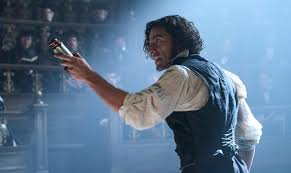
We sympathize with Victor as a survivor of childhood trauma, we admire his scientific genius and, given that he is played by the very handsome Oscar Isaac, we don’t expect Victor to be the bad guy. Victor seeks to become humankind’s greatest champion, but his arrogance and his callousness and cruelty toward the Creature define him otherwise. As characters in Frankenstein explicitly ask, who is the real monster here?
It is also, of course, a story about man’s overreaching, a central theme of literature and drama since the ancient Greeks, with their Icarus myth and their hubris-filled heroes. Not to mention the Bible (Pride goeth before destruction, and an haughty spirit before a fall). Even my beloved film noir genre is usually about someone doing something they shouldn’t, motivated by some combination of greed and lust. Audacity is required to harvest the biggest rewards (e.g., the Apollo manned flights to the moon), but audacious risks may also bring catastrophe (e.g., both Napoleon’s and Hitler’s invasions of Russia).
We humans are not very good at anticipating consequences. After all, could conquering death somehow be a bad thing? As we now see with AI – it’s impressive that you CAN do it, but SHOULD you do it?
At two-and-a-half hours, Frankenstein is over twice the length of the 1931 version – and for a good reason. Del Toro structures Frankenstein as tales told from three points of view – that of the sea captain who comes across Victor in the Arctic, that of Victor and that of the Creature himself. The first two acts are good storytelling, but Frankenstein’s third act is thrilling and emotionally powerful.
Given del Toro’s skill in bringing fantasies to life (Pan’s Labyrinth, The Shape of Water), we expect a visually unforgettable movie, and that’s what we get. Frankenstein is a spectacular testament to the imaginations and technical skills of del Toro and his collaborators – cinematographer Dan Lausten, production designer Tamara Deverell, costume designer Kate Hawley, composer Alexander Desplat and the hair and makeup team. I foresee Oscar nominations for all of them, and Hawley HAS to win for the stunning colors of Elizabeth’s dresses.
Oscar Isaac is very good as Victor, a man complicated by his best and worst traits. So are Charles Dance as Victor’s cold and cruel father and Lars Mikkelsen as the ship captain. (Dance has acted in thirty-five feature films and television series, including (Mank, Game of Thrones and The Crown, while IN HIS SEVENTIES.)

The most revelatory performance is, surprisingly that of Jacob Elordi (Saltburn, Priscilla, Oh Canada) as the Creature, who keeps evolving in his capacity to reason and to feel. Buried under pounds of makeup, Elordi is able to clearly express all of the Creature’s feelings through his eyes and the movement of his body.
Like many of you, I don’t enjoy gore and generally avoid the horror movie genre. Here, there’s only two or three minutes of body horror, as Victor surgically chops up corpses and reassembles them as his creation. You can hold your fingers over your eyes or fast forward if necessary. Just don’t miss this movie. There’s no fright or camp here – the tone is romantic and operatic.
Frankenstein is one of the Best Movies of 2025 – So Far. Frankenstein releases on Netflix this Friday. I saw Frankenstein at my local multiplex in an auditorium equipped with Dolby’s ATMOS sound. Most of you will be watching it at home on Netflix. I recommend honoring the filmmaking here by turning off the lights in the room, and watching it, UNINTERRUPTED, on your biggest screen with the sound cranked up.