OUT OF THE BLUE: when there is no redemption

Photo caption: Linda Manz in OUT OF THE BLUE. Courtesy of Discovery Productions, Inc..

Newly restored for re-release, Dennis Hopper’s 1980 Out of the Blue is an anti-redemptive parable of alienation. It features both an unforgettable performance and an unforgettable ending.

The spirited teenager Cebe (Linda Manz) has the worst parents in her British Columbia town, maybe in the entire province. Her dad (Dennis Hopper), is a drunk, deservedly in prison for an act of irreparable harm. (Cebe bears a facial scar from this incident – and lots of emotional damage as well).

Her chirpy mom (Sharon Farrell) can’t keep a needle out of her arm or guys out of her pants. Ever impulsive, she ruefully observes that there are two kinds of men – the sexy, adventuresome types and the good providers; it’s evident that she hasn’t bet her life on the good providers.

After five years in prison, the dad is released and gets a job operating heavy machinery at a garbage dump overrun by sea gulls. But he’s still sucking on his ever-present pint bottle, and the town won’t forget why he was incarcerated.

Cebe is full of life and has a gum-chewing swagger. She’s comfortable leading her teen peers in some rowdiness, but she also has a rich imagination and she spends a lot of time in her room alone, acting out her interests in Elvis and punk music.

But Cebe doesn’t know in what direction to channel her exuberance; she can’t tell her sympathetic, court-appointed psychologist (Raymond Burr) what she wants.

The one thing that Cebe doesn’t want is what’s best for her – to be separated from her parents. As is common with neglected and abused children, she clings to the bad situation that she is familiar with.

Cebe acts out in mildly rebellious mischief at school, and she runs away for a night of adventure in Vancouver, somehow emerging unscathed from risky situations.

Back home, she hides from her parent’s arguing in her room. Suddenly, the audience is shocked by something the father says (what??!!), and it is revealed that the parents’ dysfunction is MUCH darker, more twisted than previously apparent.

Cebe erupts, and Out of the Blue ends with a stunning, utterly unpredictable climax. Hopper follows Billie Wilder’s screenwriting advice – “don’t hang around”; the ending is not even one second too long.

Dennis Hopper wrote and directed Out of the Blue, pacing the film well and delivering verisimilitude from the Vancouver-area setting. The camera swirls around the actors at times, and Hopper makes good use of the thousands of seagulls populating a garbage dump.

Out of the Blue is really all about Linda Manz’s singular performance as Cebe. Often improvised, her performance is naturalistic and unpredictable. When she is in her room or walking through a Vancouver night, she acts like no one is watching her, and it’s riveting.

By the time she was 19 in 1980, Linda Manz had acted in and narrated a masterpiece (Terence Malick’s Days of Heaven) and appeared in two cult films (Philip Kaufman’s The Wanderers and Dennis Hopper’s Out of the Blue). Then she retired to raise a family. Manz died at 59 in 2020.
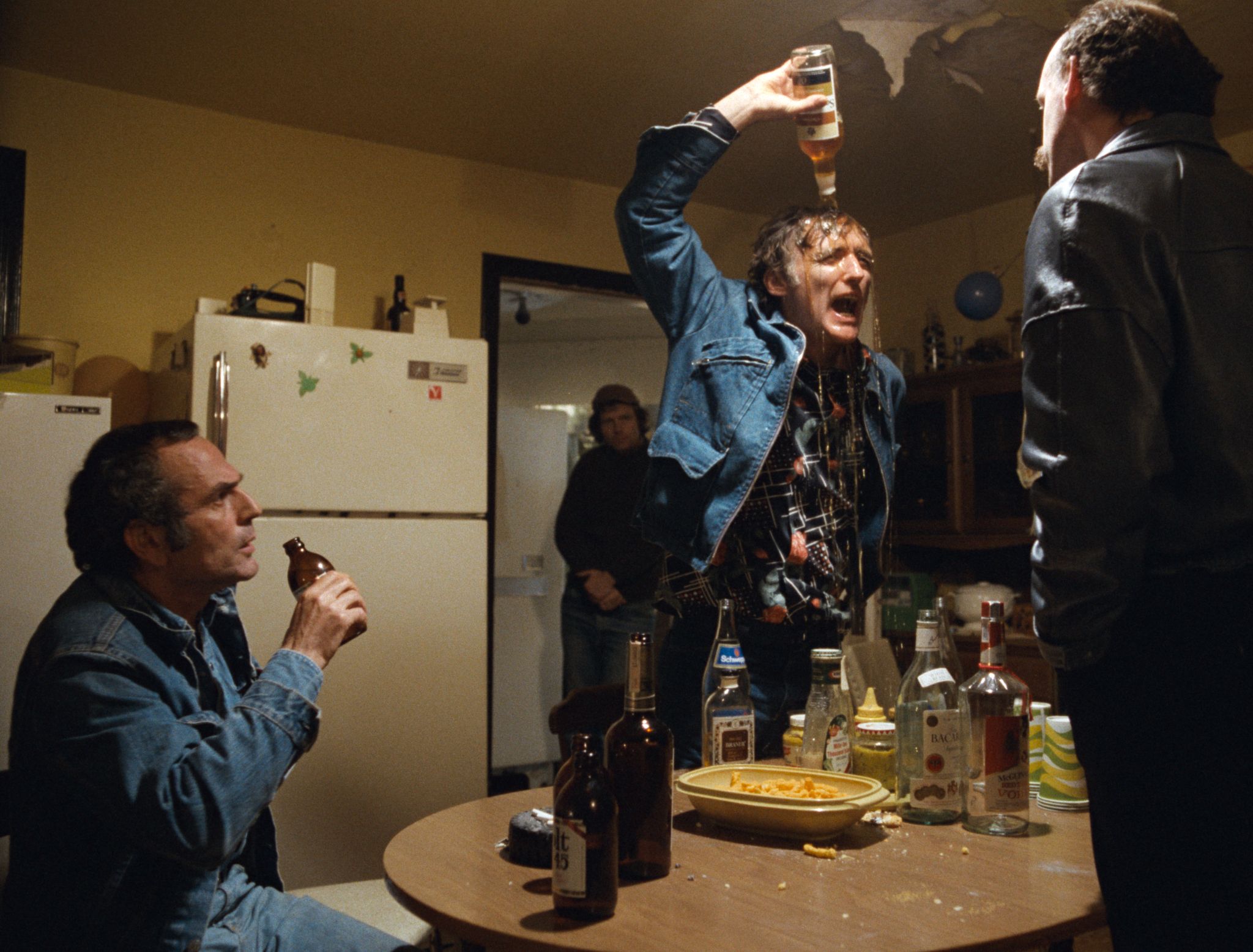
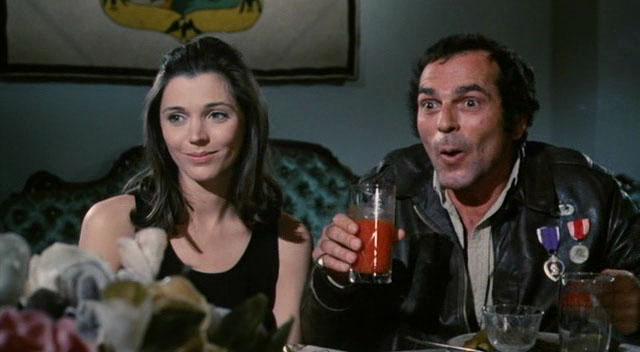
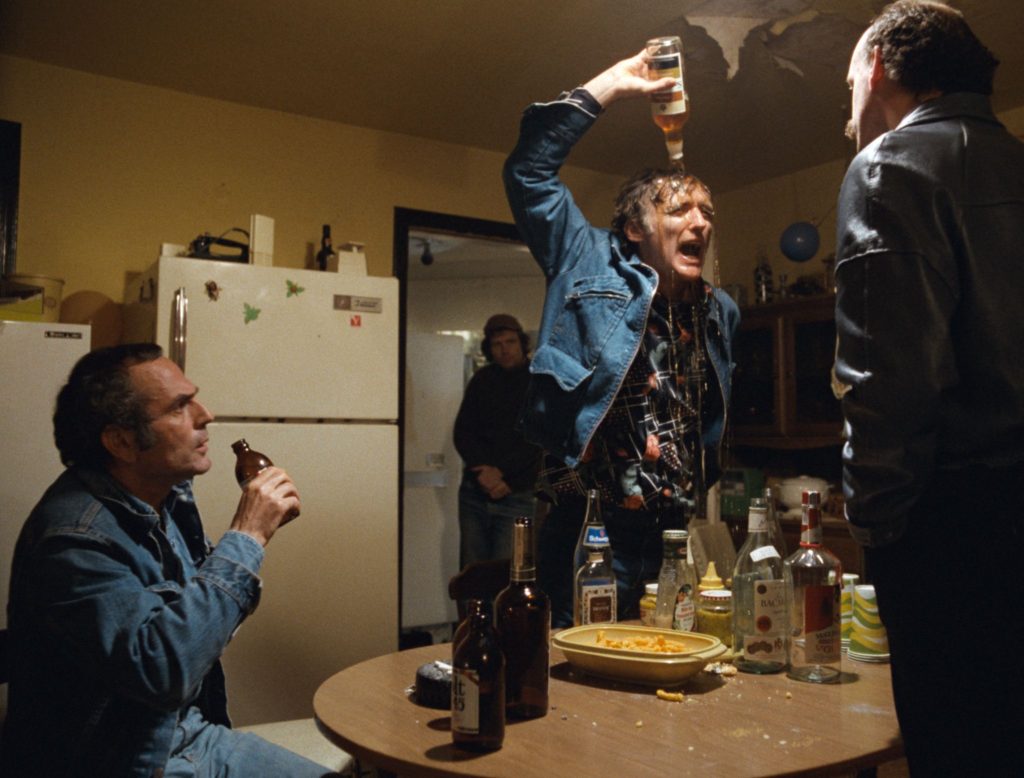
Don Gordon (left) and Dennis Hopper (center) in OUT OF THE BLUE. Courtesy of Discovery Productions, Inc.

As the dad, Hopper is able to demonstrate the charm that attracted the mom and the playfulness that endears him to Cebe. In a scene where the dad dramatically gets himself fired, Hopper shows a man so enjoying his ballsy action, and then, his visage changes as the consequences of his impulsivity sink in, reflecting on his helplessness when he is once again done in by his own impulses.

As the mom, prolific television actress Sharon Farrell excels in a rare movie role.

Don Gordon plays Charlie, the dad’s marginally more functional pal. Gordon had key supporting roles in Bullitt and Papillon and over a hundred appearances in the episodic TV of the 60s and 70s.In Out of the Blue, Gordon displays his gift for playing drunk convincingly. Gordon really understood the essence of drunk thinking and behavior, and has an even more compelling drunk scene in Hopper’s The Last Movie).

Out of the Blue premiered at Cannes and enjoyed praise from Roger Ebert (“Bitter, unforgettable. An unsung treasure.“) and other critics. But the ending is so shocking and emotionally desolate, that it wasn’t released in the US; no distributor wanted to bet on its acceptance by a US audience. John Alan Simon acquired the distribution rights for a 17-week art house tour in 1982 with Hopper. Now Simon and Elizabeth Karr have digitally restored Out of the Blue from the only two 35mm prints in existence.

Out of the Blue has only recently become available to stream; (I own the DVD.) In late 2021, the 4K restoration opened at a New York City screening presented by Chloë Sevigny and Natasha Lyonne. Now you can find Out of the Blue on the Criterion Channel, AppleTV, YouTube and Fandango.
THE LAST MOVIE: elements of a masterpiece in a misfire

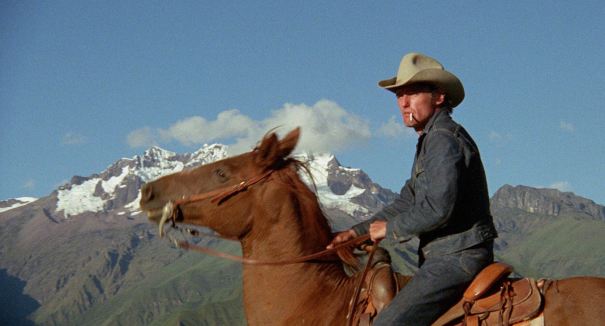
Photo caption: Dennis Hopper in THE LAST MOVIE

The Last Movie is Dennis Hopper’s notoriously “lost film”, buried by a hostile movie studio in 1971 and still generally unavailable. Given Hopper’s drug addled, out-of-control state during this decade, I was expecting a mess. But what is on the screen is an excellent 1970s art film, beautifully shot by László Kovács. There is a surreal thread that not everyone will buy into, but I think the movie works as a whole.

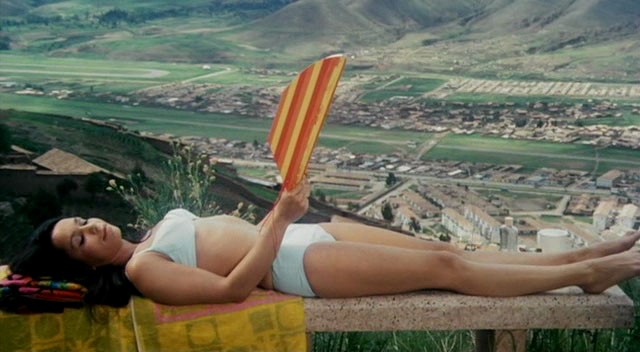
Hopper plays a Hollywood horse wrangler who is in Peru for a location shoot. He has gone native. setting up local girlfriend Maria (Stella Garcia) in a modern house. He’s already alienated, but a fatal accident on the movie set triggers him into rejecting Western modernity in favor of indigenous Peru. His paradise in the Andes becomes elusive as he meets Ugly American visitors. And then things get really weird, as the local indigenous people begin acting out the movie shoot – only without film. It is a parable of colonialism.

That weirdness, Hopper’s experimentation with the non-chronological construction of the film and some disjointedness/incoherence in the story will be off-putting for many viewers and keeps The Last Movie from being a Great Film. Roger Ebert called it “a wasteland of cinematic wreckage” and condemned it to one star. That said, the setting and Kovács’ cinematography make for a visually stunning film.

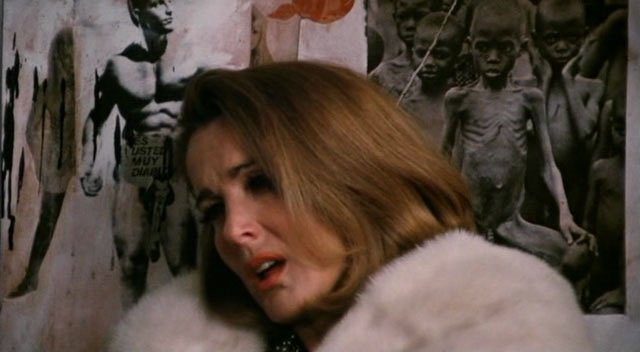
Julie Adams in THE LAST MOVIE

Hopper is always interesting as an actor, but The Last Movie features excellent, perhaps career-topping, performances by Stella Garcia, Julie Adams and Don Gordon.

Stella Garcia in THE LAST MOVIE
  • Garcia projects the inner strength and ambition of a Maria who sees herself as far more than the gringo’s plaything. On the face of it, Maria seems exploited. but she has a strong sense of her value and she insists on getting her due. Anyone who sees her as only arm candy is underestimating her at their own risk. Garcia had already amassed 23 of her 30 screen credits before The Last Movie, then played the top female character in Joe Kidd, and didn’t do much screen acting afterwards.
  • Julie Adams plays the sexually voracious wife of a visiting American businessman, capable of cruelly inflicting humiliation. With a career that started in the Studio Era (she co-starred with James Stewart and Rock Hudson in 1952’s Bend of the River), I can’t imagine that she got many scripts like this, and her performance is incendiary.
  • Prolific character actor Don Gordon plays Neville, another American expat. Neville is the guy who thinks up a get-rich-quick idea but doesn’t take into account that someone richer, more powerful and with more business sense can take the whole thing away from him. Gordon’s drunk scene is just perfect, especially in capturing how really drunk people don’t notice things about themselves or others. Gordon had the fourth lead in Bullitt and Papillon, and guest-starred in scores of television shows, but his very best work was in The Last Movie and in Hopper’s searing Out of the Blue (aka No Looking Back).
Don Gordon (right) in THE LAST MOVIE

And here’s some fun for movie fans. Fabled outlaw director Sam Fuller plays the director of the movie-within-the-movie.  Various cinema notables show up as part of the film crew and at the cast party: Toni Basil, Rod Cameron, Peter Fonda, Henry Jaglom, Kris Kristofferson, Dean Stockwell, Sylvia Miles, John Philip Law, James Mitchum, Michelle Phillips (Dennis Hopper’s wife for eight DAYS), Dean Stockwell and Russ Tamblyn.

What happened to The Last Movie and why did it become a Lost Film? First, Dennis Hopper’s self-indulgence and drug abuse caused him to discard his script, co-written by Stewart Stern, and wing it on the principal photography by cobbling together improvisations that appealed to him at the time. Then Hopper hung on to the film, constantly re-editing it, blowing past his deadline by six months. Universal Pictures mogul Lew Wasserman had given Hopper $i million and creative control; finally getting a movie that was late and grievously over budget – and a movie he found incoherent – Wasserman was outraged and buried The Last Movie’s distribution and publicity. The fiasco ruined Hopper’s reputation in the industry, and he wasn’t able to direct another movie until Out of the Blue in 1980.

I got to see The Last Movie at a 2017 special event curated by the now defunct Cinema Club Silicon Valley. The screening of The Last Movie was preceded by Along for the Ride, the 2016 Dennis Hopper documentary from the perspective of Satya De La Manitou, Hopper’s personal assistant and wing man for forty years. (Along for the Ride is streamable from The Criterion Channel, Amazon, Vudu and YouTube.) The double feature was accompanied by a panel discussion with Along for the Ride director Nick Ebeling, filmmaker Alejandro Adams, film professor Sara Vizcarrondo and critic Fernando Croce.

Hopper regained the rights to The Last Movie in 2006, but was unable to release it on DVD before his death in 2010. Still close to a Lost Film, The Last Movie is only streamable on kanopy, and it occasional screens at repertory arthouses. I’m choosing not to embed the trailer because it unforgivably gives away the last shot.

Dennis Hopper in THE LAST MOVIE

coming up on TV – Dennis Hopper and Robby Müller make things weird in THE AMERICAN FRIEND

Bruno Ganz and Dennis Hopper in THE AMERICAN FRIEND

Dennis Hopper, in his Wild Man phase, brings electricity to the 1977 neo-noir The American Friend,  an adaptation of the Patricia Highsmith novel Ripley’s Game.   Highsmith, of course, wrote the source material for Strangers on a Train along with a series of novels centered on the charming but amoral sociopath Tom Ripley; her gimlet-eyed view of human nature, was perfectly suited for noir. You can catch The American Friend on Turner Classic Movies on July 29.

German director Wim Wenders had yet to direct his art house Wings of Desire his American debut Hammett or his masterpiece Paris, Texas.  He had directed seven European features when he traveled to ask Highsmith in person for the filming rights to a Ripley story.

In The American Friend, Zimmermann (Bruno Ganz) is a craftsman who makes frames for paintings and dabbles in the shady world of art fraud, making antique-appearing frames for art forgeries.   Here, Tom Ripley (Dennis Hopper) entangles him in something far more consequential – a murder-for-hire.

As befits a neo-noir, Zimmermann finds himself amid a pack of underworld figures, all set to double-cross each other with lethal finality.  In very sly casting by Wenders, all the criminals are played by movie directors: Sam Fuller, Nick Ray, Peter Lilienthal, Daniel Schmid, Gérard Blain, Rudolf Schündler, Jean Eustache.  Nick Ray is especially dissolute-looking with his rakish eye-patch. Sam Fuller, in his mid-60s, insisted on performing his own stunt, with a camera attached to his body on a dramatic fall.

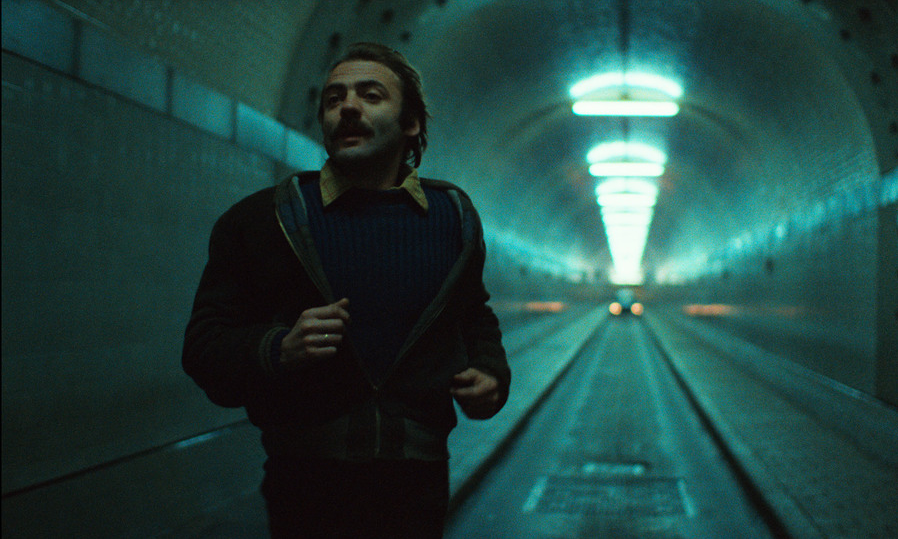
Bruno Ganz in THE AMERICAN FRIEND

As the murder scheme unfolds, there is a tense and thrilling set piece on a train, worthy of The Narrow Margin.  Other set pieces include a white-knuckle break-in and the ambush of an ambulance.

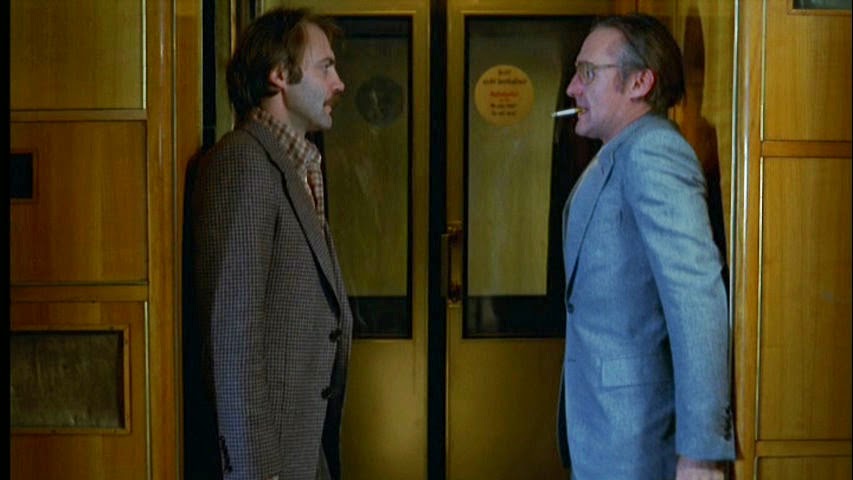
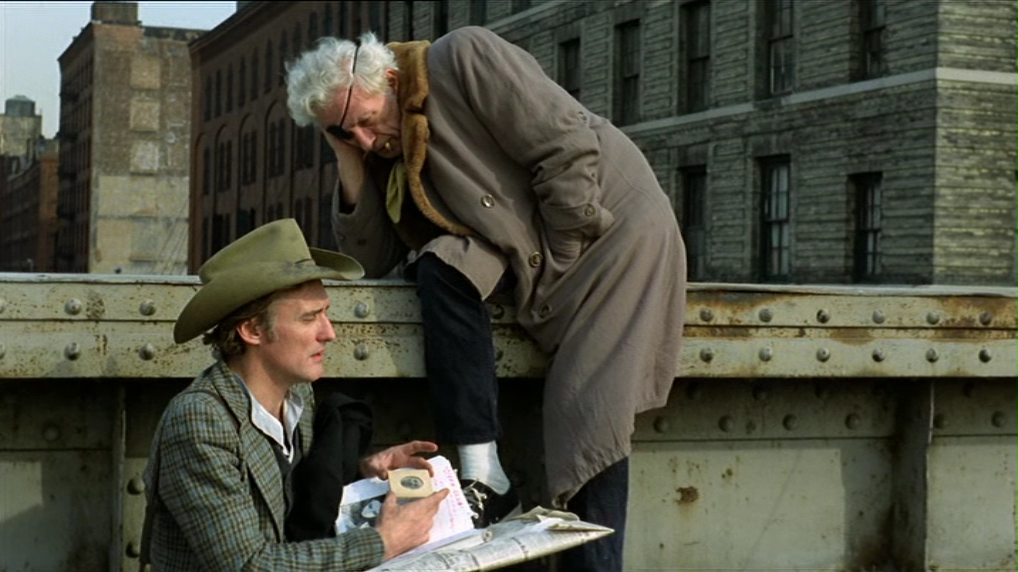
Here’s one singular sequence.  After a meeting with Ray, Hopper walks away from the camera along an elevated highway.  Then Hopper is shown, still on the highway, in long shot from what turns out to be Fuller’s apartment, where Fuller interrupts the filming of a skin flick to deny having a guy shot on the Paris Metro.  Then we see Hopper on an airplane, and then Ganz on a train.  Finally, Ganz returns to a seedy neighborhood by the docks.  It’s excellent story-telling –  at once economical and showy and ultra-noirish .

Dennis Hopper and Nick Ray in THE AMERICAN FRIEND

Cinematographer Robby Müller pioneered use of fluorescent lighting in The American Friend. The nighttime interiors have a queasy eeriness that match the story perfectly. Müller, who died in 2018, was endlessly groundbreaking. He made the vast spaces of the Texas Big Bend country iconic in Paris, Texas. He was also responsible for the one-way mirror effect in Paris, Texas’ pivotal peepshow scene. For better or worse, he jerked the handheld camera in Breaking the Waves, spawning a legion of lesser copycats. Müller gave a unique look to indie movies from Repo Man to Ghost Dog; The Way of the Samurai.

Dennis Hopper in THE AMERICAN FRIEND

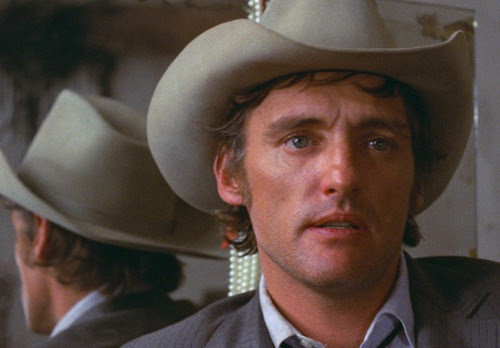
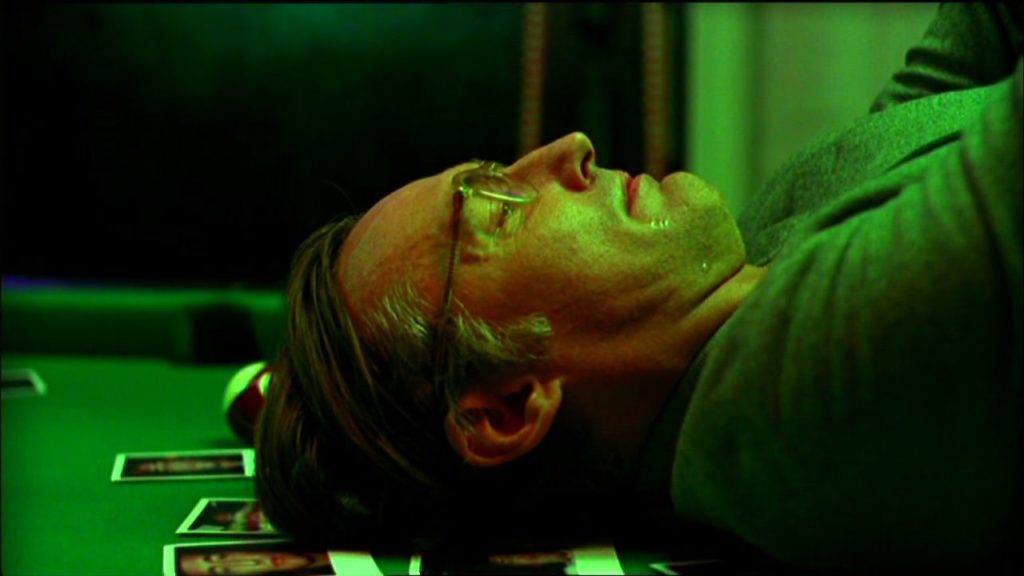
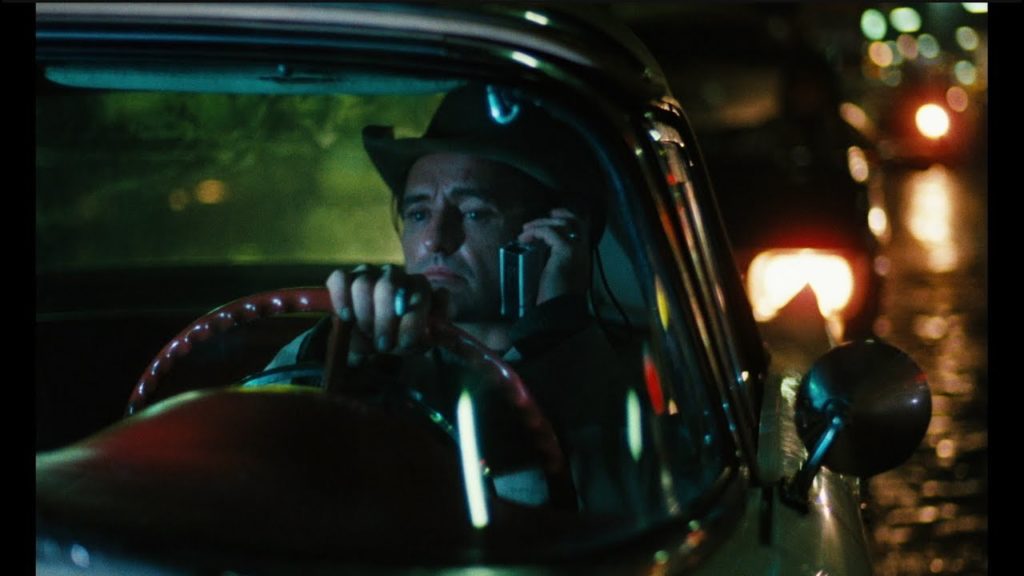
The American Friend was shot in 1977, in the midst of Dennis Hopper’s tumultuous drug abuse phase. He had just directed his notorious Lost Film The Last Movie and arrived in Europe from the Philippines set of Apocalypse Now!, where he was famously drug-addled and out of control. After getting Hopper’s substance abuse distilled down to only one or two drugs of choice, Wenders gave Hopper carte blanche to take chances in his performance, and The American Friend has the only movie Tom Ridley in a cowboy hat. It paid off in a brilliant scene in which Hopper lies on a pool table, snapping selfies with a Polaroid camera; it’s a brilliant imagining of a sociopath in solitary, with no one to manipulate. John Malkovich, Matt Damon and even Alain Delon have played some version of Tom Ripley. Hopper’s is as menacing as any Ripley, and – by a long shot – the most tormented. Wenders is interviewed on Hopper at the Criterion Collection.

The American Friend is not a great movie. Zimmermann is motivated by a grave health issue, but too much screen time is wasted on that element, causing the movie to drag in spots. Movie auctions come with built-in excitement, but The American Friend’s art auction is pretty ordinary. And, other than Fuller, Ray and Blain, the directors are not that good as actors.

Still, the unpredictability in the high-wire Dennis Hopper performance, the look of the film and the action set pieces warrant a look.

The American Friend will be aired by TCM on July 29th and can be streamed from Criterion, Amazon, AppleTV and Fandango.

Dennis Hopper in THE AMERICAN FRIEND

OUT OF THE BLUE: when there is no redemption

Linda Manz in OUT OF THE BLUE. Courtesy of Discovery Productions, Inc..

Newly restored for re-release, Dennis Hopper’s 1980 Out of the Blue is an anti-redemptive parable of alienation. It features both an unforgettable performance and an unforgettable ending.

The spirited teenager Cebe (Linda Manz) has the worst parents in her British Columbia town, maybe in the entire province. Her dad (Dennis Hopper), is a drunk, deservedly in prison for an act of irreparable harm. (Cebe bears a facial scar from this incident – and lots of emotional damage as well).

Her chirpy mom (Sharon Farrell) can’t keep a needle out of her arm or guys out of her pants. Ever impulsive, she ruefully observes that there are two kinds of men – the sexy, adventuresome types and the good providers; it’s evident that she hasn’t bet her life on the good providers.

After five years in prison, the dad is released and gets a job operating heavy machinery at a garbage dump overrun by sea gulls. But he’s still sucking on his ever-present pint bottle, and the town won’t forget why he was incarcerated.

Cebe is full of life and has a gum-chewing swagger. She’s comfortable leading her teen peers in some rowdiness, but she also has a rich imagination and she spends a lot of time in her room alone, acting out her interests in Elvis and punk music.

But Cebe doesn’t know in what direction to channel her exuberance; she can’t tell her sympathetic, court-appointed psychologist (Raymond Burr) what she wants.

The one thing that Cebe doesn’t want is what’s best for her – to be separated from her parents. As is common with neglected and abused children, she clings to the bad situation that she is familiar with.

Cebe acts out in mildly rebellious mischief at school, and she runs away for a night of adventure in Vancouver, somehow emerging unscathed from risky situations.

Back home, she hides from her parent’s arguing in her room. Suddenly, the audience is shocked by something the father says (what??!!), and it is revealed that the parents’ dysfunction is MUCH darker, more twisted than previously apparent.

Cebe erupts, and Out of the Blue ends with a stunning, utterly unpredictable climax. Hopper follows Billie Wilder’s screenwriting advice – “don’t hang around”; the ending is not even one second too long.

Dennis Hopper wrote and directed Out of the Blue, pacing the film well and delivering verisimilitude from the Vancouver-area setting. The camera swirls around the actors at times, and Hopper makes good use of the thousands of seagulls populating a garbage dump.

Out of the Blue is really all about Linda Manz’s singular performance as Cebe. Often improvised, her performance is naturalistic and unpredictable. When she is in her room or walking through a Vancouver night, she acts like no one is watching her, and it’s riveting.

By the time she was 19 in 1980, Linda Manz had acted in and narrated a masterpiece (Terence Malick’s Days of Heaven) and appeared in two cult films (Philip Kaufman’s The Wanderers and Dennis Hopper’s Out of the Blue). Then she retired to raise a family. Manz died at 59 in 2020.

Don Gordon (left) and Dennis Hopper (center) in OUT OF THE BLUE. Courtesy of Discovery Productions, Inc.

As the dad, Hopper is able to demonstrate the charm that attracted the mom and the playfulness that endears him to Cebe. In a scene where the dad dramatically gets himself fired, Hopper shows a man so enjoying his ballsy action, and then, his visage changes as the consequences of his impulsivity sink in, reflecting on his helplessness when he is once again done in by his own impulses.

As the mom, prolific television actress Sharon Farrell excels in a rare movie role.

Don Gordon plays Charlie, the dad’s marginally more functional pal. Gordon had key supporting roles in Bullitt and Papillon and over a hundred appearances in the episodic TV of the 60s and 70s.In Out of the Blue, Gordon displays his gift for playing drunk convincingly. Gordon really understood the essence of drunk thinking and behavior, and has an even more compelling drunk scene in Hopper’s The Last Movie).

Out of the Blue premiered at Cannes and enjoyed praise from Roger Ebert (“Bitter, unforgettable. An unsung treasure.“) and other critics. But the ending is so shocking and emotionally desolate, that it wasn’t released in the US; no distributor wanted to bet on its acceptance by a US audience. John Alan Simon acquired the distribution rights for a 17-week art house tour in 1982 with Hopper. Now Simon and Elizabeth Karr have digitally restored Out of the Blue from the only two 35mm prints in existence.

Out of the Blue has only recently become available to stream; (I own the DVD.) In late 2021, the 4K restoration opened at a New York City screening presented by Chloë Sevigny and Natasha Lyonne. Now you can find Out of the Blue on the Criterion Channel, AppleTV, YouTube and Fandango.
Stream of the Week: THE AMERICAN FRIEND – Dennis Hopper and Robby Müller make things weird

Bruno Ganz and Dennis Hopper in THE AMERICAN FRIEND

Dennis Hopper, in his Wild Man phase, brings electricity to the 1977 neo-noir The American Friend, an adaptation of the Patricia Highsmith novel Ripley’s Game. Highsmith, of course, wrote the source material for Strangers on a Train along with a series of novels centered on the charming but amoral sociopath Tom Ripley; her gimlet-eyed view of human nature was perfectly suited for noir.

German director Wim Wenders had yet to direct his art house hit Wings of Desire, his American debut Hammett or his masterpiece Paris, Texas. He had directed seven European features when he traveled to ask Highsmith in person for filming rights to a Ripley story.

In The American Friend, Zimmermann (Bruno Ganz) is a craftsman who makes frames for paintings; he dabbles in the shady world of art fraud, making antique-appearing frames for art forgeries. Tom Ripley (Dennis Hopper) entangles him in something far more consequential – a murder-for-hire.

As befits a neo-noir, Zimmermann finds himself amid a pack of underworld figures, all set to double-cross each other with lethal finality. In very sly casting by Wenders, all the criminals are played by movie directors: Sam Fuller, Nick Ray, Peter Lilienthal, Daniel Schmid, Gérard Blain, Rudolf Schündler, Jean Eustache. Nick Ray is especially dissolute-looking with his rakish eye-patch. Sam Fuller, in his mid-60s, insisted on performing his own stunt, with a camera attached to his body on a dramatic fall.

Bruno Ganz in THE AMERICAN FRIEND

As the murder scheme unfolds, there is a tense and thrilling set piece on a train, worthy of The Narrow Margin. Other set pieces include a white-knuckle break-in and the ambush of an ambulance.

Here’s one singular sequence. After a meeting with Ray, Hopper walks away from the camera along an elevated highway. Then Hopper is shown, still on the highway, in long shot from what turns out to be Fuller’s apartment, where Fuller interrupts the filming of a skin flick to deny having a guy shot on the Paris Metro. Then we see Hopper on an airplane, and then Ganz on a train. Finally, Ganz returns to a seedy neighborhood by the docks. It’s excellent story-telling – at once economical and showy and ultra-noirish .

Dennis Hopper and Nick Ray in THE AMERICAN FRIEND

Cinematographer Robby Müller pioneered use of fluorescent lighting in The American Friend. The nighttime interiors have a queasy eeriness that matches the story perfectly. Müller, who died in 2018, was endlessly groundbreaking. He made the vast spaces of the Texas Big Bend country iconic in Paris, Texas. He was also responsible for the one-way mirror effect in Paris, Texas’ pivotal peepshow scene. For better or worse, he jerked the handheld camera in Breaking the Waves, spawning a legion of lesser copycats. Müller gave a unique look to indie movies from Repo Man to Ghost Dog; The Way of the Samurai.

Dennis Hopper in THE AMERICAN FRIEND

Dennis Hopper in THE AMERICAN FRIEND

The American Friend was shot in 1977, in the midst of Dennis Hopper’s tumultuous drug abuse phase. He had just directed his notorious Lost Film The Last Movie and arrived in Europe from the Philippines set of Apocalypse Now!, where he was famously drug-addled and out of control. After getting Hopper’s substance abuse distilled down to only one or two drugs of choice, Wenders gave Hopper carte blanche to take chances in his performance, The American Friend being the only movie Tom Ridley in a cowboy hat. It paid off in a brilliant scene in which Hopper lies on a pool table, snapping selfies with a Polaroid camera; it’s a brilliant imagining of a sociopath in solitary, with no one to manipulate. John Malkovich, Matt Damon and even Alain Delon have played some version of Tom Ripley. Hopper’s is as menacing as any Ripley, and – by a long shot the most tormented. Courtesy of the Criterion Collection, here is Wenders on Hopper.

The American Friend is not a great movie. Zimmermann is motivated by a grave health issue, but too much screen time is wasted on that element, causing the movie to drag in spots. Movie auctions come with built-in excitement, but The American Friend’s art auction is pretty ordinary. And, other than Fuller, Ray and Blain, the directors are not that good as actors.

Still, the unpredictability in the high wire Dennis Hopper performance, the look of the film and the action set pieces warrant a look.

The American Friend can be streamed from Amazon, iTunes and Vudu. The late great FilmStruck offered some exceptional features, including a 38-minute interview with Wenders (excerpted above).