BLITZ: one brave, resourceful kid amid the horrors

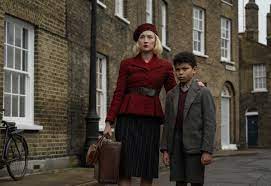
Photo caption: Saiorse Ronan and Elliott Heffernan in BLITZ. Courtesy of AppleTV.

In the WW II drama Blitz, Rita (Saiorse Ronan) is a single mom who, like all Londoners, must endure The Blitz, the 8-month German terror bombing of civilian London. Over a million English city-dwellers were evacuated to the countryside, and half of them were children. Rita’s own nine-year-old son George (Elliott Heffernan) is set to be sent to safety while she remains at her job in a munitions factory.

This plan angers George, and he bolts, running amok through London. His adventures, and Rita’s terrified search for him when she finds him missing, make up the core of Blitz. It is a child-in-peril story, but not one where the adult protagonist rescues the child. Rita may be played by a big movie star, but this is George’s story and a portrait of his determination and resourcefulness.

George is multi-racial, which is hard to be in 1940 England, where he looks different that just about everyone else. As he runs a gauntlet of racist attitudes, it’s a huge relief whenever George encounters someone with even minimal kindness.
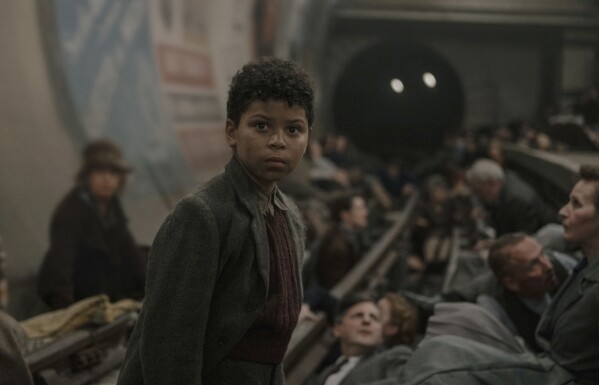
Elliott Heffernan in BLITZ. Courtesy of AppleTV.

Writer-director Steve McQueen’s biggest achievement in Blitz is to tell this story so compellingly from the child’s point of view. Sometimes George isn’t scared when he should be, and sometimes he is overwhelmed by a situation any adult could handle. McQueen certainly found the right actor to play George in Heffernan, who captures George’s vulnerabilities as well as his underlying reservoir of tenacity.

McQueen also pulls off a well-paced thriller and makes the audience feel the historical context. We’ve all seen depictions of The Blitz with the air raid sirens, blackout wardens and plucky Brits sheltering in the Underground and emerging to see the rubble, carnage and fire. But not like this. McQueen’s Blitz is vivid, uncomfortable and terrifying.

There is a spectacular scene at a ritzy hotel’s nightclub, complete with a Cab Calloway-like band and an extra-long tracking shot through the kitchen, an homage to Martin Scorsese’s famous Copacabana shot in Goodfellas. I understand that McQueen would argue that this scene sets up a brief moment later in the film, but it really isn’t necessary and McQueen is just showing off his skills (and AppleTV’s budget). It’s fun, though.

What McQueen fails to deliver, though, is multi-dimensional characters (with the exception of George). Pretty much every non-George character is just one thing – officious, bigoted, evil or saintly.

The is, however, more than a glimmer of texture in a performance by one of my favorite actors, Stephen Graham, who often plays a troubled cop or a criminal psycho in British crime shows like Line of Duty and Little Boy Blue. Graham has a small role as a depraved gang leader, and he makes the character despicable and unhinged and scary and damaged. Graham has worked in US films, too, as an Italian-American mobster in Martin Scorsese’s The Irishman, Scrum in the Pirates of the Caribbean franchise, Al Capone in Boardwalk Empire and Baby Face Nelson in Michael Mann’s Public Enemies.

Blitz is a fine adventure yarn, evocative history and a visually impressive film. Blitz is now streaming on AppleTV.
THE SETTLERS: reckoning with the ugly past

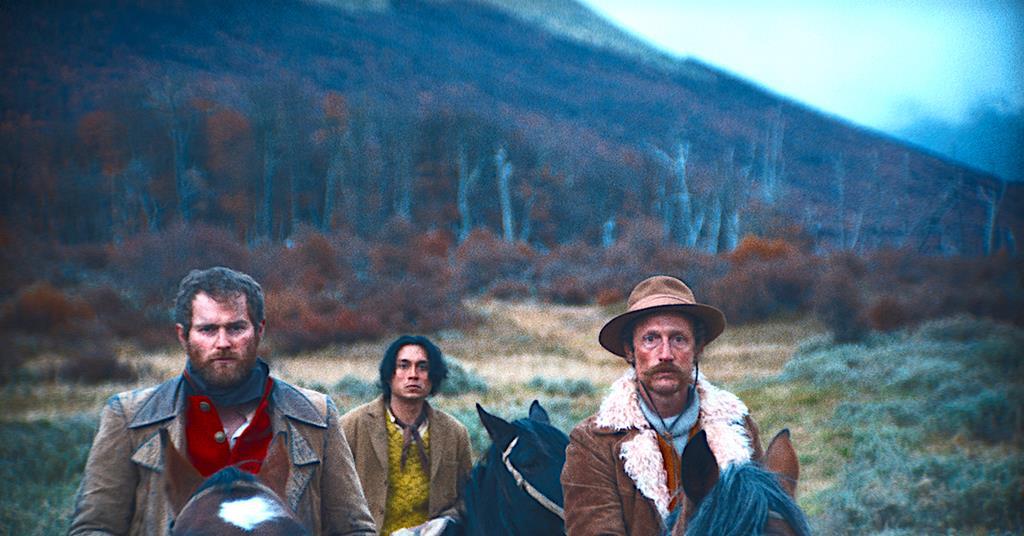
Photo caption: Mark Stanley, Camilo Arancibilia and Benjamin Westfall in THE SETTLERS.  Courtesy of MUBI.

The grimly beautiful Chilean drama The Settlers takes us to Tierra del Fuego in 1901 where Spanish tycoon Jose Menendez (Alfredo Castro) is setting up a massive sheep ranch on 250,000 acres that spans across both Chile and Argentina. Menendez assigns his foreman, a ruthless Scot former soldier, Alexander MacLennan (Mark Stanley), to clear out the indigenous residents, who are inconveniently eating some of the sheep. Melendez makes it clear to MacLennan that he wants the indigenous people exterminated. Melendez and MacLennan are real historical figures, and these events are known as the Selk’nam Genocide.

MacLennan is assigned Bill (Benjamin Westfall), an American veteran of Indian conflicts. He also brings along the half-indigenous local man Segundo (Camilo Arancibilia). Neither MacLennan or Bill sees any humanity in the indigenous, and go about their work as if they were eradicating household pests. It’s pretty awful. There is some on-screen gore, but we experience most of the horror through the reaction of Segundo.

The Settlers jumps ahead almost a decade to explore the impact of the events on some of the key characters and their loved ones. There has to be a reckoning, after all, even if it can’t be fully satisfying.

Sobering as it is, The Settlers is remarkably fine cinema, and is an impressive debut feature for director Felipe Galvez Haberle. The matter-of-fact brutality is almost dwarfed by the stark, vast expanses of Patagonia. Some of the landscape shots by cinematographer Simone D’Arcangelo (The Tale of King Crab) are absolutely breathtaking. The unsettling story is enhanced by a soundtrack reminiscent, but not derivative of, Ennio Morricone’s spaghetti western scores.

First time actress Mishell Guana is very powerful as an indigenous woman. Sam Spruell colorfully brings alive a rogue British colonel (think Kurz in Apocalypse Now!).

The Settlers played in the Un Certain Regard program at Cannes, winning the FIPRESCI prize, and has won awards at a slew of other international film festivals. The Settlers is streaming on MUBI.

CARVILLE: WINNING IS EVERYTHING, STUPID!: rascal truth-teller

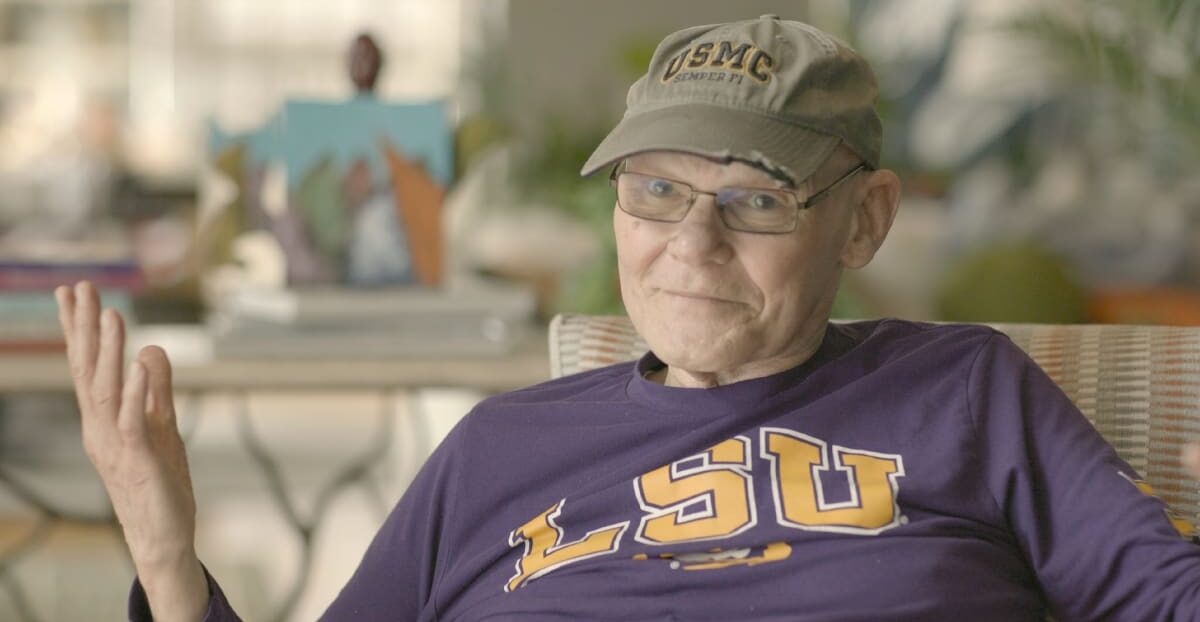
Photo caption: James Carville in CARVILLE: WINNING IS EVERYTHING, STUPID!. Courtesy of CNN Films.

The CNN documentary Carville: Winning Is Everything, Stupid! brings insight into the colorful political consultant James Carville, today’s political environment and the example of his long-surviving marriage to another strong willed professional.

Carville is known as a strategic genius and earthy communicator, but the documentaryremonds us that he was an unaccomplished Baton Rouge lawyer who hadn’t won his first major election campaign until he was age 42. Then after producing some surprise US Senate victories, at 48, he created his masterpiece – the nine lives of the oft-doomed Bill Clinton presidential campaign. Just this much is a helluva story.

But Carville, who grew up poor, watching his single mother hustle for a living, selling encyclopedias door-to-door, has always appreciated the need to get people’s attention first. That’s why he is a grinning provocateur, unafraid to offend to make his point. And you will probably be offended by something he says in Carville: Winning Is Everything, Stupid!, especially when he argues that the Democratic Party can’t be too woke to win a national election; “Screw the ARGUMENT, win the ELECTION!’. Carville was ahead of the curve in recognizing that Democratic Party needed to dump Joe Biden in 2024, and he’s comfortable in the role of truth-teller (as he sees the truth).

Carville can be dead serious about politics without taking himself seriously. Sadly, his joie de vivre has become rare in today’s toxic political environment. That’s why his rascal persona is so refreshing.

Of course, Carville is half of a celebrity marriage to Republican political strategist Mary Matalin, and she is a major part of Carville: Winning Is Everything, Stupid! Matalin, as tough as nails and intolerant of bullshit, is the perfect foil for the blustering Carville. They share the tough episode when Matalin was back working in a GOP White House during Bush’s war in Iraq, which Carville bitterly opposed. Matalin comes off as very genuine and very wise about relationships.

I watched Carville: Winning Is Everything, Stupid! in its premiere on CNN. It is now in theaters.

KNEECAP: sláinte!

Photo caption: Mo Chara, DJ Próvai and Móglaí Bap and in KNEECAP. Courtesy of Sony Pictures Classics.

In the raucous comedy Kneecap, a trio of Belfast slackers get busted for spraying some pro-republican graffiti, and, in the police station, resist by refusing to speak anything but the Irish language. When the frustrated anti-republican constabulary kick them loose, the guys form a hip-hop group that raps in Gaelic, with the provocative name Kneecap. Amazingly enough, this is the actual origin story of the real band Kneecap, whose members (Mo Chara, Móglaí Bap and DJ Próvai) play themselves in this film.

While Kneecap is about promoting Irish nationalism by embracing the Irish language, it has the tone of Roadrunner versus Wiley Coyote. Plenty of comic situations arise as our three rascals play a frenetic cat-and-mouse with the humorless and repressive cops. Adding a layer of complication to their new local notoriety, the father of one of the band members has faked his death to hide from both the cops and the IRA. The father is played by German-born but Irish actor Michael Fassbinder, he of the two Oscar nominations, who has somehow found himself in this goofy little movie.

You won’t see a more energetic movie this year. Kneecap is the first narrative feature for director and co-wrier Rich Peppiatt, and he is responsible for the zesty pace, even throwing animation and camera effects into his spicy movie, and he’s pulled it off with some first-time screen actors.

Kneecap is a good choice for those especially interested in Ireland, or for those in the mood for some harmless bawdy fun. Mid-movie, The Wife said “at this point, it’s gonna become predictable”, but then she was pleasantly surprised.

For serious dramas about Irish nationalism in Northern Ireland, see my Best Films about The Troubles (Northern Ireland).

Kneecap, which won the audience award in Sundance’s NEXT section, is now streaming on Amazon and AppleTV.

WICKED LITTLE LETTERS: a sparkling Jessie Buckley and an interesting take on repression

Photo caption: Jessie Buckley in WICKED LITTLE LETTERS. Courtesy of Sony Pictures Classics.

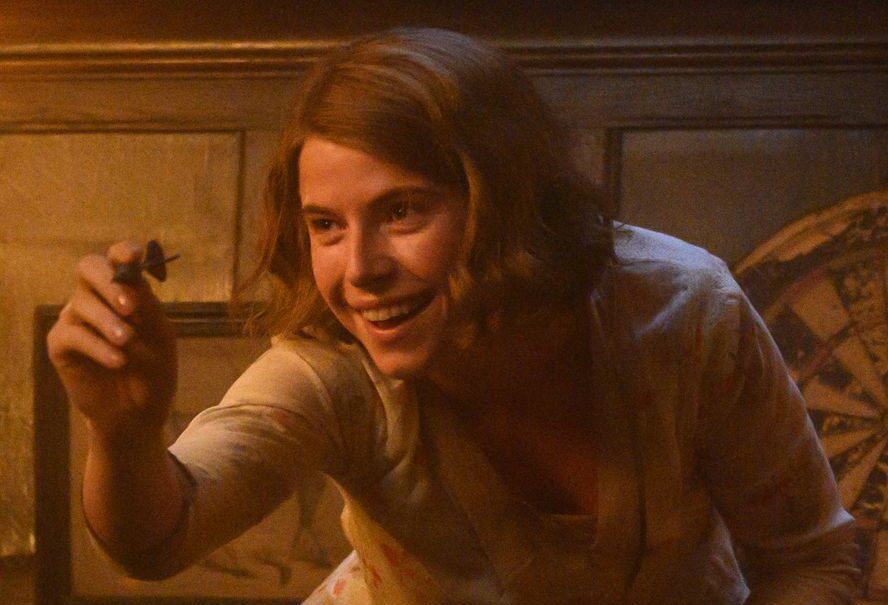
Jessie Buckley sparkles in the comedy Wicked Little Letters, about a contretemps between English neighbors that erupted into scandal. It’s 1920, and, though although no longer technically in the Victorian (or even Edwardian ) Period, Victorian social mores prevailed, and the stuffiness, repression and classism make easy targets for Wicked Little Letters.

Buckley plays Rose, a vibrant single mom who may or may not be a war widow. Foul-mouthed and a joyous carouser, Rose is decidedly tot adhering to the social and sexual mores of the time. Her ultrareligious and ridiculously proper neighbor Edith, (Olivia Colman) on the other hand, could be a poster girl for devout virginity; Edith lives under the tyranny of her father Edward (Timothy Spall), a bullying, racist, patriarchal prig.

The two women start out friendly, but inevitably fall out. Edith is shocked to received a series of profane, obscene and vituperative letters. Edward brings in the police, and soon Rose is on trial for sending the letters, although she denies it. What will happen to Rose? Who really sent the poison pen letters? Wicked Little Letters‘ story closely follows a true story, which you can read about if you Google “Littlehamption Letters Scandal“.

Here’s the most interesting aspect of Wicked Little Letters. We are used to watching people who are sexually and/or socially repressed acting out perversely (see the TV preacher or right wing politician scandal du jour). But here, we have someone who is so angry about BEING repressed, that the perverse behavior comes out of her rage.

This really isn’t much of whodunit, because the authorities, blinded by their own stupidity and classism, and ignorant of forensic tools like handwriting analysis (not to mention the scientific method), keep missing the obvious solution. A fictional young female cop (Anjana Vasan) is the stand-in for the 21st century audience and can see what her superiors miss. Once it’s revealed who is really sending the letters, Wicked Little Letters finishes a little too slowly.

But we get to enjoy a charismatic performance by Jessie Buckley, deploying a deliciously crooked grin as she brings a devil-may-care woman to life. Buckley is so good as troubled characters (Beast, Wild Rose, The Lost Daughter, Women Talking), and it’s great to see her letting loose as a fun-loving character.

Olivia Colman, of course, is superb as Edith, a woman who is not nealy as one-dimensional as she first appears. The great actor Timothy Spall (who has lost a reported 100 pounds over the past several years) has fun with a character who has no nuance whatsoever, unless you count varying shades of bigotry and entitlement.

I caught Wicked Little Letters very late in its its theatrical run and I expect that it will be leaving theaters soon; I’ll let you know when it is available to watch at home.

THE ZONE OF INTEREST: next door to the unthinkable

Photo caption: Sandra Huller in THE ZONE OF INTEREST. Courtesy of A24.

Jonathan Glazer’s The Zone of Interest is an exceptionally original and well made, intentionally unsettling and, ultimately, unnecessary film.

We first meet Hedwig (the great Sandra Huller), Rudolph (Christian Friedel) and their five children in 1943 on an idyllic riverside picnic in the woods.  They return to their spacious villa and put the kids to bed (Hedwig firmly and Rudolph gently).  When Hedwig and Rudolph are in bed themselves, they ignore what sounds like shouting and the barking of guard dogs nearby.  

The next morning we see that Rudolph is the commandant of Auschwitz and the family home is LITERALLY next door to the walls.  Hedwig, like any hausfrau, hangs laundered sheets to dry, while her groceries are delivered by death camp slave labor. 

As the family’s domestic life goes on, the soundtrack slowly becomes louder and includes more shots, screams and the drone of industrial extermination.  We see more of the skyline, with smokestacks spewing fire and ash.

Glazer slips in little matter-of-fact horrors like perverse Easter Eggs. Hedwig brags to her gal pals about furs and other luxuries she has stolen from dead Jews. Hedwig seems meaner than Rudolph and coldly utters what must be the most terrifying threat ever made to a maid.

Having married a guy who has risen to be a big boss, Hedwig is living her best life, with servants and plenty of perks, like Italian spa vacations.  She has the very disturbing capacity to shut out the hellish enterprise over her back fence, replete with the sounds, smells and images of workaday genocide. Glazer has made a Holocaust film without any images from inside the death camp; the Holocaust is just kind of leaking over the fence.

The Martin Amis novel that Glazer adapted into the screenplay did not name the commandant and his wife, but Glazer uses the names of the actual historical figures: the real Rudolph and Hedwig Hoss.  When one reads about the real Hoss, you can see the care with which Glazer depicts him, down to his distinctive haircut, the kids’ names and Hedwig’s dream of spacious gardens (She’s the true believer in lebensraum.)

Rudolph is not a hate-spewing frothing maniac, more of a Company Man go-getter.  One can imagine a 1960s version of Rudolph driving to surpass this quarter’s IBM sales goal. Yet, this is the man who admitted to murdering 2.5 million people; the other million, he said, died of disease and starvation.

The Zone of Interest is an extraordinary illustration of the banality of evil. But why do we need it?  Hannah Arendt’s recognition that Hitler’s mad horrors were not carried out by monsters, but by the ordinary and mediocre, has been generally accepted for decades. If Hitler were obsessed with dairy production or ceramic art, thousands of workaday Nazis would have been content to do just that, instead.  The logical conclusion is that the Holocaust doesn’t need a maniac to happen again, just millions of people who obey the maniac. After all, it was ordinary-looking American companies that vied for Trump Administration contracts to put migrant babies in cages, not some survivalist militia.

It’s a familiar truism, and, to my sensibilities, not worth the unpleasantness of sitting watching these unpleasant people and their unthinkable deeds. That being said, this is anything but a slog. The Zone of Interest is captivating throughout (not unlike a vehicular crash).

This is only Glazer’s fourth feature in 24 years: Sexy Beast (2000), Birth (2004), Under the Skin (2013).

The Zone of Interest has been nominated for multiple Oscars, including Best Picture.

THE BOYS IN THE BOAT: the underdogs soar

Photo caption: Callum Turner (center front) in THE BOYS IN THE BOAT. Courtesy of MGM.

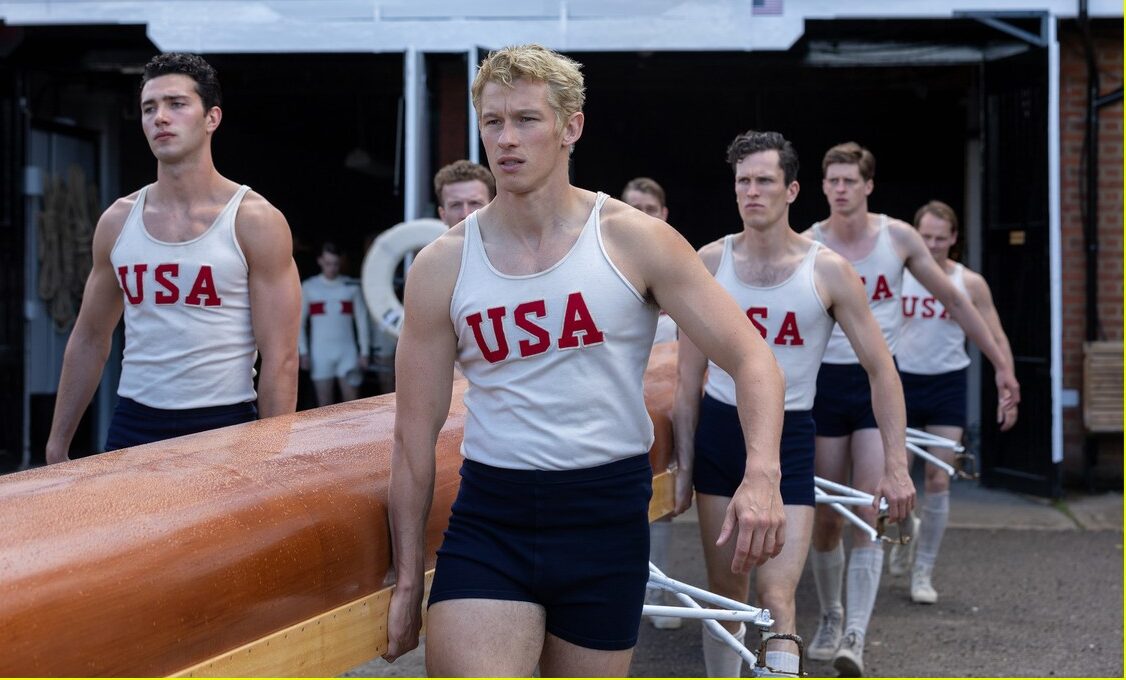
The Boys in the Boat is the entertaining true story of the ultimate sports underdog – the University of Washington’s junior varsity rowing team, which won gold medals at the 1936 Olympics hosted by Hitler in Munich (the Jesse Owens Olympics). Again, this was UDub’s JUNIOR varsity boat.

The Boys in the Boat follows a familiar arc for sports movies – the heroes must win the Big Race (actually, three Big Races here). We’ve all seen this before, but director George Clooney gets the credit for keeping The Boys in the Boat from becoming unbearably hackneyed or corny. Best known as a movie star, Clooney has proven himself an able director: Confessions of a Dangerous Mind, Good Night and Good Luck, The Ides of March, The Monuments Men.

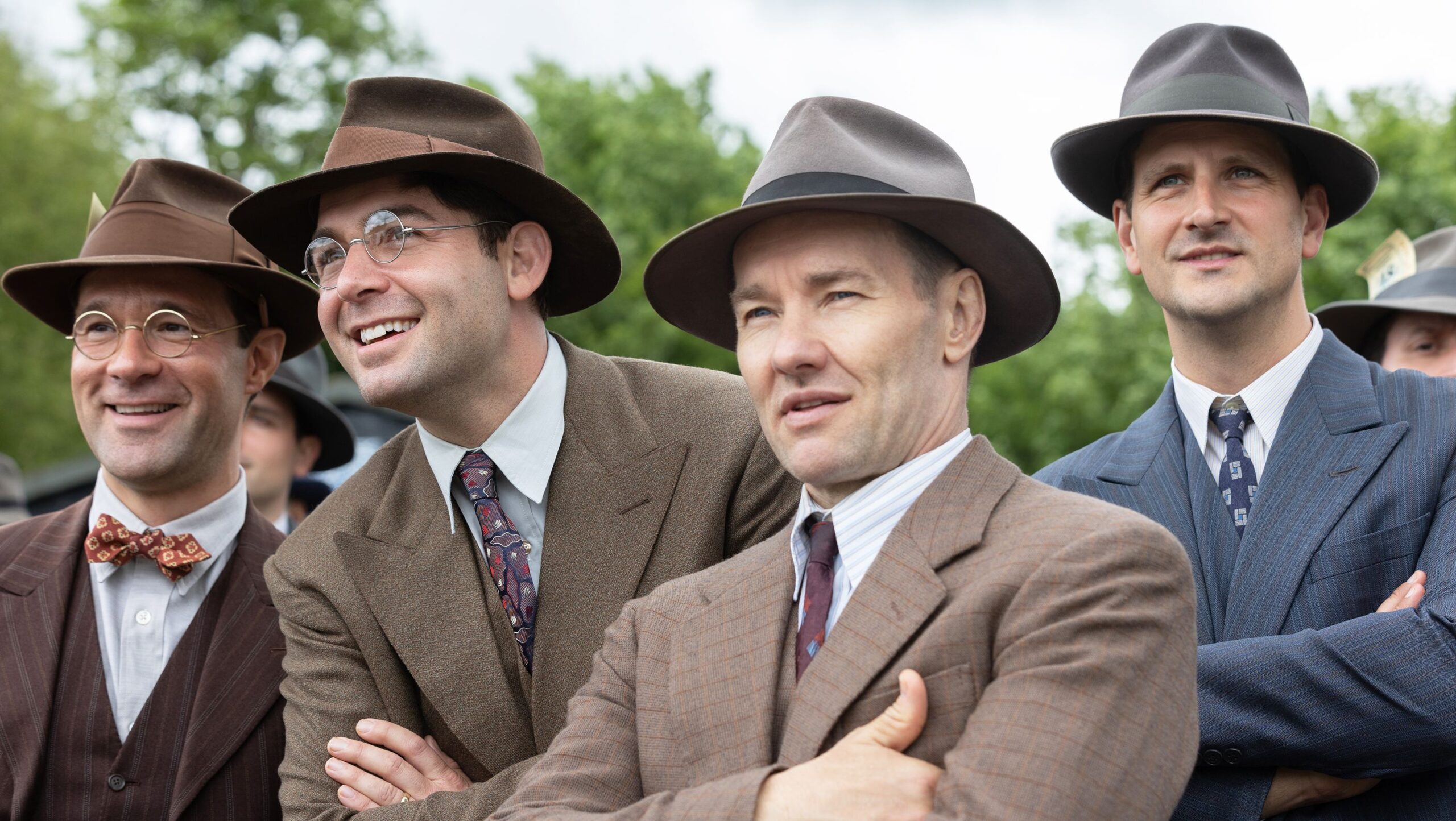
In telling the story, Clooney emphasizes the Depression setting and how impoverished the kids on the team are, especially the main kid, played by Callum Turner. Joel Edgerton plays the taciturn coach, who must gamble his job on an unconventional decision. Few of us have a deep understanding of the sport of team rowing, so Clooney takes us on a rowing procedural.

Joel Edgerton (second from right) in THE BOYS IN THE BOAT. Courtesy of MGM.

I love Edgerton in everything, and he’s starred in Master Gardener, Loving and Zero Dark Thirty. I especially recommend watching him in The Gift, which he also wrote an directed. Edgerton is very, very good here.

Callum Turner is adequate, but Luke Slattery and Jack Mulhern are especially vivid as his two of his teammates.

This story is still celebrated in Seattle, where you can still visit the boathouse and see the team’s memorabilia. One race is staged in the Montlake Cut between Lake Washington and Puget Sound. The coolest race scene has an observation train, with bleachers on the rail cars, keeping pace with the boats racing down the Hudson River.

The Boys in the Boat ain’t the most original film, but it’s enjoyable to watch.

RUSTIN: greatness, overlooked

Photo caption: Colman Domingo in RUSTIN. Courtesy of Netflix.

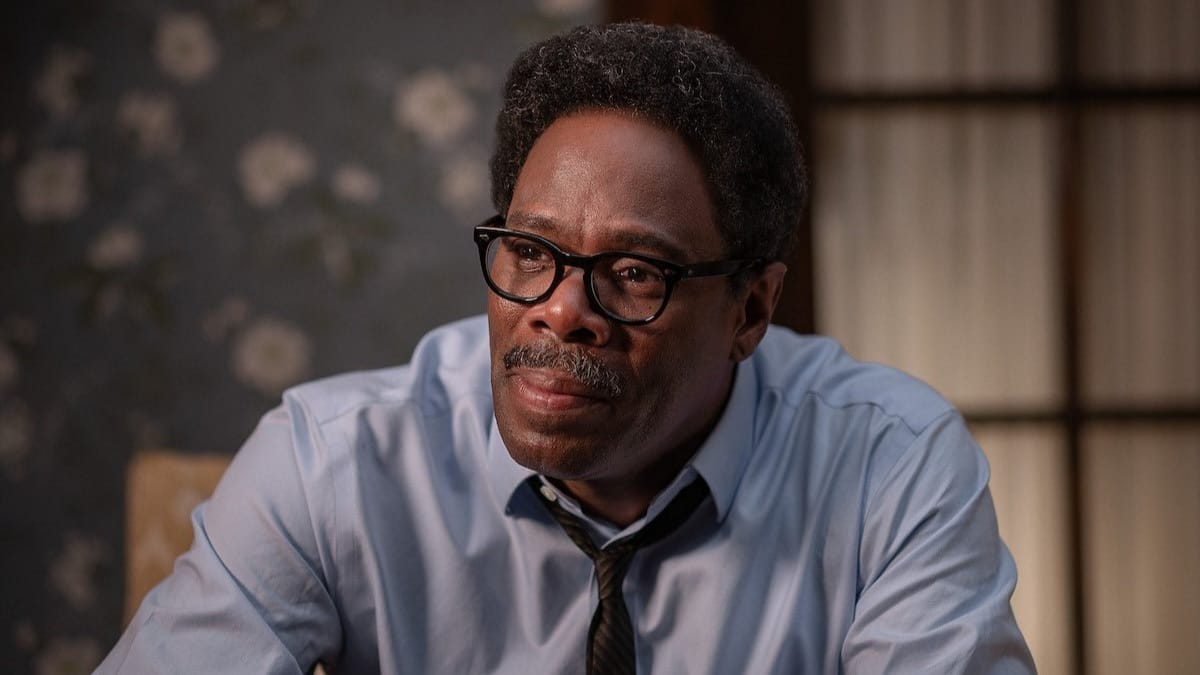
We all know of the March on Washington, culminating in Dr. Martin Luther King’s I Have a Dream speech, delivered on the steps of the Lincoln Memorial before 250,000 people filling the National Mall. It’s one of the most iconic and important moments in American history. Rustin introduces many folks to the overlooked greatness of Bayard Rustin (Colan Domingo), the organizer of the event.

Bayard Rustin was an important civil rights leader who was relegated to the background of the movement, and sometimes even ostracized, because he was a gay man. In the 1950s and 1960s, being a former Communist didn’t help, either.

Rustin’s mentor A. Philip Randolph (played in Rustin by Glynn Turman) is the other most overlooked male civil rights leader. Randolph’s two greatest accomplishments, the integration of the military and of the defense industries, occurred before television (and were filtered by the white mainstream print media). A personal note from The Movie Gourmet: my decades-long career has been in politics, and one of my very first political day jobs was funded by the A. Philip Randolph Institute. Here is more on Randolph and Rustin from the APRI website.

Rustin takes us behind the scenes, and we see the strategic disagreements, petty jealousies and jockeying for status between civil rights leaders. It’s important that the leaders came from generational strata. In 1963, Randolph was 74. Rustin was 52. NAACP head Roy Wilkins was 61, and Harlem Congressman Adam Clayton Powell was 55, both at the peaks of their careers. MLK was a rising superstar, but still only 34. John Lewis was still only 23.

In birthing the March on Washington, Rustin was fighting the overt attacks of J. Edgar Hoover and Strom Thurmond and the covert obstructionism of Attorney General Bobby Kennedy. Rustin also had the contend with the antagonism of Wilkins and Powell. But, Rustin had two cards to play – the respect demanded by Randolph and the rock star sizzle of MLK.

In a stellar, commanding performance, Colman Domingo is charismatic as Rustin. Domingo has been so good in everything I’ve seen him in: Ma Rainey’s Black Bottom, Zola, Selma and Lincoln. Glynn Turman brings gravitas and moral authority to Randolph. In ingenious, against-type casting, Chris Rock is excellent as the funny-as-a-heart-attack Roy Wilkins. Jeffrey Wright PERFECTLY captures Adam Clayton Powell.

Ami Ameen has the challenge of satisfying audience expectation in portraying MLK. He gets the speech patterns and mannerisms right, while inhabiting a still-young MLK growing into the leader he was just becoming.

If you want to learn more of Bayard Rustin, I recommend Matt Wolf’s award-winning, but hard to find, short doc Bayard & Me, which features Rustin’s longtime partner Walter Neagle’s recollection of his life with Rustin; it’s an important insight into both Civil Rights and LGBTQ history.

Rustin was directed by George C. Wolfe, whose previous feature, Ma Rainey’s Black Bottom, was my #2 movie of 2021. We need to see more movies from this guy.

Rustin is now streaming on Netflix.

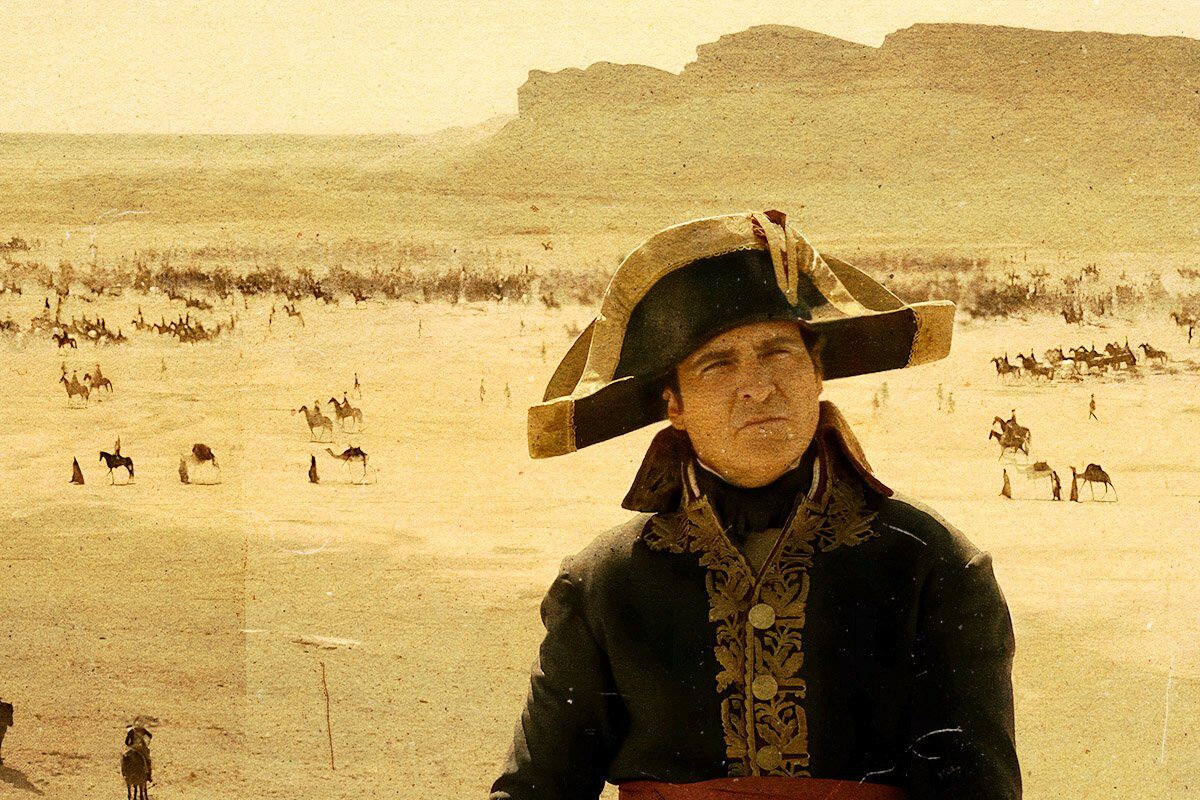
NAPOLEON: but didn’t they name a complex after this guy?

Photo caption: Joaquin Phoenix in NAPOLEON. Courtesy of AppleTV.

Of all living filmmakers, Ridley Scott would seem the most well-equipped to pull off a boundless EPIC, but his Napoleon, other than three spectacular battle scenes and a little sex, is boring, underwhelming and a little confounding. As The Wife said exiting the theater, it’s a slog, and she wasn’t referring to the winter retreat from Moscow.

For better or worse, Napoleon covers Napoleon Bonaparte’s entire public career – from his emergence in 1793 at age 24 to the beginning of his final captivity on St. Helena in 1815 at the age of 46. It’s kinda like a college survey course in the Napoleonic Era. Napoleon’s historical accuracy is solid, and, for a Hollywood movie, remarkably unusual.

Even with a running time of 2 hours and 38 minutes, there’s a lot of ground to cover. He did fight 61 battles, and it took the SEVENTH Coalition of opposing nations to defeat him. So, we get the briefest of glimpses of Napoleon’s mother, his second wife and other major figures in his life and times.

Here’s what is great about Napoleon – three extraordinarily spectacular battle scenes, depicting the Siege of Toulon, and the famous Battles of Austerlitz and Waterloo. They are amazing to watch, and the first two help us to understand Napoleon’s military genius (and the third, Wellington’s military genius). A segment of Austerlitz where Napoleon orders cannon fire to break the ice under enemy forces is one of greatest and most unforgettable battle scenes in cinema history.

Napoleon also does a pretty fair job with the the relationship between Napoleon (Joaquin Phoenix) and his first wife Josephine (Vanessa Kirby). It was a very uncomplicated one: he was utterly captivated by and devoted to her, and she just wasn’t that IN to him. Josephine was a survivor and an adventuress, who navigated through her misogynistic environment with a gift for canny manipulation. He finds that even making her an empress isn’t enough to quell her promiscuity. Phoenix and Kirby do a good job with this part of the story.

But, oddly for a biopic, Napoleon fails to help us understand Napoleon. Sure, he’s ambitious from the start, but why? And why does he need to keep conquering, at the risk of overreaching and losing everything? After all, didn’t they name a complex after this guy?

Joaquin Phoenix was so vivid as Johnny Cash in Walk the Line, as Commodus in Gladiator, and as Freddie in The Master; he was so original and authentic in Her and C’mon C’mon. But, in Napoleon, his performance doesn’t unwrap the package of Napoleon’s psyche. I can’t say it’s Phoenix’a fault, but the collaboration between Phoenix, Scott and screenwriter David Scarpa doesn’t pay off.

Scott does point out in an end title that 3 million lost their lives during the Napoleonic Wars, which raises the question, to what end? This guy with an insatiable appetite for power and conquest was starting wars with some twits who had been born into underserved monarchy.

Here’s a random digression from the movie Napoleon. Was Napoleon’s military prowess overrated? This is ironic, because Napoleon rose on his merits. But the forces he was defeating were led by royalty and aristocrats, who were given command of armies, not by their own training and demonstrated skills, but by the accident of birth. Alexander I of Russia, for example, started out as an immature, headstrong nitwit and aged into a fullblown nutcase. Maybe Napoleon was analogous to MLB Hall of Famers who never had to face black ballplayers. Hmmm.

Napoleon is now in theaters, and will stream on AppleTV on a date TBD.

THE LADY BIRD DIARIES: essential history

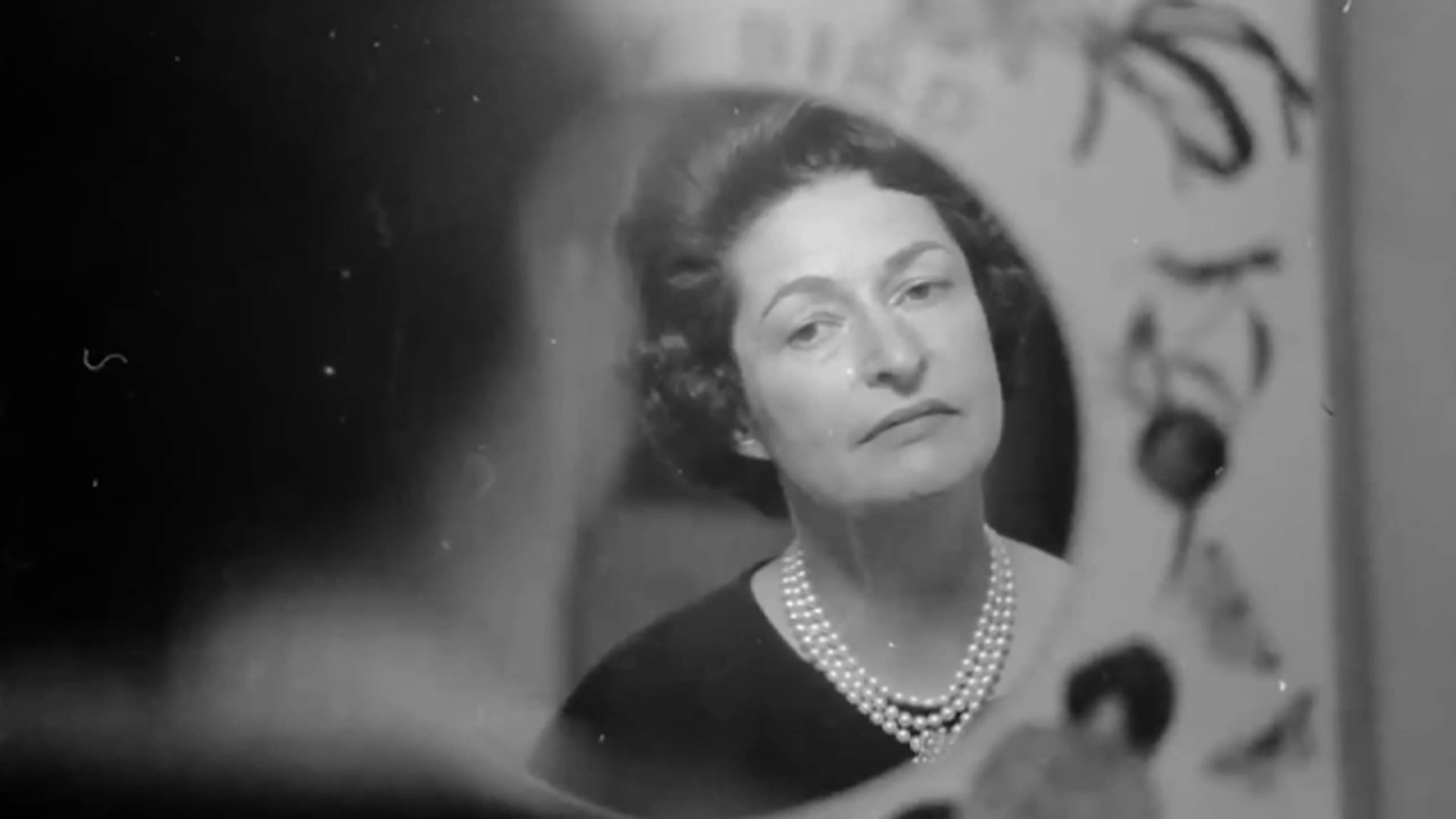
Photo caption: Lady Bird Johnson in THE LADY BIRD DIARIES. Courtesy of Hulu.

For students of 29th Century American political history, The Lady Bird Diaries is essential. In her time as First Lady, Lady Bird Johnson audio-recorded her candid observations of some of the nation’s most dynamic and turbulent years. The 123 hours of those recordings, now released after her death, have been excerpted into the core of this singular documentary.

We hear Lady Bird’s unique point of view on the JFK assassination, LBJ’s battles with depression, the infamous White House luncheon Eartha Kitt incident and RFK. And, after all, she was living in the White House with LBJ through his Civil Rights triumphs and the morass of Vietnam. LBJ’s presidency was so jampacked, we get the tiniest mention of Medicare (Oh, yeah, THAT was LBJ, too).

Lady Bird’s first-person perspective would be valuable enough in a written document, but hearing her actual voice brings even deeper insights into the events, LBJ and Lady Bird herself.

Indeed, The Lady Bird Diaries Lady Bird’s own voice is almost the entire film, annotated only by director Dawn Porter’s exceptional use of explanatory titles, archive clips and photos. Porter’s use of images is as brilliant as I’ve seen in a doc.

Lady Bird’s narration, combined with recorded phone calls between the Johnsons, makes clear Lady Bird’s involvement in her husband’s career. She gave him advice on matters both tactical, critiquing his speeches, and strategic (including whether to seek re-election). LBJ was notoriously thin-skinned, came closest to welcoming criticism only from Lady Bird. One of the most sharp and insightful segments is a disagreement between the Johnsons on how to handle the Walter Jenkins scandal (LBJ’s chief of staff caught in a homosexual haunt) days before the 1964 presidential election. Clearly, Lady Bird was determined to give LBJ her best thinking, whether he wanted it or not.

The Lady Bird Diaries also reminds us of:

  • Lady Bird’s groundbreaking work on the environment, then known as the “beautification” campaign.
  • Her gameness to campaign in a 1964 whistlestop tour through the South, facing down White voters howling about LBJ’s Civil Rights Act of 1964.
  • The toll on the Johnsons from the the unrelenting public scorn about Vietnam.

This is fantastic history and an extraordinary film. The Lady Bird Diaries is streaming on Hulu.