
I USED TO BE FUNNY: PTSD is no joke

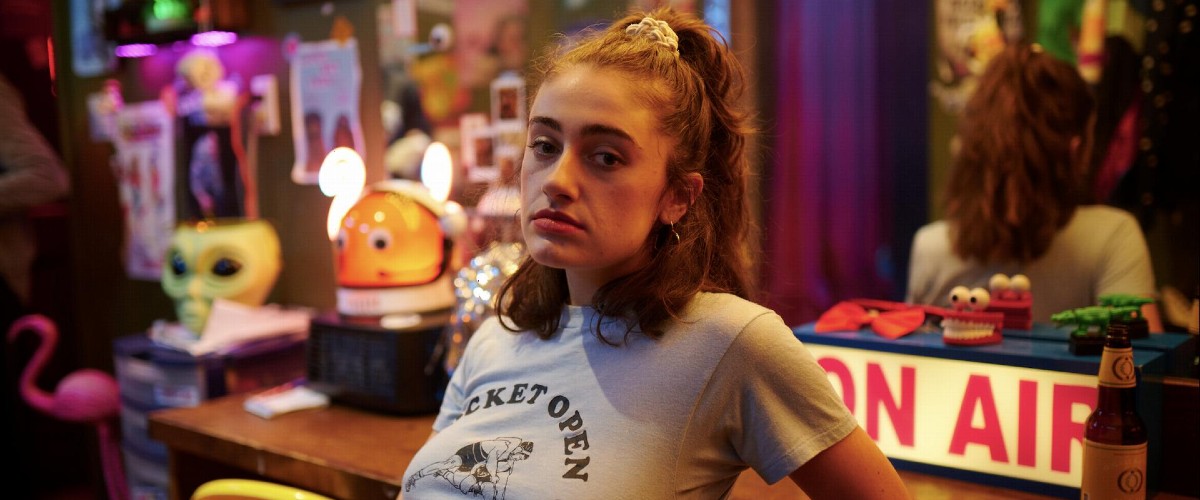
Photo caption: Rachel Sennott in I USED TO BE FUNNY. Courtesy of Utopia.

In the Canadian indie I Used to Be Funny, Sam is a standup comedian (played by Rachel Sennott, a real life standup comedian). Sam has been suffering the effects of PTSD for a year, and is existing with the kindness of her two comedian roommates. She’s been unable to work, write or leave the house, and it’s a major achievement to take a shower.

Through flashbacks, we learn how she got to her present condition. Sam had taken a day job as a nanny for a 13-year-old girl, Brooke (Olga Petsa). Brooke is a pistol anyway, but her mom is on her deathbed and her father is stricken with both grief and the bewilderment as to how to meet the needs of his teenage daughter, who is already troubled by the mom’s illness and soon to go off the rails completely. At first Brooke responds encouragingly to the hip young Sam. But then, everyone’s life is upended by the traumatic event. (That event is depicted over an hour into the film, but the audience has surely guessed what it is by then. )

Will Sam work through her PTSD and become functional again? Will Brooke be lost to her self-destructiveness?

I Used to Be Funny is the first feature for television writer-director Ally Pankiw. Pankiw accurately portrays the disabling pain of a PTSD sufferer and the helplessness of adults dealing with an out-of-control teenager. Pankiw finally gets us to a redemptive ending, but there’s a lots of emotional pain and drama on the way.

In case you forget that this is a Canadian film, you’ll notice that the comedian roommates, the estranged boyfriend, Brooke’s aunt and the folks at the comedy club are exceedingly nice. Even the troubled teen, a punk drug dealer and sexist cops are very nice for their types.

I watched I Used to Be Funny because I so enjoyed Sennott’s performance in Saturday Night. Now we know that Sennott has the emotional range to play the extremes of the spectrum – a depressive here and a sexy and masterful creative in Saturday Night. Both of those characters are quick-witted, and Sennott is very believable, of course, as a head comedy writer and as a standup comic.

I Used to Be Funny is streaming on Netflix, Amazon, AppleTV, YouTube and Fandango.
SATURDAY NIGHT: chaos as entertainment

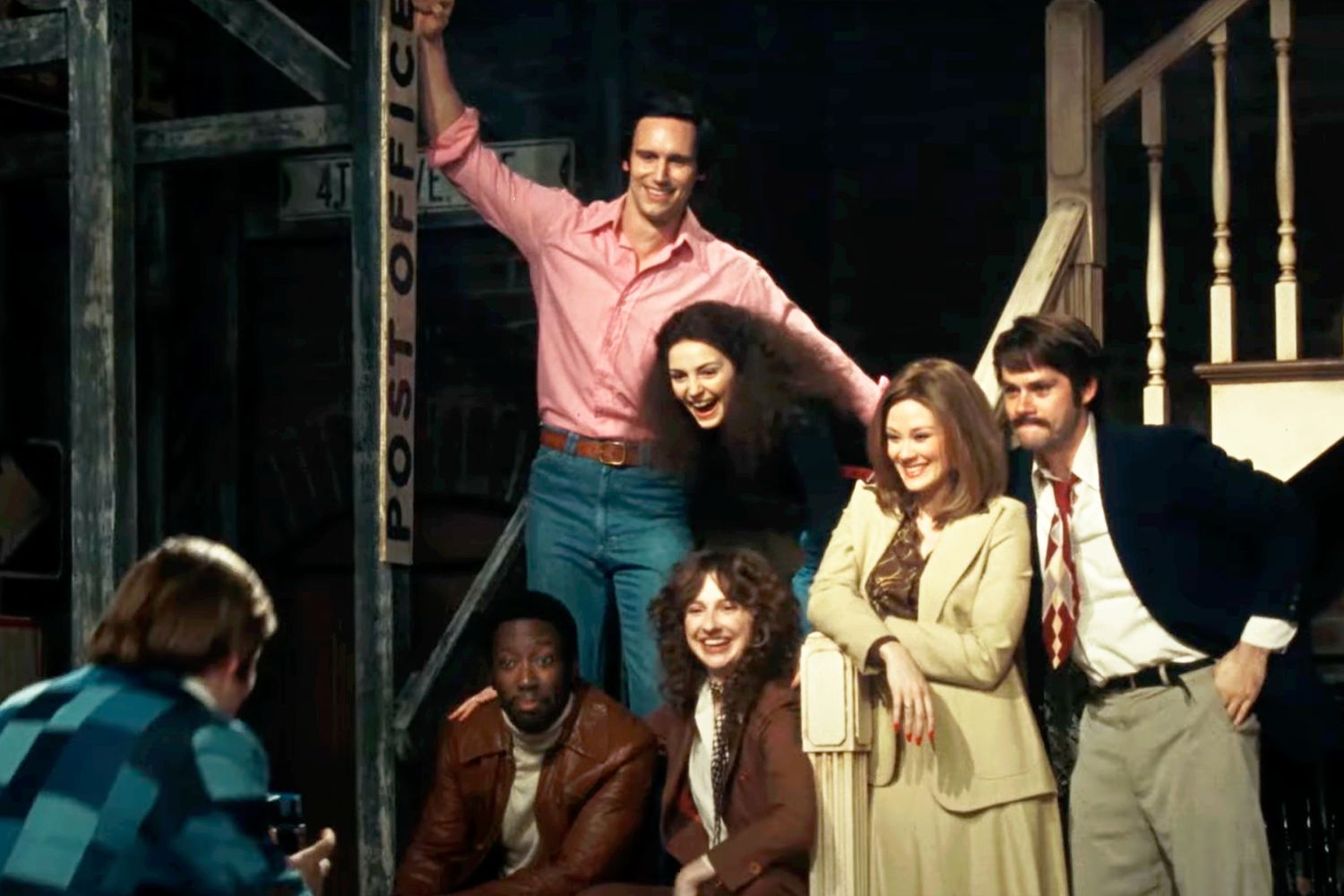
Photo caption: Cooper Hoffman (kneeling), Lamorne Morris, Cory Michael Scott. Ella Hunt, Emily Fairn, Kim Matula and Dylan O’Brien in SATURDAY NIGHY. Courtesy of Columbia Pictures and Sony Pictures Entertainment.

It’s hard to imagine, but fifty years ago there was no Saturday Night Live. There wasn’t much edginess on TV – All in the Family and M.A.S.H. were controversial -and a live performance telecast was unthinkable. Saturday Night depicts the first telecast of Saturday Night Live on October 11, 1975, and it’s quite a story.

Television network executives, always trying not to upset sponsors and affiliate stations, constricted creativity. By 1975, American music, movies, literature and fashion, had all moved on to reflect the turbulence and societal revolution of the 1960s and the Vietnam/Watergate Era of the early 70s. TV was still too square for the culture. There was nothing on TV like Portnoy’s Complaint, Midnight Cowboy, Frank Zappa or The National Lampoon. There was an opening for edgier content that would appeal to then twenty-something Baby Boomers.

As Saturday Night tells it, the timeslot was only available because NBC was in a contract dispute with Johnny Carson and needed a temporary replacement, a show that would be disposable when The Tonight Show with Johnny Carson returned. Into the breach stepped twenty-something showrunner Lorne Michaels (Gabriel Labelle) with an idea for a sketch-comedy show with musical guest performances, to be broadcast live, which the NBC’s Radio City complex was not set up for.

Saturday Night captures the chaos and risks of SNL’s debut. There were staggering technical issues with live television broadcast. The human challenges were more imposing – network suits were ready to pull the plug, the blue collar crew was in revolt and the network censor had never seen a script so transgressive. And Michaels had to wrangle a a group of artists, many whose egos and drug use were out of control.

Saturday Night’s cast members have the challenge of playing figures with whom the audience is extremely familiar – John Belushi, Dan Ackroyd, Chevy Chase, Gilda Radner, Jane Curtin, Garrett Morris and Laraine Newman. They’re all good. Dylan O’Brian kept making me me think I was watching the real 1970s version of Dan Ackroyd. Nicholas Braun captures the off-kilter talent of Andy Kaufman, and also plays a comically earnest Jim Henson.

Two performances stand out. Sennott is a revelation as SNL co-creator and head writer Rosie Shuster. Sennott’s Shuster is bright, sexy and charismatic; her command of situations, leavened with playfulness, is exactly what Lorne Michaels needs, as he is ever more confounded by unexpected crises.

J.K. Simmons is brilliant as Milton Berle, still feeling the entitlement of his TV superstardom, which, in 1975, was over 15 years in the past. Simmons dominates two of the greatest scenes in Saturday Night, the first as Berle cruelly dispenses a deserved comeuppance to Chevy Chase. In my personally favorite scene, Berle is taping an insipid variety show and mailing in his performance; just watch how Simmons’ Berle knows precisely how little effort he needs to put into a dance number.

Director Jason Reitman has delivered some the best movie comedies of the century. Saturday Night doesn’t have the depth of Reitman’s best (Juno, Up in the Air, Young Adult), but it’s entertaining. Saturday Night, a pretty good movie about a pivotal moment in our culture, is streaming on Amazon, AppleTV, YouTube and Fandango.