THE TRIAL OF THE CHICAGO 7: an earlier bizarre moment in our political history

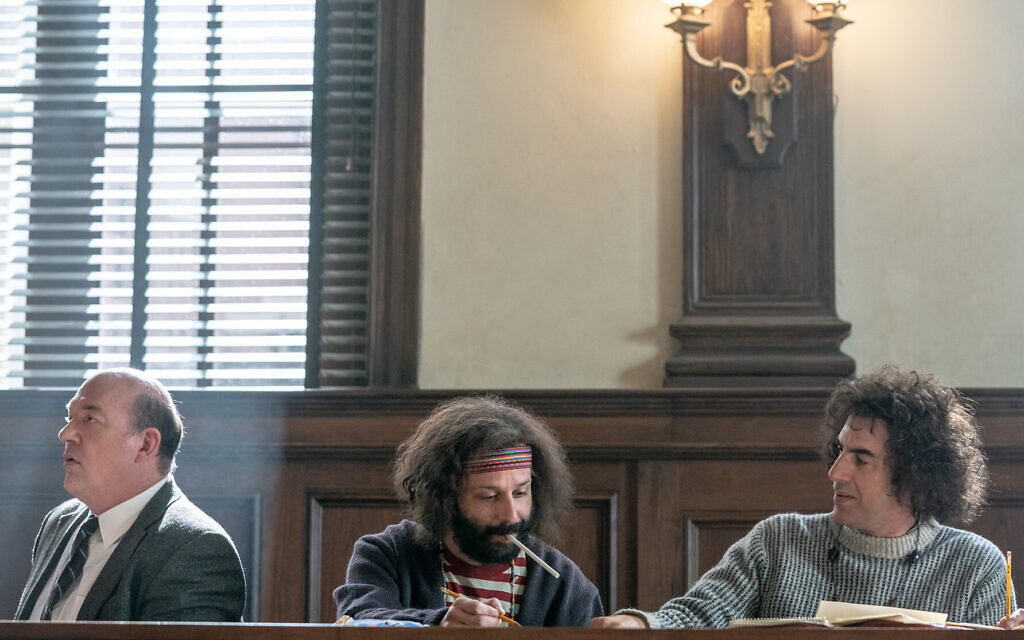
John Carrol Lynch, Jeremy Strong and Sacha Baron Cohen in THE TRIAL OF THE CHICAGO 7

In The Trial of the Chicago Seven, writer Aaron Sorkin (The West Wing, Oscar winner for The Social Network) brings history alive. The trial of anti-Vietnam war activists in 1969 was a bizarre moment in our political history (but not any more bizarre than the past four years).

Now in 2020, it’s time for this movie. Back in 1969, there were authoritative statements about criminality on both sides. But it’s more clear today – and indisputable – that the violence outside the 1968 Democratic Party convention in Chicago was a series of police riots, pure and simple, and that the trial was Nixon’s nakedly illegitimate legal assault against all activism.

The overriding absurdity of this political trial was that it alleged a conspiracy – and some of the alleged conspirators barely knew each other and some despised the others. These were rivals within the anti-war movement and only together in Nixon’s mind.

The movie makes this most clear in the conflict between Tom Hayden (Eddie Redmayne) and Abby Hoffman (Sacha Baron Cohen). Hayden of Students for a Democratic Society wanted to end the Vietnam politically. Hoffman of the Youth International Party (Yippies) was against the war, but sought a wider cultural revolution; the Yippies’ clownish political theater alienated the American Middle and made Hayden’s job harder. Hoffman was hilariously witty and Hayden was as funny as a heart attack. The two men couldn’t have conspired together to order lunch.

Hayden does not benefit from the Sorkin treatment. One is reminded that another activist said, “Tom Hayden gives opportunism a bad name.” THat almost tops Abby Hoffman’s own cutting appraisal of Hayden: “He’s our Nixon”.

The disparity between the defendants was emphasized by the prosecution of David Dellinger (John Carroll Lynch), the non-hippie, a pacifist leader from another generation. Dellinger was a suburban dad and boy scout leader, No one could see him as some punk kid, so when his outrage finally boils over, it’s one of the most powerful moments in the film.
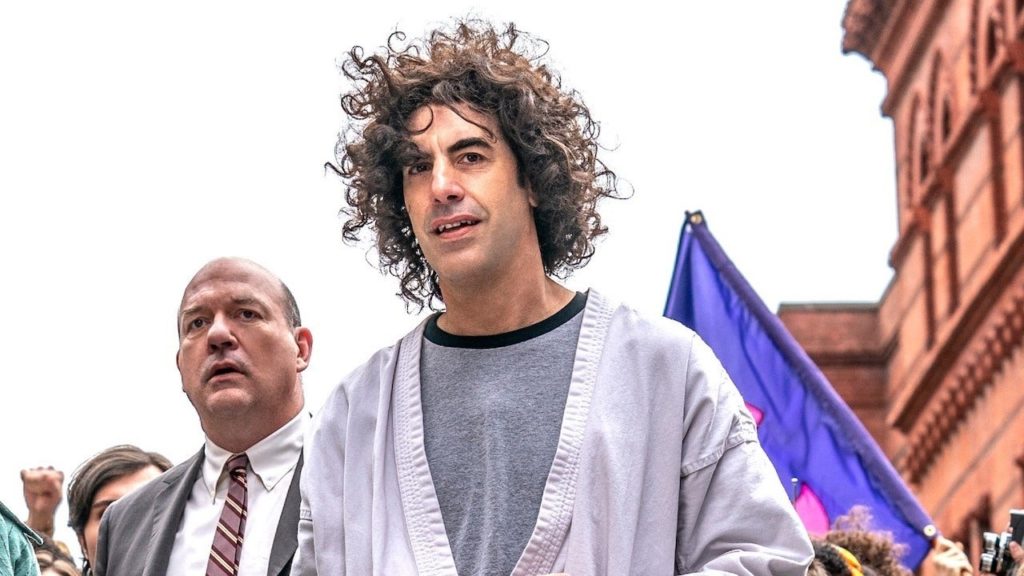
John Carrol Lynch and Sacha Baron Cohen in THE TRIAL OF THE CHICAGO 7

Cohen and Lynch are superb in The Trial of the Chicago 7, along with Kelvin Harrison, Jr., who plays Black Panther leader and martyr Fred Hampton, and Mark Rylance as defense lawyer William Kunstler. It’s a star-studded cast with Michael Keaton, Joseph Gordon-Levitt and Jeremy Strong (so good as Lee Harvey Oswald in Parkland).

Frank Langella is also brilliant as the villain, Judge Julius Hoffman. Langella’s Hoffman is imperious and intemperate, and utterly blind to his own racism and generational bias.
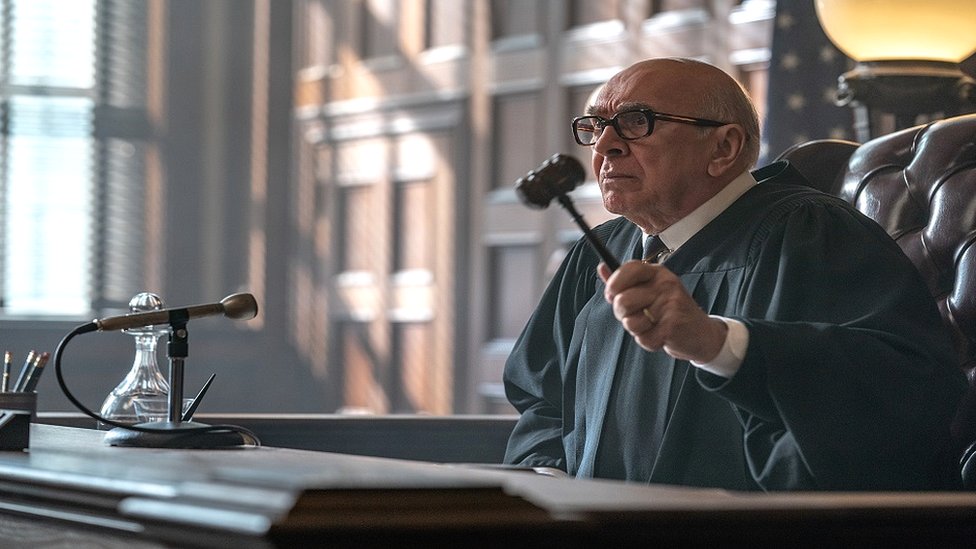
Frank Langella in THE TRIAL OF THE CHICAGO 7

The facts are compressed and – for the most part – kept in context. The role of former Attorney General Ramsey Clark (Keaton) happened a little differently but is portrayed with basic truth. Fred Hampton didn’t actually attend the trial and sit behind Bobby Seale; but the facts and impact of his assassination are fundamentally correct.

The one thing that annoys me about The Trial of the Chicago 7 is the spunky character of the defendants’ office manager Bernardine – because it’s clearly inspired by radical Bernardine Dohrn. Dohrn, who was not part of the trial, was NOT some chick answering the phone, but had already graduated from law school and was about to co-found the Weather Underground terrorist cell. I’m guessing that Sorkin wrote her in the story in a well-intentioned attempt to make the story NOT all-male. But the truth is that even the counter culture was sexist, and even male hippies saw women as adornments in 1969. The 1963 publication of The Feminine Mystique did not immediately wash away millennia of patriarchy.

This, however, is a sound retelling of a salient moment in our political and cultural history. Cohen, Lynch, Rylance, Langella, Harrison Jr, are all exceptional, and The Trial of the Chicago 7 is pretty entertaining.

Remembering John Lewis

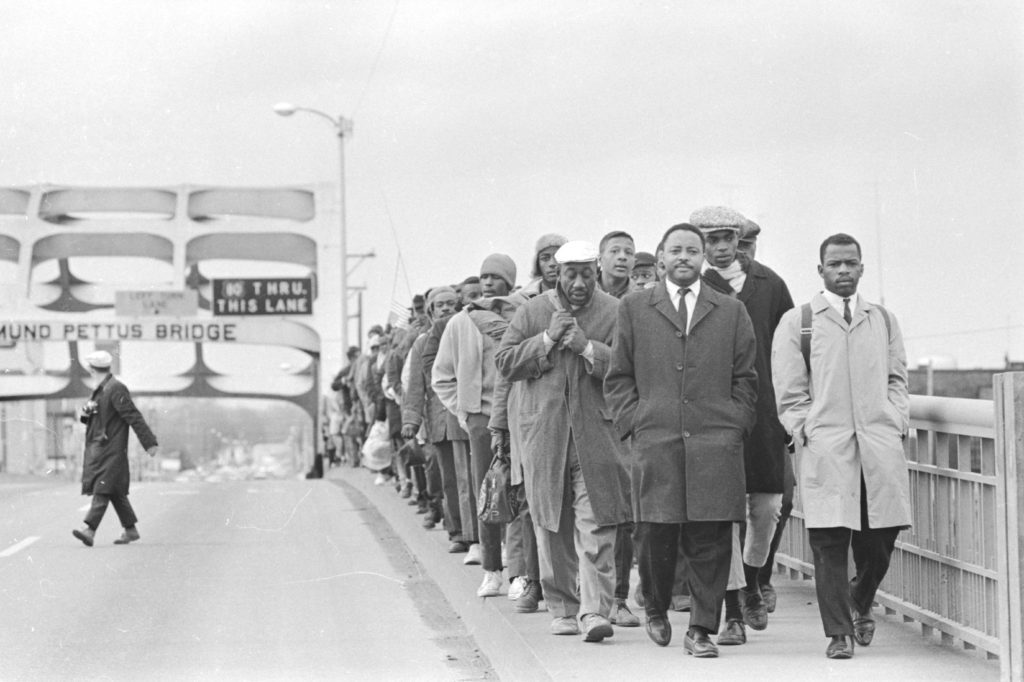
John Lewis (on far right) in JOHN LEWIS: GOOD TROUBLE. Courtesy of Magnolia Pictures.

John Lewis, that most profoundly American of American heroes, has died at age 80. Released just nine days ago, the documentary John Lewis: Good Trouble traces the life of the civil rights icon.  I usually don’t buy reverential biodocs, but when the subject is a freaking saint, I guess you have to go with it.  The rest of the title comes from Lewis’ mantra – if you see injustice, make good trouble, necessary trouble

US Representative John Lewis, of course, was a real hero.  As a very young man in 1965, he had been leading efforts to register Blacks to vote in Selma, Alabama, including a peaceful march to the State Capitol in Montgomery.  On March 7, 1965, the march got as far as the Edmund Pettus Bridge on the outskirts of Selma when they were attached by local law enforcement and Ku Klux Klan members under the command of Sheriff Jim Clark.  Lewis was in the very first rank and was beaten, shedding his own blood on “Bloody Sunday”.  Two subsequent marches on the bridge and the LBJ speech that followed led directly to the Voting Rights Act of 1964, the most important civil rights legislation since 1867. 

In John Lewis: Good Trouble, we see footage from the Edmund Pettus Bridge.  We see a young John Lewis being beaten in 1965, and we see an elderly Lewis in an anniversary march with President Barack Obama and former Presidents Bill Clinton and George W. Bush.

John Lewis: Good Trouble is well-sourced by director Dawn Porter, even though only a few of Lewis’ contemporaries survive.  When the first Black president was elected, Lewis says he wept for JFK, RFK, Dr. King and the others who hadn’t lived to see it.  Fortunately, Lewis had sisters still alive who participated in the documentary.

We get an inside glimpse at Lewis’ childhood.  We get to see Lewis watching footage of himself at a pivotal Nashville sit-in that he had “never seen”.  And, this intimate portrait shows us some dry Lewis humor and some impressive octogenarian dance moves.

How did Lewis get to Congress?  John Lewis: Good Trouble shows us the race against his longtime friend and fellow Civil Rights icon Julian Bond. My day job is in politics, and I understand that, to win, you have to do what you have to do to win; others may find this episode bracing and unsettling. 

 John Lewis: Good Trouble is an insightful view of a man and of a critical point in American history.  You can stream it on Amazon, iTunes, Vudu, YouTube and Google Play.

JOHN LEWIS: GOOD TROUBLE – an icon continues

John Lewis (on far right) in JOHN LEWIS: GOOD TROUBLE. Courtesy of Magnolia Pictures.

The documentary John Lewis: Good Trouble traces the life of civil rights icon, US Representative John Lewis.  I usually don’t buy reverential biodocs, but when the subject is a freaking saint, I guess you have to go with it.  The rest of the title comes from Lewis’ mantra – if you see injustice, make good trouble, necessary trouble

John Lewis, of course, is a real American hero.  As a very young man in 1965, he had been leading efforts to register Blacks to vote in Selma, Alabama, including a peaceful march to the State Capitol in Montgomery.  On March 7, 1965, the march got as far as the Edmund Pettus Bridge on the outskirts of Selma when they were attached by local law enforcement and Ku Klux Klan members under the command of Sheriff Jim Clark.  Lewis was in the very first rank and was beaten, shedding his own blood on “Bloody Sunday”.  Two subsequent marches on the bridge and the LBJ speech that followed led directly to the Voting Rights Act of 1964, the most important civil rights legislation since 1867. 

In John Lewis: Good Trouble, we see footage from the Edmund Pettus Bridge.  We see a young John Lewis being beaten in 1965, and we see an elderly Lewis in an anniversary march with President Barack Obama and former Presidents Bill Clinton and George W. Bush.

John Lewis: Good Trouble is well-sourced by director Dawn Porter, even though only a few of Lewis’ contemporaries survive.  When the first Black president was elected, Lewis says he wept for JFK, RFK, Dr. King and the others who hadn’t lived to see it.  Fortunately, Lewis has sisters sill alive who participate in the documentary.

We get an inside glimpse at Lewis’ childhood.  We get to see Lewis watching footage of himself at a pivotal Nashville sit-in that he had “never seen”.  And, this intimate portrait shows us some dry Lewis humor and some impressive octogenarian dance moves.

How did Lewis get to Congress?  John Lewis: Good Trouble shows us the race against his longtime friend and fellow Civil Rights icon Julian Bond. My day job is in politics, and I understand that, to win, you have to do what you have to do to win; others may find this episode bracing and unsettling. 

 John Lewis: Good Trouble is an insightful view of a man and of a critical point in American history.  You can stream it on Amazon, iTunes, Vudu, YouTube and Google Play.

CAPITAL IN THE TWENTY-FIRST CENTURY: behind the one percent

CAPITAL IN THE TWENTY-FIRST CENTURY. Courtesy of Kino Lorber.

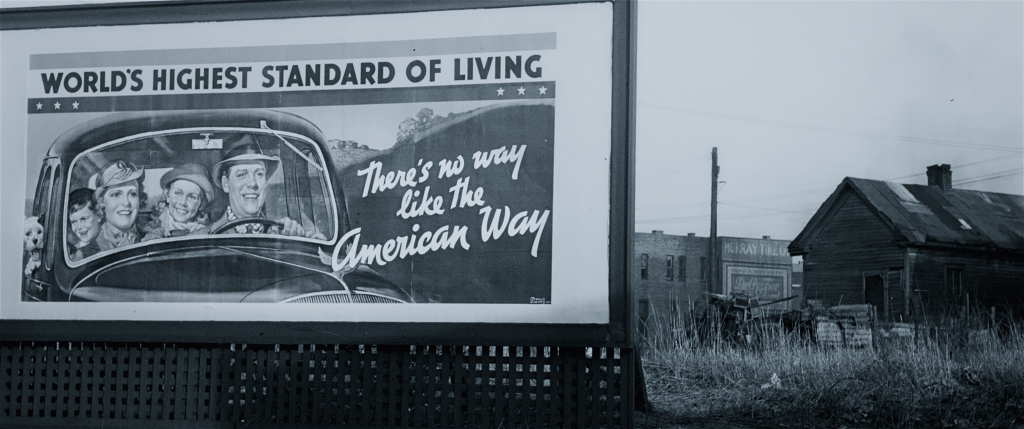
Documentarian Justin Pemberton brings alive Thomas Piketty’s bestselling Capital in the Twenty-First Century, a critique of the concentration of wealth. There’s no more fundamentally important political topic than inequality, and this theme has resonated through the best of recent cinema, including Parasite and Knives Out.

Pinketty traces the economics of wealth from feudal times to the present, and Pemberton keeps all the economic history lively with plenty of eye candy. Capital in the Twenty-First Century covers a lot of ground – globalization and movable capital, deregulation and privatization, defanging of organized labor, China state capital, and the impact on today’s youngest generations.

Piketty’s proffered solutions are simple and intellectually sound (stopping off-shore tax dodges, taxing inheritance, incentivizing wealth to be invested in productive risk instead of moving around a closed-loop of financial instruments). But, given the political power of great wealth, this is a very heavy political lift.

CAPITAL IN THE TWENTY-FIRST CENTURY. Courtesy of Kino Lorber.

Capital in the Twenty-First Century pops along fairly briskly, but, as an entertaining popularizer, it’s no The Big Short or An Inconvenient Truth. Still, about an hour in, there’s a jaw-dropping psych experiment in which people benefiting from pure luck believe and act as though they are entitled.

During its Bay Area virtual run at the Roxie, you can stream Capital in the Twenty-First Century at Roxie Virtual Cinema, or at distributoe Kino Lorber’s new virtual platform Kino Marquee.

TOWER: a most original and important retelling of a story that we thought we knew

TOWER
TOWER


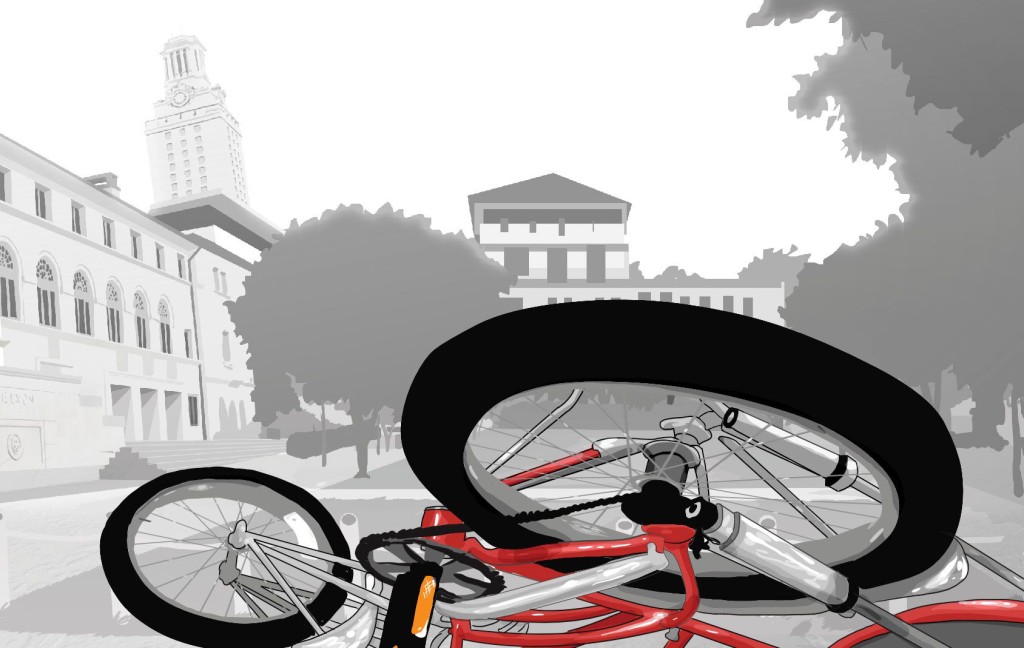
Tower is a remarkably original retelling of the 1966 mass shooting at UT Austin.  Tower is a tick-tock of the 96 minutes when 49 people were randomly chosen to be shot by a gunman in the landmark tower 240 feet above the campus.  That gunman is barely mentioned (and may not even be named) in the movie.

Tower is director Keith Maitland’s second feature. What makes Tower distinctive and powerful it’s the survivors who tell their stories, reenacted by actors who are animated by a rotoscope-like technique (think Richard Linklater’s Waking Life).  Telling this story through animation, dotted with some historical stills and footage, is captivating.

Since 1966, we’ve suffered through lots of mass shootings.   The UT Tower shooting was especially shocking at the time and prompted the questions about what drove the “madman” to his deed.  But, fifty years later, what’s really important today is how the event affected the survivors – what was what like to live through this experience and how it lives with them today.  That’s the story that Maitland lets them tell us – and in such an absorbing way.

I saw Tower at the Mill Valley Film Festival.  It opens theatrically in the Bay Area today at the Landmark Shattuck in Berkeley.

TOWER
TOWER