
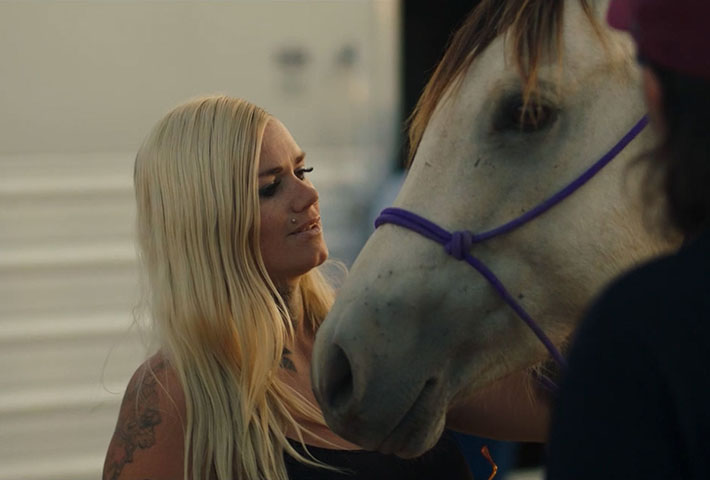
In the engrossing indie family drama East of Wall, Tabatha (Tabatha Zimiga) is struggling to manage a messy home, which even she describes as chaotic, and to survive financially. Three years after her husband’s suicide, her household includes her teenage daughter and son, her three-year-old son, her mom, her partner of the past year-and-a-half, and four more stray teens. Everyone is damaged by some trauma or another – Tabatha’s nuclear family rocked by her husband’s death and the unrelated teens by their own parental abandonment.
Tabatha is running a dilapidated South Dakota horse ranch, selling the horses that she trains. She’s a gifted horse whisperer, and she teaches horsemanship to the kids. The daughter Porshia (Porshia Zimiga) is a brilliant rider and a champion barrel racer. Trouble is, Tabatha can’t sell the horses at prices high enough to sustain the ranch or keep her family in hamburger and pizza rolls. She’s run out of credit at the local grocery, and has to send in a mortified Porshia with cash to buy the basics.
Her colorful mom Tracey (Jennifer Ehle), isn’t much practical help, babysitting the toddler with horror movies and making moonshine. Tracey is a survivor of intimate partner violence, Tabatha was a teen mom, and it’s clear that Tabatha is trying to somehow break through multi-generational dysfunction. Ehle sparkles in a very colorful role, both providing comic relief in a grief movie and in grounding the traumas endemic to the neighborhood.
Enter Roy (Scoot McNairy), a Texas horse-trader who has both swagger and the humility to recognize someone more talented than he is. And he has enough business sense to spot an opportunity. Roy brings Tabatha the hope of financial salvation, but he’s damaged, too, and there’s a question as to the cost of his help.
In her first feature film writer-director Kate Beecroft, skillfully unspools what is really going on with Roy, and McNairy’s performance keeps us guessing. Beecroft handles the central thread of the story – the highly charged relationship between Tabatha and Porshia – with remarkable authenticity. What is most impressive is that, with the exception of McNairy and Ehle, Beecroft is doing this with non-professional actors in all the main roles. These are all rural South Dakotans playing fictionalized versions of themselves.
Tracey’s gal pals celebrate her birthday with some beers round a campfire. As each, including Tracey and Tabatha share their own traumatic experiences, you won’t hear a pin drop in the theater. It’s one of the most compelling movie scenes of the year.
Beecroft also captures the verisimilitude of the setting and the local ranch-and-saloon culture. The ranch is east of Wall, South Dakota, moderately famous for its Wall Drug attraction. The area is on the edge of the Badlands, which Beecroft and cinematographer Austin Shelton (in also his feature debut) use to their advantage. The shots of galloping horses are thrilling.
(A digression: The director Chloe Zhao (Nomadland) mined rural South Dakota for her breakout films, Songs My Brother Taught Me and The Rider, which also featured non-professional actors. There are only eleven people every square mile in South Dakota, and under a million overall, so ya gotta wonder how many great personal stories are out there for filmmakers to find.)
East of Wall won the NEXT audience award at Sundance and is now in theaters.