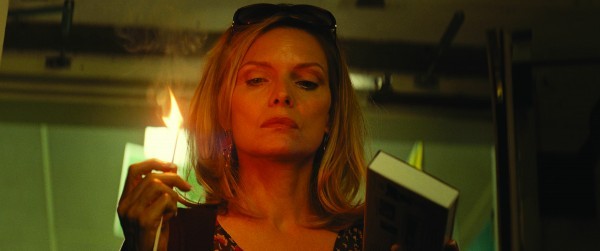
In the dark comedy The Family, the family of an American mafioso has been relocated to Europe under the witness protection program. However, they are so violent that they keep blowing their cover and have to move again. Here, they have just failed to fit themselves in to the sunny French Riviera and have been moved again to chilly Normandy.
The recurring joke in The Family is that these people escalate almost every human interaction into severe violence and that all the family members are highly skilled. The mafioso is played by Robert De Niro, his wife by Michelle Pfeiffer, and both very ably deliver the deadpan comedy. But the best performances (in the best written roles) are by Dianna Agron (Quinn in Glee) and John D’Leo as the couple’s teenagers. Tommy Lee Jones is also VERY briefly in the movie, as are Vincent Pastore and Dominic Chianese of The Sopranos.
Luc Besson (The Professional, District B13), the French director who celebrates American action movies, gets to make an American action comedy set in France. I enjoyed The Family much more than I thought I would because I expected another lame culture clash comedy and instead got a darker comedy. Still, it is what it is – a broad comedy – but a competent one.
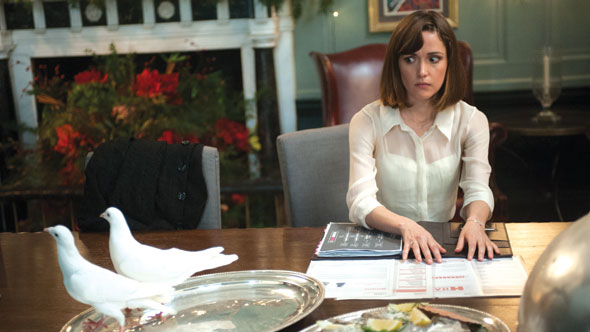
In a twist on the usual romantic comedy plot, I Give It a Year starts out with the perfect wedding, and then traces the couple’s (Rafe Spall and Rose Byrne) adventurous first year of marriage. They have married after a brief infatuation, and it turns out that they aren’t a great fit. It becomes rapidly apparent that she is more well suited with her new client (Simon Baker), and his true soul mate is his ex-girlfriend (Anna Faris).
Of course, this is a romantic comedy, so be prepared for some silliness and some implausibility. But I give it credit for an original story, and it’s mostly entertaining, with some moments of hilarity. Anna Faris is brilliant in her character’s earnest but futile attempt to master the acrobatics required in a three-way sexual encounter. And it’s very funny when the young groom realizes that the honeymoon photos that the bride is showing her parents includes some naughty bits.
I especially enjoyed the fine dramatic actress Olivia Colman (Tyrannosaur, Broadchurch, The Iron Lady) playing broadly against type as the worst imaginable marriage counselor (she interrupts a session to take a call on her cell phone and scream abuse at her husband). As in the very best comedy, Colman plays it absolutely straight as she, in turn, violates every professional precept.
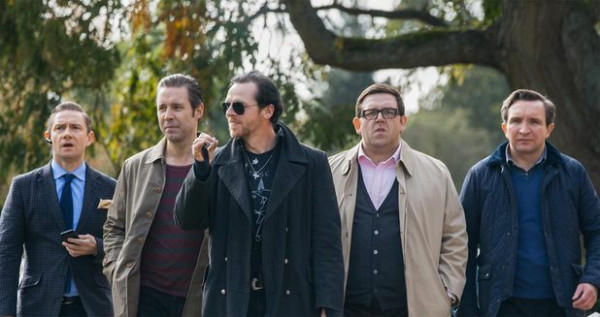
In the British farce The World’s End, five guys return to their sleepy hometown for a fabled pub crawl through all twelve local establishments – and find their old neighbors infiltrated by robot monsters from outer space (a la Invasion of the Body Snatchers). The central joke is that four of them have matured into forty-year-olds with families and careers, and they have been manipulated into this escapade by the fifth who is still stuck at age eighteen. That guy, well-played by Simon Pegg, still dresses and acts as he did in high school (and still drives the same car) – and he doesn’t see why that is not OK. The clash between this man-boy and the four regular guys is funny, and then the filmmakers add a send-up of the alien monster genre.
It’s a stellar crew – besides, Pegg, our heroes include Nick Frost (Pegg’s partner in Shaun of the Dead and Hot Fuzz, Martin Freeman (those movies plus The Office), Paddy Considine (In America, Red Riding) and Eddie Marsan (Vera Drake, Happy-Go-Lucky, Ray Donovan). The usually upper crusty Rosamund Pike is a good sport, too.
I wish it were as funny as Shaun of the Dead and Hot Fuzz, but Pegg’s earnestly immature bozo and the silliness of the alien robots can only take The World’s End so far. It’s mildly entertaining with some LOL moments, but not a Must See.
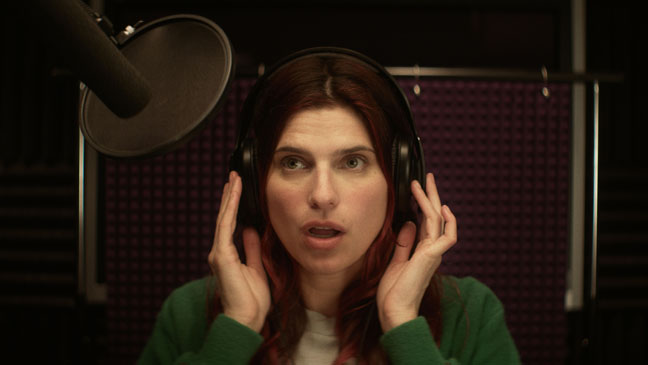
Actress Lake Bell wrote/directed/stars in In a World…, the story of an underachieving voice coach who still lives in the house of her dad, the king of movie trailer narration. She’s disheartened when he kicks her out to make room for his new and very young squeeze, but she lucks into a voiceover gig herself and is “discovered” as the hot new talent. In fact, she’s up for the most prestigious new payday when she finds out that her dad is not as supportive as one might expect…
Here’s why In a World… is so damn good – Bell has written a very funny comedy about a generational rivalry and woven it together with a Hollywood satire, an insider’s glimpse into the hitherto under-the-radar voiceover industry and a romantic comedy. The romantic comedy thread, in which our heroine is oblivious to the nice guy who really likes her, is better by itself than most romantic comedies. But we also get many LOL moments among the self-absorbed and back-stabbing Hollywood set. Plus there’s a very sweet story of the relationship between the protagonist’s sister and her hubby – that could stand alone and be better than a lot of indies as well..
Bell gets most of the laughs from the foibles of the characters and from really intelligently crafted dialogue. But she know how to pull off a physical gag, too. At one point, our heroine wants to be kissed by a handsome Hollywood bigshot, but when it happens, his technique is to put her entire nose into his mouth – and her surprise and discomfort is very funny.
Fortunately, Bell was able to cast Fred Melamed, a distinguished voiceover artist, as the father. Melamed has been the voice of CBS Sports, the Super Bowl, the Olympics and Mercedes-Benz. He’s also a brilliantly funny actor. I called Melamed’s performance as the hilariously pompous and blatantly manipulative Sy Ableman in A Serious Man “the funniest movie character of the decade”.
Bell’s previous roles have been secondary parts that have taken advantage of her unconventionally severe beauty. You may remember Bell as Alec Baldwin’s new trophy wife in It’s Complicated. Having written it herself, she finally has a role in which she can show her comic chops. I turns out that she’s a gifted comic actress, with screwball timing, a rich take and a knack for physical comedy.
The rest of the cast is uniformly good. I especially enjoyed Rob Corddry (Warm Bodies) as the long suffering husband of the sister.
In a World… is a complete and winning film. It’s already almost September, and so far, In a World… is the year’s best comedy.
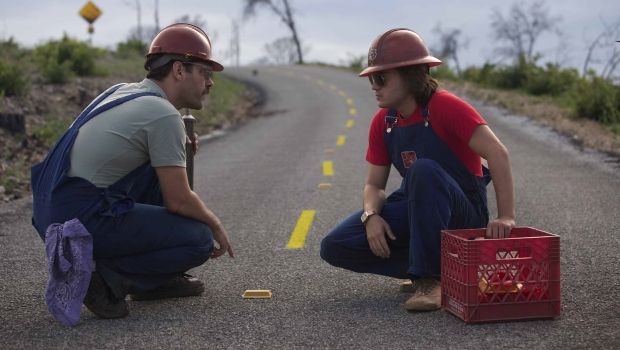
In the comedy Prince Avalanche, Paul Rudd and Emile Hirsch play two guys working a lonely job – painting the yellow line in the middle of a forlorn road through a wildfire-decimated Texas landscape. Neither guy is what you would call smart, but Rudd’s Alvin is brighter than Hirsch’s Lance. Alvin is quirky and more than a bit anal. Lance’s horizon isn’t much farther than his next sexual encounter. It’s funny when Alvin tries to keep Lance on task. As each faces some personal bad news, all semblance of order crumbles. Along the way, they meet a hilariously gonzo trucker (Lance LeGault). It’s all very funny in a droll kind of way.
Rudd, of course, is a solid comic actor, but Hirsch is the surprise. Hirsch has been very strong in dramatic roles (especially in Into the Wild), but he was the weak link in last year’s darkly funny Killer Joe. Here, he plays his dunderhead entirely straight, and the result is very funny. Who knew?
Green is now a successful director for hire (Pineapple Express and a load of commercials). But all of the indies that he’s written and directed have been really excellent: George Washington, Undertow, All the Real Girls and Snow Angels (which made my Best Movies of 2008).
I saw Prince Avalanche at a San Francisco International Film Festival screening introduced by Green. He said that, after filming Snow Angels’ suicide in frozen Nova Scotia, he was ready for something lighter. A member of the band Explosions in the Sky (his frequent collaborator) told him about the burned-out landscape around Bastrop, Texas. Having found a location, he needed a two-actor story, and so he adapted the Icelandic movie Either Way. Fueled by lots of coffee, he whipped out the screenplay in two days, with two more days for a rewrite.
One of the real pleasures of Prince Avalanche is the performance of Lance LeGault, who died just before he could have seen the movie, as the truck driver. LeGault was a veteran character actor who started off as Elvis’ stunt double and played scads of nasty military guys; Green discovered him working as an extra while shooting an auto commercial in Tehachapi. Now we can remember LeGault for stealing all his scenes in Prince Avalanche.
Prince Avalanche is in theaters, and is also streaming on Amazon, iTunes, DirecTV, Comcast, Vudu, GooglePlay and other VOD outlets.
In a twist on the usual romantic comedy plot, I Give It a Year starts out with the perfect wedding, and then traces the couple’s (Rafe Spall and Rose Byrne) adventurous first year of marriage. They have married after a brief infatuation, and it turns out that they aren’t a great fit. It becomes rapidly apparent that she is more well suited with her new client (Simon Baker), and his true soul mate is his ex-girlfriend (Anna Faris).
Of course, this is a romantic comedy, so be prepared for some silliness and some implausibility. But I give it credit for an original story, and it’s mostly entertaining, with some moments of hilarity. Anna Faris is brilliant in her character’s earnest but futile attempt to master the acrobatics required in a three-way sexual encounter. And it’s very funny when the young groom realizes that the honeymoon photos that the bride is showing her parents includes some naughty bits.
I especially enjoyed the fine dramatic actress Olivia Colman (Tyrannosaur, Broadchurch, The Iron Lady) playing broadly against type as the worst imaginable marriage counselor (she interrupts a session to take a call on her cell phone and scream abuse at her husband). As in the very best comedy, Colman plays it absolutely straight as she, in turn, violates every professional precept.
You can stream I Give It a Year now on Amazon, iTunes, GooglePlay, YouTube, Vudu and other VOD purveyors – or try to find it in limited theatrical release.
In the Irish horror comedy Grabbers, an isolated Irish island is attacked by tentacled, bloodsucking alien space monsters. Here’s the inventive device that could have resulted in a cult classic – it turns out that alcohol is toxic to the monsters, so the residents can survive as long as they keep a high enough level of alcohol in their bloodstreams. Pretty funny, right? I could imagine the colorful villagers in Waking Ned Devine helping each other to stay drunk, but not too drunk.
Unfortunately, the bit about the effects of alcohol doesn’t appear until halfway through, and the real focus in on the romantic conflict between the pretty and highly professional cop from Dublin and the drunken local Garda – an obvious story that we’ve seen in every bad romantic comedy. What we’re left with is a low-budget horror flick with a trite “Will they get together?” thread. Too bad.
Grabbers is available streaming from Amazon, iTunes, YouTube, GooglePlay and other VOD sources.
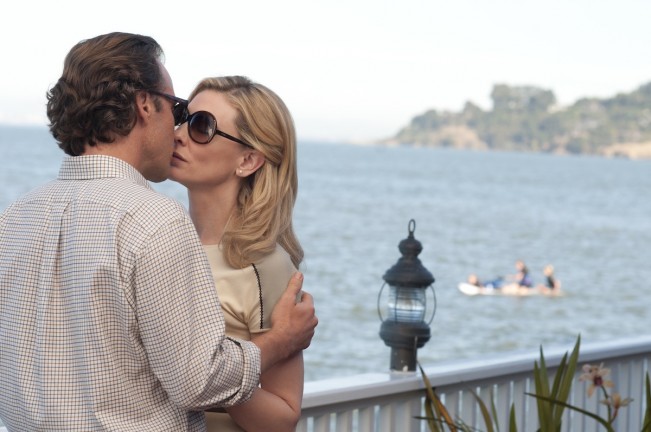
Peter Skarsgaard and Cate Blanchett in BLUE JASMINE
Woody Allen’s Blue Jasmine is a remarkably profound portrait of a woman seemingly ruined by circumstance and trying desperately to cling to who she thought she was. In a stunning performance, Cate Blanchett plays Jasmine, a New York socialite whose billionaire swindler of a hubby has lost his freedom and his fortune to the FBI. Jasmine’s identity has been based on the privilege derived from her money, her marriage and her social station – and all of that is suddenly gone. Flat broke and reeling from the shock of it all, she seeks refuge with her working class San Francisco sister.
Despite her desperate situation, Jasmine arrives still brimming with deluded entitlement, Woody having calculated an undeniable resemblance to Blanche Dubois in A Streetcar Named Desire. But Blue Jasmine is more accessible than the great play Streetcar because it’s so damn funny. Jasmine’s pretensions are as pathetic as Blanche’s, but it’s very, very funny when her top shelf expectations collide with her current reality.
Cate Blanchett will certainly be nominated for an Oscar for this role. Blanchett is able to play a woman who is suffering a real and fundamental breakdown through a series of comic episodes. She flawlessly reveals Jasmine’s personality cocktail of charm, denial, shock, desperation and sense of authority.
I know that a lot of folks are put off by the creepiness of Woody’s real life marriage, but he has written a great female lead role for Blanchett, and he’s directed actresses to four Oscars in the past, as outlined in this recent New York Times article.
In my favorite scene, Jasmine faces her young nephews across a diner’s booth in a diner. They ask her questions with childish directness and inappropriateness. Her answers are candid from her point of view, but nonetheless astoundingly deluded – and just as inappropriate. The scene is deeply insightful and hilarious.
Who and what has brought Jasmine to her knees? Certainly she has been victimized by her amoral sleazeball of a husband, but she vigorously refuses to consider taking any responsibility herself. Can she be forced to look within? And is she strong enough to face what she would see?
Sally Hawkins is equally perfect as Jasmine’s good-hearted sister Ginger, a woman who doesn’t expect much from life and still gets disappointed. Andrew Dice Clay, of all people, is excellent as Ginger’s ex, a lug who rises to a moment of epic truth-telling. Louis C.K. brings just the right awkward earnestness to the apparently decent guy who takes a hankering to the long-suffering Ginger. Alec Baldwin nails the role of Jasmine’s husband, a man whose continual superficial charm almost masks his cold predatory eyes, and it’s a tribute to Baldwin’s skill that he makes such a natural performance seem so effortless.
Playing a primarily comic character, Bobby Cannavale delivers a lot of sweaty energy, but with too much scenery chewing. The great actors Peter Skarsgaard and Michael Stuhlbarg do what they can with far less textured characters.
The Wife thought Blue Jasmine dragged in places, and she was distracted by some components that didn’t ring true about the San Francisco setting – two key working class characters with Tri-State Guido accents and a Sunday afternoon cocktail party where the men wear neckties; she’s dead right on both points, but they didn’t bother me.
Blue Jasmine may not rise to the level of Allen’s Midnight in Paris, Annie Hall, Manhattan, Hannah and Her Sisters and Husbands and Wives, but it’s a pretty good film with a superlative, unforgettable performance.
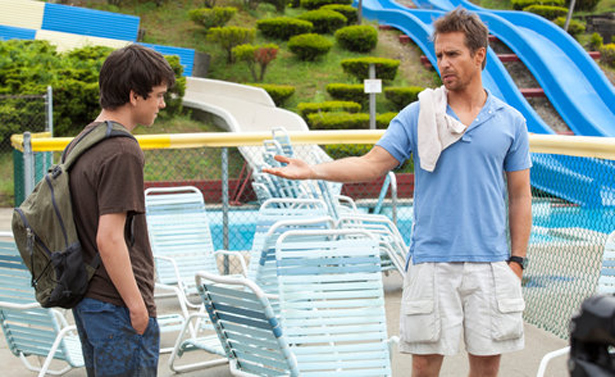
In the appealing coming of age story The Way, Way Back, a betrodden teen (Liam James) gains confidence when mentored at his summer job by a lowlife (Sam Rockwell). The kid’s mom (Toni Collette) has been rocked by a divorce (hubby found a young thing), and has rediscovered some self esteem in the attentions of a creep (Steve Carrell). Now the kid, his mom, her insufferable boyfriend and the boyfriend’s bratty daughter are off to his summer home on the Atlantic shore. The kid finds a job at a cheesy local water park, and funny stuff happens.
In depicting the ways that parents make their teen kids miserable, The Way, Way Back is spot on. I’m not talking about the uncool cluelessness that makes all teens embarrassed about the even most perfect parents. The Way, Way Back focuses on children from broken marriages who are made to feel unvalued or whose weaknesses are picked at or whose parents become too involved with their own issues. Indeed all the kids in The Way, Way Back come from divorced families. Even one childless marriage (Rob Corddry from Warm Bodies and Amanda Peet) is very imperfect.
Collette’s performance nails the desperation of a woman, once abandoned, for a relationship that will meet at least some of her needs. Alison Janney is hilarious as the neighboring divorcee who is embracing her alcoholism. The rest of the cast, including Maya Rudolph, is good, too. Give credit to Carrell for taking on a very unsympathetic role, something not every bankable star will do.
It may not be a Must See, but The Way, Way Back is sweet, perceptive and pretty funny.
Now out on VOD, Bert and Arnie’s Guide to Friendship is an odd couple comedy with the promising premise that the two main characters become entangled when one has an affair with the other’s wife. The good news is that the comedy is driven by the characters, one an abrasive womanizer and the other a pretentious and self-involved minor novelist. The bad news is that the broad characters are neither textured or interesting or sympathetic enough to sustain a movie of longer than 49 minutes (which is when I stopped watching). And worse, Bert and Arnie wastes a supporting performance by the delightful Anna Chlumsky.
Bert and Arnie’s Guide to Friendship is available streaming from Amazon and iTunes.