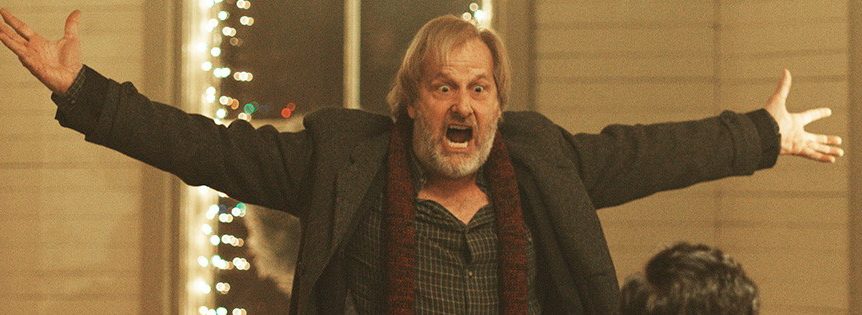
In the Finnish family comedy Happier Times, Grump, a grouchy and emotionally-repressed Finnish farmer has been content to alienate everyone in his life, but then gets the chance to step up and support his teen granddaughter emotionally. The curmudgeon’s son, the girl’s father, is a Yuppie living in Belgium and he’s a piece of work himself; he has long resented the old man’s harshness and emotional detachment. The worlds of the simple old farmer and the hyper-connected urban teenager are centuries apart, but the odd couple must connect to handle a crisis in the girl’s life.
To enjoy Happier Times, Grump, the audience must 1) be amused by the politically incorrect and Luddite pronouncements of the old man and 2) relish an overtly sentimental ending.
Jeff Daniels wrote and stars in Guest Artist, a comic two-hander about a Pulitzer Prize-winning playwright drinking his way through an 18-year-old writer’s block. The playwright has sunk to accepting a guest residency from a Lima, Ohio, amateur theater company. He shows up drunk, bitter and entitled, and, of course, he hasn’t written the play that has been commissioned. His appointed Man Friday is a wannabe playwright (newcomer Thomas Macias) who desperately tries to handle the raging ego and the self-destructive behavior of his idol.
[MILD SPOILER HERE] It turns out that the writers’ block stems from a self-suppression of artistic expression. But there really isn’t any humor or insight into the artistic process that we haven’t seen before.
Jeff Daniels is very good as the frustrated genius. Daniels has been a cinema star for a long time, and for good reason. It’s been 34 years since he broke through with his star turn in Woody Allen’s Purple Rose of Cairo, and he’s beloved for roles ranging from those in the Dumb and Dumber movies and television’s The Newsroom. I most admire Daniels’ performance as professor-turned-battlefield-commander Joshua Lawrence Chamberlain in Gettysburg (1993).
Guest Artist is essentially a filmed play, and it looks like it. For some, a dose of Jeff Daniels will be enough.
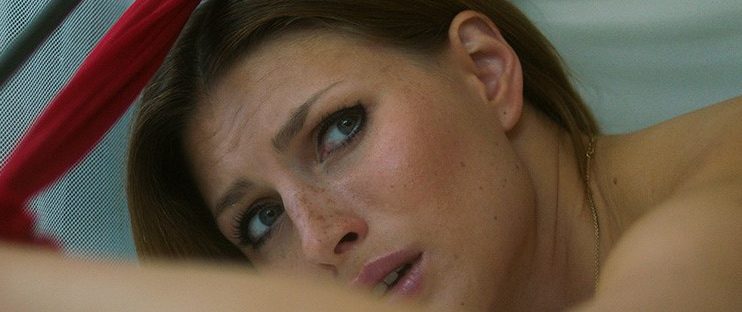
In the horror comedy Blood Paradise, the author (Andrea Winter) of lurid best sellers is wallowing in malaise after her latest book bombs. For a change of pace, she gets away to the Swedish version of an agriturismo, a remote and spartan farm. The farm has every earmark of Gothic horror, and Blood Paradise has great fun with every creaky door and ominous scarecrow. The farmer explains his wife’s grave out back, “she loved the garden but now it’s only a garden of death”. The farmer’s creepy middle-aged sister is obsessed with dolls. His menacingly silent, paunchy son is mostly shirtless and fondling a shotgun. And the author’s driver is her biggest fan – and seriously unhinged. Just when the blood starts splattering, the author’s hunky, dim and besotted boyfriend Teddy shows up for a surprise visit in a white suit.
Part of the fun is that the author has adventuresome sexual fantasies and makes a living envisioning gruesome scenarios; her especially rich imagination makes every ominous cue seem even more alarming.
Blood Paradise is written by its star Andrea Winter and directed by Patrick von Barkenberg (who also plays Teddy); it is the first narrative feature for both. Winter is a good sport about her own nudity, and has fun playing the author as a brat. She also has fun with Teddy’s allergies, which erupt at the most importune times. And there’s a very amusing homage to Psycho.
This is a Swedish movie set in Sweden, but almost all the dialogue is in English. Blood Paradise plays at the 2019 Cinequest.
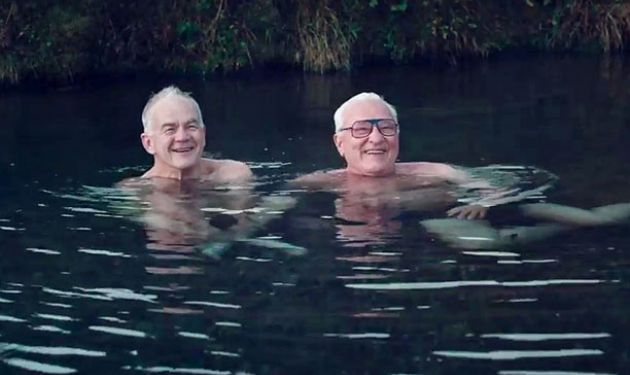
Here’s a really fun movie. Land Ho! features a vibrant and irascible geezer who conscripts an old friend into a rowdy road trip to – of all random places – Iceland. It’s a showcase for Earl Lynn Nelson, who essentially plays himself in the movie. Nelson is a 72-year-old Kentucky doctor who is a force of nature and has possibly an even dirtier mind than The Movie Gourmet’s. He is a friend of the 29-year-old writer director Martha Stephens who was INSPIRED to see the possibilities in sending him off on an adventure and filming the results. His friend (and ex-brother-in-law) is played by an actor, Paul Eenhoorn.
It all works. Nelson – an unapologetic hedonist – is funnier than hell, and Eenhoorn stays right with him as the more reserved and sometimes aggrieved buddy. Land Ho! is a string of LOL moments, whether Nelson is providing politically incorrect fashion advice to young women or unsolicited marital advice to a honeymooning couple or pulling out a joint and proclaiming “It’s time for some doobiefication”.
This is a geezer comedy that doesn’t make the geezers cute. Nelson may be a piece of work, but there’s nothing in Land Ho! that isn’t genuine.
I just have two knocks on the movie. It’s only 95 minutes long, but it would be crisper at about 87. And, as The Wife pointed out, there’s really no need for the huge jarring subtitles to let us know precisely where these guys are in Iceland.
Nevertheless, it’s worth a watch. The audience at Sundance loved this movie, and I think Land Ho! is a hoot-and-a-half. Land Ho! is available on DVD from Netflix and streaming from Amazon, iTunes, Vudu, YouTube, and Google Play.
{Note: I got the meet and spend some time with Paul Eenhorn at Cinequest 2015, when he was premiering his film In the Company of Women. Great guy.]
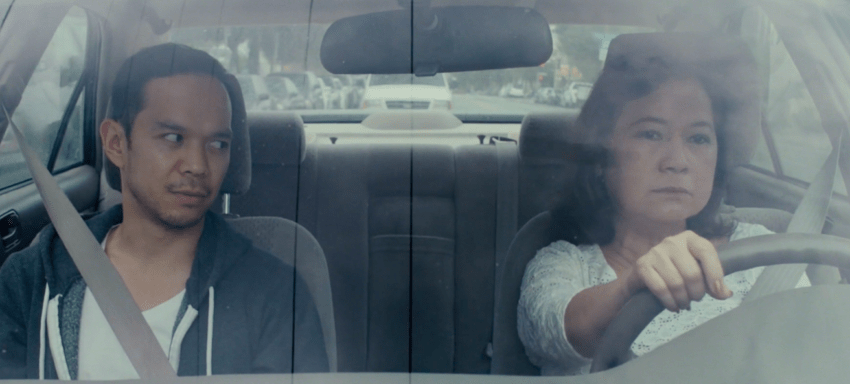
Bitter Melon is H.P. Mendoza’s dark indie comedy on an issue that a Bay Area family must finally face. The dad has long abandoned the family, and it’s almost like he has moved to a different city (but he hasn’t). Two of the adult sons have moved to New York City and Philadelphia. The third son, Troy, lives in the mom’s family home with his wife and kid – and this guy is a nightmare. Troy (Patrick Epino) has a delusional self-image that he is somehow super-talented, even though he is unemployed and living off his wife and mom; worse, he has an anger management problem, and the entire family tiptoes around on eggshells – trying to avoid any disagreement with him.
It should be no surprise that Troy, who thinks he is entitled to his way all of the time, also beats his wife. The wife is too traumatized to seek help, Troy’s mom is in denial and the siblings, having put the family’s day-to-day life in their rearview mirrors, all combine to enable the abuse. When the two brothers return for the Christmas Holiday, the situation becomes unbearable and the family members decide that they must take an extreme step to deal with Troy.
I’ve just described a pretty grim story line, but Bitter Melon is very funny.
Bitter Melon invites us into a Filipino-American family, which is a welcome look at an underrepresented subject. But Bitter Melon is much more than cultural tourism – the characters and story here are universal, from the adult kids coming back to sleep in their childhood rooms for the holidays, the differences between first and second generation immigrants and the family issues of abuse and denial.
H.P. Mendoza is a Bay Area treasure, having written the screenplay and music for the rollicking and refreshing comedy Colma: The Musical and written and directed the genre-bending art film I Am a Ghost. I recommend the delightful Colma: The Musical for anyone, especially Bay Area residents; you can stream it from Vudu, YouTube and Google Play.
Bitter Melon begins a Bay Area theatrical run tomorrow.
The Ballad of Buster Scruggs is the Coen Brothers’ homage to the Western genre; it’s an anthology with SIX of their darkly funny stories. They clearly share Mark Twain’s cynically wry take on human nature, which they depict in Western situations of wagon trains, stagecoach rides, prospecting and hangings. The Coen brothers are not just making fun of Western clichés but also celebrating the genre, with beautiful vistas of New Mexico’s harshness and the spectacular Colorado high country.
The funniest is the opening vignette, with its over-the-top send up of Western conventions – white and black hats, saloon gambling, super fast gunplay and the rest, including nods to the “loquacious Western” subgenre. And it cements Tim Blake Nelson as having the funniest shit-eating grin in cinema.
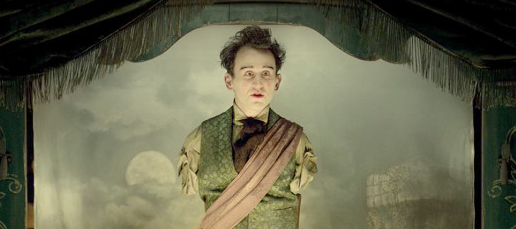
The best performance is Harry Melling’s in the Meal Ticket segment. Melling is best known as Harry Potter’s Dudley Dursling. He plays an itinerant performer who only speaks during his performances; Melling is startlingly brilliant in those performances and even better when he silently and fatalistically regards his competition.
Harry Melling in THE BALLAD OF BUSTER SCRUGGS
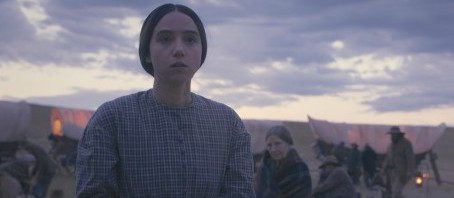
By far the best story is the saddest, The Gal Who Got Rattled, about a sad-eyed young woman (Zoe Kazan) who is following her delusional brother west, to what we all know will be heartbreak. Untethered by her obligation to the brother, she gets the Old West’s opportunity to remake her destiny until the Old West’s cruel chance intervenes.
The movie peters out in the ghostly last story, The Mortal Remains, despite Saul Rubinek’s delicious portrayal of a Frenchman in the Old West.
I don’t recommend The Ballad of Buster Scruggs for general audiences, but Westernphiles and fans of the Coen Brothers dark, dark humor will find it worthwhile viewing; it doesn’t rise anywhere near the level of the Coen’s best: Blood Simple, Fargo, A Simple Man, No Country for Old Men or True Grit. The Ballad of Buster Scruggs is playing in a few theaters and streaming from Netflix.
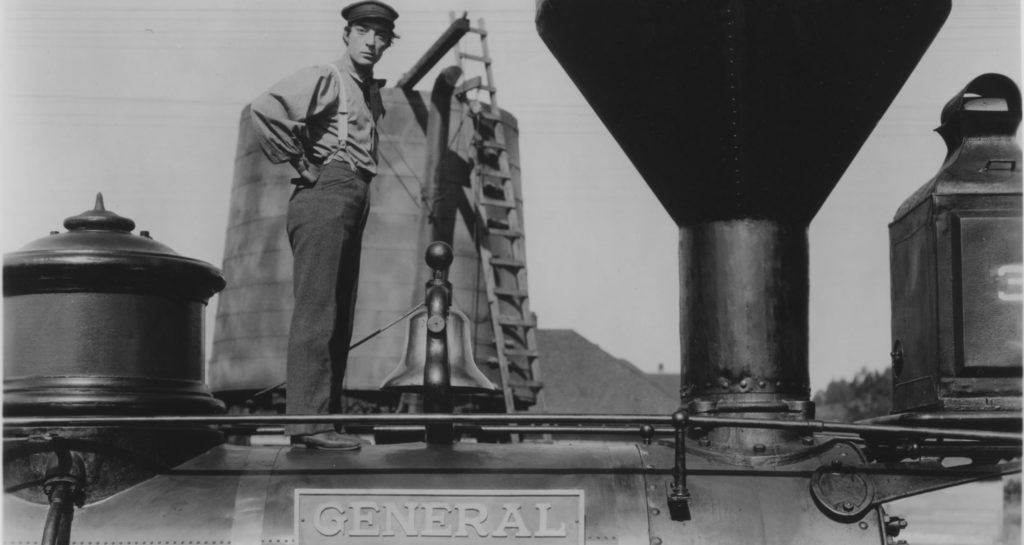
Buster Keaton’s THE GENERAL in THE GREAT BUSTER: A CELEBRATION. Courtesy of Cohen Media Group.
The documentary The Great Buster: A Celebration traces the life and career of the filmmaking genius Buster Keaton. Every chance I get, I recommend Keaton’s silent masterpieces Seven Chances and The General. But The Great Buster puts Keaton’s work in helpful context.
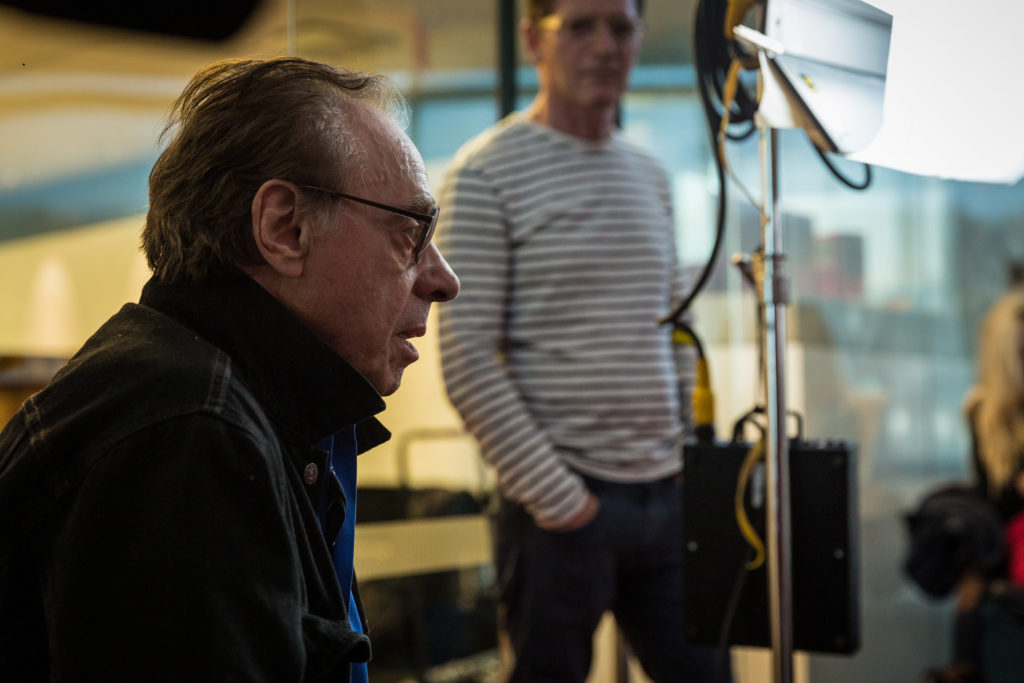
First, director/film historian Peter Bogdanovich introduces us to Keaton’s upbringing as the child star in his parent’s vaudeville act. This is a CRAZY story, about Keaton working one-night performances from the age of FOUR in an act where he was essentially a guided missile in a fake leprechaun beard.
Next we learn about the young adult Keaton being introduced to the movie business by San Jose’s own, Fatty Arbuckle, and then moving on to creating his own two-reelers. Then The Great Buster focuses on the ten great features on which Buster had complete creative control. And then Bogdanovich takes us through MGM’s mishandling of Keaton’s career and the resultant decline. I thought that I had a good handle on Keaton’s body of work, but The Great Buster is essential to understanding it.
The Great Buster gives us many cool tidbits from his work in TV commercials through his final happy marriage. And 100-year-old actor Norman Lloyd relates an anecdote about performing a scene in Limelight with Keaton and Charlie Chaplin.
Peter Bogdanovich in THE GREAT BUSTER: A CELEBRATION. Courtesy of Cohen Media Group.
The Great Buster: A Celebration opens this weekend in the Bay Area.
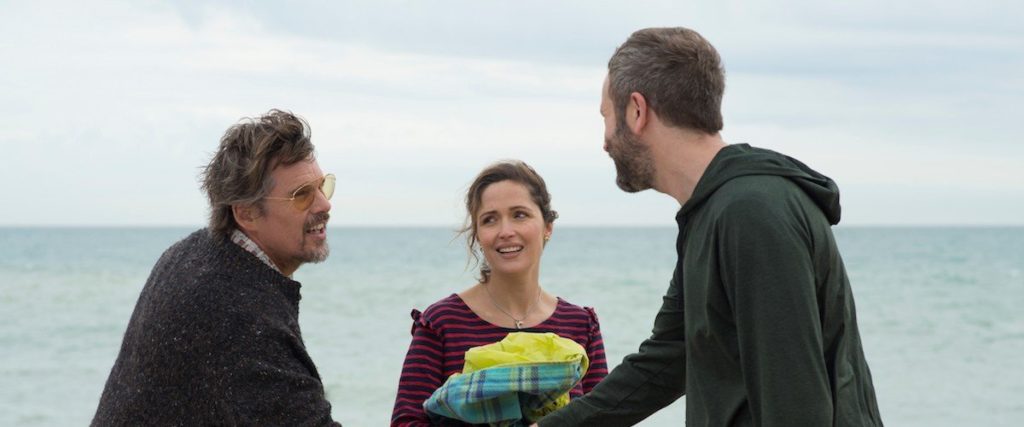
Ethan Hawke, Rose Byrne and Chris Dowd in JULIET, NAKED
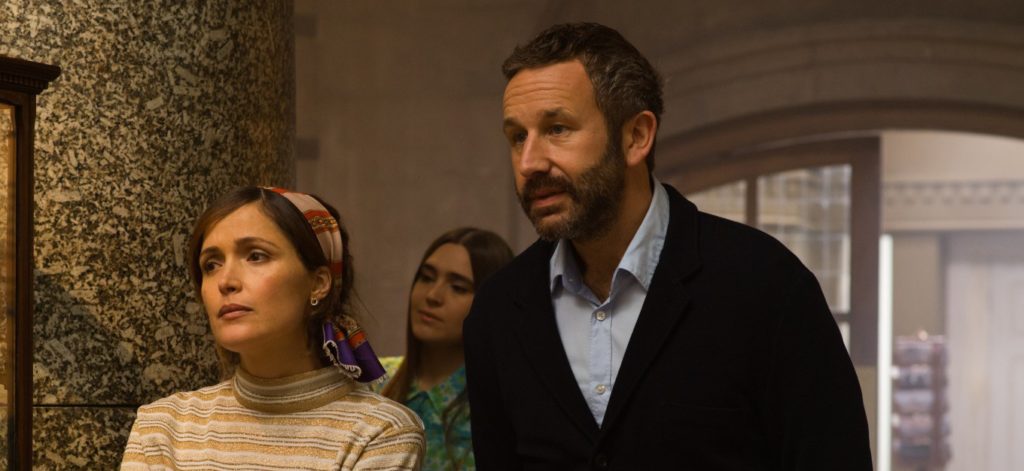
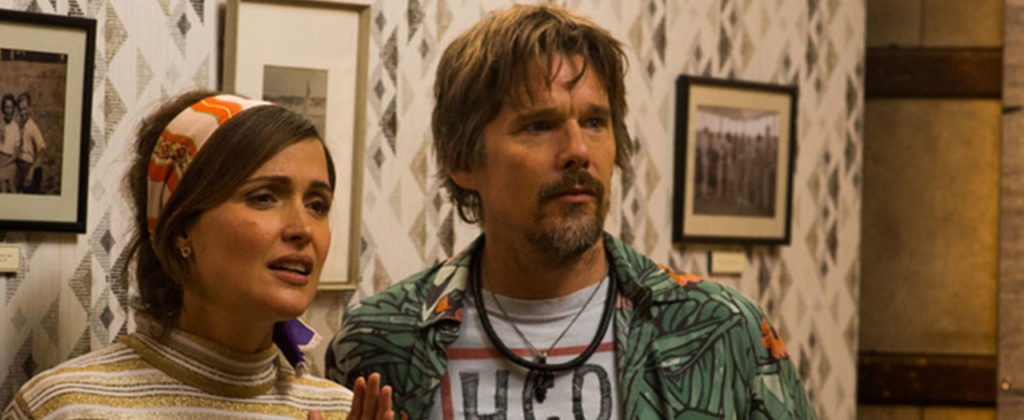
Rose Byrne, Ethan Hawke and Chris O’Dowd sparkle in the affable romantic comedy Juliet, Naked. This rom com has a fresh premise – boy loses girl and finds her pursued instead by his lifelong idol. But the core of the film is, is it ever too late to jump start your life?
Annie (Byrne) lives what has become a very unsatisfying life in a British beach resort. Upon her father’s death, she returned to her hometown to help raise her little sister and the take over her father’s tiny museum. She fell in love with the local professor Duncan (O’Dowd), and they’ve been living together for over a decade. But now the sister is grown, she’s outgrown the museum, and the self-absorbed Duncan just doesn’t care about her opinions or her wants. She’s very unhappy – and it’s all sneaked up on her.
Duncan, on the other hand, is completely fulfilled by his obsessive fandom for the pop singer-songwriter Tucker Crow, who disappeared into seclusion twenty years ago. He’s filled a room of their apartment with Tucker Crowe memorabilia, and lives for the online discussions that he moderates discussions on his Tucker Crowe website. He derives status and gratification from being the world’s leading self-appointed authority on Tucker Crowe. He is a major league bloviator. In the movies, O’Dowd always seems so lovable; here, he;s successful in stretching himself into an unsympathetic character.
Tucker Crowe (Hawke), is living in an exile of self-loathing. Whereas Annie has settled for a life she no longer wants, Tucker has blown his life up with bad choices. After fathering several kids with several mothers – and abandoning them – he is now trying for redemption as the stay-at-home dad for his youngest, an eight-year-old boy. It turns out that one act of bad behavior in particular has – to him – discredited all his hit songs.
Rose Byrne and Chris Dowd in JULIET, NAKED
A turn of events lead to Annie kicking out Duncan, and Annie and Tucker – two unhappy and lonely people – meet online. Comedy and romance ensues. Among the funnier moments are when Duncan meets Tucker in real life, when Tucker stumbles into Duncan’s Tucker Crowe shrine and when all of Tucker’s exes and progeny descend on Tucker and Annie in a hospital room.
Ethan Hawke, who is a fair musician, nails a sweet cover of The Kinks’ Waterloo Sunset. Hawke also performs many of the songs on the soundtrack, including a very fun punk anthem during the closing credits.
Rose Byrne and Ethan Hawke in JULIET, NAKED
Overall, I liked Juliet, Naked as an agreeable romp. The Wife recommends it as a home video watch, not for a special trip to the theater.
The Wife also said she was distracted by all the clumsy efforts to hide Rose Byrne’s pregnancy – extra-roomy dresses and Byrne’s awkwardly front-carrying duffels and all manner of objects. I didn’t notice, but Byrne did gave birth in November 2017, so I assume that The Wife was once, again, far more observant than I.
Isabelle Chester and Sam Sonenshine in THREESOMETHING
In the cheeky and original comedy Threesomething, Charlie (Sam Sonenshine) and his buddy Isaac (James Morosini) invite Charlies’ friend Zoe (Isabelle Chester) to engage in a three-way sexual encounter. That pitch alone is one of the funniest three-minute, fifteen-second, openings to a film I’ve seen in years. But then Threesomething finds the ridiculous moments in both the sex itself and in the all-consuming passion of new infatuation. After a crisp 72 minutes, Threesomething‘s ending is very fresh and non-formulaic, posing just enough ambiguity about the characters’ futures.
Co-writers Morosini and Sonenshine have identified the comic possibilities within the notion that a threesome is more or less symmetrical. Let me explain it this way. What if your idea of a threesome is three participants, but it evolves into two participants and a spectator?
Lust and love are such ripe sources of comedy because we humans are our most ridiculous when we are the most absorbed and single-minded – and that is definitively the case while having sex. And everyone’s sexual fantasies and fetishes – even if shared with one’s sexual partner – are laughable or creepy to someone else. Threesomething reaps the laughs from these situations without being sit-commy.
This is the Are you good? generation. Threesomething’s commentary on the compulsive over-checking in and over-supportiveness is all very sharply witty. And over-sharing is the core of Charlie’s relationship with his mother (Dru Mouser, who steals all of her scenes).
Sonenshine is just about perfect in his reactions during the threesome. He is fantastically gifted at playing both awkward discomfort and contained frustration.
Chester’s performance has several highlights, beginning with Zoe’s takes on the initial proposition and a particularly ill-timed outburst of weeping (inspired). As the story concludes, watch Chester’s face as Zoe considers and reconsiders how comfortable she really is in her choice of partner(s).
Threesomething is Morosini’s directorial debut and the first feature screenplay for both Morodini and Sonenshine. Comedy is hard to write, especially comedy as smart and original as this. I saw Threesomething’s world premiere at this year’s Cinequest. It is available to stream on Amazon, iTunes, Vudu, YouTube and Google Play.
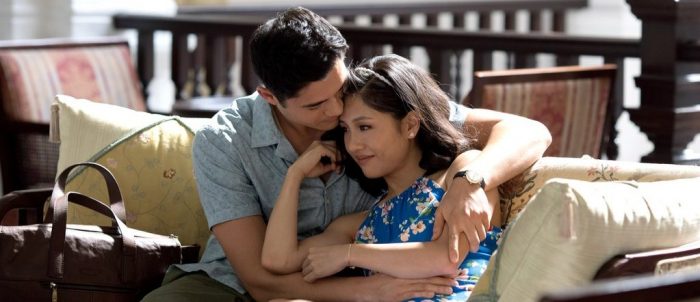
Henry Golding and Constance Wu in CRAZY RICH ASIANS
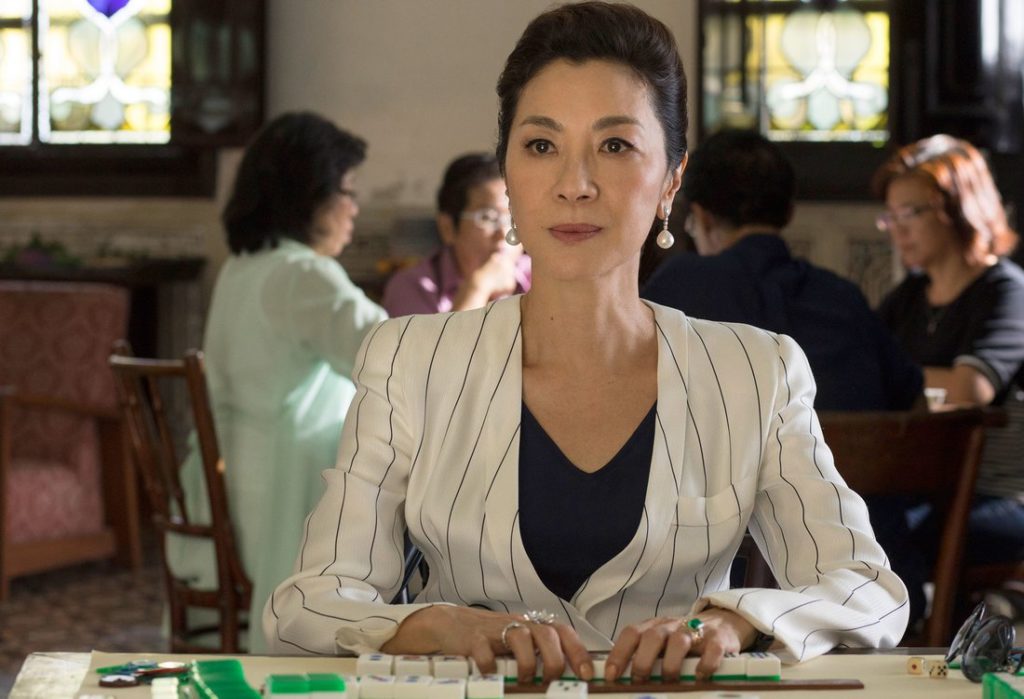
Crazy Rich Asians is wildly popular for a reason – it’s damn entertaining and probably the year’s most appealing date movie. Nick (the hunky Henry Golding) is getting serious about his New York girlfriend Rachel (Constance Wu) and wants to take her to meet his family in Singapore. Now Rachel, being a beautiful NYU economics professor who is fluent in multiple languages, is just about anybody’s ideal daughter-in-law. What Rachel doesn’t know is that Nick’s family is super, super rich – so rich that their set puts on $40 million weddings. The family matriarch, Nick’s mom Eleanor (Michelle Yeoh – the leading lady in Crouching Tiger, Hidden Dragon), is never going to approve Nick marrying an American, even a Chinese-American rock star like Rachel. As the lovers try to win over the formidably stern Eleanor, comic situations ensue. Will love prevail?
As you can tell, this story follows a familiar arc for a romantic comedy, but with an Asian cast, an Asian location and lots of Asian cultural references. But his isn’t a just rom com with a gimmick. Director John M. Chu keeps the pages turning quickly all the way through the two hours running time (a little long for this genre) without any slow spots. The three main characters are surrounded by wacky friends and family, and most of the biggest laughs come from the foibles of the supporting characters.
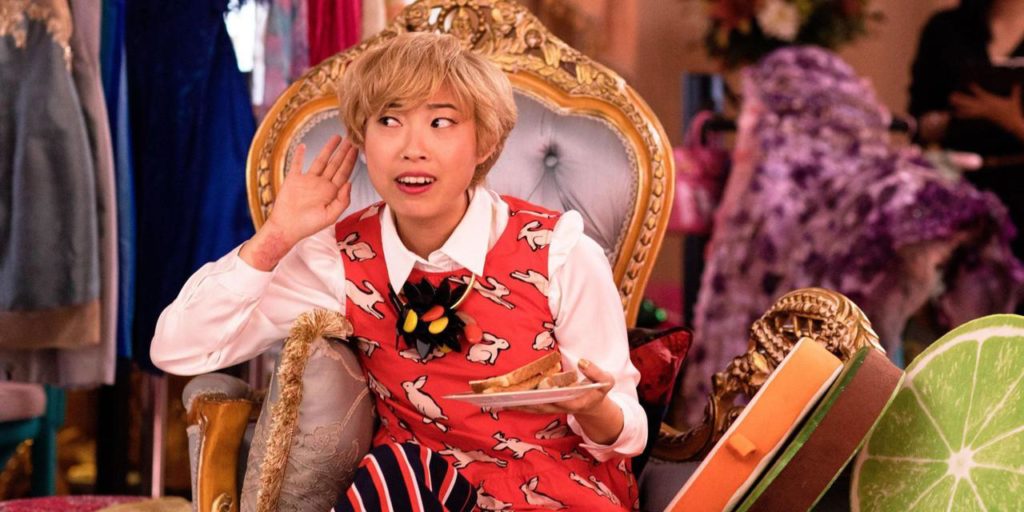
I saw this film in a heavily Asian audience, and Ken Jeong’s scenes in particular drew howls from the Asian crowd. The rapper Awkwafina, who has gotten good notices for her performance in Oceans Eight, is hilarious as Rachel’s zany friend. We’re going to be seeing a lot more of Awkwafina in the movies; she has Lucille Ball’s lasered-in earnestness.
Awkwafina in CRAZY RICH ASIANSMichelle Yeoh in Warner Bros. Pictures’ and SK Global Entertainment’s and Starlight Culture’s contemporary romantic comedy CRAZY RICH ASIANS, a Warner Bros. Pictures release.
The Asians in my audience also responded knowingly to the references to Chinese family traditions and parents’ relations to their adult children, much of which is, of course, also universal.
Crazy Rich Asians has some fine set pieces, including an over-the-top wedding where the bridal party wades down a flooded aisle – and a reception so decadent that it makes Baz Luhrmann’s The Great Gatsby look Amish. There’s also a mouth-watering street food scene in Singapore.
You’ll laugh, you’ll cry. Here’s the teaser (not the trailer because the trailer gives away two of the most impactful lines).