Stream of the Week: THREESOMETHING – original and cheeky

Isabelle Chester and Sam Sonenshine in THREESOMETHING

In the cheeky and original comedy Threesomething, Charlie (Sam Sonenshine) and his buddy Isaac (James Morosini) invite Charlies’ friend Zoe (Isabelle Chester) to engage in a three-way sexual encounter. That pitch alone is one of the funniest three-minute, fifteen-second, openings to a film I’ve seen in years. But then Threesomething finds the ridiculous moments in both the sex itself and in the all-consuming passion of new infatuation. After a crisp 72 minutes, Threesomething‘s ending is very fresh and non-formulaic, posing just enough ambiguity about the characters’ futures.

Co-writers Morosini and Sonenshine have identified the comic possibilities within the notion that a threesome is more or less symmetrical. Let me explain it this way. What if your idea of a threesome is three participants, but it evolves into two participants and a spectator?

Lust and love are such ripe sources of comedy because we humans are our most ridiculous when we are the most absorbed and single-minded – and that is definitively the case while having sex. And everyone’s sexual fantasies and fetishes – even if shared with one’s sexual partner – are laughable or creepy to someone else. Threesomething reaps the laughs from these situations without being sit-commy.

This is the Are you good? generation. Threesomething’s commentary on the compulsive over-checking in and over-supportiveness is all very sharply witty. And over-sharing is the core of Charlie’s relationship with his mother (Dru Mouser, who steals all of her scenes).

Sonenshine is just about perfect in his reactions during the threesome. He is fantastically gifted at playing both awkward discomfort and contained frustration.

Chester’s performance has several highlights, beginning with Zoe’s takes on the initial proposition and a particularly ill-timed outburst of weeping (inspired). As the story concludes, watch Chester’s face as Zoe considers and reconsiders how comfortable she really is in her choice of partner(s).

Threesomething is Morosini’s directorial debut and the first feature screenplay for both Morodini and Sonenshine. Comedy is hard to write, especially comedy as smart and original as this. I saw Threesomething’s world premiere at this year’s Cinequest.  It is available to stream on Amazon, iTunes, Vudu, YouTube and Google Play.

CRAZY RICH ASIANS: heckuva date movie

Henry Golding and Constance Wu in CRAZY RICH ASIANS

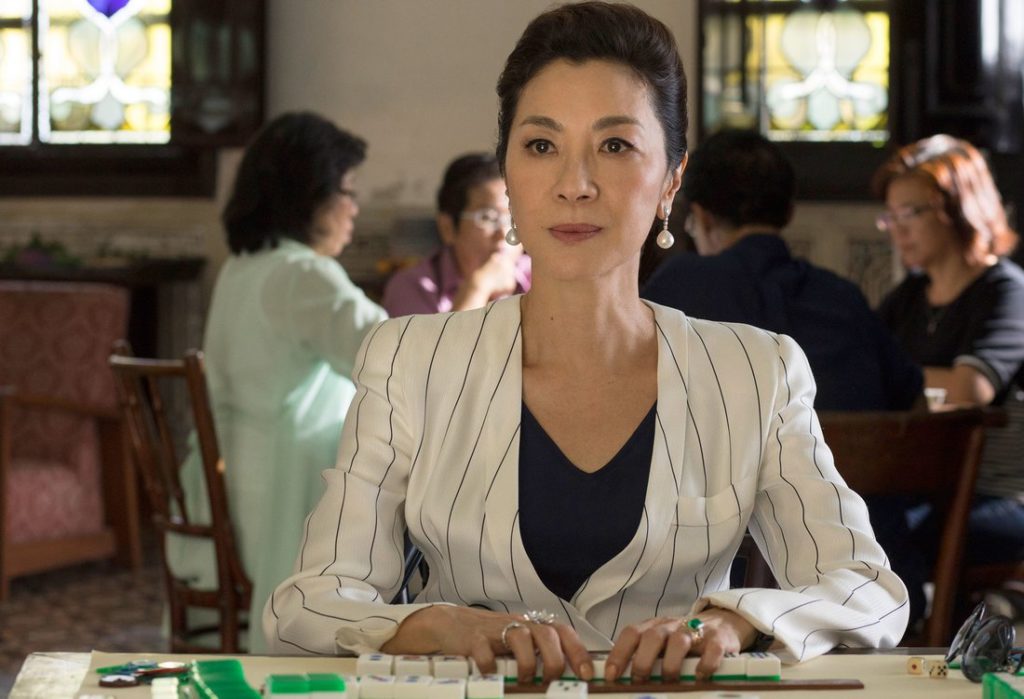
Crazy Rich Asians is wildly popular for a reason – it’s damn entertaining and probably the year’s most appealing date movie.  Nick (the hunky Henry Golding) is getting serious about his New York girlfriend Rachel (Constance Wu) and wants to take her to meet his family in Singapore.  Now Rachel, being a beautiful NYU economics professor who is fluent in multiple languages, is just about anybody’s ideal daughter-in-law.  What Rachel doesn’t know is that Nick’s family is super, super rich – so rich that their set puts on $40 million weddings.  The family matriarch, Nick’s mom Eleanor (Michelle Yeoh – the leading lady in Crouching Tiger, Hidden Dragon), is never going to approve Nick marrying an American, even a Chinese-American rock star like Rachel.  As the lovers try to win over the formidably stern Eleanor, comic situations ensue.  Will love prevail?

As you can tell, this story follows a familiar arc for a romantic comedy, but with an Asian cast, an Asian location and lots of Asian cultural references.  But his isn’t a just rom com with a gimmick.  Director John M. Chu keeps the pages turning quickly all the way through the two hours running time (a little long for this genre) without any slow spots.   The three main characters are surrounded by wacky friends and family, and most of the biggest laughs come from the foibles of the supporting characters.

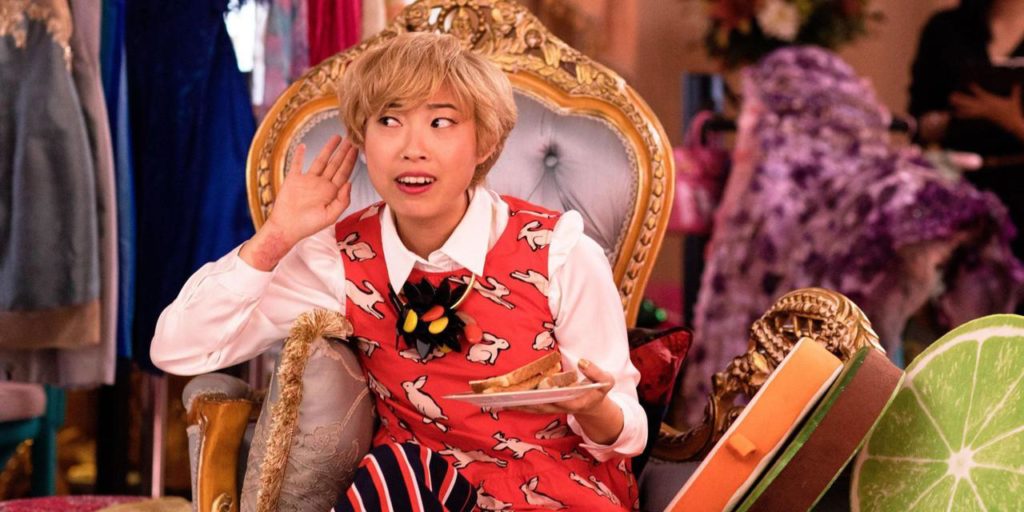
I saw this film in a heavily Asian audience, and Ken Jeong’s scenes in particular drew howls from the Asian crowd.  The rapper Awkwafina, who has gotten good notices for her performance in Oceans Eight, is hilarious as Rachel’s zany friend.  We’re going to be seeing a lot more of Awkwafina in the movies; she has Lucille Ball’s lasered-in earnestness.

Awkwafina in CRAZY RICH ASIANS
Michelle Yeoh in Warner Bros. Pictures’ and SK Global Entertainment’s and Starlight Culture’s contemporary romantic comedy CRAZY RICH ASIANS, a Warner Bros. Pictures release.

The Asians in my audience also responded knowingly to the references to Chinese family traditions and parents’ relations to their adult children, much of which is, of course, also universal.

Crazy Rich Asians has some fine set pieces, including an over-the-top wedding where the bridal party wades down a flooded aisle – and a reception so decadent that it makes Baz Luhrmann’s The Great Gatsby look Amish. There’s also a mouth-watering street food scene in Singapore.

You’ll laugh, you’ll cry. Here’s the teaser (not the trailer because the trailer gives away two of the most impactful lines).

BLACKKKLANSMAN: funny and razor sharp

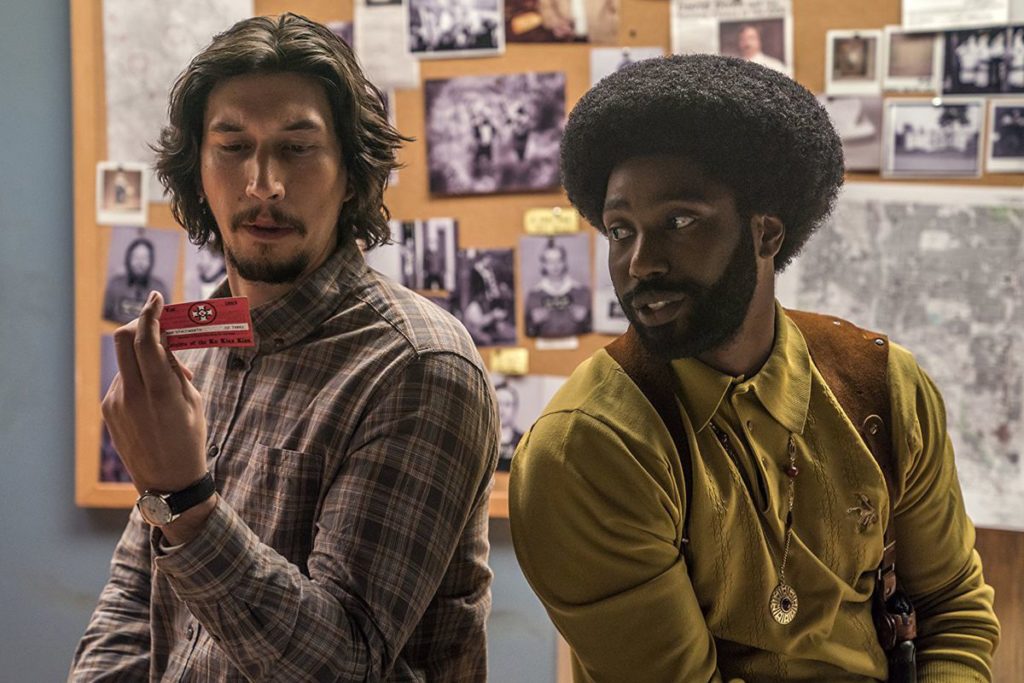
Adam Driver and John David Washington in BLACKKKLANSMAN

In BlacKkKlansman, Spike Lee takes the stranger-than-fiction story of Ron Stallworth and soars. Stallworth was a real African-American rookie cop in Colorado Springs who infiltrated the local Ku Klux Klan in the 1970s.

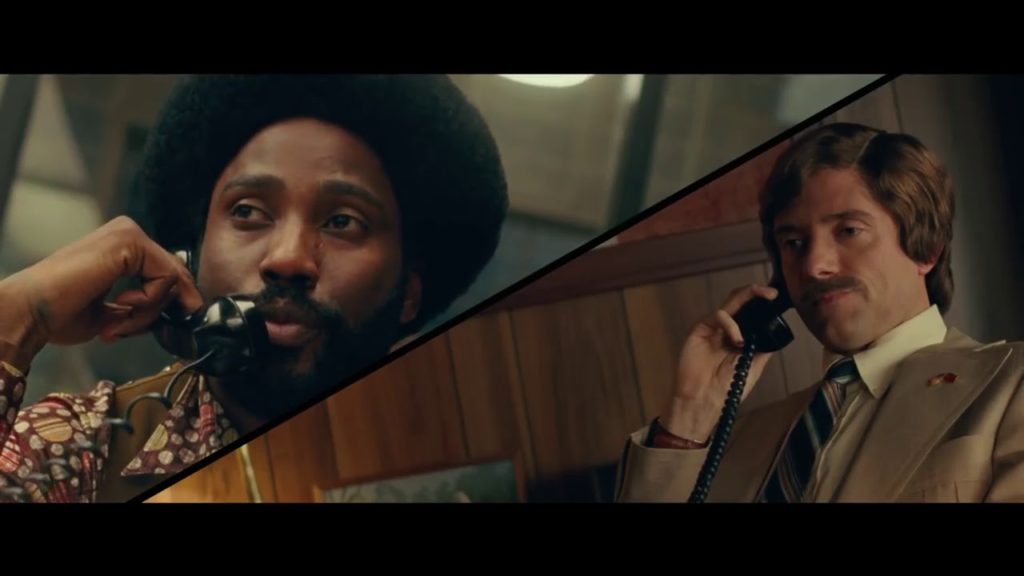
Stallworth (John David Washington) seduces the KKK with a racist rant on the telephone, and then has his white partner Flip Zimmerman (Adam Driver) impersonate him at the KKK meetings. Stallworth and Zimmerman race against the clock to quash KKK violence. Along the way, Stallworth tries to romance the comely cop-hating militant Patrice (Laura Harrier).

All of the actors are excellent, but it’s Spike Lee who is the star here, taking this oddball novelty story and transforming it into an exploration of hate in America – then and now.

The local KKK is a bunch of clowns. Paul Walter Hauser (Shawn in I, Tonya) plays a member of the Colorado Springs Klan posse, which tells you all you need to know about their efficacy. Suffice it to say that this gang who can’t burn a cross straight will get their comeuppance. Even their media-slick national leader, David Dukes (Topher Grace), is ripe for an epic prank.

As the moronic Klansmen bumble around and even name Stallworth their leader, BlacKkKlansman is riotously funny. But Spike makes it clear that racial hatred is not going to be wiped out in the 70s with the Colorado Springs KKK. When David Dukes lifts his glass to “America First”, it’s chilling.

At the end of the film, Spike lets go with his patented dolly shot, and we are sobered by a racist symbol unbowed. Then, Spike takes us seamlessly into the present with some actual scenes from contemporary America. It’s very powerful, and, when I saw it, many audience members wept.

John David Washington and Topher Grace in BLACKKKLANSMAN

Spike is inclusive – inclusive with intentionality – and this goes beyond the Ron/Flip buddy partnership. The Civil Rights movement benefited from Jewish support, and Black leaders like Thurgood Marshall and Martin Luther King Jr. worked hand-in-hand with Jewish colleagues. But Jews (and all whites) were less welcome in the Black Power age. In BlacKkKlansman, Spike makes it clear that African-Americans and Jews are natural allies in the struggle against bigotry, and seeks to revive the alliance.

Spike also celebrates the Afro.  BlacKkKlansman boasts the most impressive assembly of Afros, perhaps ever, especially Harrier’s.   Oscar Gamble, Franklyn Ajaye and Angela Davis would be proud.

Spike also masterfully employs period music to tell this story: Ball of Confusion, Oh Happy Day, and, of course,  Say It Loud -I’m Black and I’m Proud.  Somehow, he even found a place for Brandy (You’re a Fine Girl).  But Emerson Lake and Palmer’s Lucky Man may be the most perfectly placed song.  It’s all pretty stellar.

Spike Lee has made two cinematic masterpieces: Do the Right Thing and 25th HourBlacKkKlansman may not be a masterpiece, but it’s right at the top of Spike’s other films and it’s perfect for this age in America.

SORRY TO BOTHER YOU: audacious and savagely funny

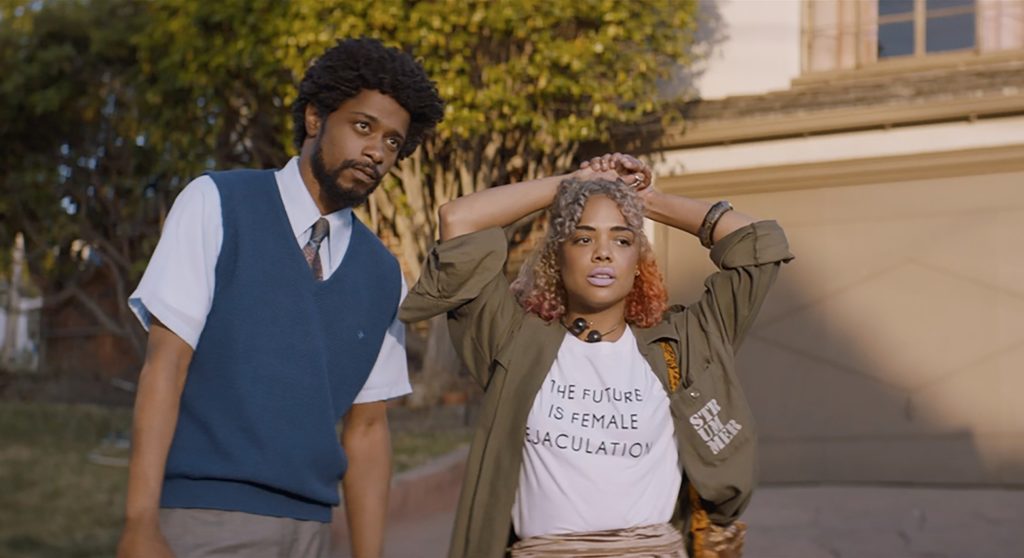
Lakeith Stanfield and Tessa Thompson in SORRY TO BOTHER YOU

The savagely funny social satire Sorry to Bother You rips both the excesses of 21st century capitalism and the popular response to those excesses – apathetic submissiveness.  This may be the most original American film of the year.

Sorry to Bother You is set with specificity in Oakland, but the story is about the greater corporate-dominated culture.  A sinister corporation named Worry Free flourishes by enlisting consumers to “lifetime contracts” for their employment and household needs; Worry Free clients/employees are provided for life with meals, housing (in barracks crammed with bunk beds) and clothing (hospital scrubs) in return for menial factory labor.  The Worry Free system, of course, is slavery.  Almost nobody cares about that – this is a vapid culture where the most popular TV game show is I Got the Shit Kicked Out of Me, where each week’s contestant is beaten and humiliated for mass entertainment.  Only the insurgent group Left Eye resists, with graffiti and guerilla actions.

Cassius (Lakeith Stanfield), a young man without prospects, is living in his uncle’s Oakland garage with his avant-garde artist girlfriend Detroit (Tessa Thompson).  Cassius is overjoyed to finally score a telemarketing job, even though his new boss explains that every applicant is hired.  Cassius’ telemarketing career is futile until he acts on a tip from an older colleague (Danny Glover) to “use your white voice”.  Suddenly, Cassius vaults to the top of the telemarketing world, and is promoted to make big money pitching Worry Free’s slave labor force to global manufacturers. This raises the question, when does “success” become “selling out”?

Complicating matters for Cassius, his former telemarketing buddies and Detroit take on The Man by organizing a union.  Cassius becomes both the butt of a viral YouTube video and estranged from his support system just as Worry Free’s founder (Armie Hammer) offers Cassius an even bigger opportunity.  Finding slavery not  profitable enough, Worry Free is about to launch what is horrifically called “the future of labor” – a sci-fi solution to create a work force “more durable and compliant” than human slaves.  If Cassius decides to expose the atrocities, how will the public react?

Sorry to Bother You is the first feature as writer-director for Bay Area artist and rapper Boots Riley,  It’s an impressive film debut for Riley, who has proven himself to be a first-rate social observer and satirist.

Lakeith Stanfield is excellent as the stoic, hunched Cassius, and so is the rest of the cast (Thompson, Glover, Steven Yuen, Omari Harwick, Germaine Fowler).  Armie Hammer’s performance as the unapologetically monstrous entrepreneur is delicious.  Kate Berlani sparkles as the new telemarketing “team leader”, who, having drank the Kool-Aid, spouts corporate management babble.

Sorry to Bother You is a riot – in the comedic sense and also as sociopolitical disruption.  Nary a joke goes awry, from Detroit’s self-crafted earrings to the security code in the corporate elevator.  And Riley plays a final joke for us (and on us) in the closing credits.

THE LAST MOVIE STAR: reflections on a famous life

Burt Reynolds and Ariel Winter in THE LAST MOVIE STAR

In The Last Movie Star, an aged action movie star (Burt Reynolds playing someone very similar to Burt Reynolds) examines his life choices.  It’s very funny and sentimental (in a good way).

Burt plays a thinly disguised version of himself – a retired movie star named Vic Edwards, who had played halfback at Tennessee instead of Burt’s Florida State.  The movie opens with opens with  a clip of the 70s Burt from the Smokey and the Bandit era.  But then there’s a stark cut to Burt today, looking every one of his eighty-two years.  Vic is in a depressing veterinary waiting room, about to get bad news about his pet.  We see that Vic lives a lonely existence, padding about his Beverly Hills home devoid of human recognition or contact.

Vic finds himself invited to be honored at a Nashville film festival.  Flattered and excited, he flies off to find that, instead of a ego-boosting tribute, the festival unleashes one indignity after another.  Humiliated and enraged, he  goes on a rogue road trip to his hometown of Knoxville, where he gets the chance to reflect on his life and make an important amend.

His road trip partner is his film festival driver, a nightmare of Millennial self-absorption, drama and bad attitude played by Ariel Winter (Alex Dunphy in Modern Family).   Winters’ character adds an Odd Couple thread to the comedy, and Winter brings down the house with a monologue on her history with psychotropic medication.

Director Adam Rifkin cleverly inserts the 82-year-old Burt into his own movies to interact with the 36-year-old Burt.  We see Burt as one of the greatest guests ever on Tonight Show with Johnny Carson.  And we see him in Deliverance, brandishing a bow-and-arrow and clad in a sleeveless neoprene vest – there has never been a more studly image in the history of cinema.

The key to Burt Reynolds’ appeal is that unique combination of virility, and charm, his stunning physicality leavened by his not taking himself too seriously.  I’m ridiculously handsome, and isn’t that just ridiculous?

If you’re going to be sentimental, then be unashamedly sentimental.  Rifkin takes this to heart, which makes The Last Movie Star so emotionally satisfying as well as so damn funny.

I saw The Last Movie Star at Cinequest, where it was warmly received by the festival audience.  The Last Movie Star was released theatrically for about a minute-and-a-half (and on only ONE screen in the Bay Area).    Fortunately, now you can stream it on Amazon, iTunes, Vudu, YouTube and Google Play.
Stream of the Week: THE WOMEN’S BALCONY – a righteous man must keep his woman happy

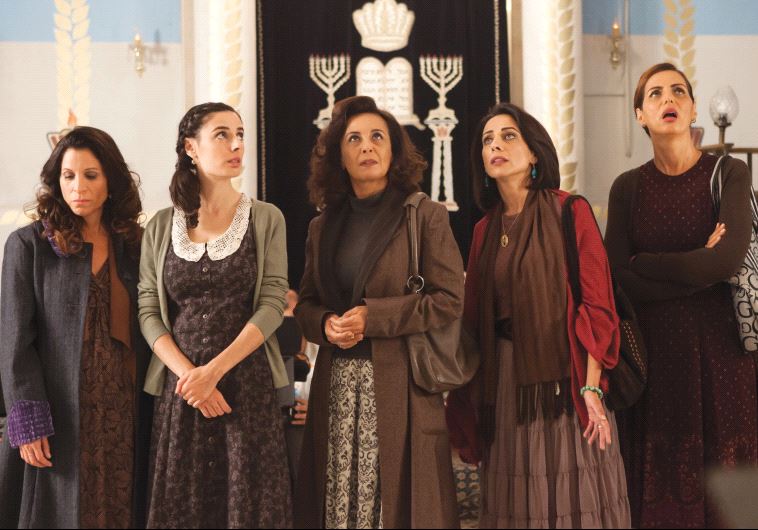
THE WOMEN'S BALCONY
THE WOMEN’S BALCONY

A community of women in a traditional culture revolt in the delightfully smart and funny Israeli comedy The Women’s Balcony. The balcony in a small Jerusalem synagogue collapses, and the building is condemned. The old rabbi’s wife is seriously injured, and he suffers a trauma-induced psychotic breakdown. Just when it looks like the leaderless congregation will die, a young and charismatic rabbi (Avraham Aviv Alush) appears, enlivens the congregation and repairs the building. But he rebuilds the synagogue WITHOUT the women’s section. Profoundly disrespected, the synagogue’s women strike in protest.

The women live in a culture where males have all the power and religious authority trumps all. The women all have their individually distinct gifts, personalities and rivalries. But they all appreciate the injustice of the situation, and they are really pissed off. They are very creative in finding way to leverage the power that they do have, and the result is very, very funny.

This could have been a very broad comedy (and a Lysistrata knock-off). Instead, it’s richly textured, with an examination of ethical behavior and loving relationships. It’s also dotted with comments on the relations between Israeli Orthodox and Ultra-Orthodox and on the importance of food in this culture. It’s the first – and very promising – feature for both director Emil Ben-Shimon and writer Shlomit Nehana.

THE WOMEN'S BALCONY
THE WOMEN’S BALCONY

There are plenty LOL moments, including a scene where one of the congregants masquerades as the demented old rabbi to secure the needed psychotropic meds.

We soon understand that the young rabbi has a very unattractive side – grossly sexist and power-hungry. But he has seduced the men and then cows them by manipulating his religious authority. He’s tearing apart a closely bound community braided together by decades of deep friendship and inter-reliance. The movie turns on whether the men can recognize when his supposed righteousness veers into what is really unethical and, in one pivotal scene with the old rabbi, indecent.

Two of the male characters, deeply in love with their women, step up and do the right thing. This overt comedy has a very a romantic core.

Most of all, The Women’s Balcony is about mature relationships. Most of these couples have been married for decades, especially the couple at the core of the story, Ettie (Evein Hagoel) and Zion (Igal Naor). Ben-Shimon and Nehana prove themselves to be keen and insightful observers of long-lasting relationships.

A righteous man must keep his woman happy. This may not be written in the Holy Scriptures, but it’s damn useful advice. (It also helps, we learn, if he can make a mean fruit salad.) The longer you’ve been married, the funnier you’ll find The Women’s BalconyThe Women’s Balcony is available to stream from Netflix Instant, Amazon, iTunes, Vudu, YouTube and Google Play.
TULLY: insightful, compelling and, finally, magical

Charlize Theron stars in Jason Reitman’s TULLY. Courtesy of SFFILM.

The compelling dark comedy Tully stars Charlize Theron, is written by Diablo Cody and directed by Jason Reitman. Those three combined on the underrated game-changing comedy Young Adult, and Tully is another very singular film.

Theron plays Marlo, a mom who has just given birth to her third child.  Her oldest kid has intense special needs and a newborn brings another level of obligation.  Marlo develops a serious case of depression.  To ease the burden, she gets a night nurse named Tully; Tully has an otherworldly quality which brings relief and respite to Marlo.  And then there’s a major plot twist…

Theron is a fearless actress – not afraid to glam down, She gained fifty pounds for this role (not as big a glam down as for Monster). In Young Adult, she was game to play a thoroughly dislikable character. Here she plays a real Mom, not a Perfect Mom. In real life, caregiving can take its toll, and that’s what we see here.

Mackenzie Davis brings a magical quality to the character of Tully.  Ron Livingston is very good as a loving but clueless husband; ill-equipped to recognize, let alone deal with Marlo’s depression.

Tully was featured at the San Francisco International Film Festival (SFFILM) (although I missed it because I was at the Leave No Trace screening);  Theron and Reitman attended the SFFILM screening, and, from all reports,  Theron wowed the crowd.

Tully is an excellent and insightful film.  It’s a dark comedy and NOT A LIGHT MOVIE – after all, with all its laughs, it’s about postpartum depression.

QUALITY PROBLEMS: a screwball comedy for the sandwich generation

QUALITY PROBLEMS
Brooke Purdy in QUALITY PROBLEMS

The remarkably successful dramedy Quality Problems plunges us into a contemporary world that most of us in the sandwich generation recognize – a life so busy that the relative importance of our stress-inducers can blur. Something like the cake for your kid’s birthday party can seem as important as paying the bills or dealing with an aging parent. Until cancer reshuffles the deck. Quality Problems‘ insights in navigating modern life are accessible because it’s so damn funny.

Bailey (Brooke Purdy) and Drew (Doug Purdy) are a couple in their early forties with two school-age kids. Each is comfortable taking on one child-rearing or domestic task while handing off a competing responsibility to their partner. Each knows – and accepts – what the partner is – or is NOT – good at. Both have wicked senses of humor, and they are affectionate and even playful. Their relationship has weathered the usual financial and parental challenges, along with an episode where Bailey beat back breast cancer.

Brooke Purdy wrote the screenplay and also co-directed with Doug Purdy. The breezy banter between characters is often flat-out hilarious. This is not sitcom-grade humor, it’s much closer to a Hawksian screwball comedy. The characters deal with cancer and parental dementia with a dark humor that is realistic and funny.

Bailey’s single neighbor and bestie Paula (Jenica Bergere) is an essential member of the family’s support structure, but Paula and Drew loathe each other. Chained together because of their attachment to Bailey and the kids, every interaction sparks a new round of insults. This isn’t good-natured teasing – the jibes, in particular about his job and her reproductive health, are aimed to hurt. The Paula-Drew relationship adds some edginess to the mix and contributes to the film’s authenticity.

Watch for an uncredited cameo by the prolific and versatile character actor Alfred Molina (Raiders of the Lost Ark, Love Is Strange). Veteran Chris Mulkey is excellent as Bailey’s dad, who is sinking into dementia.

Quality Problems is the directing debut for Brooke and Doug Purdy, and I attended its world premiere at Cinequest.  Quality Problems can now be streamed from Amazon Prime, iTunes, Vudu, YouTube and Google Play.
DVD/Stream of the Week: YOUNG ADULT – comedy game-changer

Charlize Theron in YOUNG ADULT

This weekend, Charlize Theron stars in Tully, from screenwriter Diablo Cody (Juno) and director Jason Reitman (Thank You for Smoking, Juno, Up in the Air).  Seven years ago, in Young Adult, this same team challenged the current mode of comedy itself. They turned many comic conventions on their heads in this nastily dark comedy, and Young Adult was on my list of Best Movies of 2011.

Played by Charlize Theron, the main character is stunningly non-empathetic, utterly self-absorbed and thoroughly unpleasant. She was the prom goddess in her small town high school, and has moved to the city for a job with a hint of prestige. With a failed marriage, a looming career crisis and no friends, she’s drinking too much and is in a bad place. So she decides to return to her hometown and get her old boyfriend (Patrick Wilson) back – despite the fact that he’s gloriously contented with his wife and newborn infant.

Naturally, social disasters ensue. Along the way, the story probes the issues of happiness and self-appraisal.

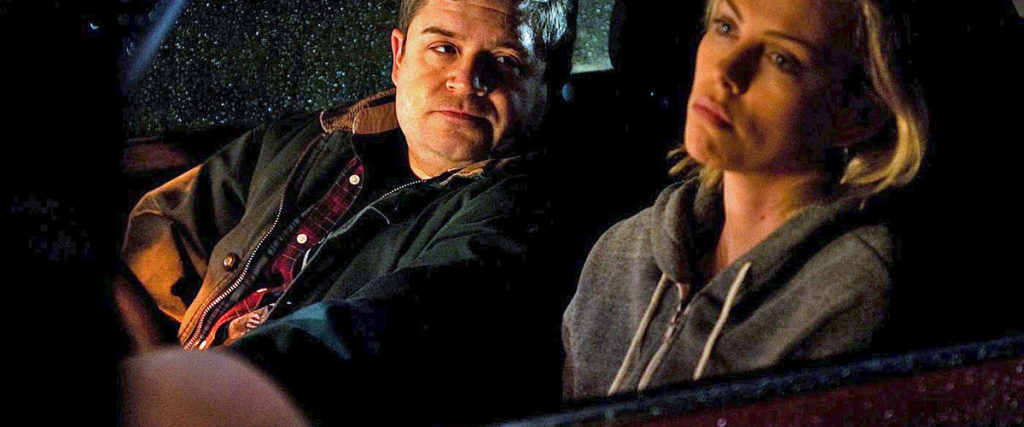
Patton Oswalt and Charlize Theron in YOUNG ADULT

Patton Oswalt is wonderful as someone the protagonist regarded as a lower form of life in high school, but who becomes her only companion and truth teller.

Young Adult is inventive and very funny. Its cynicism reminds me of a Ben Hecht or Billy Wilder screenplay (high praise). Note: This is NOT a film for someone expecting a light comedy. Young Adult is available on DVD from Redbox and streaming from Amazon, iTunes, Vudu, YouTube and Google Play.
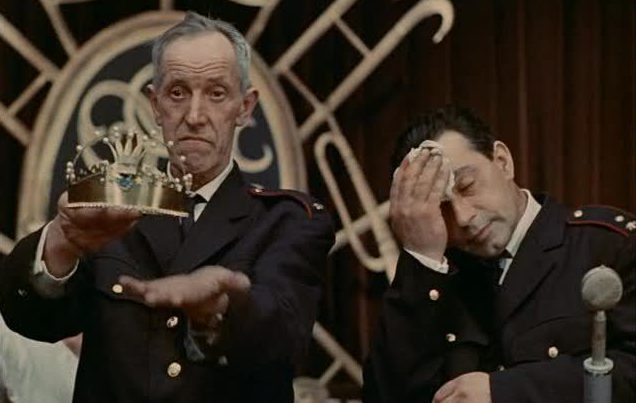
DVD/Stream of the Week: THE FIREMEN’S BALL

THE FIREMEN’S BALL

As a tribute to the great director Miloš Forman, who just died at age 86, this week’s video pick is Forman’s 1967 Czech comedy The Firemen’s Ball.  Forman came of age in Communist Czechoslovakia, and the prevalent thread in his films was the challenging, even mocking, of authority.  That’s what The Firemen’s Ball is all about.

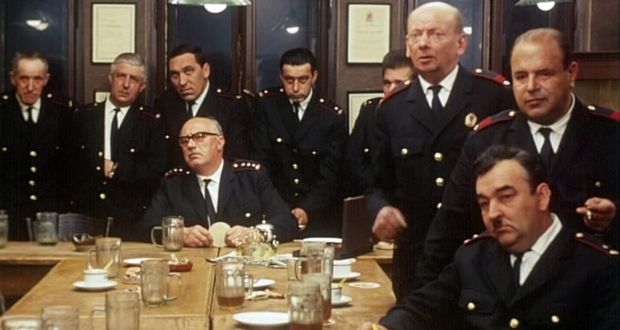
It’s a comedy of errors set during the annual ball of a small town fire brigade. It’s an obligatory occasion, and everyone is just going through the motions. No one is willing or able to do what they are supposed to be doing, whether it is protecting the raffle prizes or even putting out fires. The film eviscerated the moral bankruptcy of the Communist society.

The bumbling old farts on the ball committee try to put on a beauty contest, and they shanghai a bunch of young women in attendance and parade them around the committee room to prep them for the pageant.  The Wife was offended by the sexism of the scene, but she didn’t stick around to see the committee get their comeuppance when the contestants themselves blow up the Big Announcement and turn the committee members into objects of ridicule.  Stick with it – the whole movie is only 73 minutes long.

In his youth, Forman lived through the Nazis, who he described as evil, and the Communists, who he described as absurd.  Indeed, the Czech ruling Politburo did recognizer themselves in The Firemen’s Ball’s bumbling firemen’s ball committee, and they concocted a pretext to ban the film in Czechoslovakia.

The Firemen’s Ball (which is also sometimes listed as The Fireman’s Ball) can be streamed from Amazon Prime and rented on DVD from Netflix. It’s only one hour, thirteen minutes long, and it’s a hoot.

THE FIREMEN’S BALL