THE FOUNDER: moneygrubbing visionary

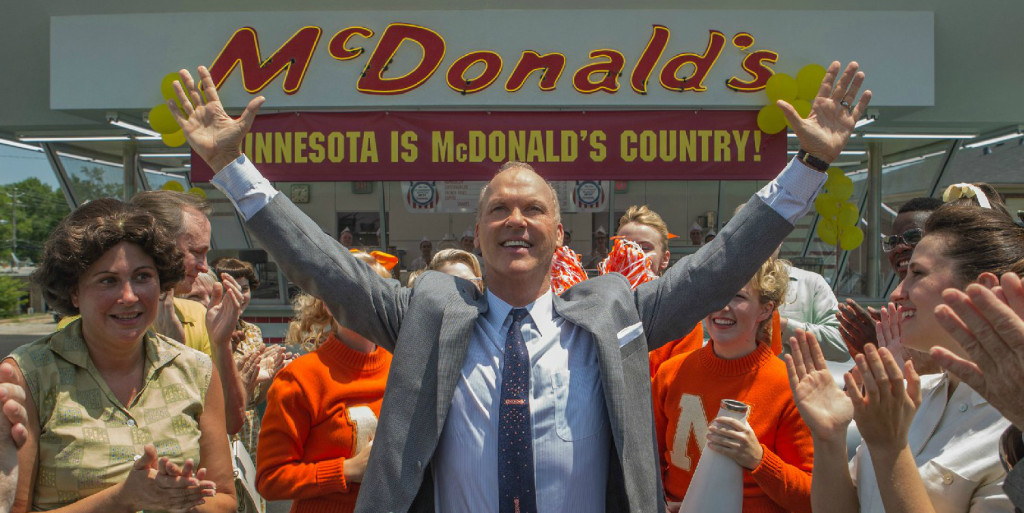
Michael Keaton in THE FOUNDER

In the enjoyably addictive The Founder, Michael Keaton brings alive Ray Kroc, the man who created the global corporate superpower that is McDonald’s.  It’s both a vivid portrait of a particular change-maker and a cold-eyed study of exactly what capitalism really rewards.

Speaking of capitalism, it’s hard to imagine a truer believer than Ray Kroc, not even Willy Loman.  When we meet Kroc, he is grinding through small town America selling milkshake mixers none too successfully.  Each night he retires to yet another dingy motel for heavy doses and Early Times bourbon and a motivational speaker on his portable record player.

Then Kroc stumbles across the McDonald brothers Dick (Nick Offerman) and Mac (John Carroll Lynch).  In their Riverside, California, hamburger stand, the McDonald brothers invented the industrialization of food service, their achievement being “fast food” as we know it today.  One the most fascinating sequences in The Founder is a flashback of the McDonald brothers designing the most efficient fast food kitchen possible with chalk on a tennis court.  The brothers are passionate about their business, equally devoted to their product and their customers.

Kroc falls in love.  Having driven through every town in the country as a traveling salesman, he can appreciate the untapped market.  He persuades the brothers to let him take over franchising McDonald’s restaurants.  It turns out that that the 50ish Kroc is well-equipped for the job because he’s driven, absolutely ruthless and always on the verge of desperation.  He HAS to succeed.  Kroc is hungry, perpetually hungry, and learns to identify potential franchisees who are not complacent investors, but are who are also driven enough to accept his discipline and run each franchise by the numbers.  Egotistical as he is, Kroc is also smart enough to adopt a brilliant idea from someone else – the key to making McDonald’s his.
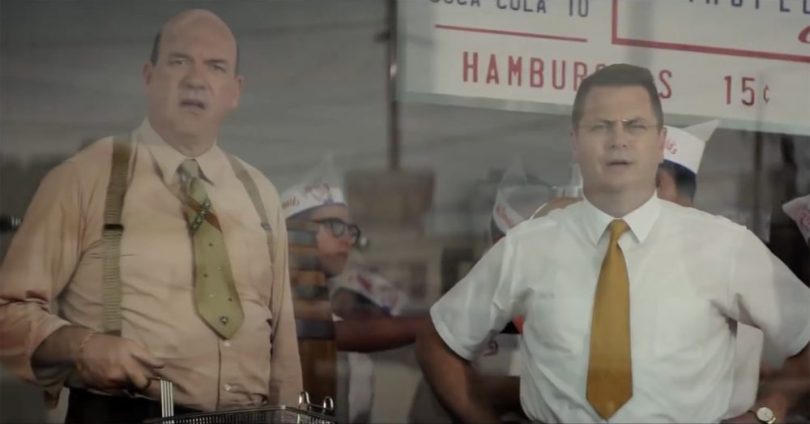
John Carroll Lynch and Nick Offerman in THE FOUNDER

Dick McDonald is a humorless detail freak with brilliant ideas; Mac is the conflict-avoidant, supportive brother, always unruffling Dick’s feathers and keeping their options alive.  Both are proud and true to their values.  The McDonald brothers are authentic American business geniuses, but are they too principled to fight off a double cross by Kroc?

In much of the movie, Dick is on phone with Mac listening to Dick’s side of the conversations.  Both Nick Offerman and John Carroll Lynch are superb, but Lynch’s performance  is Oscar-worthy.  There’s a “handshake” scene where WE know and MAC knows that he is going to get screwed, and Lynch’s eyes in those few seconds are heartbreaking.

As far as I can tell, The Founder is very historically accurate.  Thanks to screenwriter Robert D. Siegel (The Wrestler) and director John Lee Hancock (The Blind Side),  we also meet some other historical characters – Harry Sonneborn, Fred Turner, June Martino and Joan Smith Kroc – and appreciate their contributions to the McDonald’s business.

The Founder’s Ray Kroc is shitty to his wife (Laura Dern), shitty to his partners and, basically, shitty to his core.   But we HAVE to keep watching him.  Do we root for him  because only HE can build this empire?  We Americans have a heritage of empire building.  And the idea of someone building something so big and so successful with only his smarts, persistence and opportunism is irresistible to us.

This is a good movie.  I’ll even watch The Founder again.  And I’ll have fries with that.
JACKIE: dreary and somnolent

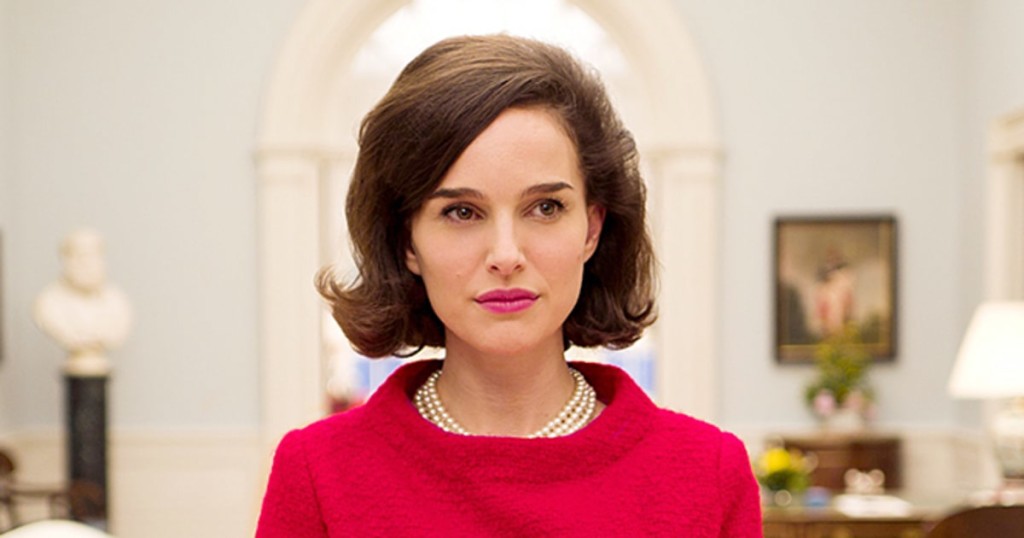
Natalie Portman in JACKIE

If you put a Chanel suit and pillbox hat on Natalie Portman and direct her to speak breathily, you’ve got Jackie Kennedy, which is noteworthy, but not enough reason to see the dreary Jackie.  Portman superbly paints the portrait intended by director Pablo Larrain (No), but that vision is unconvincing and not at all compelling.

Larrain’s thesis is that Jackie moved from shocking grief to a fierce determination to enhance her husband’s legacy in the three days after the assassination, intentionally creating the brand of “Camelot”.  He interweaves three stories: the assassination and funeral, Jackie’s later Hyannis Port interview with journalist Theodore H. White and a re-enactment of the First Lady’s televised White House tour.

Despite a remarkable impersonation by Portman, none of this really works.  Jackie ranges from dreary to gloomy, and in case we forget, we’re prodded by an intrusive score of sad, really sad discordant music.   One can imagine several cellists committing suicide after performing this score.

The real Jackie was bred to be a docent, and her confident White House tour was a television triumph.  Yet Jackie’s Jackie acts like she needed one more Xanax to make it through without a breakdown.  I didn’t believe Jackie’s bitter cat-and-mouse with the journalist, either.

Portman is exceptional at playing the on-top-of-the-world celebrity First Lady, the stunned and shattered victim and the laser-focused widow.  John Hurt is excellent as a consoling priest.  Greta Gerwig plays Jackie’s confidante Nancy Tuckerman, and manages  to avoid blame for ruining a movie by herself for the first time.  This is not the actors’ fault – it’s Larrain’s.

I’ll describe a movie with the word “somnolent” for the first time on this blog because I actually did drift off to sleep twice.  It would have been just once, but The Wife prodded me awake both times.

[SPOILER ALERT:  Bad history in historical movies enrages me, and there are two examples that appear in the last ten minutes of Jackie.  First, as Jackie is preparing to move out of the White House, we see Ladybird Johnson actually fingering the fabric for new curtains, which CERTAINLY did not happen for a variety of reasons, chief among them being that Ladybird was too decent.  Second, we see a flashback of JFK spinning Jackie around a White House dance floor like a polka king; of course, JFK’s chronic back condition did not allow him to move like that.]

THE BANDIT: a buddy movie about a buddy movie

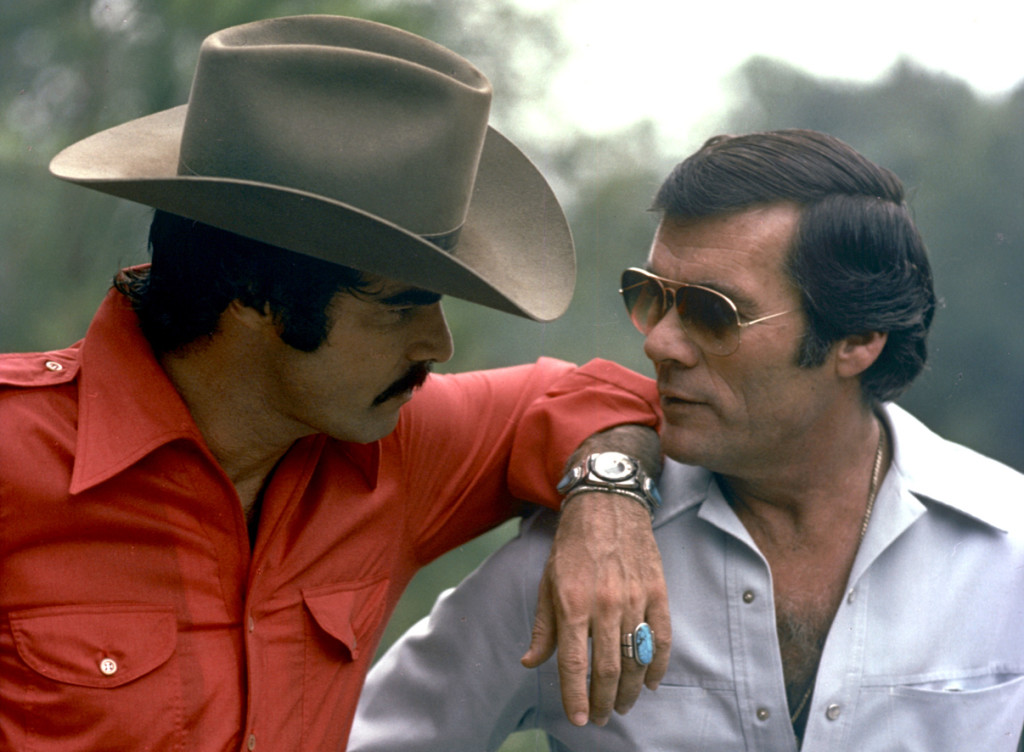
Burt Reynolds and Hal Needham in THE BANDIT. Photo courtesy of the San Francisco Film Society.

Writer-director Jesse Moss describes The Bandit as “a buddy movie about a buddy movie”, and he’s right. The buddies are mega-star Burt Reynolds and his stuntman/friend/roommate Hal Needham, who directed the enormously successful Smokey and the Bandit franchise.

Needham, one of only two stuntmen with an Oscar, is arguably cinema’s greatest stunt performer and stunt coordinator. Reynolds did many of his own stunts, and we we see some hard, hard falls in The Bandit. But Burt did nothing to nothing to match Needham, whose FIRST career stunt was jumping off an airplane wing to tackle a rider off his horse. We see many instances where Needham became a LITERAL car crash test dummy.

One of The Bandit’s highlights is the Needham stunt that broke his back – jumping a car off a dock and onto a barge – and slamming into the barge a little short.

There’s rich source material here from Burt’s garage (Reynolds calls it “King Tut’s Tomb for documentarinans”), which stored tapes back to 1956.

For added color, Needham and Reynolds were epic partiers, who embraced and exemplified the Mad Men era. Needham was a vivid character and lived a helluva life. I strongly recommend Terry Gross’ Fresh Air interview with Needham.

Hal’s widow told Bay Area filmmaker Jesse Moss that Needham hated documentaries because they were boring, so Moss aimed to make a documentary that Hal would enjoy. Indeed, The Bandit opens with the sly Reynolds, in maroon leisure suit with flared pant legs, mocking his own image outrageously. And, it’s a hoot throughout.

(Moss’ first movie was at San Francisco’s Castro Theater in 1979, when his dad took him a double feature of Erroll Morris’ Gates of Heaven and Hardware Wars, a documentarian born!)

I saw The Bandit at its premiere at the San Francisco International Film Festival (SFFILM). It played on TV channel CMT, and now can be streamed on Amazon, Vudu, YouTube and Google Play.

ALL THE WAY: LBJ comes alive

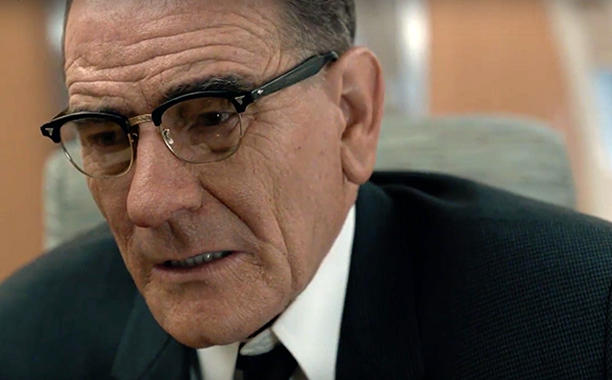
Bryan Cranston in ALL THE WAY

Lyndon B. Johnson, one of American history’s larger-than-life characters, finally comes alive on the screen in the HBO movie All the Way. Bryan Cranston (Breaking Bad, Trumbo) is the first actor who captures LBJ in all his facets – a man who was boring and square on television but frenetic, forceful and ever-dominating in person.  All the Way traces the first year in LBJ’s presidency, when he ended official racial segregation in America with the Civil Rights Act of 1964.

LBJ was obsessed with gaining and keeping political power, and he was utterly ruthless and amoral about the means to do that. His tools of persuasion included deceit, flattery, threats, promised benefits and horse-trading. He was equally comfortable in playing to someone’s ideals and better nature as well to one’s vanity or venality. In All the Way, we see one classic moment of what was called “the Johnson treatment”, when LBJ looms over Senator Everett Dirksen, and it becomes inevitable that Dirksen is going to be cajoled, intimidated or bought off and ultimately give LBJ what he wants.

LBJ was so notoriously insincere that one of the joys of All the Way is watching LBJ tell completely inconsistent stories to the both sides of the Civil Right battle. Both the Civil Rights proponents (Hubert Humphrey and Martin Luther King, Jr.) and the opponents (the Southern Senators led by Richard Russell) must determine whether LBJ is lying and to whom. Each of them must make this calculation and then bet his own cause on his perception of LBJ’s real intentions.

But LBJ amassed power for two reasons – he needed to have it and he needed to do something with it. Along with the LBJ’s unattractive personal selfishness and the political sausage-making that some may find distasteful, All the Way shows that Johnson did have two core beliefs that drove his political goals – revulsion in equal parts to discrimination and poverty. We hear references to the childhood poverty that led to the humiliation of his father, to the plight of the Mexican schoolchildren in Cotulla, Texas, that he mentored as a young man, and his outrage at the discriminatory treatment suffered by his African-American cook Zephyr.

Bryan Cranston brilliantly brings us the complete LBJ – crude, conniving, thin-skinned, intimidating and politically masterful. Besides Cranston’s, we also see superb performances by Melissa Leo as Lady Bird, Anthony Mackie as MLK, Bradley Whitford as Hubert Humphrey and Frank Langella as Richard Russell.

All the Way is remarkably historically accurate. It does capsulize some characters and events, but the overall depiction of 1964 in US history is essentially truthful. As did Selma, All the Way drills down to secondary characters like James Eastland and Bob Moses. We also see the would-be scandal involving LBJ’s chief of staff Walter Jenkins, a story that has receded from the popular culture. Vietnam is alluded to with a reference to the Gulf of Tonkin incident, which is fitting since Vietnam grew to become LBJ’s nemesis and the national obsession only after the 1964 election.

All the Way was adapted from a Broadway play for which Cranston won a Tony. I saw three movies in theaters last weekend and none of them were as good as All the Way. LBJ’s 1964 makes for a stirring story, and All the Way is a compelling film. Seek it out on HBO.

BORN TO BE BLUE: aching to get clean

BORN TO BE BLUE
BORN TO BE BLUE

In Born to Be Blue, Ethan Hawke plays jazzman Chet Baker as he seeks to overcome his heroin addiction and mount an artistic comeback.

Writer-director Robert Budreau made the successful choice to start the story when Baker had hit bottom in the mid-1960s.  Baker is relearning how to play the trumpet after his teeth were smashed by an angry creditor.  Now he’s living in his girlfriend’s VW van and playing for free in a pizza joint, trying to work his way back up to a marquee venue and a recording deal.  We see his 1950s glory days in flashback.

In a typically outstanding performance, Ethan Hawke makes us root for this guy, even as we cringe at the likelihood that his disease is going to find a way to destroy him.  If you’ve seen Before the Devil Knows You’re Dead, you know that Hawke is a master at playing unreliable characters – which makes him a perfect choice for a junkie like Chet Baker.  Still, in a bowling alley scene, we glimpse the Chet Baker charm that could attract a woman who certainly knew better.  Hawke convincingly fingers the horn as we hear the real Chet Baker play;  Hawke himself sings on Baker’s signature vocal numbers Over the Rainbow and My Funny Valentine.

Carmen Ejogo (Coretta Scott King in Selma) is also excellent as two of the women in Baker’s life.

This movie’s elephant in the room is Baker’s addiction to heroin, about which he says, “It makes me happy”.  Some very incisive scenes with his father hint at the roots of Baker’s disquiet.  The people closest to Baker want him to kick the habit, but, unfortunately, more than he wants to himself.  As he clings on with his fingerprints, Born to Be Blue is achingly effective.

I SAW THE LIGHT: but the theater was projecting this dull movie

I SAW THE LIGHT
I SAW THE LIGHT

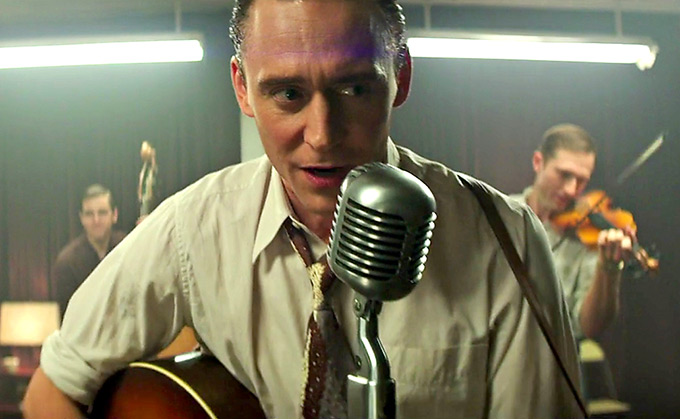
You really can’t blame Tom Hiddleston, Elizabeth Olson or any of the cast for the unremitting dullness of the biopic I Saw the Light.  The life of Hank Williams, Sr. was so filled with pathos and singular achievement that it should inspire a captivating movie.  After all, Hank’s songwriting genius (36 hits and six #1 songs in only six years) catapulted him from the obscurity of backwater Alabama to national celebrity.  Being a womanizing alcoholic with chronic back pain made him a less than ideal husband, resulting in martial carnage.  And his meteoric career ended when he died in the back seat of his Cadillac at age twenty-nine.  Now THAT’S a compelling life story.

Unfortunately, neither the singularity of Hank’s talent nor the urgency of his self-destructiveness comes through in the series of vignetted in I Saw the Light.  Marc Abraham is an able producer (The Commitments, The Hurricane, Children of Men) – writer-director not so much.  Halfway through, I was contemplating where to dine afterwards.

As Hank, Hiddleston impersonates Hank’s singing voice well and brings a special gleam to the performances.  But he can’t enliven this plodding movie.

LIFE: James Dean without the charisma

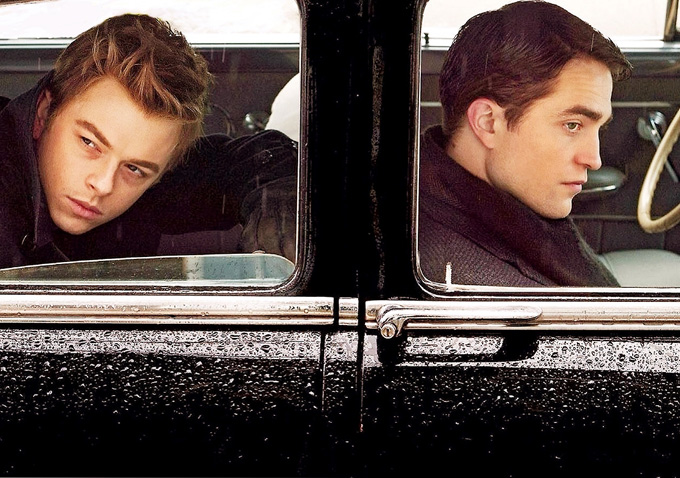
Dane DeHaan and Rovert Pattinson in LIFE
Dane DeHaan and Robert Pattinson in LIFE

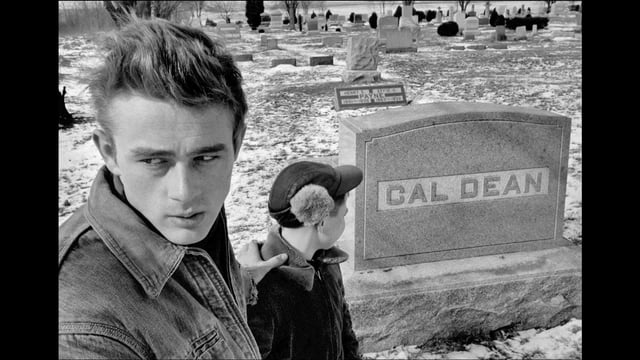
In 1955, James Dean wasn’t yet an icon.  East of Eden was in the can but hadn’t been released, and Dean was trying to get cast in Rebel Without a Cause.   To the extent he was known in popular culture, it was as Pier Angeli’s red carpet date at movie premieres.  The free-lance photographer Dennis Stock was convinced that Dean was fascinating, and Stock followed Dean around New York and to Dean’s Indiana home town.  The resulting photos in LIFE magazine (one is below) were indeed iconic, and the film LIFE follows the two men in this episode.

LIFE is moderately interesting because Dean was such a character. And it’s an interesting time in cinema and we get glimpses of Angeli (Alessandra Mastronardi), Nicholas Ray, Natalie Wood, Julie Harris, Elia Kazan and Lee Strasberg.  Ben Kingsley has a fun turn as Jack Warner, a mogul who has dealt with many a temperamental artist and is more than a match for any of them.

The problem with LIFE is that it’s about one of the most charismatic actors in film history.  Dane DeHaan captures Dean’s mannerisms very well, and we see Dean as interesting, charming, insecure, infuriating, bratty and striving.  But we don’t see him suck all of the oxygen out of the room.  We don’t experience Dean’s charisma.

Now I am a big fan of Dane DeHaan, who was absolutely brilliant in Kill Your Darlings.  He’s a fine, fearless and promising actor and a real original.  It’s not his fault that he’s not James Dean.

Robert Pattinson plays James Stock, and his stoniness sure doesn’t help.  I still don’t understand why Twilight fans find him to be so dreamy.  Kelly McCreary of Grey’s Anatomy plays Eartha Kitt, the one character whose dazzling persona pierces this otherwise bland movie.

LIFE is available to stream from Amazon Video, Vudu, YouTube and Google Play.

Dennis Stock photo of James Dean

DVD/Stream of the Week: AMY – emotionally affecting and thought-provoking

AMY
AMY

Amy, documentarian Asif Kapadia’s innovative biopic of singer-songwriter is one of the most heart-felt and engaging movies of the year.

In a brilliant directorial choice, Amy opens with a call phone video of a birthday party. It’s a typically rowdy bunch of 14 year-old girls, and, when they sing “Happy Birthday”, the song is taken over and finished spectacularly by one of the girls, who turns out to be the young Amy Winehouse. It shows us a regular girl in a moment of unaffected joy and friendship, but a girl with monstrous talent.

In fact ALL we see in Amy is footage of Amy. Her family and friends were devoted to home movies and cell phone video, resulting in a massive trove of candid video of Amy Winehouse and an especially rich palette for Kapadia.

We have a ringside seat for Amy’s artistic rise and her demise, fueled by bulimia and substance addiction. In a tragically startling sequence, her eyes signal the moment when her abuse of alcohol and pot gave way to crack and heroin.

We also see when she becomes the object of tabloid obsession. It’s hard enough for an addict to get clean, but it’s nigh impossible while being when harassed by the merciless paparazzi.

Amy makes us think about using a celebrity’s disease as a source of amusement – mocking the behaviorally unhealthy for our sport. Some people act like jerks because they are jerks – others because they are sick. Winehouse was cruelly painted as a brat, but she was really suffering through a spiral of despair.

The Amy Winehouse story is a tragic one, but Amy is very watchable because Amy herself was very funny and sharply witty. As maddening as it was for those who shared her journey, it was also fun, from all reports. Everyone who watches Amy will like Amy, making her fate all the more tragic.  It’s available to rent on DVD from Netflix and Redbox and streaming on Amazon Instant, iTunes, Vudu, YouTube and Google Play.

BLACK MASS: psychopathy and ambition is a nasty combination

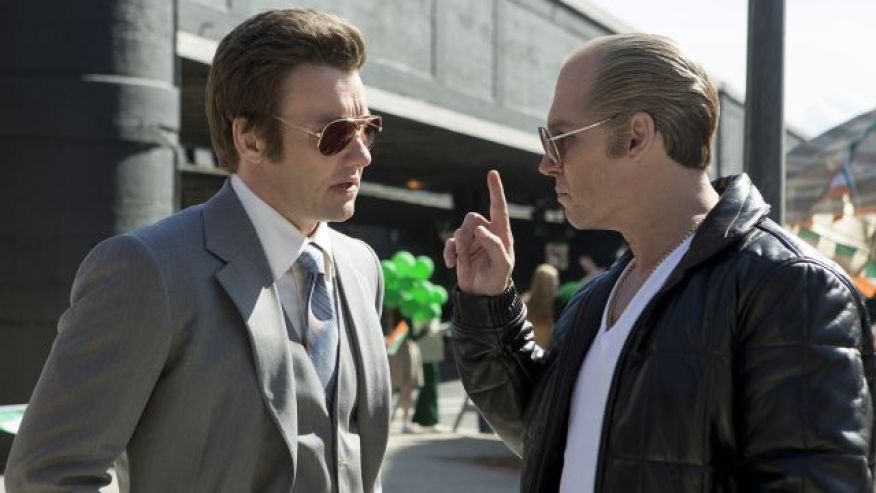
Joel Edgerton and Johnny Depp in BLACK MASS

The excellent crime drama Black Mass tells the true life story of how gangster James “Whitey” Bulger built his Boston Irish gang into a major crime empire under the protection of the FBI.  As if we needed an illustrative example, Bulger is proof that psychopathy and ambition is a really nasty combination.  And, as Black Mass points out with the FBI characters, even ambition alone can prove to be a vulnerability.

Here’s what really happened:  Bulger (Johnny Depp), the ruthless leader of the Winter Hill Gang in South Boston was approached by FBI agent John Connolly (Joel Edgerton) for help in eradicating Boston’s Italian Mafia.   Connolly was as ambitious as Bulger, and the two men shared Southie  roots.  It was in Bulger’s interest to rid himself of the competition, and he parlayed Connolly’s career-climbing grasping into a de facto amnesty that allowed Bulger to expand his murderous enterprises throughout Boston and beyond – even to Florida jai alai and gun running to Northern Ireland.

It’s an amazing tale, and director Scott Cooper (Crazy Heart) tells it very well, letting Depp and Edgerton drive the story by inhabiting a pair of characters that become a toxic mixture.  With an erect swagger and some of the coldest eyes in cinema history, Johnny Depp is superb as the feral Bulger.  The trailer below includes his life lesson to a small boy around the family breakfast table that shows his world view.  When the eyes go cold, Depp’s Bulger can terrorize with a touch, a word or even just a glance.

Joel Edgerton is equally effective as the corrupted FBI agent Connolly, who uses Southie bombast and bluster to escape the snares of office politics.  Alas,  it all finally catches up to him when a new prosecutor directs fresh eyes on Boston’s crime scene.  Until recently, I’ve known Edgerton as an Australian action star (he was the the Navy Seal team leader in Zero Dark Thirty and one of the thugs in Animal Kingdom). Edgerton recently wrote, directed and stared in the excellent psychological thriller The Gift, and his performance in Black mass reinforces that he’s a very talented and versatile filmmaker.

The cast is very deep and uniformly excellent, including Julianne Nicolson, Juno Temple, Kevin Bacon, Benedict Cumberbatch, Corey Stoll (Midnight in Paris and House of Cards) and Dakota Johnson.  Besides Depp and Edgerton, three other actors popped off the screen for me:

  • Rory Cochrane plays Bulger’s partner Steve Flemmi.  Cochrane is a veteran actor whose most memorable role is probably as the pothead Slater in Dazed and Confused.  Now filled out in middle age, he plays a guy who is about half of Depp’s scenes, but says very, very little.  As they say, the best acting is reacting, and Cochrane just chews gum and observes, letting his eyes tell us what he is thinking and feeling.
  • David Harbour plays Connolly’s FBI partner, a guy who becomes entangled in a web not of his own doing.  One of the most riveting scenes in Black Mass, he becomes terrorized about, of all things, a recipe for a steak marinade.  Harbour is a reliable veteran, but this is among his very best work.
  • Peter Sarsgaard is always brilliant, and here he gets to become a tweaked out lowlife who involuntarily giggles when he thinks that getting handed a valise full of cash is a good thing when it’s not.

Black Mass is a top rate crime story very well-told.  No more and no less.

One more thing:  there is a string of up-close-and-personal murders depicted here, including two by strangulation and a host of gunshot executions.  It’s not particularly gruesome by the standards of modern crime movies, but DON’T TAKE YOUR 4-YEAR-OLD.  A couple at my screening did just that.  What are people thinking?

DVD/Stream of the Week – LOVE & MERCY: a tale of three monsters and salvation

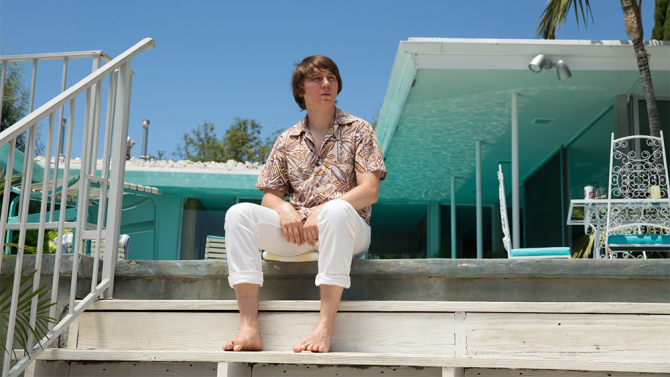
Paul Dano as Brian Wilson in LOVE & MERCY

Love & Mercy, the emotionally powerful biopic of the Beach Boys’ Brian Wilson, is the true life story of an extraordinarily gifted person facing three monsters. Wilson is a musical genius, one of the great songwriting, arranging and producing talents of his century. But his art and his very survival were tested by his tormentors until unselfish love found him an escape to treatment, and, ultimately, his salvation.

In his first feature as a director, veteran producer Bill Pohlad chose to depict two phases of Wilson’s life, with Wilson played by Paul Dano and John Cusack.

The first monster is Wilson’s father Murry (Bill Camp), an abusive father whose adult sons still fear after they have fired him as their manager. What kind of father needs to belittle and sabotage his sons so he doesn’t have to acknowledge that their success surpasses his own? Brian Wilson is deaf in one ear from his father’s punches, but the psychological scars are even more deeply felt.

The second monster is Brian’s own schizoid affective disorder, a condition causing auditory hallucinations. Brilliantly, Pohlad has chosen to let the audience hear what Brian hears. This can be thrilling in moments of musical inspiration. And, of course, it is terrifying most of the time.

The third monster is charlatan psychologist Dr. Eugene Landy (Paul Giamatti), a Svengali-like manipulator, who over-medicates Brian, then confines him, while controlling and watching his every move. Landy leeches off Brian’s fortune and is ruthlessly protective of his racket.

Murry and Landy are so scary that Beach Boy Mike Love, known to be (and portrayed here as) a colossal jerk, almost seems sympathetic by comparison.

In the younger Dano segments, we see Brian at his creative peak, emotionally tortured by Murry and about to be driven into a breakdown by his condition. In the middle-aged Cusack parts, we see Brian, broken down by his illness, utterly helpless against and captive to Landy’s web of control.

Dano shows us Brian’s vulnerable genius. Cusack shows us Brian as gentle and genuine. The story of Love & Mercy is about how he escapes being under the thumb of his monsters, chiefly from the perspective of Melinda Ledbetter (Elizabeth Banks), the woman who would become his second wife. As good as are Dano and Cusack, Banks is absolutely stellar; her character must continually react to the unpredictability of Brian’s illness and the increasing horror of Landy’s tyranny.

From the beginning, Love & Mercy sweeps us up into the highs and lows of Brian Wilson’s life – and it’s a helluva life. Love & Mercy is one of the Best Movies of 2015 – So Far. Watch the end credits all the way to the end.

Love & Mercy is available on DVD from Netflix and Redbox and streaming from Amazon Instant Video, iTunes and Vudu.