Photo caption: Pierre Niney in THE COUNT OF MONTE-CRISTO. Courtesy of Samuel Goldwyn Films.
The French epic The Count of Monte Cristo is a relentlessly entertaining three hour plunge into betrayal, revenge and forgiveness – and some spectacular French real estate. Alexander Dumas published the original adventure novel 185 years ago, and it’s been made into over 100 movies and episodic series. This version, by writer-directors Alexandre de La Patelliere and Matthieu Delaporte, is pretty fun, and gorgeous to look at.
The sweeping story spans 24 years, beginning in 1815 when the protagonist, Edmond Dantes, (Pierre Niney) is nineteen years old and on the verge of a wonderful life. A seafaring prodigy, he has just earned the captaincy of his own ship, which will earn him affluence, and he’s about the marry the stunningly beautiful love of his life. But three other jealous and resentful men manufacture a false charge and railroad into a life sentence of solitary confinement in a remote island dungeon. Before he know what has hit him, Dantes has been suddenly and unjustly stripped of everything he had or could have had.
After languishing in hopeless squalor for six years, he makes contact with another prisoner who has a plan for an escape – but it will take them another eight years to implement. In The Count of Monte-Cristo‘s most thrilling scene, he manages a skin-of-the-teeth escape. He then tracks down an immense medieval fortune and returns to France with a new identity – the Count of Monte-Cristo – and the power and status of great wealth.
He can no take revenge on the three men who betrayed him, but killing them is not enough for Dantes – this is not the kind of revenge movie that we’re used to. Dantes needs to break them completely – he needs to deprive them of their wealth, their status, their families and their own sense of self-worth. To do that, he creates and manipulates an elaborate web of traps.
The base assumptions and societal mores of early 19th century France, of course, are utterly anachronistic to our modern sensibilities , but de La Patelliere and Delaporte make Dantes’ situation relatable. The first two hours of the story is remarkably adherent to the source material. De La Patelliere and Delaporte reworked the some of the revenge devices at the end, but they were true to Dumas’ overall story arc. And, who, these days, has actually read the original? (I’ll admit that I have only read the Classics Illustrated comic book as a boy.)
De La Patelliere and Delaporte, along with cinematographer Nicolas Bolduc make this a visually splendid film, aided by impressive chateaus, period costumes and the attractive cast.
Niney is an able enough actor to carry the film, appearing in 90 percent of the scenes and aging 24 years. The rest of the cast is fine, too, with Patrick Mille sparkling as the ever-grinning, vile speculator Danglers, one of Dantes’ three main targets.
The Count of Monte-Cristo is available to watch for free on kanopy and to rent from Amazon,AppleTV, YouTube and Fandango. There are many similar titles, including a 2025 mini-series,so be sure to get the 2024 French movie with the hyphen in the title.
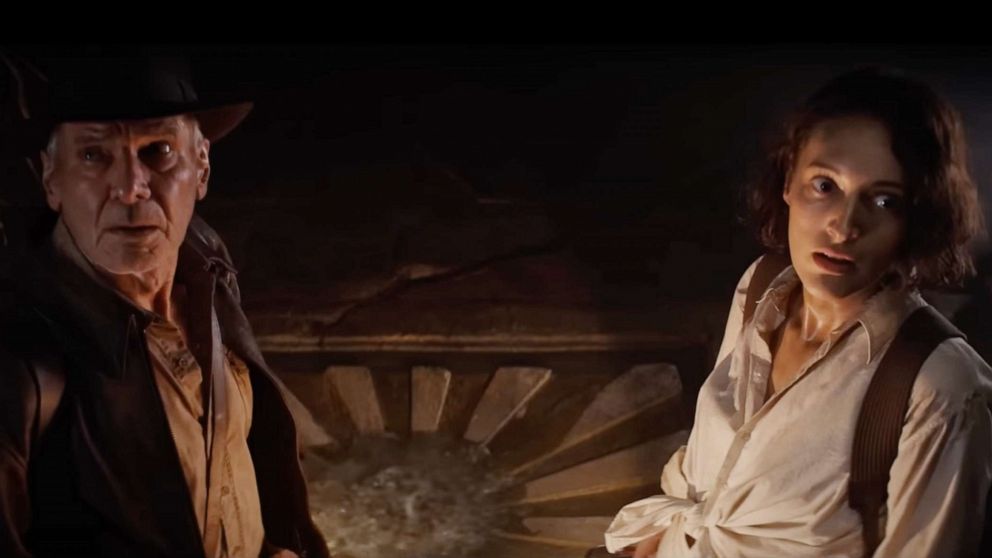
Photo caption: Harrison Ford and Phoebe Waller-Bridge in INDIANA JONES AND THE DIAL OF DESTINY. Courtesy of Walt Disney Studio Motion Pictures.
What everyone wants out of the new Indiana Jones and the Dial of Destiny is to enjoy Harrison Ford’s relatable Indiana Jones survive a series of harrowing chases, and director James Mangold’s Dial of Destiny delivers. This is pure entertainment.
The opening set piece in Raiders of the Lost Ark was breathtaking to audiences in 1981, and the opening of Dial of Destiny meets that standard. Once again, the plot has the characters, good guys, bad guys and, this time, an ambiguously-motivated woman, hunting an archaeological MacGuffin. Once again, they cover the globe, dipping from thrilling action set piece to thrilling action set piece. As in Raiders, history’s worst actual villains, the Nazis, make for the best movie villains.
Harrison Ford is 80-years-old and convincingly plays Indy at the approximate ages of 41 in 1945 and 65 in 1969. The filmmakers de-aged him by four decades with astounding computer effects. I totally suspended disbelief and never thought about Indy being decades younger than Ford now is. I will say that Harrison Ford can move his body with remarkable suppleness for an 80-year-old.
Fitting for a movie with its star playing forty years younger, the story revolves around time travel.
Phoebe Waller-Bridge, the creator and star of Fleabag, co-stars as Helena, the daughter of Indy’s old pal; Helena is as smart and daring as Indy, and even more obsessive. Helena’s motives, however, are in question and Waller-Bridge brings the needed edginess to the role. Future Raiders sequels starring Waller-Bridge are possible.
Mads Mikkelsen, one of my favorite screen actors, plays the villain, a guy who aspires to be more effective than Hitler. Mikkelsen, who often plays villains in big budget Hollywood thrillers, is a brilliant actor in a wide range of Scandinavian movies, having delivered some of the best performances of the past two decades in After the Wedding, The Hunt, Another Round, and Riders of Justice.
Shaunette Renée Wilson makes a compelling presence early in the film as a mysterious secret agent. As expected, Toby Jones, Antonio Banderas come through with solid performances. There are sentimental and rewarding cameos by Ford’s Raiders of the Lost Ark co-stars Karen Allen and John Rhys-Davis.
Ethann Isidore ably plays Helena’s 12-year-old partner-in-crime. Since Ke Huy Quan played Indy’s child sidekick in Temple of Doom 38 years ago and won an acting Oscar THIS YEAR, let’s not dismiss Ethann as a one-hit-wonder.
The enormous henchman is played by Dutch actor Olivier Richters, who really is a 7 foot 2 bodybuilder.
Indiana Jones and the Dial of Destiny is just a whole lotta fun.
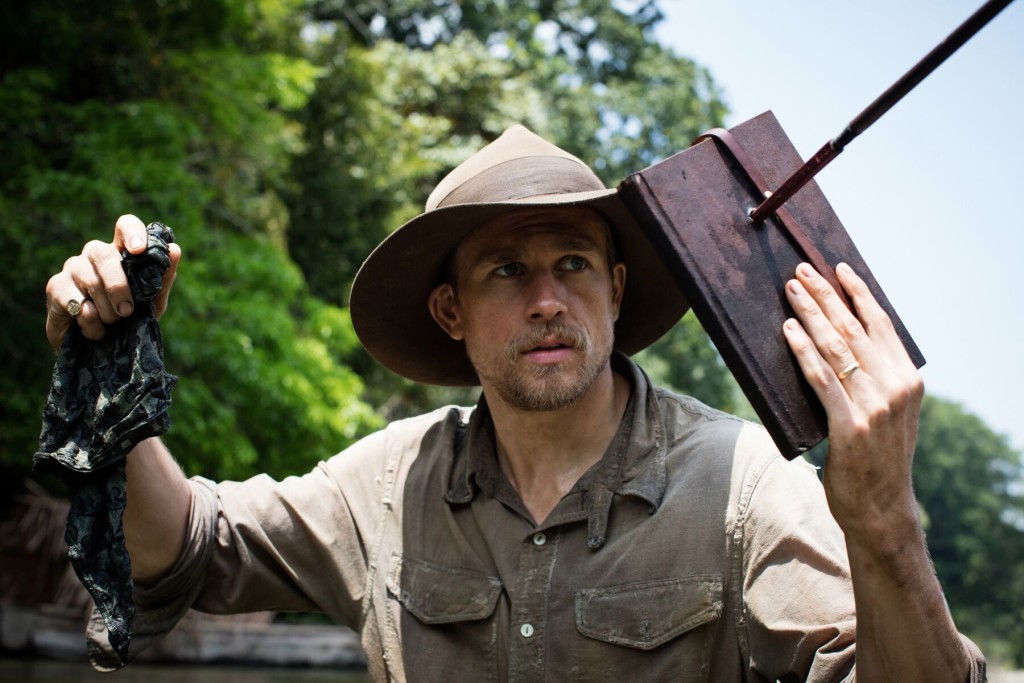
Charlie Hunnam in THE LOST CITY OF Z
photo courtesy of SFFILM
Because the San Francisco International Film Festival (SFFILM) was supposed to be underway now (it’s been cancelled for the COVID-19 emergency), here’s a film from SFFILM’s 2017 program. In auteur James Gray’s sweeping turn of the 20th Century epic The Lost City of Z, a stiff-upper-lip type British military officer becomes the first European to probe into the deepest heart of unmapped Amazonia. Finding his way through the lush jungles, braving encounters with sometimes cannibalistic indigenous warriors, he becomes obsessed with finding the lost city of an ancient civilization. I know this sounds like Indiana Jones, but it’s based on the real life of Percy Fawcett as chronicled in the recent book Lost City of Z by David Grann.
The Lost City of Z begins with an Edwardian stag hunt
through the verdant Irish countryside, complete with horses spilling
riders. This scene is gorgeous, but its point is to introduce the young
British military officer Percy Fawcett (Charlie Hunnam) as a man of
unusual resourcefulness, talent and, above all, drive. Despite his
abilities, he has been chaffing at the unattractive assignments that
have precluded his career advancement. In the snobby Edwardian military,
he has been in disfavor because his dissolute father had stained the
family name. One of Fawcett’s commanders says, “He’s been rather
unfortunate in his choice of ancestors”.
That yearning to earn the recognition that he believes he merits –
and to attain the accomplishments of a Great Man – is the core of this
character-driven movie. Fawcett resists yet another assignment away from
the career-making action, a mapping expedition designed to have a minor
diplomatic payoff. But it takes him on a spectacular Amazon exploration
that brings him celebrity – and backing for more high-profile
expeditions. Fawcett was surfing the zeitgeist in the age of his
contemporaries Roald Amundsen (South Pole), Robert Peary (North Pole)
and Howard Carter (King Tut).
In that first expedition, Fawcett becomes convinced that he can find the magnificent city of a lost civilization deep in the Amazon, a city he calls Z (which is pronounced as the British “Zed”). The Lost City of Z takes us through two more Amazonian expeditions, sandwiched around Fawcett’s WW I service in the hellish Battle of the Somme. That final expedition ends mysteriously – and not well.
No one knows for sure what happened to Fawcett. In The Lost City of Z,
Gray leads us toward the most likely conclusion, the one embraced by
Grann’s book. If you’re interested in the decades of speculation about
Fawcett’s fate, there’s a good outline on Percy Fawcett’s Wikipedia page.
Fawcett comes with his own Victorian upper class prejudices, but he
has the capacity to set those aside for a post-Darwin open-mindedness.
Gray made it a point that the indigenous peoples in the movie are
independent of Fawcett; Gray shows them living their lives in a world
that Fawcett has found, not just advancing the plot points in Fawcett’s
quest. Four real tribes – and their cultures – are shown in the film.
As Percy Fawcett, with his oft-manic obsession and fame-seeking that
color his scientific curiosity and his old-fashioned Dudley Do-Right
values, Charlie Hunnam gives a tremendous, perhaps carer breakthrough,
performance. He’s been a promising actor in Sons of Anarchy and the overlooked thriller Deadfall) (and such a good actor that I never dreamed that he’s really British). Hunnam will next star as the title character in the King Arthur movie franchise.
Robert Pattinson is unexpectedly perfect as Fawcett’s travel buddy Henry Costin. With his Twilight dreaminess hidden behind a Smith Brothers beard, Pattinson projects a lean manliness. It’s probably his best performance.
Sienna Miller shines as Fawcett’s proto-feminist wife Nina. I first
noticed Miller (and Daniel Craig) in the underrated neo-noir thriller
2004 Layer Cake. Now Miller is still only 35 years old and has delivered other fine recent performances in Foxcatcher, American Sniper and (in an especially delicious role) High-Rise.
Director James Gray (The Yard, Two Lovers, The Immigrant) is
a favorite of cinephiles and of other filmmakers, but regular audiences
don’t turn out for his movies. That may change with The Lost City of Z,
a remarkably beautiful film that Gray shot, bucking the trend to
digital, in 35 mm. The jungle scenes were filmed in a national park in
Columbia. The cinemeatographer is the Oscar-nominated Darius Khondji.
Khondji shot The Immigrant for Gray and has been the DP of choice for David Fincher (Se7en) Alan Parker (Evita), Michael Haneke (Amour), and Woody Allen (Midnight in Paris).
Along with the stag hunt and the voyages up and down the jungle rivers,
there is also a breathtakingly beautiful ballroom scene and a gaspingly
surreal nighttime discovery of a rubber plantation’s opera house deep
in the jungle.
There have been other Lost Expedition movies, most famously Werner Herzog’s Aquirre, the Wrath of God and Fitzcarraldo. The Lost City of Z
shares an obsession, a quest and a mysterious tragic end with those
films, but it stands apart with its exploration of the motivation of a
real life character and the authenticity of Gray’s depiction of the
indigenous people.
Movie studios used to make an entire genre of very fun movies from Gunga Din and The Four Feathers through Lawrence of Arabia and Zulu
that featured white Europeans getting their thrills in exotic third
world playgrounds. We often cringe at the racist premises and the
treatment of “the natives” those movies today. Since the 1960s, the best
examples of the genre, like Raiders of the Lost Ark, have had an ironic tinge. With The Lost City of Z, James Gray loses both the racism and the irony, and brings us brings a straight-ahead exploration tale.
The Lost City of Z revives the genre of the historical
adventure epic, with all the spectacle of a swashbuckler, while braiding
in modern sensitivities and a psychological portrait. This is a
beautiful and thoughtful film. The Lost City of Z is available on DVD from Netflix and Redbox and to stream from Amazon, iTunes, Vudu, YouTube and Google Play.
Also see my notes from the director James Gray’s Q & A at the San Francisco International Film Festival. [And here are some completely random tidbits. There’s a cameo by Spaghetti Western star Franco Nero. And the closing credits recognize the “data wrangler”.]
Charlie Hunnam in THE LOST CITY OF Z photo courtesy of SFFILM
In auteur James Gray’s sweeping turn of the 20th Century epic The Lost City of Z, a stiff-upper-lip type British military officer becomes the first European to probe into the deepest heart of unmapped Amazonia. Finding his way through the lush jungles, braving encounters with sometimes cannibalistic indigenous warriors, he becomes obsessed with finding the lost city of an ancient civilization. I know this sounds like Indiana Jones, but it’s based on the real life of Percy Fawcett as chronicled in the recent book Lost City of Z by David Grann.
The Lost City of Z opens tomorrow in Bay Area theaters. I saw The Lost City of Z at the San Francisco International Film Festival (SFFILMFestival) at a screening with director James Gray. I’ll be sharing some snippets from Gray’s Q & A on Sunday.
The Lost City of Z begins with an Edwardian stag hunt through the verdant Irish countryside, complete with horses spilling riders. This scene is gorgeous, but its point is to introduce the young British military officer Percy Fawcett (Charlie Hunnam) as a man of unusual resourcefulness, talent and, above all, drive. Despite his abilities, he has been chaffing at the unattractive assignments that have precluded his career advancement. In the snobby Edwardian military, he has been in disfavor because his dissolute father had stained the family name. One of Fawcett’s commanders says, “He’s been rather unfortunate in his choice of ancestors”.
That yearning to earn the recognition that he believes he merits – and to attain the accomplishments of a Great Man – is the core of this character-driven movie. Fawcett resists yet another assignment away from the career-making action, a mapping expedition designed to have a minor diplomatic payoff. But it takes him on a spectacular Amazon exploration that brings him celebrity – and backing for more high-profile expeditions. Fawcett was surfing the zeitgeist in the age of his contemporaries Roald Amundsen (South Pole), Robert Peary (North Pole) and Howard Carter (King Tut).
In that first expedition, Fawcett becomes convinced that he can find the magnificent city of a lost civilization deep in the Amazon, a city he calls Z (which is pronounced as the British “Zed”). The Lost City of Z takes us through two more Amazonian expeditions, sandwiched around Fawcett’s WW I service in the hellish Battle of the Somme.
That final expedition ends mysteriously – and not well.
No one knows for sure what happened to Fawcett. In The Lost City of Z, Gray leads us toward the most likely conclusion, the one embraced by Grann’s book. If you’re interested in the decades of speculation about Fawcett’s fate, there’s a good outline on Percy Fawcett’s Wikipedia page.
Fawcett comes with his own Victorian upper class prejudices, but he has the capacity to set those aside for a post-Darwin open-mindedness. Gray made it a point that the indigenous peoples in the movie are independent of Fawcett; Gray shows them living their lives in a world that Fawcett has found, not just advancing the plot points in Fawcett’s quest. Four real tribes – and their cultures – are shown in the film.
As Percy Fawcett, with his oft-manic obsession and fame-seeking that color his scientific curiosity and his old-fashioned Dudley Do-Right values, Charlie Hunnam gives a tremendous, perhaps carer breakthrough, performance. He’s been a promising actor in Sons of Anarchy and the overlooked thriller Deadfall) (and such a good actor that I never dreamed that he’s really British). Hunnam will next star as the title character in the King Arthur movie franchise.
Robert Pattinson is unexpectedly perfect as Fawcett’s travel buddy Henry Costin. With his Twilight dreaminess hidden behind a Smith Brothers beard, Pattinson projects a lean manliness. It’s probably his best performance.
Sienna Miller shines as Fawcett’s proto-feminist wife Nina. I first noticed Miller (and Daniel Craig) in the underrated neo-noir thriller 2004 Layer Cake. Now Miller is still only 35 years old and has delivered other fine recent performances in Foxcatcher, American Sniper and (in an especially delicious role) High-Rise.
Director James Gray (The Yard, Two Lovers, The Immigrant) is a favorite of cinephiles and of other filmmakers, but regular audiences don’t turn out for his movies. That may change with The Lost City of Z, a remarkably beautiful film that Gray shot, bucking the trend to digital, in 35 mm. The jungle scenes were filmed in a national park in Columbia. The cinemeatographer is the Oscar-nominated Darius Khondji. Khondji shot The Immigrant for Gray and has been the DP of choice for David Fincher (Se7en) Alan Parker (Evita), Michael Haneke (Amour), and Woody Allen (Midnight in Paris). Along with the stag hunt and the voyages up and down the jungle rivers, there is also a breathtakingly beautiful ballroom scene and a gaspingly surreal nighttime discovery of a rubber plantation’s opera house deep in the jungle.
There have been other Lost Expedition movies, most famously Werner Herzog’s Aquirre, the Wrath of God and Fitzcarraldo. The Lost City of Z shares an obsession, a quest and a mysterious tragic end with those films, but it stands apart with its exploration of the motivation of a real life character and the authenticity of Gray’s depiction of the indigenous people.
Movie studios used to make an entire genre of very fun movies from Gunga Din and The Four Feathers through Lawrence of Arabia and Zulu that featured white Europeans getting their thrills in exotic third world playgrounds. We often cringe at the racist premises and the treatment of “the natives” those movies today. Since the 1960s, the best examples of the genre, like Raiders of the Lost Ark, have had an ironic tinge. With The Lost City of Z, James Gray loses both the racism and the irony, and brings us brings a straight-ahead exploration tale.
The Lost City of Z revives the genre of the historical adventure epic, with all the spectacle of a swashbuckler, while braiding in modern sensitivities and a psychological portrait. This is a beautiful and thoughtful film. The Lost City of Z is available on DVD from Netflix and Redbox and to stream from Amazon, iTunes, Vudu, YouTube and Google Play.
Also see my notes from the director James Gray’s Q & A at the San Francisco International Film Festival.[And here are some completely random tidbits. There’s a cameo by Spaghetti Western star Franco Nero. The closing credits recognize the “animal weath coordinator” and the “data wrangler”.]
Charlie Hunnam in THE LOST CITY OF Z photo courtesy of SFFILM
In auteur James Gray’s sweeping turn of the 20th Century epic The Lost City of Z, a stiff-upper-lip type British military officer becomes the first European to probe into the deepest heart of unmapped Amazonia. Finding his way through the lush jungles, braving encounters with sometimes cannibalistic indigenous warriors, he becomes obsessed with finding the lost city of an ancient civilization. I know this sounds like Indiana Jones, but it’s based on the real life of Percy Fawcett as chronicled in the recent book Lost City of Z by David Grann.
The Lost City of Z opens tomorrow in Bay Area theaters. I saw The Lost City of Z at the San Francisco International Film Festival (SFFILMFestival) at a screening with director James Gray. I’ll be sharing some snippets from Gray’s Q & A on Sunday.
The Lost City of Z begins with an Edwardian stag hunt through the verdant Irish countryside, complete with horses spilling riders. This scene is gorgeous, but its point is to introduce the young British military officer Percy Fawcett (Charlie Hunnam) as a man of unusual resourcefulness, talent and, above all, drive. Despite his abilities, he has been chaffing at the unattractive assignments that have precluded his career advancement. In the snobby Edwardian military, he has been in disfavor because his dissolute father had stained the family name. One of Fawcett’s commanders says, “He’s been rather unfortunate in his choice of ancestors”.
That yearning to earn the recognition that he believes he merits – and to attain the accomplishments of a Great Man – is the core of this character-driven movie. Fawcett resists yet another assignment away from the career-making action, a mapping expedition designed to have a minor diplomatic payoff. But it takes him on a spectacular Amazon exploration that brings him celebrity – and backing for more high-profile expeditions. Fawcett was surfing the zeitgeist in the age of his contemporaries Roald Amundsen (South Pole), Robert Peary (North Pole) and Howard Carter (King Tut).
In that first expedition, Fawcett becomes convinced that he can find the magnificent city of a lost civilization deep in the Amazon, a city he calls Z (which is pronounced as the British “Zed”). The Lost City of Z takes us through two more Amazonian expeditions, sandwiched around Fawcett’s WW I service in the hellish Battle of the Somme.
That final expedition ends mysteriously – and not well.
No one knows for sure what happened to Fawcett. In The Lost City of Z, Gray leads us toward the most likely conclusion, the one embraced by Grann’s book. If you’re interested in the decades of speculation about Fawcett’s fate, there’s a good outline on Percy Fawcett’s Wikipedia page.
Fawcett comes with his own Victorian upper class prejudices, but he has the capacity to set those aside for a post-Darwin open-mindedness. Gray made it a point that the indigenous peoples in the movie are independent of Fawcett; Gray shows them living their lives in a world that Fawcett has found, not just advancing the plot points in Fawcett’s quest. Four real tribes – and their cultures – are shown in the film.
As Percy Fawcett, with his oft-manic obsession and fame-seeking that color his scientific curiosity and his old-fashioned Dudley Do-Right values, Charlie Hunnam gives a tremendous, perhaps carer breakthrough, performance. He’s been a promising actor in Sons of Anarchy and the overlooked thriller Deadfall) (and such a good actor that I never dreamed that he’s really British). Hunnam will next star as the title character in the King Arthur movie franchise.
Robert Pattinson is unexpectedly perfect as Fawcett’s travel buddy Henry Costin. With his Twilight dreaminess hidden behind a Smith Brothers beard, Pattinson projects a lean manliness. It’s probably his best performance.
Sienna Miller shines as Fawcett’s proto-feminist wife Nina. I first noticed Miller (and Daniel Craig) in the underrated neo-noir thriller 2004 Layer Cake. Now Miller is still only 35 years old and has delivered other fine recent performances in Foxcatcher, American Sniper and (in an especially delicious role) High-Rise.
Director James Gray (The Yard, Two Lovers, The Immigrant) is a favorite of cinephiles and of other filmmakers, but regular audiences don’t turn out for his movies. That may change with The Lost City of Z, a remarkably beautiful film that Gray shot, bucking the trend to digital, in 35 mm. The jungle scenes were filmed in a national park in Columbia. The cinemeatographer is the Oscar-nominated Darius Khondji. Khondji shot The Immigrant for Gray and has been the DP of choice for David Fincher (Se7en) Alan Parker (Evita), Michael Haneke (Amour), and Woody Allen (Midnight in Paris). Along with the stag hunt and the voyages up and down the jungle rivers, there is also a breathtakingly beautiful ballroom scene and a gaspingly surreal nighttime discovery of a rubber plantation’s opera house deep in the jungle.
There have been other Lost Expedition movies, most famously Werner Herzog’s Aquirre, the Wrath of God and Fitzcarraldo. The Lost City of Z shares an obsession, a quest and a mysterious tragic end with those films, but it stands apart with its exploration of the motivation of a real life character and the authenticity of Gray’s depiction of the indigenous people.
Movie studios used to make an entire genre of very fun movies from Gunga Din and The Four Feathers through Lawrence of Arabia and Zulu that featured white Europeans getting their thrills in exotic third world playgrounds. We often cringe at the racist premises and the treatment of “the natives” those movies today. Since the 1960s, the best examples of the genre, like Raiders of the Lost Ark, have had an ironic tinge. With The Lost City of Z, James Gray loses both the racism and the irony, and brings us brings a straight-ahead exploration tale.
The Lost City of Z revives the genre of the historical adventure epic, with all the spectacle of a swashbuckler, while braiding in modern sensitivities and a psychological portrait. This is a beautiful and thoughtful film.
[And here are some completely random tidbits. There’s a cameo by Spaghetti Western star Franco Nero. The closing credits recognize the “animal weath coordinator” and the “data wrangler”.]