SELMA: igniting the tide of history

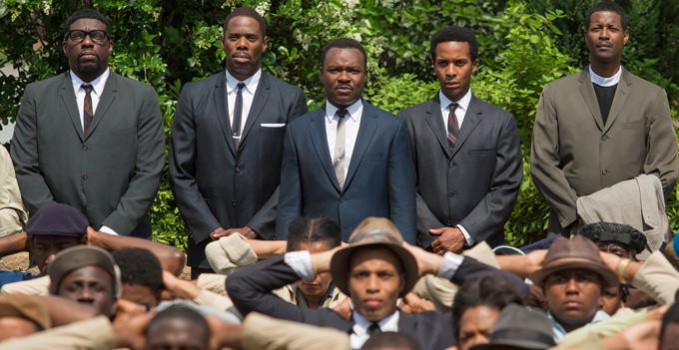
David Oyelowo as Martin Luther King Jr. (center back) in SELMA

It’s been a while since I’ve seen as stirring a movie as Selma, Director Ava DuVernay’s retelling of the Selma, Alabama, Civil Rights marches in 1965 – one of the most heroic episodes in a saga known for heroism.

It’s an important story.  Although the marches came on the heels of a racist atrocity, instead of just vomiting rage, Martin Luther King (David Oyelowo) and his fellow civil rights leaders had a specific strategic goal in mind.  Their planned civil rights march from Selma to Montgomery was designed to trigger the passage of yet-to-be-drafted legislation, the Voting Rights Act of 1965.  They knew that there would be risks to all and sacrifices by many – both martyrs to the cause and victims of terrorism.  Those sacrifices were real and are depicted in the movie.  As the civil rights leaders navigate the reefs of local Jim Crow rule and murderous racist terrorism, Selma’s story is compelling minute-to-minute.

King himself must bear the burden of responsibility of a leader sending his charges out to possibly sacrifice their lives. All the time, he is receiving threats to his safety and that of his family, dealing with blackmail and character assassination and going through a rough patch in his marriage to Coretta Scott King (Carmen Ejogo).

But Selma, like history, is not a One Man Show. King doesn’t just dictate the path for his Southern Christian Leadership Council (SCLC). He has to work with his colleagues in the SCLC and reach out to build a coalition with the local African-American community and other national organizations, chiefly the Student Non-violent Coordinating Committee (SNCC). King is not just another noble face. He’s got to show a canny craftiness as a study in negotiating, a guy who knows when to hold ’em and knows when to fold ’em.

Here’s something else that Selma does extraordinarily well. I’m a history buff who understands that – to relate a historical narrative in 90-120 minutes – filmmakers must compress historical events and compound characters. However, Selma allows us to glimpse the broad canvas by seeing other important figures of the Civil Rights movement – Andrew Young, Ralph Abernathy, Hosea Williams, John Lewis, James Forman, Diane Nash, James Bevel, James Orange and even Malcom X and Bayard Rustin. There are also the white martyrs James Reeb and Viola Liuzzo.  And New York Times reporter Roy Reed is there, representing the handful of national newsmen who brought the civil rights struggle into the homes of non-Southern America.  As villains, we have not just George Wallace (Tim Roth) but Al Mingo and Sheriff Jim Clark.

And what about the controversial depiction of President Lyndon Johnson (Tom Wilkinson)?  The short answer is that Selma’s treatment of LBJ is sometimes factually inaccurate and definitely wrong in tone.  I am going to discuss this more fully in another post, probably on Wednesday.  But the bottom line is this – see the movie anyway.  At its core, the movie is about what happened in Selma and within the leadership of the Civil Rights movement – it generally gets that right.

After seeing Selma, I reflected on the media landscape in 1965 – where every home in America watched the TV news from either CBS, NBC or ABC.  The repugnant spectacle of the white mob beating the peaceful demonstrators came into every American living room, including mine.  We Americans all saw the same thing.  But in today’s media environment, a huge fraction of the country gets it news from Fox News, which would likely twist and minimize the very facts that mobilized a nation in 1965 – and another huge fraction would be watching non-news content and miss the controversy all together.

But my most sobering reflection upon leaving the theater was this – right now the Republican Congress and the majority of the US Supreme Court are trying their hardest to emasculate the very Voting Rights Act that was the culmination of the campaign in the movie Selma.

In a uniformly well-acted movie, David Oyelowo deserves special praise for his portrayal of MLK. Oprah Winfrey and veteran character actor Henry G. Sanders are the best of the rest. On a personal note, I relished seeing one of my faves Wendell Pierce (Treme and The Wire) and also up-and-comer Tessa Thompson of Dear White People.

Selma is inspirational, kids should see it and families should discuss it.  It’s just outside the Top Ten of my Best Movies of 2014.
Movies to See Right Now

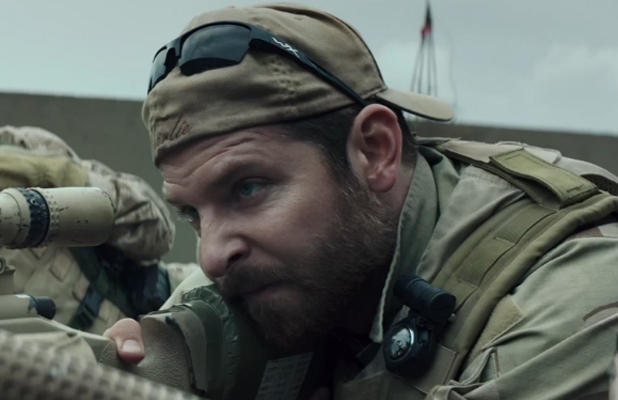
Bradley Cooper in AMERICAN SNIPER

Time to start watching the Oscar nominees.  Here are the best choices now in theaters:

  • Clint Eastwood’s thoughtful and compelling American Sniper, with harrowing action and a career-best performance from Bradley Cooper.
  • The inspiring Selma, well-crafted and gripping throughout (but with an unfortunate historical depiction of LBJ).
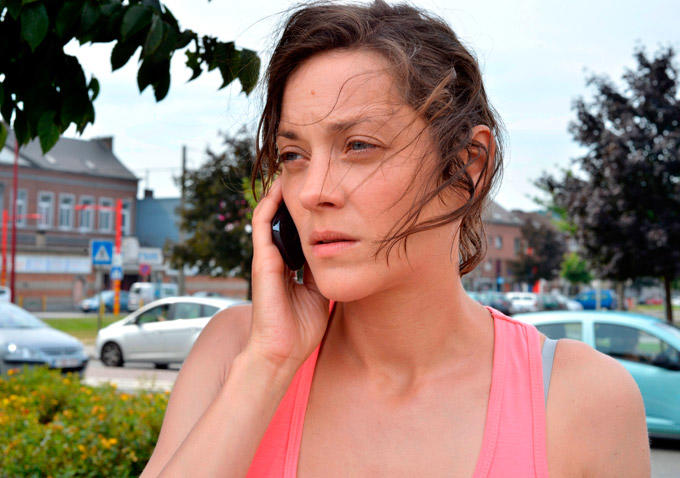
  • The Belgian drama Two Days, One Night with Marion Cotillard, which explores the limits of emotional endurance.
  • The cinematically important and very funny Birdman. You can still find Birdman, but you may have to look around a bit. It has justifiably garnered several Oscar nominations, including for Best Picture.
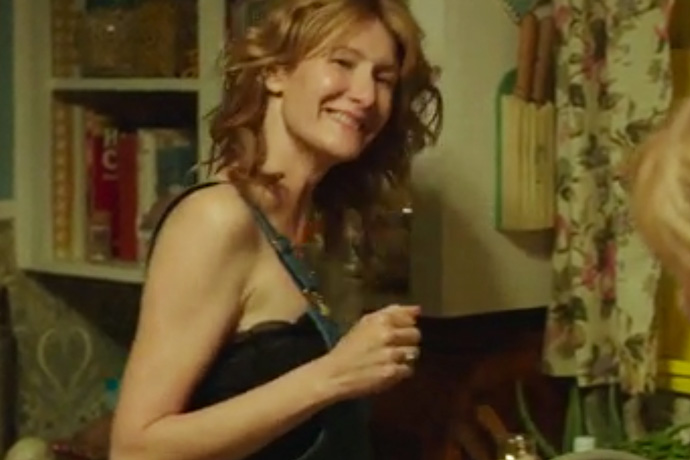
  • Reese Witherspoon is superb in the Fight Your Demons drama Wild, and Laura Dern may be even better.
  • The Theory of Everything is a successful, audience-friendly biopic of both Mr. AND Mrs. Genius.
  • The Imitation Game – the riveting true story about the guy who invented the computer and defeated the Nazis and was then hounded for his homosexuality.

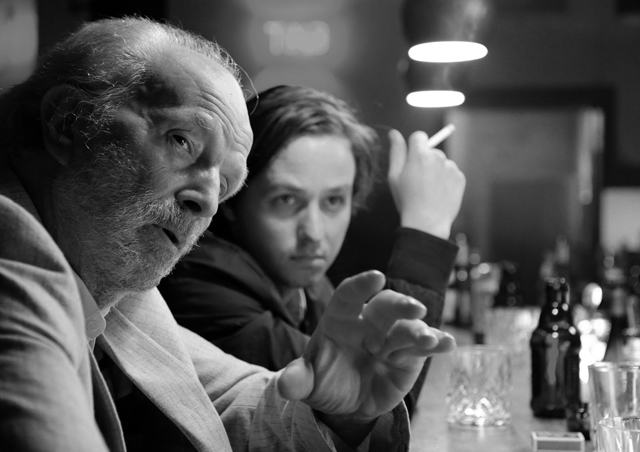
My DVD/Stream of the week is the wry German comedy A Coffee in Berlin. A Coffee in Berlin is available on DVD from Netflix and streaming from Amazon, Vudu, YouTube and Google Play.

On January 27, Turner Classic Movies is airing my favorite movie on American politics, The Candidate – I’ve worked in several dozen political campaigns and this movie still resonates with my experiences.

And on January 26, TCM will broadcast The Earrings of Madame de… (1953). This is one of the great movies that you have NOT seen, having just been released on DVD in 2009. Max Ophuls directed what is perhaps the most visually evocative romance ever in black and white. It’s worth seeing for the ballroom scene alone. The shallow and privileged wife of a stick-in-the-mud general takes a lover, but the earrings she pawned reveal the affair and consequences ensue. Great Italian director Vittorio De Sica plays the impossibly handsome lover.

TWO DAYS, ONE NIGHT: the limits of emotional endurance

Marion Cotillard in TWO DAYS, ONE NIGHT

In the Belgian drama Two Days, One Night, a factory worker (Oscar winner Marion Cotillard) finds out on Friday afternoon that she will be laid off unless she can convince nine of her sixteen co-workers to sacrifice their bonuses. She must make her case to each of them before a vote on Monday morning. It’s a substantial bonus, and every one of her colleagues really needs it; their spouses are expecting it, too, and many have decided how they are going to spend it. The vote is going to be close, the stakes for each family is high and the tension builds.

Our protagonist is anything but plucky. She needs to be coaxed and prodded by her husband and a militant co-worker. She is buoyed enough by an early victory to keep going, but she’s constantly on the verge of giving up.

She hasn’t been been well, which also complicates things. Because the filmmakers wait until midway to explicitly reveal her illness, I’m being careful not to spoil it here. But the precise illness is important because it affects both her own stamina and the confidence of her co-workers about how well she would contribute to the workplace.

Two Days, One Night is the latest from two of my favorites writer-director filmmakers, the brothers Jean-Pierre and Luc Dardennes. They specialize in contemporary dramas of the Belgian working class. Their The Kid with a Bike was #1 on my Best Movies of 2012. And I think that their 2002 The Son (Le Fils) was pretty much a masterpiece, too. The Dardennes’ hand held (but NOT shaky) cameras intrude right on top of the characters, bringing an urgency and immediacy to every scene. Hyper realism contributes to the verisimilitude and thereby builds more power into the stories; here, a tense conversation in the doorway to an apartment building get interrupted by someone walking in – just as it would be in real life.

At its core, Two Days, One Night explores the limits of emotional endurance. What does she need to rebound form her malaise – the adrelin surge of battle? Or the power from getting to make her own choice?

[Anyone who has visited France or Belgium will recognize the remarkable politeness of the characters – observing all the formalities of greeting, shaking hands and saying thanks and goodbye even in the most awkward and emotionally charged encounters.]

Two Days, One Night is a fine film, just outside the Top Ten on my Best Movies of 2014. Unsurprisingly, Cotillard’s glammed-down performance is brilliant. It’s a compelling story as we walk her tightrope of desperation, heading toward redemption. Two Days, One Night opens widely in the San Francisco Bay Area tomorrow.

AMERICAN SNIPER: a hero in battle, a tinderbox back home

Bradley Cooper in AMERICAN SNIPER

In Clint Eastwood’s real-life story American Sniper, Bradley Cooper plays Chris Kyle, the most effective sniper in US military history. A Navy Seal in the Iraq War, Kyle signed up for a soul-sucking four tours. American Sniper is about how he survived those searing war experiences and how he did/did not cope with the emotional legacy of those experiences back in the USA.

Nobody should have to see and endure what Kyle (and tens of thousands of his comrades) did. Kyle was that recognizable American male who refused to admit that his experience could be taking an emotional toll. As a result, he’s constantly on the verge of being blown up in the war scenes and on the verge of imploding in the scenes back home. Sometimes there’s more danger in the domestic scenes than in the war action scenes.

The war scenes are convincing, brutal and adrenalin-packed. The final battle scene is one of the most harrowing I’ve ever seen in a movie. While Kyle’s unit is under siege, we can see what his headquarters is seeing on the high tech satellite view – and it looks increasingly hopeless. When the situation is at it most desperate, a sand storm hits, and suddenly we’re immersed into the fog (sand?) of war, trying to tell who is who and what is happening.

And here’s an observation on violence in Eastwood movies. Clint used to trade in good old fashioned movie violence as he shot ’em up in westerns, war action films and the Dirty Harry series. But beginning with Unforgiven, all of Eastwood’s films have featured only the most realistic violence. With Unforgiven, a toggle switched inside Clint, and he must have determined to use violence only for STORYTELLING and never for ENTERTAINMENT. This is the case with American Sniper.

This may be Bradley Cooper’s finest performance. He is perfect as the Everyman hero surviving battle, but clinging on by his fingernails in peacetime. It’s a finely modulated performance without a shred of PTSD cliche. The other actors (including Sienna Miller as the wife) are just fine, but their roles are relatively underwritten.

American Sniper is a very strong movie, compelling and thoughtful. It just makes the Top Ten on my Best Movies of 2014.

DVD/Stream of the Week: A COFFEE IN BERLIN – slacker minus coffee equals plenty of laughs

A COFFEE IN BERLIN (OH BOY)

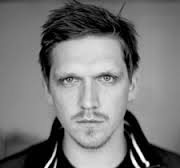
Ranging from wry to hilarious, the German dark comedy A Coffee in Berlin hits every note perfectly. It’s the debut feature for writer-director Jan Ole Gerster, a talented filmmaker we’ll be hearing from again.

Jan Ole Gerster
Jan Ole Gerster

We see a slacker moving from encounter to encounter in a series of vignettes. Gerster has created a warm-hearted but lost character who needs to connect with others – but sabotages his every opportunity. He has no apparent long term goals, and even his short term goal of getting some coffee is frustrated.

As the main character (Tom Schilling) wanders through contemporary Berlin, A Coffee in Berlin demonstrates an outstanding sense of place, especially in a dawn montage near the end of the film. The soundtrack is also excellent – the understated music complements each scene remarkably well.

I saw A Coffee in Berlin (then titled Oh Boy) at Cinequest 2013 and singled it out as one of the three most wholly original films in the festival and as one of my favorite movie-going experiences of the year. A Coffee in Berlin was snagged for the festival by Cinequest’s film scout extraordinaire Charlie Cockey. A Coffee in Berlin is available on DVD from Netflix and streaming from Amazon, Vudu, YouTube and Google Play.

Movies to See Right Now

Laura Dern in WILD
Laura Dern in WILD

After today, all of the prestige movies of 2014 will be in wide release except for A Most Violent Year and Two Days, One Night, which open more widely next weekend. Of the ones that I’ve seen, here are your best bets:

    • The cinematically important and very funny Birdman. You can still find Birdman, but you may have to look around a bit. It has justifiably garnered several Oscar nominations, including for Best Picture.
    • Reese Witherspoon is superb in the Fight Your Demons drama Wild, and Laura Dern may be even better.
    • The Theory of Everything is a successful, audience-friendly biopic of both Mr. AND Mrs. Genius.
    • The Imitation Game – the riveting true story about the guy who invented the computer and defeated the Nazis and was then hounded for his homosexuality.
    • Big Eyes is a lite audience pleaser.
    • Set in the macho world of Olympic wrestling, Foxcatcher is really a relationship movie with a stunning dramatic performance by Steve Carell.
    • Mr. Turner is visually remarkable and features a stuning performance by Timothy Spall, but it’s toooo loooong.

My DVD/Stream of the week is Boyhood, an important film – a milestone in the history of cinema. It may turn out to be the best film of the decade. It’s a Must See. Boyhood is available on DVD from Netflix and streaming from Amazon Instant, iTunes, Vudu, YouTube, Google Play and Xbox Video.

On January 20, Turner Classic Movies is airing A Face in the Crowd. During every year of the 1960s, Andy Griffith entered the living rooms of most Baby Boomers as Sheriff Andy Taylor on The Andy Griffith Show and in guest appearances on Mayberry R.F.D. Younger folks knew him from another ten seasons on television starring as Matlock.

But, in his very first feature film, Griffith shed the likeability and decency that made him a TV megastar and became a searingly unforgettable villain. In the 1957 Elia Kazan classic A Face in the Crowd, Griffith plays Lonesome Rhodes, a failed country guitar picker who is hauled out of an Arkansas drunk tank by talent scout Marcia Jeffries (Patricia Neal). It turns out that he has a folksy charm that is dynamite in the new medium of television. He quickly rises in the infotainment universe until he is an A List celeb and a political power broker. To Jeffries’ horror, Rhodes reveals himself to be an evil, power hungry megalomaniac. Jeffries made him – can she break him? The seduction of a gullible public by a good timin’ charmer predicts the careers of Ronald Reagan and George W. Bush, although Lonesome Rhodes is meaner than Reagan and less ideological than Bush.

Amazingly, A Face in the Crowd did not garner even a nomination for an Academy Award for Griffith – or for any of its other filmmakers. Today, it is well-regarded, having been added to the library of Congress’ preservation list in the US National Film Registry and rating 91% in the critical reviews tallied by Rotten Tomatoes. It is one of the greatest political films.

DVD/Stream of the Week: BOYHOOD – the best movie of the decade?

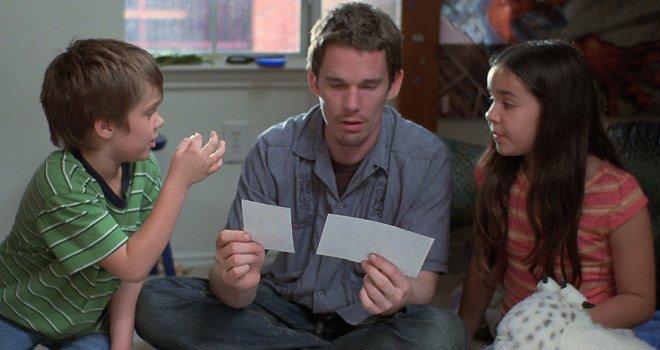
Eller Coltrane, Ethan Hawke and Lorelei Linklater in BOYHOOD

Boyhood is a profoundly moving film – and I’m still trying to figure out why. It’s a family drama without a drop of emotional manipulation – there’s no big moment of redemption and no puppies are saved. It’s just about a boy growing up in a family that we all can recognize and going through a series of moments that all of us have gone through. Still, I found myself responding very emotionally and, hardass as I may be, I had a lump in my throat and moist eyes during the last half hour or so.

There’s a sense of fundamental human truth in Boyhood that comes from the amazing, risky and groundbreaking way that writer-director Richard Linklater made this movie. Boyhood traces the story of Mason (Eller Coltrane), his big sister (Lorelei Linklater) and their divorced parents (Patricia Arquette and Ethan Hawke) from the time when Mason was six-years-old to when he is going off to college at age 18. Linklater and the cast shot the movie in 39 days over a TWELVE YEAR PERIOD. So the cast members actually aged twelve years without the need for creating that effect with makeup or by switching the child actors. Other than Linklater’s own Before Sunrise/Before Sunset/Before Midnight series of romances spaced nine years apart, he only movies that have used this technique of aging-in-real-time have been documentaries, most notably the 7 Up series and Hoop Dreams.

Besides the authenticity that comes from the aging-in-real-time, the key to Boyhood is the reality of each moment. Each scene in the film is universal. Every kid has had to suffer the consequences of the life decisions made by his/her parents. Every kid has felt disrespected by a parental edict or disappointed when a parent has failed to come through. Everybody has been bullied in the school bathroom. Everybody has felt the excitement of connecting with a first love – and then the shock/humiliation/heartbreak of getting dumped. No scene individually moves the plot forward. But each scene helps complete our picture of who Mason is and how he is being shaped by his experiences.

Of course, when parents divorce and when a kid’s family is blended with that of a step-parent’s, those are especially big deals. All those things happen to Mason in Boyhood; he has control over none of them, but they all have a lasting impact on his life and development. And when his mom decides to better herself by working her way through college and grad school to become a college instructor, her self-improvement makes her less available to her kids – and that’s a big deal, too. (This part of Linklater’s story is autobiographical.)

As we trace Mason’s early years, we relate to these universal experiences and, without noticing it, start rooting for him and his sister. By the time he is 15, we are hooked and so seriously invested in him that it’s easy to feel as much pride in his high school graduation as do his fictional parents.

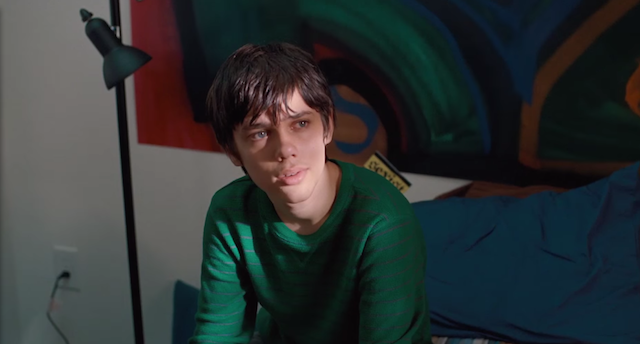
The actors who begin as children and age into young adults – Eller Coltrane and Lorelei Linklater (the director’s daughter) – are very good. Arquette and Hawke are also excellent in playing warts-and-all parents; each parent grows (in different ways) over the twelve years as much as do their kids.

So what’s it all about – as in, what’s life all about? That question is addressed explicitly by four characters in separate scenes in the final 35 minutes of the movie – by Mason as a brash and cynical, bullshitting 17-year-old, by his mom in a self-reflective meltdown, by his dad in a moment of truthful humility and by a potential girlfriend wise beyond her years. Whether any one of them is right and whether any one of them speaks for the filmmaker – that’s up to you.

Linklater has made other films that are exceptional and groundbreaking, most notably the Before series. His indie breakthrough Slacker followed a series of characters, handing off the audience to one conversation to another – a structure seemingly without structure. He followed that his Waking Life, another random series of conversations with his live actors were animated by rotoscope. Even his recent dark comedy Bernie is offbeat – a sympathetic take on a real life murderer (who is now out of prison and living in Linklater’s garage apartment). But Boyhood is Linklater’s least talky movie – and his masterpiece.

Boyhood is an important film – a milestone in the history of cinema. (I sure didn’t expect that I would ever write that sentence.) It may turn out to be the best film of the decade. It’s a Must See.  Boyhood is available on DVD from Netflix and streaming from Amazon Instant, iTunes, Vudu, YouTube, Google Play and Xbox Video.  Settle in and turn off all distractions for the next two hours and forty minutes – you’ll be glad that you did.

Eller Coltrane in BOYHOOD

Movies to See Right Now

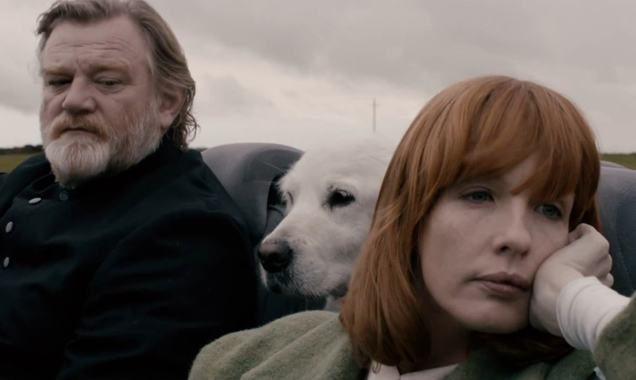
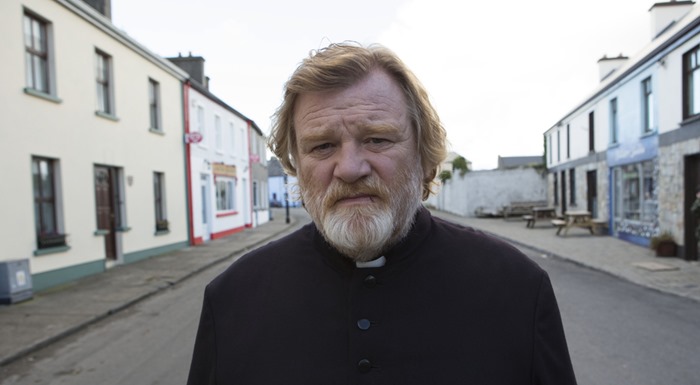
Brendan Gleeson and Kelly Reilly in CALVARY

We’re still harvesting the Best Movies of 2014 (and awaiting the wider release of Selma, A Most Violent Year, American Sniper and Inherent Vice):

  • The cinematically important and very funny Birdman.
  • The best Hollywood movie of 2014, the thriller Gone Girl, with a career-topping performance by Rosamund Pike.
  • I liked the droll Swedish dramedy Force Majeure, which won an award at Cannes and is Sweden’s submission for the Best Foreign Language Oscar.

And here are some other hearty recommendations:

  • Reese Witherspoon is superb in the Fight Your Demons drama Wild, and Laura Dern may be even better.
  • The Theory of Everything is a successful, audience-friendly biopic of both Mr. AND Mrs. Genius.
  • The Imitation Game – the riveting true story about the guy who invented the computer and defeated the Nazis and was then hounded for his homosexuality.
  • Set in the macho world of Olympic wrestling, Foxcatcher is really a relationship movie with a stunning dramatic performance by Steve Carell.
  • Big Eyes is a lite audience pleaser.
  • J.K. Simmons is brilliant in the intense indie drama Whiplash, a study of motivation and abuse, ambition and obsession.
  • Mr. Turner is visually remarkable and features a stuning performance by Timothy Spall, but it’s toooo loooong.

My DVD/Stream of the Week is the dark, intense and mesmerizing Calvary. In my opinion, Brendan Gleeson’s extraordinary performance as a good man navigating a grimly urgent situation is the very best acting of the year. Calvary is available on DVD from Netflix and streaming from Amazon Instant, iTunes, YouTube, Google Play and Xbox Video.

Coming up on TV on January 11, Turner Classic Movies brings us Knife in the Water, Roman Polanski’s first feature, made in Communist Poland in 1962. A couple picks up a hitchhiker and invite him on to their small sailboat and sexual tension ensues – think of a mystery thriller influenced by the French New Wave. Knife in the Water lost the Best Foreign Picture Oscar to Fellini’s 8 1/2. This was Polanski before Rosemary’s Baby, Chinatown, Sharon Tate’s murder by the Manson Family, the rape scandal and the fugitive flight from prosecution in the US, The Pianist and a slew of inappropriately young actress girlfriends. Incidentally, the most thoughtful and revealing documentary on Polanski is Roman Polanski: Wanted and Desired, which is available on DVD from Netflix.

GOODBYE TO ALL THAT: an amusing new world, post-divorce

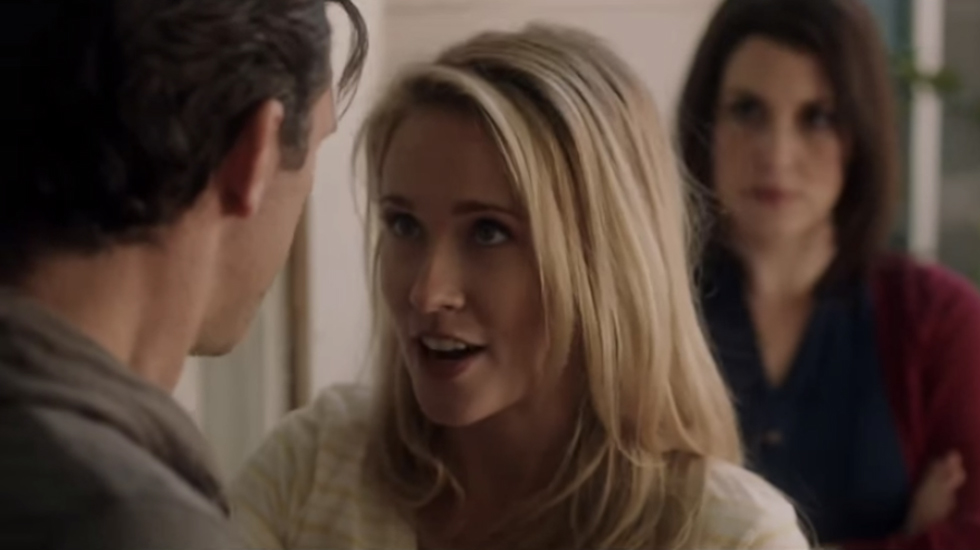
Anna Camp (center) in GOODBYE TO ALL THAT

In the light but smart comedy Goodbye to All That, a guy (Paul Schneider) is slobberknocked when his wife demands a divorce.  Trying to right himself, he takes on post-divorce co-parenting and modern-age dating.  Amusing episodes ensue.

Our hero encounters a slew of well-acted female characters who provide him with a menu of challenges; the cast includes Amy Sedaris, Melanie Lynskey, Heather Graham and Ashley Hinshaw.  There’s a particularly hilarious scene with his wife’s steadfastly partisan therapist (Celia Weston).

But the funniest role is played by Anna Camp (Pitch Perfect, Caitlin D’arcy in The Good Wife and Gwen in The Mindy Project) – a bipolar nymphomaniac evangelical Christian.  I still chuckle when I think of “I’m Debbie Spangler!”

This is the directorial debut of Angus McLachlan, the writer of the delicious Junebug.  It’s not as good as Junebug, but it has the same sharp observation of human foibles.  Goodbye to All That is available streaming on Amazon Instant, iTunes, YouTube, Google Play and Xbox Video.

DVD/Stream of the Week: CALVARY – dark, intense and mesmerizing

Brendan Glesson in CALVARY
Brendan Gleeson in CALVARY

The superbly written drama Calvary opens with a startling line, which kicks off the unsettling premise. Brendan Gleeson (In Bruges, The Guard, The Grand Seduction) plays a very good man who is an Irish priest, Father James. In the confessional, a man tells him that – in one week – he will kill Father James. Having been molested by a priest (now dead), the man will make his statement against the Church: “There’s no point in killing a bad priest. I’m going to kill you because you’re innocent.”

Who is the man? (Father James figures it out before the audience does.) Will the execution really happen? Will Father James take steps to protect himself? Tension builds as the days count down.

The character of Father James is wonderfully crafted. Having come to the priesthood in midlife, after being married and having a secular career, he is seasoned and unburdened by high expectations of human nature – and has a wicked sense of humor. Yet he is moral in the best sense and profoundly compassionate. And Gleeson – always excellent – nails the role. It’s one of the finest leading performances of the year.

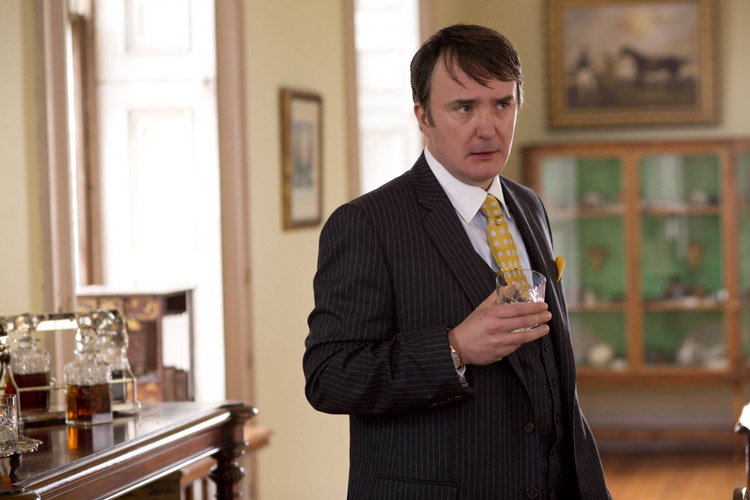
We know that the killer comes from a very limited pool of villagers and would-be parishioners, played by Chris O’Dowd, Dylan Moran, Aidan Gillen, M. Emmet Walsh, Isaach de Bankole and Orla O’Rourke. Their feelings for Father James range from fondness to indifference. Their attitudes toward the Church, on the other hand, range from indifference to hostility. (Moran is the best – playing a man grappling with his unhappiness, despite enjoying a fortune built by exploiting others. )

None of these characters is a stereotype. It’s a quirky bunch – but not CUTE quirky. There’s a lot of buried rage in this village – and dry humor, too. Referring to his wife, one casually says, “I think she’s bipolar, or lactose intolerant, one of the two”.

But it’s not the villagers that Father James must deal with. He gets a visit from his occasionally suicidal adult daughter (Kelly Reilly, who is ALWAYS good); he loves and welcomes her, but she often contributes more stress. He doesn’t love his roommate, an idiotically shallow priest David Wilmot (the thug in The Guard who hilariously couldn’t figure out if he was a psychopath or a sociopath). Then there’s a seriously twisted imprisoned killer (the star’s son Domnhall Gleeson), a foreign tourist numbed by a sudden tragedy (Marie-Josee Croze) and a scheming bishop (David McSavage).

Writer-director John Michael McDonagh (The Guard) gets the credit for populating his screenplay with enough unique and original characters for an entire film festival, let alone one movie. After The Guard and Calvary, I can’t wait to see his next movie.

As one should ascertain from its title, Calvary ain’t a feel-good movie. It plumbs some pretty dark territory. But as we follow Brendan Gleeson’s extraordinary performance as a good man navigating a grimly urgent situation, it is mesmerizing.  Calvary is available on DVD from Netflix and streaming from Amazon Instant, iTunes, YouTube, Google Play and Xbox Video.

Dylan Moran in CALVARY