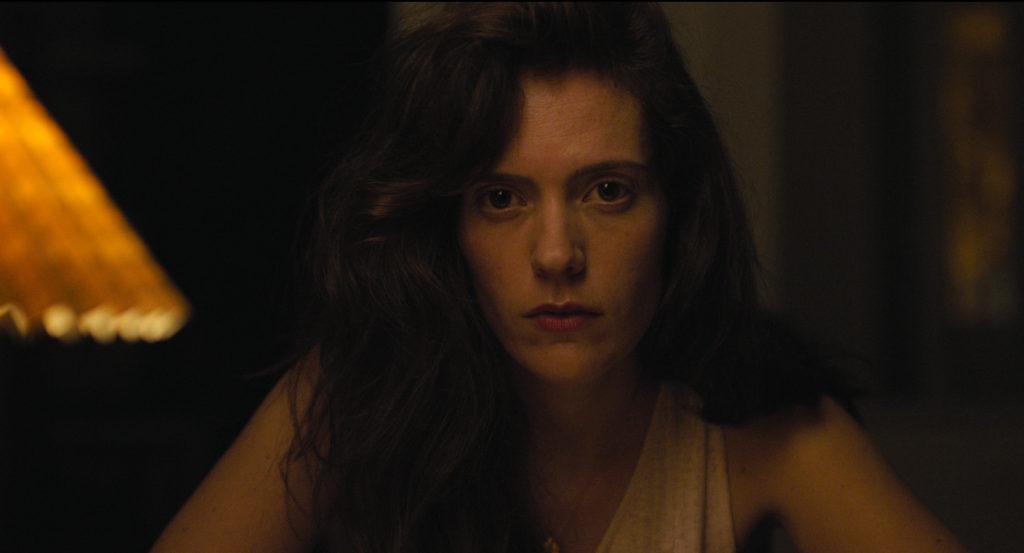
The inoffensive but unsatisfying On the Rocks, which can technically be described as a romantic comedy, wastes of the talents of Sofia Coppola, Bill Murry and Rashida Jones.
Laura (Rashida Jones) suspects that her husband Dean (Marlon Wayans), the striving CEO of a startup, is cheating on her. Her father Felix (Bill Murray), a worldly art dealer and serial womanizer, encourages her to stalk Dean, and propels them into increasingly crazy dad-daughter escapades.
The problem is that the suspicious wife plot is so tired that not even the considerable talents of Murray and Jones can make it sparkle. From Shakespeare through Howard Hawks to I Love Lucy, we’ve seen comedies based on mistaken perceptions, so we should expect SOME new element or nuance. This is, after all, from the writer-director of The Virgin Suicides and Lost in Translation. The dad-daughter issues in On the Rocks just aren’t enough.
I did enjoy the character of Felix, for whom wordly is a gross understatement. Completely at home with the billionaire class, he also knows every cop, concierge and maître d’, and glides smoothly among all of them with charm and craftiness. He also can’t resist hitting on anybody without a visible Adam’s apple.
Murray is winning as Felix, but he can’t elevate the predictable screenplay. As we watched On the Rocks, I said to The Wife, “I’ve always said that I could watch Blil Murray reading the phone book, but this IS Bill Murray reading the phone book.”
Michael Apted. Photo credit: First Run Features courtesy Everett Collection.
The director Michel Apted has died at age 79, leaving us with one of the most significant documentary series in cinema history (and on my list of Greatest Movies of All Time). Apted’s 7 Up series explicitly documented the impacts of societal privilege and evolved into a holistic observation of humanity.
Each of the nine films followed the same fourteen British children, filming snapshots of their lives at ages 7, 14, 21, 28, 35, 42, 49, 56 and 63. Choosing kids from different backgrounds, the series started as a critique of the British class system, but has since moved into a broader exploration of what factors can lead to success and happiness at different stages of human life.
Apted was the hands-on researcher, not the director, on Seven Up! and then directed the next eight films in the series. Apted was a big time movie director (Coal Miner’s Daughter, Gorillas in the Mist). It is remarkable that he returned so faithfully to his subjects in the Up series.
Because Apted included clips from earlier films to set the stage for each character, you don’t need to watch all nine movies. The earlier films are difficult, perhaps impossible, to find streaming, but the entire series (Seven Up!, Seven Plus Seven, 21 Up, 28 Up, 35 Up, 42 Up, 49 Up, 56 Up) has been available on Netflix DVDs (for anyone that still subscribes). 42 Up, one the most powerful films in the series, is available to stream from Amazon, AppleTV, Vudu, YouTube and Google Play. 56 Up can be streamed from AppleTV, Hoopla and kanopy.
I saw 63 Up in 2019 at the Mill Valley Film Festival, with Apted in attendance. Apted was then 78, and hoped to direct 70 Up if he still had mental acuity. Apted acknowledged that his biggest mistake was not including enough girls at the outset (four girls out of fourteen kids); he tried to address this in the later films by expanding the roles of several female partners of the male subjects.
To give you a feel for Michael Apted’s body of work, here’s the trailer for 63 Up.
On January 12, Turner Classic Movies presents another of my Overlooked Noir and one of most fun to watch: His Kind of Woman. A down-and-out gambler (Robert Mitchum) is offered a deal that MUST be too good to be true; he’s smart enough to be suspicious and knows that he must discover the real deal before it’s too late. He meets a on-the-top-of-the-world hottie (Jane Russell), who is about to become down on her luck, too. Witty entertainment ensues.
Robert Mitchum and Jane Russell in HIS KIND OF WOMAN
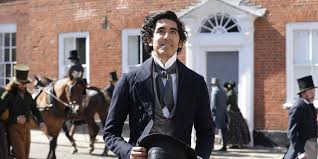
Dev Patel in THE PERSONAL HISTORY OF DAVID COPPERFIELD
New this week – a dazzling literary adaptation, a profound social satire and a dreary slog. And check out my Best Movies of 2020.
I’ve also recently remembered 32 filmmakers that we lost in 2020:
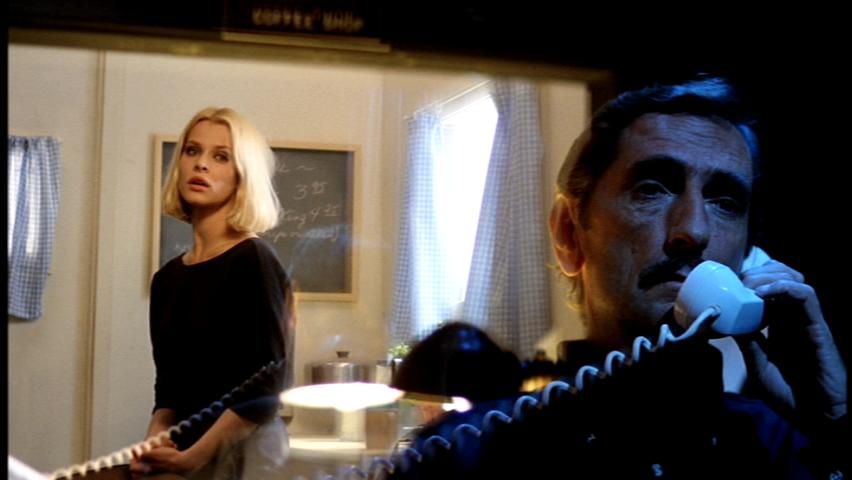
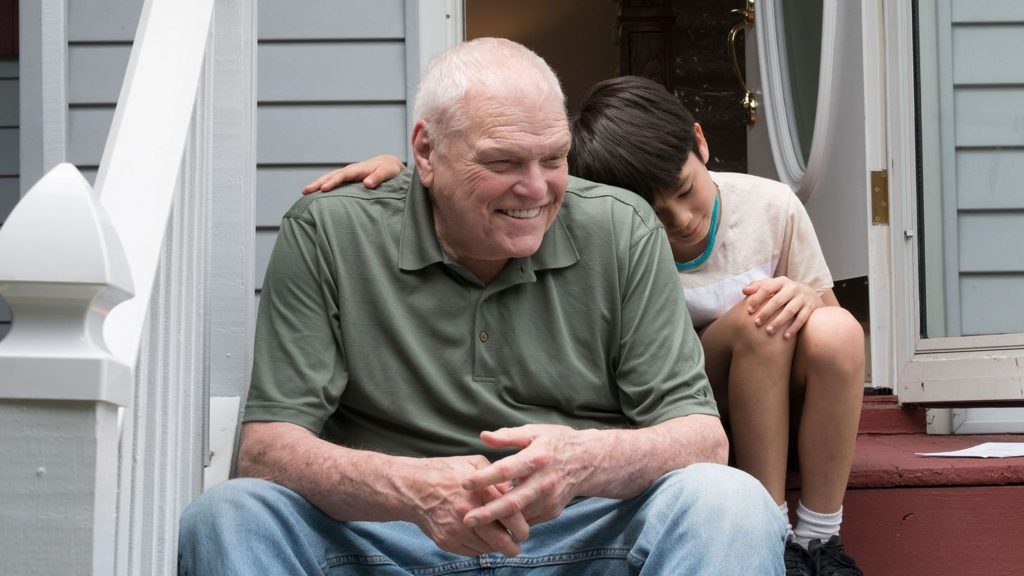
2020 Farewells: On the Screen (Part 1): Kirk Douglas, Sean Connery, Max von Sydow, Carl Reiner, Olivia de Havilland, Rhonda Fleming. Brian Dennehy, Fred Willard and Chadwick Boseman.
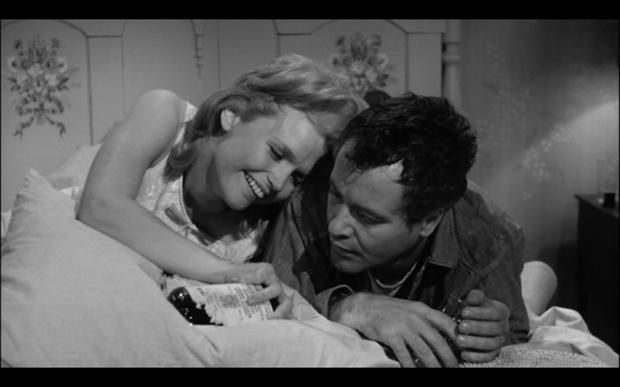
2020 Farewells: On the Screen (Part 2): John Saxon, Ian Holm, Jerry Stiller, Allan Garfield, Michael Lonsdale, Ann Reinking, Stuart Whitman, Wilford Brimley, Sue Lyon, Jo Shishido, Little Richard, Linda Manz and John Benfield.
2020 Farewells: Behind the Camera: Ennio Morricone, Buck Henry, Terry Jones, John le Carré, Lynne Shelton, Ivan Passer, Michael Chapman, Alan Parker, Joel Schumacher and Mike Cobb.
ON VIDEO
The Personal History of David Copperfield: That master of social satire, Amando Ianucci, brings Charles Dickins’ masterpiece to life in this vivid and brilliantly constructed film. Streaming on Amazon, Vudu, YouTube and Google Play.
Another Round: Writer-director Thomas Vinterberg once again explores human foibles with humor and cold-eyed insight – and profoundly to boot. Mads Mikkelsen is stellar. I watched Another Round on Virtual Cinema at Laemmle.
Ammonite: The fine acting of Kate Winslet and Saoirse Ronan can’t save Ammonite, a slog of a period romance. Streaming on Amazon.
On January 5, Turner Classic Movies presents David Lean’s WWII epic The Bridge on the River Kwai. It’s the stirring story of British troops forced into slave labor at a cruel Japanese POW camp. The British commander (Alec Guinness, in perhaps his most acclaimed performance) must walk the tightrope between giving his men enough morale to survive and helping the enemy’s war effort. He has his match in the prison camp commander (Sessue Hayakawa), and these two men from conflicting values systems engage in a duel of wits – for life and death stakes. William Holden plays an American soldier/scoundrel forced into an assignment that he really, really doesn’t want. There’s also the stirringly unforgettable whistling version of the Colonel Bogey March. The climax remains one of the greatest hold-your-breath action sequences in cinema, even compared to all the CGI-aided ones in the 62 years since it was filmed.
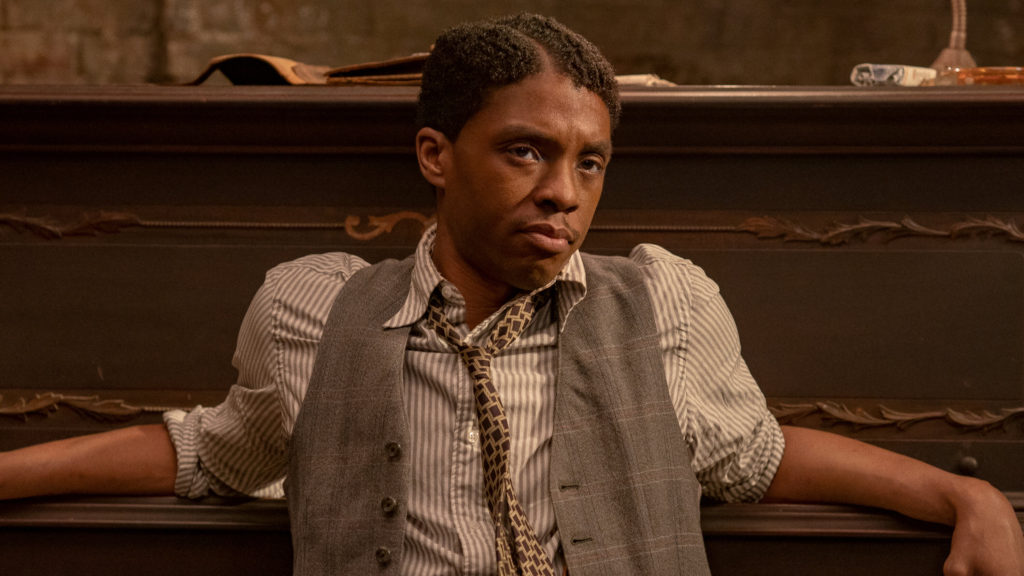
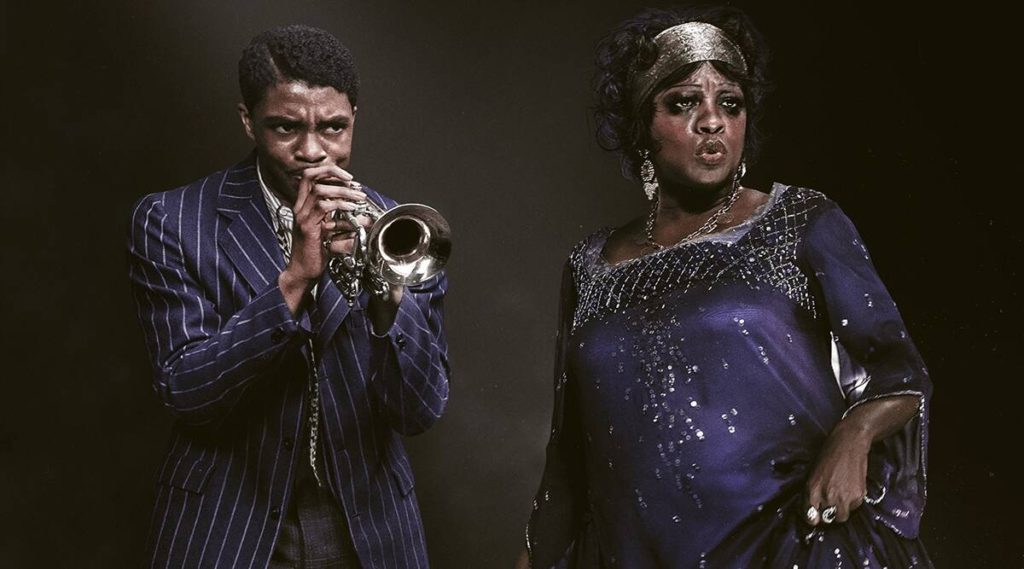
Chadwick Boseman in MA RAINEY’S BLACK BOTTOM. Photo courtesy of Netflix.
In the Year of Pandemic, I somehow managed to watch one hundred and fifteen 2020 movies (and another one hundred and forty-nine movies from earlier years). Here are the Best Movies of 2020.
Every year, I keep a running list of the best movies I’ve seen this year. By the end of the year, I usually end up with a Top Ten and another 5-15 mentions. Here’s last year’s list.
To get on my year-end list, a movie has to be one that thrills me while I’m watching it and one that I’m still thinking about a couple of days later. I haven’t yet seen Nomadland, Mayor or The Sound of Metal, and I will add films to the list as I see fit.
BEFORE THE FIRE: world premiere at Cinequest. Photo courtesy of Cinequest.
2020 sucked so badly that several of my favorite movies weren’t from 2020. Noir CIty led me to discover the Czech neo-noir masterpiece …And the Fifth Horseman Is Fear and the amazing German romantic tragedy Black Gravel. And I loved A Colt Is My Passport on Turner Classic movies, a 1960s Japanese hybrid – a Spaghetti Western in the guise of a Yazuka film.
In Another Round, filmmaker Thomas Vinterberg once again explores human foibles with humor and cold-eyed insight – and profoundly to boot. And, in Another Round, Mads Mikkelsen delivers one of the year’s finest performances.
Mikkelsen plays one of four middle-aged male teachers – each in some sort of personal rut and struggling with career burnout. The other three are played by Thomas Bo Larson (love this guy whenever I see him), Magnus Millang and Lars Ranthe.
Grasping on to some convenient pseudo-science, the four decide to try living their lives with an alcoholic buzz – trying to maintain a steady blood alcohol level of 0.05 from morning through 8 PM. Now THERE’S a good idea.
They all should be trying SOMETHING new. Mikkelsen’s history teacher Martin is mailing in his job performance, so much so that his students and their parents confront him, worried that he won’t cover enough history for the kids to pass their exams. His marriage is comfortably civil but passionless.
With the boost of a drink or two, Martin and his buddies become more lively. Less inhibited, they fly back into their passions and share them with their students.
Suddenly, Martin is a man of spontaneity, shocks wife Annika (Maria Bonnevie) with a surprise vacation, and rekindles romantic sparks.
So far so good. But then they decide to try more is better, and try raising their blood alcohol level to 0.10. things don’t go as smoothly, and then they go on an epic bender and blow well past the 0.10.
The drunk behavior is realistic. So, some is funny slapstick, some is cringeworthy and some is heartbreaking. There’s a buffoonish moment in a supermarket, and we think that it would not be not amusing to be there in that moment. But when, out at dinner, Mikkelsen utters “It’s the little things“, the quip is hilarious.
Their experiment with alcohol treats each of them differently. One guy comes out ahead – he doesn’t suffer any long lasting consequences and even finally gets a girlfriend. Another guy blows up his marriage, but only temporarily, and he’ll be able to look back on this episode as a cautionary tale.
But alcohol abuse does not fit well with latent depression, with tragic results for one character.
Martin has the most complicated experience because he is predisposed to addiction. When it’s time for the guys to end the experiment, he can’t. There’s a moment when he receives a text message in a restaurant hallway, and we think “Leave right now!“, but he goes back inside for another drink. Will he be able to recover from the addiction? Another Round’s final thrilling scene ends with a euphoric dance – and leaves us with that question. (I think I know the answer.)
Mikkelsen’s performance is stellar. Usually we see Mikkelsen in charismatic roles; here he begins the story as a hollow shell, beaten down by the disappointments and responsibilities of life. He allows us to glimpse the talent, charm and vigor of his younger self. Finally, we see him thinking through each life choice (and choosing another round usually wins out); his Martin is not a hedonistic brute – he understands the consequence of each drink. Technically, his portrayal nails the various stages of drunkenness (which much be harder than it looks because even good actors don’t always get it right).
You’ll recognize Mikkelsen, a big star in Europe, from After the Wedding, the 2006 Casino Royale (he was the villain with the tears of blood) and TV’s Hannibal. He won the 2012 Cannes Best Actor award for his performance in Vinterberg’s The Hunt.
A groundbreaking writer/director, Thomas Vinterberg is an astute and cold-eyed observer of behavior. He broke through with Celebration (Festen), that darkest of dark comedy, and directed and the thriller The Hunt (Jagten). (And he can even do bodice rippers like Far From the Madding Crowd.) Vinterberg has worked before with all four of the main actors in Another Round.
Vinterberg also uses Another Round to comment on the drinking culture in his native Denmark (and, presumably, the rest of Scandinavia). This is a society that doesn’t blink at binge drinking, even by teenagers.
Anthony Hopkins and Olivia Colman deliver heartbreaking performances in The Father, an unsettling exploration of memory loss.
As we meet the elderly Anthony (Hopkins), he is insisting on independence that he can no longer sustain. That makes it hard on his daughter Anne (Colman), who is trying to keep him safe and healthy, despite his resistance. But Anthony is losing his memory and becoming ever more suspicious. Soon, all the characters are experiencing disorentation, even fantasies and hallucinations.
The Father is the directing debut for Florian Zeller, who wrote the original play. Along with the superb acting, the key to The Father is Zeller’s ever shifting of reality as understood by the characters and by the audience. As we think we understand what is going on and then have it unraveled, we, like Anthony, lose confidence in our orientation.
Anthony Hopkins has an Oscar and a long list of great performances (The Silence of the Lambs, The Remains of the Day, Nixon, The Human Stain, The Two Popes), but none is better than this one. His Anthony is a man whose characteristic wilfulness is finally self-defeating; he is a man ever confident of his opinions, but the factual basis for those opinions is eroding. He is a man who firmly believes he is always right, facing a new reality in which he demonstrably is not.
Colman is also superb as the able and devoted daughter who is hurt by her father’s perception that she is betraying him. The rest of cast – Rufus Sewell, Imogen Poots, Mark Gattis and Olivia Williams – is impeccable.
The Father, which I saw while covering the virtual Mill Valley Film Festival in October, had been set for a December release, but Sony Pictures Classics has now scheduled a February 26 release. Nevertheless, it’s on my list of Best Movies of 2020.
The fine acting of Kate Winslet and Saoirse Ronan can’t save Ammonite, a slog of a period romance.
Winslet plays a 19th century paleontologist isolated in the inhospitable climate of an English coastal village. Ronan plays a young wife whose clueless husband has diagnosed as melancholy, although her biggest issue seems to be him; he thinks that leaving her with Winslet’s loner in the brisk ocean breeze might be therapeutic.
The general arc of the story is predictable – these two underestimated women will come to appreciate each other’s gifts and will fall in love, a forbidden love in this time and place. Of course, it takes a long time to break down the anti-social barriers that the Winslet character has constructed to protect herself emotionally. In the mean time, there’s only so much smoldering that the audience can stand to consume.
The problem here is the directing and editing – the pace needed to be picked up. There’s not enough of a payoff to this story to reward a slow, slow, slow burn. The Wife and I just couldn’t hang in there with it. We stopped caring.
The Winslet character is so solitary – and so terse when she’s not alone – dialogue in Ammonite is scant. And the sound design is intentionally rigged to emphasize this – and it’s a problem. All of the non-dialogue sounds are louder than usual. Now, this works near the crashing surf; we all know that voices are drowned out by waves crashing on rocks. But every footstep and creaking hinge a makes a pronounced, even jarring, sound. Once you figure out what’s going on, it’s very distracting.
The sound design, because it is so innovative, has prompted some Oscar buzz. But it’s innovative-bad, not innovative-good.
Ammonite is available to stream; I watched it on Amazon.
Not The Wife, but Helen Mirren in PRIME SUSPECT symbolizes the twenty seasons of British crime dramas we feasted upon together this year.
Happy 20th Anniversary to The Wife, also known as Lisa, The Love of My Life!
But – this dreadful year was like no other. We’ve sheltered in place together 24/7, with each of us working from home, for ten months. Overall, the year has been horrible, but our mutual confinement hasn’t been.
Like me, she has been evangelizing for Driveways, 2020’s most overlooked film. We enjoyed lighter fare, too: Lovebirds, Inmate #1: The Rise of Danny Trejo, Mucho, Mucho Amor: The Legend of Walter Mercado, The Speed Cubers and Voices of Fire.
This year we binged more episodic television together than ever, like The Crown (and, yes, Tiger King). Her favorite has been Derry Girls. And AT LEAST TWENTY FULL SEASONS of British crime dramas – Prime Suspect, Marcella, Vera, DCI Banks, Shetland, Deadwater Fell, Hidden, Broadchurch. As far as we can tell, England, Scotland and Wales are filled with entertaining murders.
As usual, I got to introduce her to some film classics: Key Largo, Witness to Murder and Le Boucher.
Once again, she tolerated my spending huge chunks of time covering Cinequest and Noir City in person and the SXSW, Mill Valley Film Festival, Cinequest’s Cinejoy and Noir City (again) virtually.
She’s the biggest fan and supporter of this blog DURING ALL OF ITS TEN YEARS, and I appreciate her and love her. Happy Anniversary, Honey!
Dev Patel in THE PERSONAL HISTORY OF DAVID COPPERFIELD
Here’s an unexpected treat: Amando Ianucci’s vivid and brilliantly constructed The Personal History of David Copperfield. Unexpected because I’ve never warmed to the work of Charles Dickins or to any Dickins movies (except for the 1951 A Christmas Carol with Alistair Sim).
Of course David Copperfield IS a storyteller and Ianucci uses the device of David’s storytelling to frame the tale as David remembers it and as his readers and listeners imagine it in their own minds. Ianucci makes the highs in David’s life so vibrant and the lows so piercing, that the total package is a dazzling delight.
Dev Patel, he of the instantaneous appeal and the gleaming smile, is perfect as the quick-witted and charming David Copperfield. Patel’s David suffers grievance after grievance, just waiting for a moment of good luck when he can control his destiny.
That the talented David Copperfield, because of his station, cannot control his destiny in the class-constricted Victorian society is the whole point of David Copperfield, social criticism which Dickins keeps from stridency with his humor.
That’s prime territory for Armando Ianucci. Ianucci is a master of wickedly funny political satire, having directed In The Loop and Death of Stalin and created the television series Veep. (In case you want to know what I do on my day job, I am basically Malcom Tucker in In the Loop, whom you can find on YouTube.) Ianucci’s production designer, Cristina Casali, deserves a shout-out, too.
Peter Capaldi in THE PERSONAL HISTORY OF DAVID COPPERFIELD
It’s a wonderful cast, including Tilda Swinton and Hugh Laurie. The standouts are:
Laurie as the addled, but dignified, Mr. Dick.
Ben Whishaw as one of literature’s most distinctive villains, Uriah Heep.
Peter Capaldi (who played the aforementioned Malcom Tucker) as Mr. Micawber, a character modeled after Dickins’ own father.
Rosalind Eleazer as the even-smarrter-than-David Agnes.
Morfydd Clark as the sweetly vacant Dora Seamans.
Bronagh Gallagher (who played one of the backup singers in The Commitments) as the remarkably glass-half-full Mrs. Micawber.
Dickins wrote this story about white people in Victorian England. As is obvious with the casting of Patel as David, The Personal History of David Copperfield has an interracial cast, based on a premise that any actor can play any role. I’m okay with that, and I think as more directors cast their movies this way, the distracting aspects will evaporate for most viewers.
The Personal History of David Copperfield is streaming on Amazon, Vudu, YouTube and Google Play.