They shouldn’t have done this to John Doucette

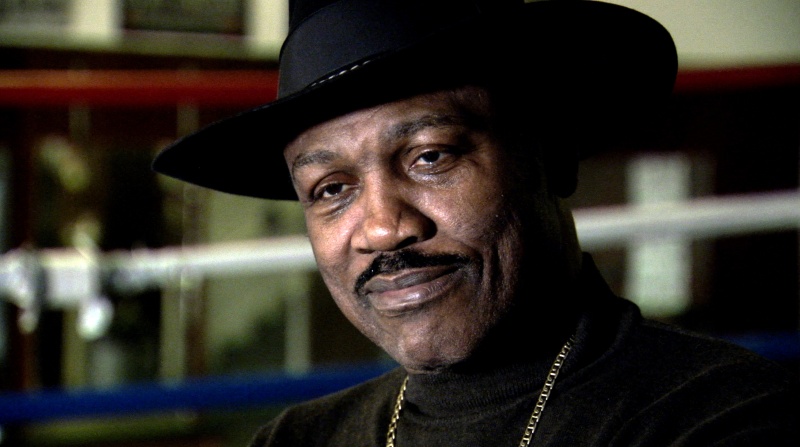
I was watching the 1950 Western Rancho Notorious when I asked myself, “Who’s the bad guy in the pageboy?”.  Indeed, the reliable character actor John Doucette has been forced to don a platinum blonde pageboy wig to play Whitey.  When shot in the back at the campfire, he gets to die with his boots on  – and with his pageboy.  I’ve added this on to my list of Least Convincing Movie Hair.

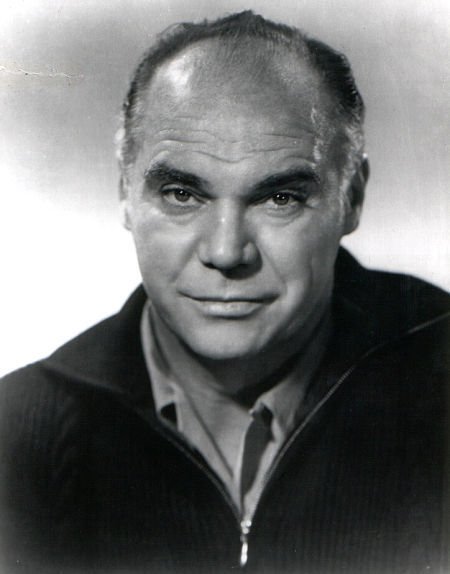
the John Doucette that we all recognize

BTW Rancho Notorious – directed by Fritz Lang and starring Arthur Kennedy, Marlene Dietrich and Mel Ferrer – really doesn’t stand up very well.  It’s easily the most disappointing Lang film that I’ve seen.

A Remarkable Film Distributor

Roger Ebert just tweeted that today is the 20th birthday of Sony Pictures Classics.  I normally don’t weigh in on distributors, but I note that Sony Pictures Classic has already released three of the films on my Best Movies of 2011 – So FarIncendies, The Guard and Midnight in Paris.

In 2009-20, their released four films that made my annual top ten lists:  Another Year, The Secrets in Their Eyes and A Prophet.  And, in 2008, Sony Pictures Classics released both my #1 film, I’ve Loved You So Long, and my #2, Rachel Getting Married.  Not bad.


Coming up on TV: TCM’s History of Hollywood

On Labor Day, Turner Classic Movies is broadcasting all seven parts of its series Moguls And Movie Stars: A History of Hollywood.  Most histories of cinema emphasize the technical and creative evolutions of film.  Instead, Moguls traces the business story – how mostly Jewish immigrants started with the early peep shows in old Eastern cities and wound up building monopolistic empires in the sun and glamor of Hollywood.  It’s a great story, and this series tells it very well.

TCM originally broadcast the series in fall 2009.  The DVD set is now available for purchase for about $28.  Here’s the original TCM promo.

A breakthrough year for Jessica Chastain

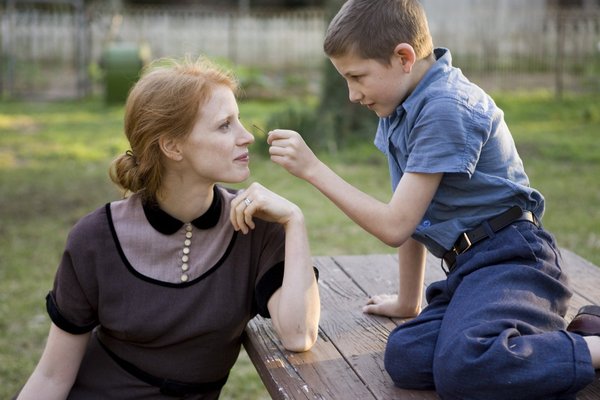
Jessica Chastain in THE TREE OF LIFE

If any new face has broken through in 2011, it’s the actress Jessica Chastain.  First, she delivered a fine performance as an enabling 1950s mom in the most coherent part of The Tree of Life.  This week, she followed that with an excellent performance as a 1960s Mossad agent (the younger version of Helen Mirren’s character) in the thriller The Debt. She won critical praise for the trashy but aspiring housewife in a film I haven’t seen – The Help.  So we already know that Chastain is versatile enough to play soft and tough, brittle and sexy, action and romance.

Later this fall, she will have three more films in release.  In Take Shelter, she plays the wife of the mentally disintegrating Michael Shannon.  She’s a tough cop in The Texas Killing Fields.  And then she’s in Ralph Fiennes’ adaptation of Shakespeare’s Coriolanus.

Six movies in six months – that’s quite a way to start a career.  Here’s a New York Times profile of Chastain.

Movies free condemned man from death row

Last week, three men were released from prison in Arkansas – one of them from death row.  This wouldn’t have happened without two HBO documentaries, the 1996 Paradise Lost: The Child Murders at Robin Hood Hills and its sequel Paradise Lost 2:  Revelations.  HBO is rebroadcasting them on Monday, August 29th (the first one) and Tuesday, August 30th (the sequel).

The men had served over eighteen years each for a horrific crime that they apparently had nothing to do with.  Three second grade Cub Scouts were brutally raped, murdered and their bodies mutilated.  The authorities, under understandable pressure to solve the crime, arrested three Metallica-loving teenagers and railroaded them for a supposed Satanic ritual killing.  Although no physical evidence tied them to the crime, one teen with an IQ of 76 was browbeaten into a confession that he later recanted.

The HBO films spawned media interest and public and celebrity support for the convicted men, who became known as the West Memphis Three.

Recently-processed DNA evidence was inconsistent with any of the defendants.  Facing the specter of a futile new trial, the prosecutor accepted a plea bargain that freed the men without their having to acknowledge guilt. Interestingly, the father of one of the victims has gone from the villain of the second HBO film to a supporter of the recently freed men.   Here’s the New York Times coverage.

And here’s a trailer for the first film.


Interesting launch of Sayles film

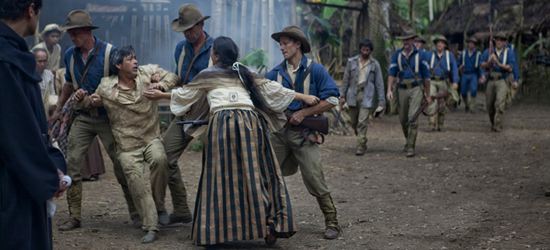
John Sayles' AMIGO

John Sayles’ new film Amigo is opening this weekend in New York, Los Angeles and San Francisco. Nothing unusual there.  But, in the San Francisco Bay Area, a Sayles film would usually open in the San Francisco, San Jose and Berkeley art houses.  Instead, Amigo, a historical drama set in the Phillipines,  is opening at mall multiplexes in Milpitas and southwestern San Francisco.  Why? It can’t be a coincidence that these theaters are most accesible to the thriving Filipino communities in Milpitas and northern San Mateo County.

Best 7-year-old boogie woogie ever

Here’s 7-year-old Frankie “Sugar Chile” Robinson in 1955’s No Leave, No Love with Van Johnson, Keenan Wynn and Marina Koshetz.   He’s playing his hit “Caldonia”.  Frankie was performing “Caldonia” at a 1946 gala when he belted out “How’m I Doin’, Mr President?” to Harry Truman, which became a catch phrase of the moment.

As a teenager, Robinson chose to return to school,  graduated from high school at 15 and then earned his college psychology degree.

Happy 80th, Billy Jack

Billy Jack (1971)


Tom Laughlin

Tom Laughlin, the groundbreaking independent film maker who created the 70s iconic character Billy Jack, turns 80 today. Laughlin originated the character in his biker exploitation movie Born Losers (1967), and then fully unleashed him in Billy Jack (1971), The Trial of Billy Jack (1974) and Billy Jack Goes to Washington (1977).

Billy Jack is a Vietnam vet who embraces his own combo of New Age mysticism and Native American spiritualism and uses martial arts to kick the crap out of the bad guys who bully women,  Native Americans and teenagers.  Laughlin played a character along similar themes in his The Master Gunfighter (1975), only bearded and wielding a samurai sword.

The prickly Laughlin made and distributed his films independently, and Billy Jack and Trial were huge box office successes, among the most financially successful indies ever.  For The Trial of Billy Jack, Laughlin engineered the then-unheard-of simultaneous release on 1500 screens.  This excellent Bill Gibron article in Pop Matters describes this precursor of the Hollywood blockbuster strategy.  Billy Jack was also the first widely seen martial arts movie in America.

Despite his innovations in the movie business, Laughlin never succeeded in making a good movie.  Filled with clumsy acting and hackneyed dialogue, the films are still pompous,  self-important and humorless.

Laughlin’s signature as a screenwriter is heavy-handedness.  It’s never enough for the bad guys in the Billy Jack movies to be bad.  They also have to be racist AND mean to animals AND sexually perverted.  Billy Jack opens with the bad guys illegally raiding an Indian reservation to steal a herd of wild mustangs and herd them to a corral where they will be shot at pointblank range to bring in six cents per pound as dog food.  One of the Billy Jack villains seduces a 13-year-old, insists on forcing a willing floozie at knifepoint and, for good measure, stakes a saintly teacher to the ground for a ritual rape.  In The Trial of Billy Jack, a government henchman shoots a child – in the back – while he is cradling a bunny.

I have a Bad Movie Festival that features unintentionally bad movies that are fun to watch and mock.  The Billy Jack movies are too painful for this list.  While bad enough, they are gratingly platitudinous.

Laughlin has been married since 1954 to his Billy Jack co-writer and co-star Delores Taylor.

More prison movies (the raunchiest of the genre)

It’s not often that I get accused of being too high brow, but my friend Steve has criticized my heretofore well-regarded list of 10 Best Prison Movies for not including Women in Chains (1972).  Women in Chains is part of the subgenre of women-in-prison exploitation movies.  A prison setting offers a filmmaker the possibility of violence, sex and S&M to exploit.  With women’s prisons, nude shower scenes and catfights are added to the mix.  Steve fondly remembers this aspect of Women in Chains.  But, Steve, it was a made-for-TV movie, so it couldn’t have been THAT racy.

The absolute master of this genre is the website BigBustOut.com – The Original Encyclopedia of Women in Prison Films, which lists over 300 women-in-prison movies.  BigBustOut.com also has an excellent history of the genre. I’ve included BigBustOut on my list of Other People’s Great Movie Lists.  Here is BigBustOut’s take on Women in Chains.

My own guilty pleasure from 70s prison exploitation films is 1971’s 1,000 Convicts and a Woman, which I saw in a drive-in during a misspent evening of an otherwise upstanding youth.  1,000 Convicts and a Woman doesn’t make BigBustOut because it’s not about a women’s prison.  Instead, the oversexed daughter of the warden returns from finishing school and moves into the men’s prison.  Played by vamp-eyed blonde Alexandra Hay, she immediately begins to tease the incarcerated, with forseeable results.


The Movie Gourmet hits the all-you-can-eat buffet

It was a perfect storm.  Lots of important movies were opening where I live.  The Wife was out-of-town.  And my buddy Kiefer was game to join me.  It was time for the all-you-can-eat buffet of movie-going – five movies in 48 hours!

We started on Friday night by catching Super 8 at San Jose’s Camera 12.  We were both impressed with authenticity of the coming of age story embedded in the sci-fi thriller.  Good start!

Saturday morning, we drove to San Francisco’s Embarcadero Center Cinema for the noon show of Beginners.   Home run!  We both loved this smart and original comedy by Mike Mills.  Christopher Plummer will certainly get an Oscar nod.  I rated it as one of the year’s best.

We jumped in a cab to make the 2:30 show of Le Quattro Volte at the Lumiere.  The cabbie knows most of the San Francisco Giants – and even two of their moms; he keeps a box of baseballs in the front seat for autographs.

We settled in for Le Quattro, the Italian goatherd movie and a critical fave.  An aged goatherd moves his goats up and down a hill, coughing as he goes.  The next day, he does the same, only coughing more. Suddenly, a young goat is born, starts to grow up and gets lost.  Here’s where Kiefer fell asleep.  Then the villagers cut down a tall tree for a festival.  After the festival, it is added to a pile of wood that becomes charcoal.  I get that it is intended to comment on The Circle of Life, but I found it less a tranquil and profound reflection than an eye-glazing bore.  After the screening, other patrons were asking who voted this Best of Europe?

Okay – back to the Embarcadero for an early dinner at San Francisco’s oldest restaurant The Tadich Grill.  Cioppino still awesome!

Now we needed to drive back to San Jose for the 7:15 PM show of The Tree of Life.  We got stuck in San Francisco Giants traffic, and we’d never make it to San Jose in time.  Never fear, some Blackberry surfing in the car revealed a 7:15 show in Palo Alto that we COULD make.

So we got to the Palo Alto Square CineArts in time for The Tree of Life.  This screening was packed.  We were both stunned, and most of the crowd stumbled out mumbling something like “What the hell was THAT?”.  Kiefer and I were laughing – even after we had mentally cut out all of the Sean Penn scenes, we were still trying to figure out whether Tree of Life was worse than the Italian goatherd movie.

Sunday morning, we have breakfast and amble into my 10:30 AM Camera Cinema Club at The Camera 7 in Campbell.  This month’s Club selection was Turkey Bowl, a delightful indie comedy set in a group of friends’ annual touch football game.  It is a mere 62 minutes, but loaded with laughs.  After the screening, we heard writer-director Kyle Smith tell how he financed the film with $25,000 that he earned from a reality TV show, and shot it over ten days in an East LA city park.

So, all-in-all, we had a very rich film experience sampling indies, art films, a mini-blockbuster, foreign cinema, the most accessible movies and the most obtuse.  Doesn’t get any better.