The high stress care of a difficult 88-year-old grandmother is tearing a Basque family apart. They think that she’s addled, until one family member after another come to realize that she actually is lucid and diabolical. She’s so evil that it becomes either her or them.
Monserrat Carulla makes the most of the delicious role as the conniving grannie. You may have seen her in the excellent Spanish horror film The Orphanage. The rest of the cast is excellent, too.
It’s a dark comedy and much, much darker than American audiences are used to. She does some very bad things to sympathetic human characters and to innocent animals.
This Spanish movie is in the Basque language and is also titled Urte Berri On, Amona!.
The road trip comedy Come As You Are is about three disabled young Belgian men who yearn to discard their virginity. Two are in wheelchairs and one is blind. After hearing about a brothel that caters to guys with special needs, they plot a road trip to Spain’s Costa del Sol. They need their parents to send them with a male nurse, but not to come along or know the true destination. All goes well, until the parents withdraw their permission and our heroes sneak off under the care of a necessary evil, a no-nonsense female nurse. Their getaway is expedited by a very funny 11 year-old kid sister.
Along the way, their individual personalities are exposed (for better and for worse) and they experience real unsheltered freedom for the first time (with its pluses and minuses). It’s a little movie with some poignant moments among the laughs.
The film, titled Hasta La Vista in Europe, is mostly in Flemish, with some French and English.
In Children of the Green Dragon, a hangdog Hungarian real estate agent must avoid getting fired by selling a rundown warehouse that is currently rented to a shady Chinese import company. The Chinese watchman is tasked, for his part, to prevent the sale of the warehouse – or face an additional year of involuntary servitude. Surprisingly, they bond.
This movie is about the culture clash between the two guys. Their relationship blossoms despite that and despite their competing job interests. Then both become fascinated by an edgy pizza delivery woman. It’s a funny and sweet little film.
The film is titled A Zold Sarkany Gyermekei in Hungarian.
This Norwegian comedy, set in a sport that even the Norwegians find to be odd and boring, is HILARIOUS. The star of a curling team suffers a psychotic breakdown and, after years of treatment, is released from an asylum heavily medicated. To win money for a friend’s lifesaving operation, the curling team must win a tournament and the star needs to go off his meds to regain his game skills.
It’s a broad comedy, but the key is that the actors aren’t trying to be funny, a la Jack Black or Will Ferrell. Instead, they play it absolutely straight, relying on the characters, situations and dialogue to generate the laughs. And laughs, they are aplenty.
The curling star tries to maintain despite his recurring hallucinations of floating pink lint. One of the Norwegian curlers, a womanizer with unusually low standards, keeps lapsing into American gangsta street talk. Another has a long-lost father who turns up as, of course, a Rod Stewart impersonator who doesn’t sound remotely like Rod Stewart. And then there’s the kissing dog. You gotta see this movie – it’s a top drawer broad comedy.
It’s playing again at Cinequest tonight (March 2) and tomorrow (March 3).
In a sizzling performance, Woody Harrelson plays a corrupt and brutal LA cop trying to stay alive and out of jail. Woody’s Dave Brown is always seeking control. He manipulates his superiors. From behind his badge, he unleashes sadistic brute force on every other unfortunate within his sight. Yet he is a man out of control, whose impulses to bully, to drink and to seduce increasingly endanger his job security, his finances and what is left of his relationship with his family. He is already skating on the edge of self-destruction when one brutal incident is caught on video and goes viral a la Rodney King.
Rampart benefits from the one of the best large supporting casts – less an ensemble than a series of great single performances as individual characters tangle with Dave Brown. Ben Foster (The Messenger) is brilliant as a homeless man with too many drugs and not enough meds. Robin Wright is also superb as an emotionally damaged lawyer who sleeps with Dave until his paranoia takes over. Sigourney Weaver and Ice Cube are two LA officials who see Dave as a walking, talking threat to public order and the City treasury. Ned Beatty is the retired cop who has kept his finger in the police corruption racket. The Broadway star Audra McDonald plays a cop groupie that Dave meets in a bar. As one would expect, Anne Heche and Cynthia Nixon are excellent as Dave’s two amiable but bullshit-proof ex-wives. Brie Larson and Sammy Boyarsky are especially effective as the daughters, who figure in Rampart‘s most breathtaking scenes.
Rampart is a singularly visual film – we always know that we are in the sunwashed, diverse, sometimes explosive anarchy that is LA. The movie is structured and shot to heighten the experience of both the chaos that Dave causes and that the chaos that he feels. This is Oren Moverman’s second effort as writer-director, the first being the searing The Messenger, also starring Harrelson and Foster. Moverman keeps Rampart spinning along wildly as we wonder what will happen next to unravel Dave Brown’s life.
If you need some redemption to leaven a very dark story, this is not the movie for you. Rampart reminds us that not everyone finds redemption.
Thin Ice is the Fargoesque story of a sleazy Wisconsin insurance agent whose small scam spins into a major crime. By the time that he gets into real trouble, he has already lied to everyone in his life so often, that no help is available.
Greg Kinnear plays the ethically challenged agent who is always “on”; if he asks you the time, you know that he is trying to turn your money into his money. Literally.
Kinnear is excellent, as is Alan Arkin as the old farmer that he is trying to fleece. Billy Crudup plays the psycho ex-con who becomes Kinnear’s unwelcome partner in crime. David Harbour shines as go-getter young salesman. So does Lea Thompson as Kinnear’s soon-to-be-ex-wife and Bob Balaban as a fastidious luthier (look it up if you have to). And keep your eye on Michelle Arthur, who plays Kinnear’s long suffering secretary.
Thin Ice is entertaining while Kinnear gets more and more entangled in his own web of lies and the pressure builds. The final reveal at the end (a loooong eight minutes or so of exposition) is kinda lame, and doesn’t stand up to the top films in the genre. Still, it’s a harmless and fun diversion.
You might ask what the script of a silent movie looks like. Well, here’s the screenplay for The Artist, a film with only three lines of spoken dialogue (and a fourth line while the credits roll). BTW in a silent movie, the cards that pop up between live action shots are called “intertitles”.
In the crowd, a young woman right at the front is staring at him in rapture. She drops her bag and, as she bends to pick it up, a swell in the crowd pushes her underneath the arms of the policeman in front of her, out of the crowd and into George. She stares at him, more in love than ever, delighted to be there. The police wait for someone to give orders. George doesn’t quite know what to do. Nobody moves. The young woman finally bursts out laughing, which, after a moment of shock, causes George to laugh too, thus placating the cops and tacitly signaling to the photographers that they can take pictures of the scene. The flashes seem to lend the woman self-confidence who, in a very carefree manner, begins to clown about in front of them. George is delighted at the sight, by the whole scene and, realizing this, the young woman steals a kiss. Flash. The image becomes static, then dissolves into the printed picture on the front page of “The Hollywood Reporter” newspaper, along with three other pictures of the scene and the headline WHO’S THAT GIRL?
Safe House, the first big Hollywood movie of 2012, is a fine paranoid spy thriller. Ryan Reynolds is a green but determined CIA agent who finds himself isolated in South Africa and forced to bring in rogue superspy Denzel Washington. Like Hannibal Lector, Denzel’s character Tobin Frost over matches everyone he faces; it takes entire teams of elite commandos to trap and transport Frost, so Reynolds has his hands full. Not to mention that more teams of elite commandos keep popping up, trying to kill them both. Swedish director Daniel Espinosa keeps his pedal jammed to the floor, and this two hour movie flashes by in what seems like 90 minutes.
It takes a screen presence like Denzel’s to make Tobin Frost, with his unique mix of charisma, menace and lethal skills, credible. Reynolds holds up well against Denzel, and the always excellent Vera Farmiga, Brendan Gleeson and Sam Shepherd round out the cast.
I wouldn’t rate Safe House at the very top of the genre. Espinosa didn’t take advantage of the opportunity to flesh out the characters played by Farmiga, Gleeson and Shepherd, who all end up playing oft-recycled types. And there are some holes in the plot that you’ll recognize in the few moments when you can catch your breath (See spoiler below the trailer).
But the action and thrills are there, and the extremely well-paced Safe House is a satisfying watch.
Spoiler alert: Since the CIA knows about Reynolds’ girlfriend, why don’t they kidnap her or at least tap her phone to help them track down Reynolds?
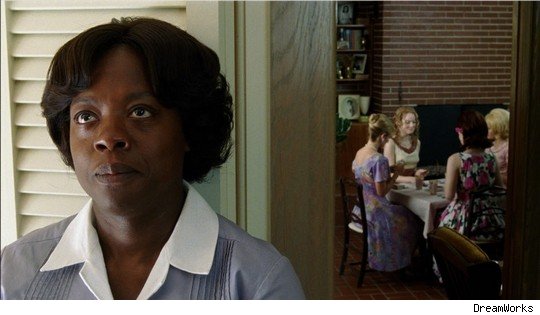
Well, given the upcoming Oscars, I should weigh in on The Help and its four Oscar nominations. Based on the well-received novel by Kathryn Stockett, it is the story of black maids raising white children amid the hatefully poisonous racism of 1963 Jackson, Mississippi. Unfortunately, the film is overlong, plodding and wastes the talents of an unholy multitude of our greatest actresses.
I am told by The Wife that the characters in the novel are full and textured. The problem with the movie is that the characters are cartoonish cardboard cutouts of real people. Unfortunately, Stockett’s novel was adapted by director Tate Taylor, and he stripped any hint of nuance or ambiguity from virtually every role. Octavia Spencer and Allison Janney play characters that have a mix of human virtues and foibles. But the rest of the awesome cast – Olivia Davis, Bryce Dallas Howard, Jessica Chastain, Cecily Tyson, Sissy Spacek, Mary Steenburgen and Emma Stone – must play either saints or bitches.
Davis and Spencer are nominated for acting Oscars, and I wish them well. But here’s a baffler – Chastain is a brilliant actress who has delivered not one but FIVE superb performances this year (Take Shelter, The Tree of Life, The Debt, Coriolanus, Texas Killing Fields), yet she is nominated for the one role written so broadly that she is obviously acting (The Help).
The actor Ralph Fiennes directs and stars in Shakespeare’s Coriolanus. The title character is a fierce and successful military leader upon whom is thrust political leadership that he has not aspired to and to which he is utterly ill-equipped. It’s not going to end well, and that’s why they call it tragedy.
Coriolanus is devoted to the idea of Rome, which inspires his heroism in its defense. But he despises most Romans and thinks it would be insincere to show them the least civility, which doesn’t bode well for his political career. Fiennes does a good job playing Coriolanus, an oddball for whom “curmudgeon” doesn’t begin to tell the story.
Unfortunately, Coriolanus is propelled into the peacetime limelight by his ultra-ambitious mother (Vanessa Redgrave) and an able and well-meaning politician (Brian Cox). Redgrave and Cox are splendid, and their performances are highlights of Coriolanus. Coriolanus is well-acted, including by Jessica Chastain, the wonderful Irish actor James Nesbitt and even, surprisingly, Gerard Butler.
Fiennes the director has done well to set Shakespeare’s tale of ancient Rome into the present. This story of war and politics comes alive in today’s world of cable television news, with its crawling captions and pundits, protest demonstrations and soldiers in Humvees. By stripping away the swords and togas, Fiennes helps us recognize the ambition, personal stubbornness, political treachery and the fickleness of public opinion at the core of the story. As Shakespeare probably wanted to, Fiennes is able to put his audience into realistic warfare. Coriolanus was filmed in the Balkans and, indeed, Butler certainly looks like a Serbian warlord from the very recent past.
The problem with Coriolanus is that we admire Coriolanus’s high-mindedness less than we cringe at his social obtuseness. But Fiennes (and Redgrave and Cox) have given us one of the best cinematic adaptations of Shakespeare.