
DVD/Stream of the Week: The Man Nobody Knew: In Search of My Father, CIA Spymaster William Colby

William Colby was a daring saboteur in World War II, an effective espionage agent in the Cold War, an architect of an especially brutal aspect of the Vietnam War and, in the post-Watergate 70s, the nation’s top spy and the Director of Intelligence who made public the CIA’s historic misdeeds.  His son, Carl Colby, explores the man who lived that life in The Man Nobody Knew: In Search of My Father, CIA Spymaster William Colby (2011).

Carl Colby makes use of family photos and filmed interviews with Colby’s colleagues, rivals and observers beginning with his secret missions in WW II.  Chief of these is Barbara Colby, William’s wife of 39 years and Carl’s mother.  The talking heads also include the likes of James Schlesinger, Robert McFarland, Brent Scowcroft, Bob Woodward, Seymour Hersh and even Oleg Kalugin (the KGB’s chief spy in the US).  We also hear the White House audio of Colby, along with JFK, RFK and Averell Harriman, discussing the upcoming overthrow of Vietnam’s Diem government.

Carl Colby admires his father’s smarts, toughness, principles, physical bravery and compulsion to serve.  He also recognizes the impact that such devotion to duty has on family responsibilities.  “It’s a terrible thing to say, but sometimes I think I would have rather worked for him than be his son,” Carl said. “I would have been closer to him.”

Carl Colby interviewed his father’s second wife but did not use the footage in the film, and he did not interview his siblings.  As discussed in this Washington Post article, those family members disagree with the film’s portrayal of Colby as an absentee parent and a suicide victim.

But those are comparatively minor parts of the story. The most historically significant (and interesting) segments are:

  • Colby’s successful secret support of Italy’s Christian Democratic Party, resulting in election victories over the Italian Communist Party.
  • His inside view of the November 1963 anti-Diem coup in Vietnam (which Colby opposed).
  • His decision to resist the Ford Administration and lay bare the CIA’s “Family Jewels”, the past illegal activities, including assassination attempts and domestic surveillance.  Not surprisingly, the always smirking Don Rumsfeld, Henry Kissinger and Dick Cheney are the bad guys in this episode.

The Man Nobody Knew is available on DVD and on Netflix streaming.  Incidentally, it now #6 on my list of Longest Movie Titles, between Can Heironymus Merkin Ever Forget Mercy Humppe and Find True Happiness? (1969) and Don’t Be a Menace to South Central While Drinking Your Juice in the Hood (1996).
Killer Joe: OMG

Here’s a movie that will either thrill or disgust you. Either way, you sure ain’t gonna be bored.

In Killer Joe, Thomas Haden Church, Gina Gershon and Emile Hirsch play a white trash family with a get rich quick scheme.  They give a hit man (Matthew McConaughey) the teen daughter (Juno Temple) as a deposit.  They’re all as dumb as a bag of hammers, so what could go wrong?

Killer Joe was directed by William Friedkin (The French Connection, The Exorcist) and shot by cinematographer Caleb Deschanel (The Right Stuff, The Natural) in just 20 days.  These guys know how to tell a story, and Killer Joe pops and crackles.

Killer Joe is rated NC-17 for good reason and Friedkin accepts the rating without complaint.  Indeed, Killer Joe has its share of Sam Peckinpah style screen violence and an unsettling deflowering scene.  But the piece de resistance is an over-the-top sadistic encounter between McConaughey and Gershon involving a chicken drumstick,  at once disturbing and darkly hilarious.   But Sam Fuller and Quentin Tarantino would have loved it, and so did I.  Nevertheless, some viewers will feel like they need a shower after this movie.

The cast does a good job, but the picture really belongs to McConaughey and Temple.  McConaughey is currently recalibrating his career a la Alec Baldwin – he’s moving from playing pretty boys in the rom coms to taking meatier, more interesting roles.  He is both funny and menacing as Killer Joe (and I liked him in Bernie and Magic Mike, too).  I’m really looking forward to seeing him in Mud and The Paperboy.

The movie slowly makes Juno Temple’s character more and more central, until she takes command of the denouement.  Temple is always sexy (Kaboom and Dirty Girl), and here she is able to ratchet down her intelligence to play a very simple character, always exploited by others, who is finally empowered to take control.

I saw Killer Joe at a screening where Friedkin said that the screenwriter saw Juno Temple’s character as the receptacle for all feminine rage.  Friedkin himself sees it as a Cinderella story – just one where Cinderella’s Prince Charming is a professional killer.  hat’s all pretty deep sledding to me – I see Killer Joe as a very dark and violent comedy – kinda like In Bruges with twisted sex.

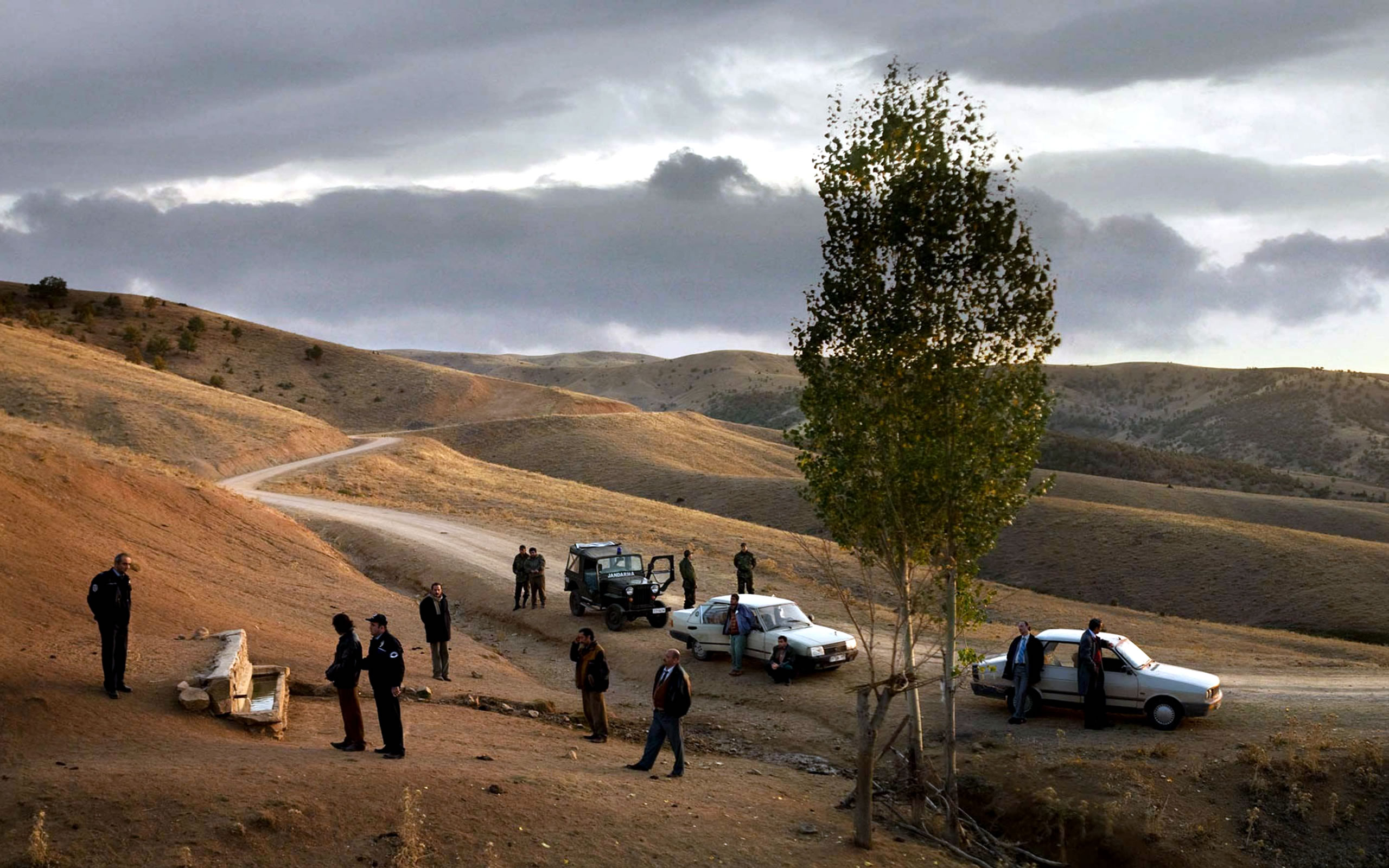
Once Upon a Time in Anatolia: a road trip to the depths of the human condition

Once Upon a Time in Anatolia,  one of the best movies of the year and an extraordinary achievement in filmmaking, is too long and too slow for most audiences.  That’s okay with its director Nuri Bilge Ceylan, who says that it’s just fine with him if audiences give up halfway through.  That sounds self-indulgent, but there isn’t a bit of self-indulgence in the film’s 2 hours and 37 minutes.  It’s just that the movie demands that you meet it halfway.  If you don’t, you’re going to be bored.  If you patiently settle in to the tempo of the film, you’ll be as transfixed as I was.

Technically, it’s a police procedural because the cops are solving a crime – and, indeed, by the end, we know who committed the crime and why and how.  But those aren’t the most important questions posed in the movie, which probes fundamental aspects of the human condition – love, betrayal, loss and decency.

As the movie begins, three carloads of men are driving at night through rural Turkey.  They think that they are wrapping up a murder investigation.  Two guys have confessed to killing a man and burying his body out in the sticks.  The cops are taking the culprits out in the country to locate the body.  But the desolate hills and lonely roads all look alike.  One of the killers was asleep on the drive and can’t help find the grave.  The other one was drunk, and he only remembers a nearby fountain and, unhelpfully,  “a round tree”.

They arrive at a potential crime site, but it isn’t the right place.  So they drive to another, but strike out again.  One group argues about the best unpasteurized yogurt.  The men are becoming fatigued and irritable, and, as we listen to snippets of conversation, we learn about each of the characters.  We piece together that they all defer to the prosecuting attorney.  He has brought along a doctor to observe the corpse; the doctor is living a rut-like existence in a nowhere town, not able to move on after a divorce.   The provincial police chief is burned out but puts in long hours to avoid the stress at home (he has a son with a condition, maybe autism or epilepsy).  One affable cop goes to the country and shoots his guns to blow off steam.  One man is haunted by an event in his past.

This first one hour and twenty minutes of the film is at night – lit only by the headlights of the three cars.  Although nothing seems to be advancing the plot, the story is spellbinding as we lean in and try to deconstruct the characters.  By now, the rhythm of the story is hypnotic.

The men take a predawn break in a tiny village.  The mayor gives them food and tea, acting out of Middle Eastern courtesy and also taking advantage of a chance to pitch a public works project to the official from the capital.  The power goes out, and they sit in darkness.  Then a door creaks open and the mayor’s teenage daughter brings in a tray with an oil lamp and glasses of tea.  She is modestly dressed, beautiful and lit only by the lamp.  As she serves tea to each of the exhausted men, we can see that she looks to them like an angel.  They wonder how such beauty could appear out of nowhere and about her fate in such a remote village.  It’s a stunning scene.

Now the convoy sets off again, and dawn breaks.  We see the Anatolian steppe in widescreen desolate vistas like a Sergio Leone spaghetti western.  As in the nighttime scenes, when they get out of their vehicles, the camera shoots the men in extreme long shot, so they are tiny against the endless steppe.  The cinematography is superb.

Forty minutes in, a character begins telling an anecdote to another, but they are interrupted.  After another thirty minutes, the listener presses the teller to finish the story and weighs in with some questions of his own.   Near the end of the movie, the two revisit the story.  This time the teller of the anecdote connects the dots and finally understands a pivotal moment in his own life.  This moment, drawing on profound acting by Taner Birsel, is raw and searing.

Once Upon a Time in Anatolia won the jury prize at Cannes.  I felt well rewarded for investing in its 2 hours and 37 minutes.  This visually striking movie, with its mesmerizing story, is uncommonly good.  Once Upon a Time in Anatolia is now available on DVD.

Farewell, My Queen: a palace teeters on the brink

This lavishly staged  and absorbing costume drama depicts Marie Antoinette’s Versailles at the onset of the French Revolution.  The story is set during the three pivotal days following the storming of the Bastille.  We view the Upstairs Downstairs of the palace through the eyes of the Queen’s personal reader, played compellingly by Lea Seydoux.  Seydoux’s performance is key to the movies’ success.  When Upstairs, we see her flattering the Queen and observing the Queen’s intimate moments – without becoming an intimate. When Downstairs, we see her unfiltered personality and opinions.

The performance by Diane Kruger as the Queen is equally good.   Her days are designed for her entertainment, and a battalion of servants scurry about to gratify every caprice.  In the days before remote controls, the ADD monarch uses her servant to skip from whim to whim.  She is supreme, but also vulnerable because she craves another person and because she comes to realize that the monarchy itself is threatened.

Virginie Ledoyen plays the Queen’s intimate friend the charismatic social climbing Duchess of Polignac.  In a secondary but essential role, Ledoyen exudes the sexual magnetism that has captivated a queen.

The fourth star of the film is Versailles itself – the movie was shot in the actual palace.   Farewell, My Queen is directed by Benoit Jacquot, and he makes Versailles come alive as a palace, not the museum it is today.  An army of servants bustle about to serve the royals and the nobles.  Even the ostentatiously clad resident aristocrats scuttle like cockroaches for a peek at the king or queen.  It’s a real treat – even those of us who have visited the Queen’s bedroom in Versailles haven’t seen it at night, lit only by the fireplace and candles.

Unfortunately, the ending wraps up the stories of the historical figures Marie Antoinette and The Duchess of Polignac but fails to address the fate of the palace servants who we’ve been following and relating to throughout the film.  I understand that Seydoux’s character is fictional, but we want to know what happened to those vivid characters that are themselves worrying about their own lots.

You might also want to read this superb Mick LaSalle review.

Dark Horse: an epic underachiever, unattractive but human

Dark Horse:  In this engaging indie dramedy by writer-director Todd Solondz (Welcome to the Dollhouse, Happiness), an epic underachiever falls in love with a heavily medicated depressive.

This guy has not moved out from his boyhood room in his parent’s house.   He gets a paycheck from his dad’s company although the office assistant does his work while he spends his day bidding for collectible toys on eBay.  He drives a bright yellow Hummer that blares the sappiest pop music.  Yet he feels completely entitled, is surly to his enabling parents and bellows like a wounded water buffalo when his genius remains unrecognized.

This guy is remarkably unsympathetic.  Still, Solondz ‘s clear-eyed and unsparing portrait is not mean-spirited and, eventually, becomes even empathetic. In particular, Solondz makes able use of dream/fantasy segments to explore the yearnings of the characters.

Jordan Gelber is excellent as the hapless blowhard protagonist.  The cast (Selma Blair as the girlfriend, Christopher Walken and Mia Farrow as the parents) is quite good, too, especially Donna Murphy as the office assistant and Aasif Mandvi as the girlfriend’s ex.

I saw this at a screening with Todd Solondz, and he said that Dark Horse is a reaction to the Apatowesque man-child movies.  In those films, the underachieving slackers are endearing goofs.  Here, the underachieving slacker is realistically unattractive, but has a realistic vulnerability and fundamental humanity.  Solondz says that the protagonist, at last, finds life in death.

Dark Horse has the trademark Solondz quirkiness, but without the trademark perversion.  As with most Solondz films, I’m still thinking about it several days later.

Note:  In Dark Horse, Walken and Farrow appear to be watching Seinfeld.  Instead of paying the fee to license a snippet of the real Seinfeld, Solondz got Jason Alexander, Estelle Harris and Jerry Stiller to read Solondz-written faux Seinfeld dialogue.

The Dark Knight Rises: Unfortunately, over 2 hours when Catwoman is not on the screen

Well, there’s 2 hours and 44 minutes that I’ll never get back. First, the good news about The Dark Knight Rises.  Anne Hathaway excels as the best Catwoman ever, and the banter between her and Batman crackles.  There are some exceptional CGI effects of Manhattan’s partial destruction. There’s a cool personal hovercraft, the Bat, and an equally cool combo motorcycle/cannon, the Batpod.

Unfortunately, that’s all the good stuff in director Christopher Nolan’s newest chapter of the Batman saga.  The problem is the screenplay, dotted with the corniest of dialogue and laden with pretentious Batman mythology.  When Catwoman tells him “you don’t owe these people any more! You’ve given them everything!”, Batman solemnly replies, “Not everything. Not yet.”

The plot simply exists to transition from action set piece to action set piece.  There are too many times, when a good guy is in peril, that another good guy pops up utterly randomly and just in the nick of time – too many even for a comic book movie.

With her bright wit and lithe sexiness, Hathaway fares far better than her colleagues.   Christian Bale continues his odd husky growl as Batman.   As the villain, an uber buffed Tom Hardy glowers from behind a fearsome mask.  The hackneyed screenplay wastes the rest of the extremely talented cast:  Joseph Gordon-Levitt, Marion Cotillard, Michael Caine, Gary Oldman and Morgan Freeman.  We barely glimpse Liam Neeson.  The captivating Juno Temple is apparently dropped into the story just enough to set her up for the sequel with Gordon-Levitt.

I saw The Dark Knight Rises in IMAX, which worked well for the long shots of NYC and made the fight scenes more chaotic.

DVD/Stream of the Week: Woody Allen: A Documentary

Woody Allen’s To Rome with Love is a pleasant enough trifle, but I’d rather focus on Woody’s masterpieces like Annie Hall, Manhattan, Hannah and Her Sisters, Crimes and Misdemeanors and last year’s Midnight in Paris.  In fact, combining his great films with his really good ones reveals an astounding track record: Play It Again Sam (1972), Annie Hall (1977), Manhattan (1979), Hannah and Her Sisters (1986), Another Woman (1988), Crimes and Misdemeanors (1989) , Husbands and Wives (1992), Mighty Aphrodite (1995), Deconstructing Harry (1997), Match Point (2005), Vicky Christina Barcelona (2008) and Midnight in Paris (2011).

What American filmmaker has created twelve films of this quality?  Woody is up there in Billy Wilder and John Ford territory.  The fact that Woody is so prolific may work against him – cranking out a movie each year means that there are some stinkers (Small Time Crooks, Curse of the Jade Scorpion) that dilute his reputation.  And then there was the scandal…

Cinephiles and Woody’s fans will appreciate Woody Allen: A Documentary, which traces Woody’s life and work, providing key insights into his creative process.  Robert Weide followed Woody for eighteen months and filmed interviews with over thirty associates and critics – many from Woody’s earliest days.  These include Woody himself, his mother (in footage shot by Woody in the 80s)), his sister and producer Letty Aronson and his longtime casting director Juliet Taylor.  We also hear from ex-wife and co-star Louise Lasser and ex-girlfriend and co-star Diane Keaton.

Weide uncovers slew of nuggets.  We see how Woody keeps ideas for potential movies on scraps of paper, which he revisits when he needs to think up another movie.  We see how he uses an old typewriter and lo tech cut-and-staple to construct his screenplays.  We hear how his screenwriting experience on What’s New Pussycat taught him to insist on total artistic control of his films.   He explains how he learned a woman’s point of view from Diane Keaton, which changed his perspective for Hannah and Her Sisters.

The documentary also addresses, but does not dwell on, the Soon-Yi scandal that blew up as he and Mia Farrow were finishing the shooting of Husbands and Wives.

Woody Allen: A Documentary has two parts – the whole thing clocks in a shade under 3 1/2 hours.  It’s available on DVD and on Netflix streaming.

In the Family: debut of a brilliant director

6-year-old Chip has two daddies, Cody and Joey.  When his biological father Cody is killed in an auto accident, Cody’s sister takes custody of Chip, and Joey fights to get his son back.  Writer-director Patrick Wang stars as Joey, and what makes In the Family more than just another social issue picture is Wang’s authenticity as a writer and brilliance as a director.

Wang uses long scenes shot by a static camera and an almost silent soundtrack to draw in the audience.   We watch Joey being told of Cody’s death through a hospital window and we only hear the passing truck traffic.  We see the kitchen when Joey and Chip come home after the funeral – Joey sits stunned, fingering the mail, and Chip, yearning for some normalcy, sets up beverages.  The film climaxes with Joey’s testimony at a deposition, mostly shot from the end of a conference table.  These are some of the most compelling scenes that I’ve seen this year.

The problem with In the Family is that it is 2 hours and 47 minutes long.  There are long films that need to be long (e.g., Once Upon a Time in Anatolia), but this isn’t one of them.  There’s probably a 130 minute indie hit somewhere inside In the Family.

It’s clear that Patrick Wang is a fine actor and an unusually talented writer-director (who needs to find an equally talented editor).  I’m certainly looking forward to his next work.

As yet without a distributor, Wang is self-releasing In the Family in various cities.

Neil Young Journeys: see it if you already like him

Neil Young Journeys documents Neil Young’s return to Ontario for a 2011 concert at Toronto’s Massey Hall.  It’s about 85% Neil Young music and about 15% Neil Young’s guided driving tour around his old haunts (“there is a town in north Ontario…all my changes were there”).  Young plays four of his songs from 2010 and several more from 1969-79.  He is alone on stage with boxes of equipment and a cigar store Indian, and accompanies himself with electric guitar, harmonica, piano and, on Down By the River, a stentorian pipe organ.  Ohio is intercut with video of the Kent State massacre and pictures of the victims.

It’s the third Neil Young film by director Jonathan Demme (Silence of the Lambs, Rachel Getting Married).  Demme shows the good sense to simply show Neil and then his music unadorned.   He does get arty with one camera that zooms on to Young’s mouth and grizzled chin.  Sitting in the third row, I felt like I’d need to duck spittle at any moment.

If you don’t love Neil Young, skip this movie.  If you do love Neil Young, see the movie in a theater or in a home theater with a good sound system.  Turn it up.

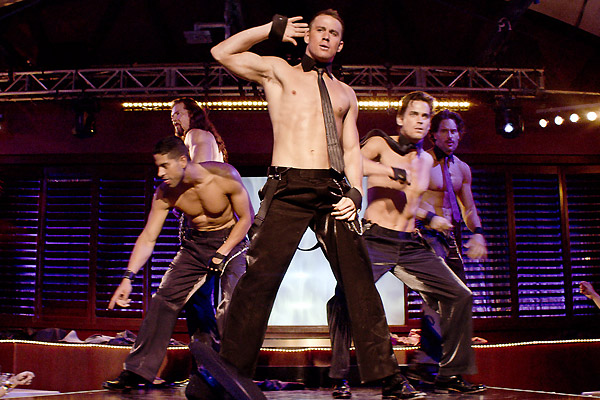
Magic Mike: male strippers, no magic

MAGIC MIKE

Magic Mike is about watching male strippers, period.  There are a couple lame plot threads, but it’s about the stripping.  The star, Channing Tatum, is winning and impressively athletic.  Matthew McConaughey helps re-brand his career with a funny performance as a sleazeball strip club owner – and shows off his body, too.

Director Steven Soderbergh is known for his prestige pictures but still relishes making B movies.  Good for him – he brought something special to the B picture Haywire last year (which co-starred Tatum).  But there’s no magic in Magic Mike.  And, at 110 minutes, it’s too long.