The heartfelt and intoxicating documentary In a Wintry Season starts out looking like a fairy tale, and unpredictably turns decidedly not, as the real world and human behavior intervene.
Writer-director Mary Posatko tells the increasingly unpredictable story of her parents. I generally resist filmmakers profiling their own parents, but In a Wintry Season won me over with its candor, authenticity and surprises. It’s a relatable story of two people and their family and their times, but it brings us into a meditation on what is American Catholicism today. Very sweet ending.
I screened In a Wintry Season for its US premiere at Cinequest, where I predict it will be a crowd-pleaser.
The hyper-kinetic Argentine neo-noir Gunman (Gatillero) kicks off when the small time gunsel Galgo (Sergio Podeley) returns from prison and learns that the neighborhood drug gangs find him expendable. He immediately finds himself framed for a gangland assassination and goes on the run in a 75-minute, real-time thrill ride.
This is a cops-and-robbers story with no cops. The police are corrupt and stay out of the gang territory, so Galgo is trapped between two gang factions and neighborhood vigilantes – all armed to the teeth and trigger-happy.
As the prey in a midnight man hunt, Galgo’s dash for survival is captured by a handheld camera in shots of very long duration. If you liked Run, Lola, Run or Victoria, you’ll love Gunman.
Prisons are full of guys with bad impulse control, and Galgo is anything but strategic; he is, however, canny enough to recognize when he is being set up. He has some has gangster skills, which he needs as he careens through the hood, We’re certainly not thinking that he’s headed for redemption.
This is a genre film, but also is a real cinematic achievement. Gunman is an amazing first feature for director and co-writer, Cris Tapia Marchiori, and an unforgettable achievement for Marchiori and his veteran cinematographer Martin Sapia.
Based on a true story and shot in its actual setting, the drug-plagued Buenos Aires neighborhood of Isla Maciel, Gunman is brimming with verisimilitude.
As Galgo, Sergio Podeley is in almost every shot, and is believable as the impulsive and increasingly desprate Galgo. Susana Varela is compelling as Nilda, the community’s matriarch and moral center.
I screened Gunman for its US premiere at Cinequest.
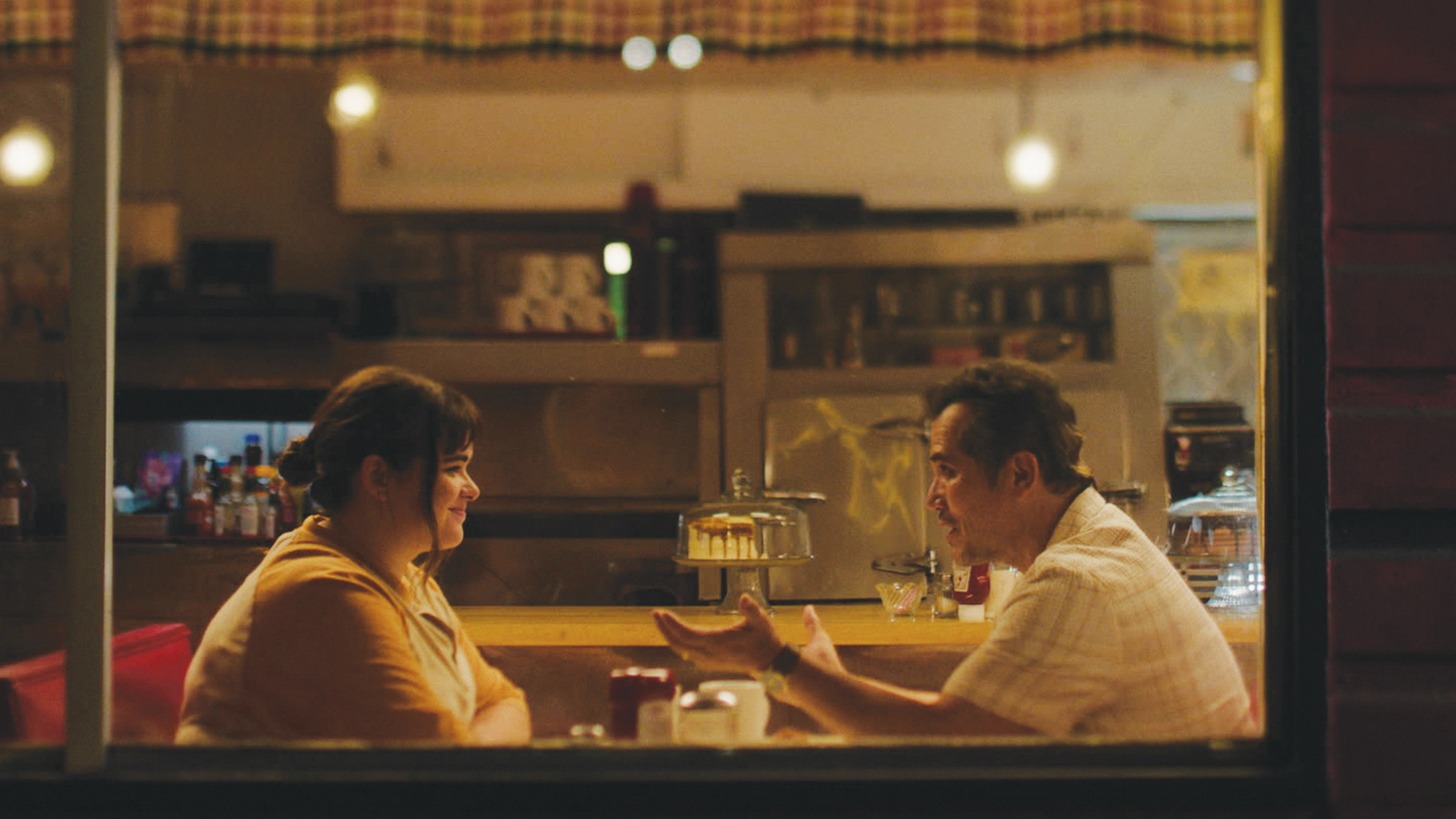
Photo caption: Barbie Ferreira and John Leguizamo, in BOB TREVINO LIKES IT. Courtesy of Roadside Attractions.
In Bob Trevino Likes It, one those adult coming of age stories that have become increasingly common increasingly common, twenty-something Lily (Barbie Ferreira) is stuck. She’s going nowhere in her career and her social life, and she just doesn’t envision herself as deserving the good things that anyone would want.
When we meet her father (French Stewart), we begin to understand why. Lily’s Dad is so self-absorbed that he only interacts with Lily when he sees her as a useful prop in his dating life. Hehasn’t romoted any sense of self-esteem in his daughter; his contribution is more like anti-self esteem. Still, she gets despondent when he overtly and cruelly rejects her.
When Lily searches for her dad’s name on Facebook, Robert Trevino, she finds lots of men with the same name, including a contractor who lives a couple hours away. Some online interactions grow into a cyber friendship, and then they meet in person. This Bob Trevino (John Leguizamo) is a really nice guy.
Lily is getting the interest, support and counsel from Bob that, ideally, one would get from one’s father. Lily wants to plunge headlong into a situation where Bob becomes her surrogate father. Bob is kind, but reticent about getting in too deep. The audience learns what Bob doesn’t reveal to Lily – Bob’s own grievous loss and the major stresses from his family and his job.
This is a heartfelt, if simplistic, story, and it’s a weeper.
It’s entirely believable that such a chosen family could result from an encounter on today’s social media, and, indeed, the film bears a title, “inspired by a true story“. Bob Trevino Likes It was written and directed by Tracie Laymon in her first feature.
John Leguizamo is very good in a role as a very decent man who is emotionally contained and suffers the burdens of other people’s issues. So is French Stewart as a less complicated character – Stewart does narcissism very well.
I screened Bob Trevino Likes It for the Nashville Film Festival, where it won the jury award for narrative features. It won both the jury award and the audience award at SXSW. That means that most people will like it more than I did. Again – it’s a weeper.
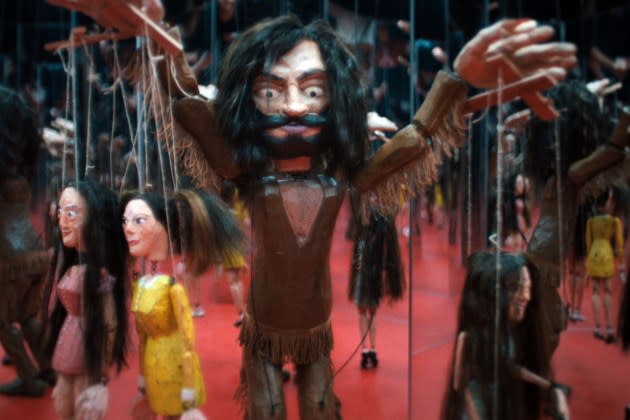
Photo caption: CHAOS: THE MANSON MURDERS. Courtesy of Netflix.
Master documentarian Erroll Morris revisits and updates the Manson Murders in Chaos: The Manson Murders. After over a half-century, it’s still a chilling, unforgettable story – human behavior so bizarre and transgressive that it’s almost incredible.
Morris introduces us to writer Tom O’Neill, who adds a conspiracy theory. .O’Neill accepts that the Manson Family perpetrated the murders at Charlie Manson’s direction,, but he also sees a connection between Manson and a CIA-funded experiment in mind control, although he doesn’t prove a link. It’s clear that Morris doesn’t buy the conspiracy.
What does Chaos: The Manson Murders add to to our understanding, besides the probably bogus conspiracy theory? The passage of time has added sources and perspective that Morris uses to retell the story more completely than in the past. One dispassionate and ultra-credible source is one of the prosecution team, Stephen Kay, an eyewitness to and participant in the trials. Morris has also found archival footage of interviews with members of the Manson Family and, yes, of Charlie himself.
That allows Morris to unspool a chronological narrative that begins with Manson’s release from prison, his assembling his family of misfits in San Francisco and moving them all to LA so he could dabble in the music industry – just enough to develop a grudge. Morris tells the lesser-known stories of the prequel crimes, the murder of Gary Hinman and the attempted murder of Bernard Crowe, who Manson mistook for a Black Panther because of his Afro. And then finally, the horrors on Cielo Drive and Waverly Drive.
For 46 years, Erroll Morris has been one of the greatest documentarians, with a body of work that ranges from the hilarious (Gates of Heaven, Vernon Florida, Fast Cheap and Out of Control, Tabloid) to the unflinching (The Thin Blue Line, Mr. Death, The Fog of War, Standard Operating Procedure),
(BTW a friend of mine on a prison tour was actually introduced to Charlie Manson in the prison yard. He reported that, indeed, Manson creeped him out with a very scary vibe.)
Chaos: The Manson Murders, the ultimate true crime doc, is streaming on Netflix.
Photo caption: Robert Pattinson in MICKEY 17. Courtesy of Warner Bros.
In Bong Joon Ho’s futuristic comic fable Mickey 17, Robert Pattinson plays Mickey, a dim bulb looking to escape a nasty loan shark. Mickey’s desperation is so high, and his self esteem is so low, that he takes a horrific assignment on a space colonization expedition. Mickey’s new job title is Expendable – his body and brain are scanned so that he can be replicated and reprogrammed with his own memories if he is killed; that allows the expedition to use him as a guinea pig and a scout, who can test pilot conditions that might be lethal. Indeed, Mickey has been killed so often that his seventeenth version – Mickey 17 – has just been 3-D printed.
The expedition is led by a buffoonish narcissist and media hog (Mark Ruffalo). He is an election loser who seeks to regain his Big Fish status on a frozen planet. Headstrong and intellectually lazy, he hasn’t bothered to research the destination planet, figuring that he can bull ahead and overwhelm any obstacles with resources, aggression and technology. Does this profile remind you of anyone? He is amoral and utterly ruthless, as is his wife (Toni Collette) . She is kind of a demented Lady Macbeth, obsessed with concocting something she calls “sauce”.
As the colonization attempt faces more challenges and the leader becomes more awful and more unhinged, the expedition’s survival depends on poor Mickey and his closest two colleagues (one of which is really, really, really close). Comic situations and sci fi action ensues.
Although Mickey 17 is a comedy, I only heard the occasional chuckle from the audience. I found the ending to be predictable.
Director and writer Bong Joo Ho adapted the screenplay from the Edward Ashton novel Mickey 7. Bong is a critic of unfettered capitalism, and, Mickey 17, like Snowpiercer, Okja and his Oscar-winner Parasite, takes on the issues of class and corporate greed.
Part of the problem is that Bong asked Ruffalo (with gleaming teeth and a rich guy haircut) and Collette to deliver over-the-top performances, and they obliged. The social satire would have packed more of a punch with more realistic characters, as in Parasite.
This may be, however, a career-topping performance by Robert Pattinson, who nails Mickey’s goofy resignation. His narration, in Mickey’s voice, is a hoot.
Besides Pattinson, the standout is British actress Naomi Ackie, who plays what is essentially the female lead. She’s wonderfully charismatic, and badass,
Bong Joo Ho makes movies so original that it’s been said that he is his own genre. His Memories of Murder is, for my money, the very best serial killer movie. Mickey 17 is always entertaining, but, on th whole, one of Bong’s lesser efforts.
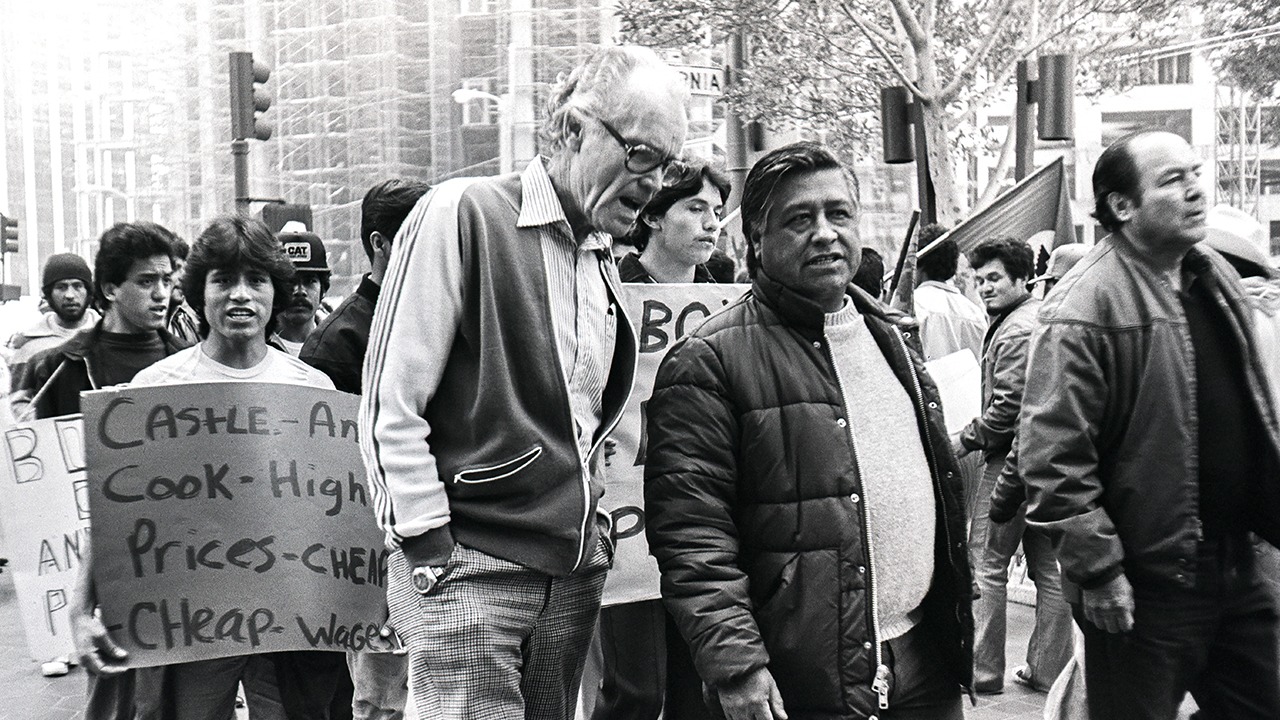
Fred Ross (foreground left) and Cesar Chavez (foreground right) in AMERICAN AGITATORS. Courtesy of Cinequest.
American Agitators is the important story of legendary organizer Fred Ross, the mentor of Cesar Chavez, and essentially a saint of the social justice movement. American Agitators shows Ross being formed by the Great Depression and the left-wing politics, the union movement and the New Deal. As a fully formed organizer, Ross met Chavez; Ross’ organizing resonated with Chavez applied his own imagination to Ross’ tactics and launched his own historically essential movements for farmworker unionization and Chicano Rights.
Director Raymond Telles has sourced the film impeccably. The third act rolls out Ross’ legacy today, not just Chavez the icon and the Farmworkers movement, but the influence of Fred Ross, Jr. and then a more loosely configured compendium of recent and current labor campaigns..
Fred Ross and Dolores Huerta in AMERICAN AGITATORS. Courtesy of Cinequest.
LOCAL SAN JOSE INTEREST: Fred Ross met Chavez at Cesar’s home at 53 Sharff Avenue in San Jose, hired Cesar as his deputy and organized out of McDonnell Hall at Our Lady of Guadalupe on East Antonio Street. Cesar’s son Paul (of San Jose) appears in the film as does Luis Valdes of Teatro Campesino, who has also had a significant presence in San Jose.
I screened American Agitators for its world premiere at Cinequest.
The title character in the affecting dramedy Burt is a an elderly street musician with Parkinson’s Disease. Burt rents a room in the home of his landlord Steve, an ever-suspicious and oppositional guy who is Burt’s age. Nevertheless, Burt is relentlessly upbeat. A young man, Sammy, arrives with a letter from one of Burt’s youthful flames, explaining that Sammy is Burt’s son. Burt jumps into belated fatherhood with both feet, and then discovers that all is not as it seems.
Burt (Burton Berger) may face disappointment and hurt, but he does so with an irrepressible generosity of spirit. This is not a Disease of the Week movie. It’s not about Burt’s Parkinson’s. It’s about Burt, a vital guy who is open about his living with Parkinson’s, but who focuses on what he can still experience.
Oliver Cooper and Burton Berger in BURT. Courtesy of Cinequest.
Oliver Cooper (David Berkowitz in Mindhunter, Levon in Californication) captures the contradictions within Sammy, who’s been incarcerated until recently. Sammy shares a lot of traits with the average criminal – not smart, not strategic, irresponsible and easily led astray. I’m guessing that his impulse control and anger management aren’t great, either. But, somehow, Sammy has a reservoir of empathy that may impede his criminality. Cooper also co-wrote.
A remarkably endearing movie, Burt is just the second feature for director and co-writer Joe Burke. Burke shot Burt in seven days for $7,000 with a three person crew. He succeeded in getting fine performances from the non-professional actors playing Burt (Berger) and Steve (Stephen Levy)..
Burt was executive produced by indie stalwart David Gordon Green (George Washington, All the Real Girls, Undertow). I screened Burt for its world premiere at Cinequest.
Nicole Betancourt in THE UNFIXING. Courtesy of Cinequest.
The mesmerizing The Unfixing is a self-therapeutic memoir, chronicling the filmmaker’s personal journey through her parents’ divorcee, her own sudden disability from chronic fatigue syndrome, and then shockingly, her daughter’s affliction with the same symptoms via Lyme Disease; mom and daughter experiment with a new therapy that purports to rewire their brains. How will this family story end?
The clever structure (in yearly segments tied to climate change) and repeated motifs (of photography, the beach and grief) make this an art film inside a memoir. The Unfixing is the first feature for director, writer and subject Nicole Betancourt.
THE UNFIXING. Courtesy of Cinequest.
This unique film may not be for everyone, but it’s that wholly original cinema that people hope to see at a film festival. I screened The Unfixing for its US premiere at Cinequest.
Severin Films founder David Gregory in BOUTIQUE: TO PRESERVE AND COLLECT. Courtesy of Cinequest.
Ry Levey’s infectious documentary Boutique: To Preserve and Collect is about passion – passion that fuels the preservation and rejuvenation of cult cinema. We’re mostly talking about exploitation movies that would otherwise be lost. Much the credit for saving them goes to Severin Films and Vinegar Syndrome, which are essentially the Criterion Collection for grindhouse cinema. Both companies evolved from aficionados making bootleg tapes of their favorite obscure films into legitimate catalogues of preserved films.
You may not think that a certain movie is IMPORTANT, but there is probably someone who finds it absolutely ESSENTIAL. Many movies have been made to be disposable, but have inspired loyal fans. One person’s drive-in may be another’s arthouse. What makes Boutique: To Preserve and Collect fun to watch is the contagious enthusiasm of the devotees.
Boutique: To Preserve and Collect takes us from the Dark Ages, back when, once you had seen it in a theater, a film was forever lost to you. No matter how much you wanted to watch it again or share it with others, your only recourse would be to scour TV Guide for when it might show up on late night television. Then, the introduction of the VCR made it possible to collect movies you love and to evangelize for them. The video store and the DVD opened up the possibilities even more.
Boutique: To Preserve and Collect covers a lot of ground, much of it arcane, so it’s fortunate that the editing keeps the film popping. Canadian filmmaker Ry Levey has been to Cinequest before, most recently with his fine LGBTQ pro wrestling doc, Out in the Ring.
[Severin is now selling House of Psychotic Women: Rarities Collection Volume 2 and a Blu-ray set of Fear in the Philippines: The Complete Blood Island Films. Vinegar Syndrome’s current offerings include DVDs of The Possession of Joel Delaney (4K Ultra HD) and The White Cannibal Queen.]
I screened Boutique To Preserve and Collect for its US premiere at Cinequest.
The mysterious Russian sci fi tale Alien is set in the unfamiliar, remote Ural hinterlands. Lyosha (Maxim Stoyanov), the local oddball, has a hearing disability, lives in his grandmother’s cabin on the edge of the settlement, and has built an impressive tower out of trash that he has collected. He has also jerrybuilt a radio system and made giant circles in the fields, all attempts to contact space aliens He is teased pitilessly by the village japesters. We later learn that the long ago disappearance of his mother has affected his psyche.
A newcomer suddenly appears at his cabin – most certainly not looking like any space alien that Lyosha has imagined. Is this visitor just a runaway from another village, an emissary from deep in the universe, or a supernatural messenger from his mother? It’s all up in air as hostile villagers close in, all the way to an unpredictable ending.
This is a dynamite screenplay from writer-director Ivan Sosnin, who keeps us guessing for its 73 minutes. I screened Alien for its US premiere at Cinequest.