BECOMING COUSTEAU: amazing guy, pedestrian biodoc

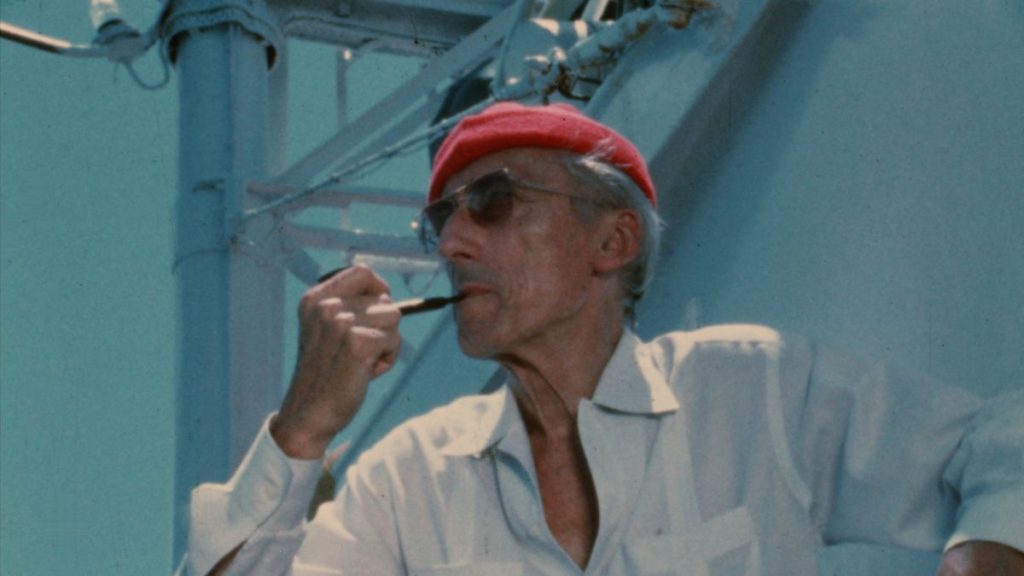
Photo caption: BECOMING COUSTEAU. Courtesy of National Geographic.

The educational if not scintillating biodoc Becoming Cousteau traces the world-changing career of Jacques-Yves Cousteau.

This was an important man. Before Cousteau, we looked at the oceans the way that humans had regarded them for centuries – based on what was on their surface and at their edges. The vastness of the oceans gave them a mask of invulnerability.

Becoming Cousteau tells how Cousteau, a pilot recovering from a motoring accident, became one of one three free divers in France before WWII, and how he was involved with or responsible himself for the invention of the aqualung, undersea stations, the underwater movie camera and his scientific ship Calypso.

Fortunately, Cousteau’s second passion was cinema, which allowed him to reveal the undersea world to the general public. He strongly preferred to call his work adventure film instead of documentary. (The cinematographer for Cousteau’s breakthrough 1956 film was Louis Malle, only two years before Malle’s own breakthrough masterpiece Elevator to the Gallows.)

That allowed Cousteau to become the great popularizer of ocean science through his ABC series The Undersea World of Jacques Cousteau.

Becoming Cousteau shows us how, at first, Cousteau had the explorer’s outlook of conquering the elements – but evolved into an ecologist. Cousteau canoodled with the oil industry in the 1950s, which he regretted in the 1970s. The preservation of Antarctica may be his enduring legacy.

Becoming Cousteau is dotted with some revealing tidbits such as how his first wife Simone was in love with Calypso and lived there, while Cousteau was on the road and their sons were in boarding school.

I am usually entranced by documentaries as superbly sourced and revelation-filled as Becoming Cousteau, but I found it a bit of a yawner. Twice Oscar-nominated director Liz Garbus packs a lot into 94 minutes, but it seems longer. Vincent Cassel voices Cousteau’s written words.
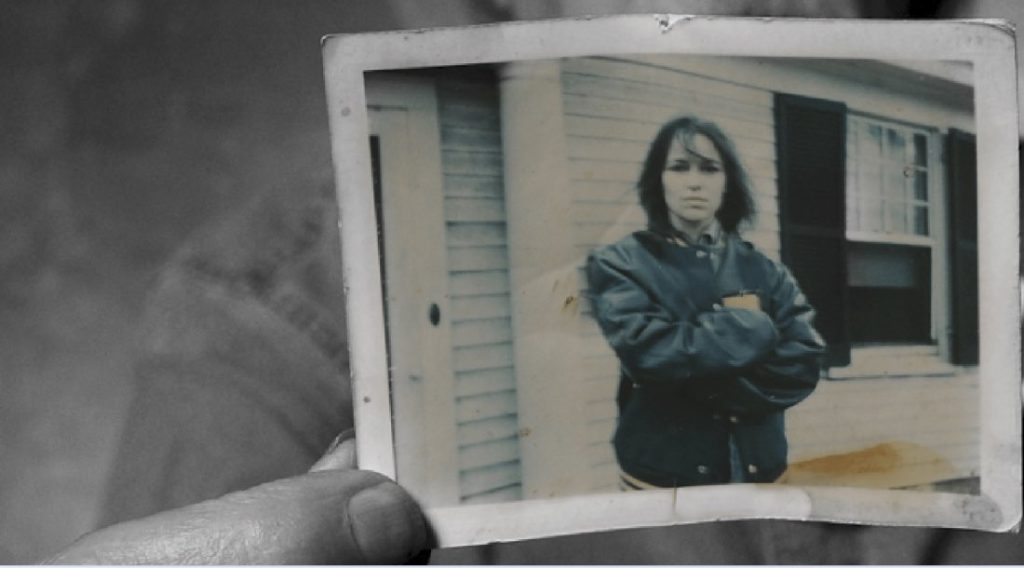
WITHOUT GETTING KILLED OR CAUGHT: her soul and her heart

Guy Clark holds his favorite photo of Susanna Clark in WITHOUT GETTING KILLED OR CAUGHT

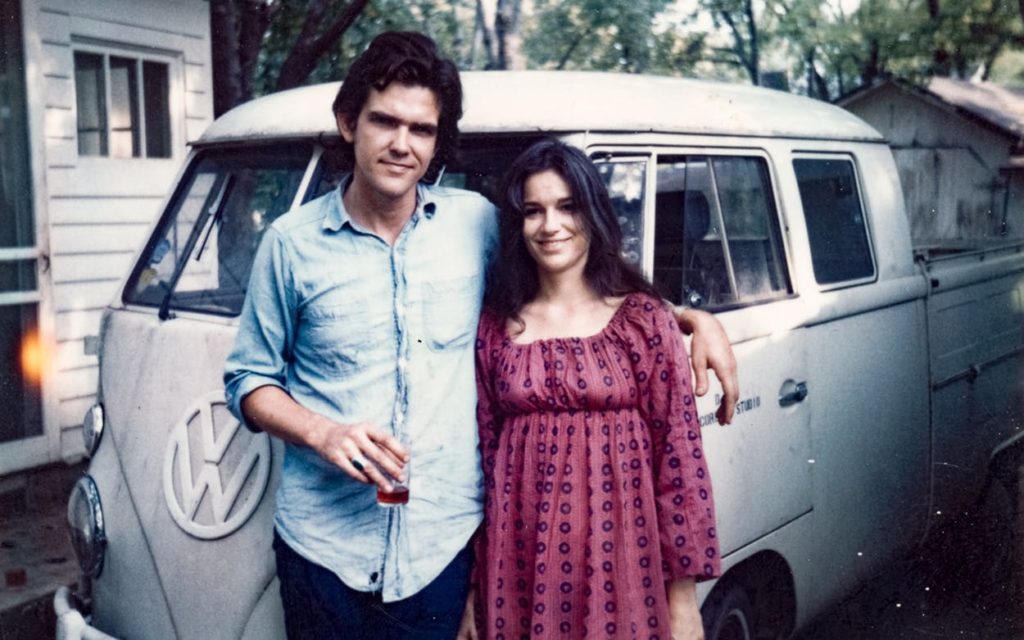
The lyrical documentary Without Getting Killed or Caught is centered on the life of seminal singer-songwriter Guy Clark, a poetic giant of Americana and folk music. That would be enough grist for a fine doc, but Without Getting Killed or Caught also focuses on Clark’s wife, Susanna Clark, a talented painter (album covers for Willie Nelson and Emmylou Harris) and songwriter herself (#1 hit I’ll Be Your San Antone Rose). What’s more, Guy’s best friend, the troubled songwriter Townes Van Zandt, and Susanna revered each other. Van Zandt periodically lived with the Clarks – that’s a lot of creativity in that house – and a lots of strong feelings.

Susanna Clark said it thus, “one is my soul and the other is my heart.”

The three held a salon in their Nashville home, and mentored the likes of Rodney Crowell and Steve Earle. You can the flavor of the salon in the 1976 documentary Heartworn Highways (AppleTV, Vudu and YouTube). It features Townes Van Zandt’s rendition of his Waitin’ Round to Die. (Susanna was also a muse for Rodney Crowell, who, after her death, wrote the angry song Life Without Susanna.)

Documentarians Tamara Saviano and Paul Whitfield, have unearthed a great story, primarily sourced by Susanna’s diaries; Sissy Spacek voices Susanna’s words. These were artsy folks so there are plenty of exquisite photos of the subjects, too. It all adds up to a beautiful film, spinning the story of these storytellers.

Guy and Susanna Clark in WITHOUT GETTING KILLED OR CAUGHT

I loved this movie, but I’m having trouble projecting its appeal to a general audience, because I am so emotionally engaged with the subject material. I’m guessing that the unusual web of relationships and the exploration of the creative process is universal enough for any audience, even if you’re not a fanboy like me.

The title comes from Guy’s song LA Freeway, a hit for Jerry Jeff Walker:

I can just get off of this L.A. freeway

Without gettin’ killed or caught

There is plenty for us Guy Clarkophiles:

  • the back story for Desperados Waiting for a Train;
  • the identity of LA Freeway’s Skinny Dennis;
  • Guy’s final return from touring, with the declaration “let’s recap”.

There’s also the story of Guy’s ashes; the final resolution is not explicit in the movie but you can figure it out; here’s the story.

Without Getting Killed or Caught is in very limited theatrical run; I saw at the Balboa in its last Bay Area screening.

THE EYES OF TAMMY FAYE: some dignity for the clown

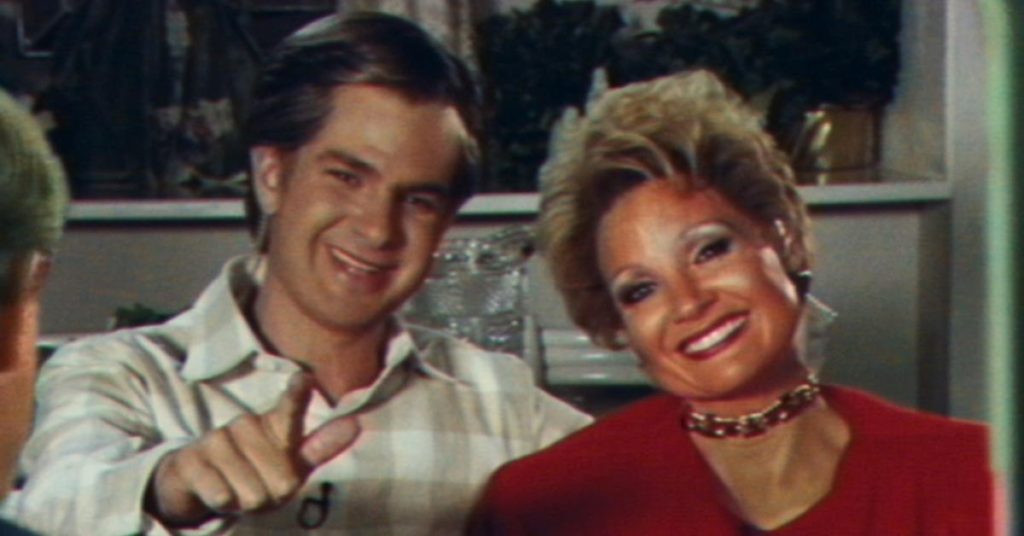
Photo caption: Andrew Garfield and Jessica Chastain in THE EYES OF TAMMY FAYE

Jessica Chastain’s powerhouse performance in The Eyes of Tammy Faye humanizes and brings dignity to a disgraced celebrity. Tammy Faye, of course, is Tammy Faye Bakker, married to televangelist Jim Bakker of the PTL Club. The relentlessly upbeat couple eschewed fire-and-brimstone for a happy talk ministry based on “Jesus loves you” and “God wants you to be rich”.

Jim Bakker was the preacher and talk show host. Tammy Faye was the singer, puppeteer and sidekick. Tammy Faye’s on-her-sleeve emotions, swinging between pep talks and ready tears – were especially popular (and revenue-inducing) with the PTL Club’s audience.

Of course, the ministry empire was a Ponzi scheme, which eventually sent Jim into federal prison; a sex scandal precipitated the collapse. The story is well-chronicled in the excellent 2000 documentary, also titled The Eyes of Tammy Faye, upon which this movie is based (available to stream on Amazon, AppleTV, Vudu and YouTube).

Jim Bakker (and certainly not Tammy Faye) was the mastermind of the fraud. But Tammy Faye, with her increasingly grotesque makeup and her flamboyant persona, had also become a figure of widespread ridicule, and her fall from grace was also very harsh.

Chastain’s convincing performance is centered on Tammy Faye’s EverReady Bunny exuberance and naive good intentions. Reportedly, she had to spend several hours each day getting outfitted wih prosthetics and daubed with makeup.

Andrew Garfield perfectly captures Jim Bakker’s smarminess and ambiguous sexuality.

Tammy Faye’s mother is played by Cherry Jones (Transparent), who always gives a strong performance. Here she plays a character who starts out seeming to be an emotionally distant, kill-the-dream stick-in-the-mud, but who evolves into the story’s moral anchor.

The one false note in The Eyes of Tammy Faye is Vincent D’Onofrio, who is supposed to be playing Jerry Falwell. Falwell, of course, was rarely seen without his smug grin. Onofrio plays him as a hulking, never smiling menace and with a much different accent and speech pattern than Falwell’s. It’s as if D’Onofrio had never seen Falwell, and his performance completely misses the insincerity and hypocrisy behind Falwell’s veneer of affability.

The Eyes of Tammy Faye is now in theaters.

WHAT SHE SAID: THE ART OF PAULINE KAEL – the drive for relevance

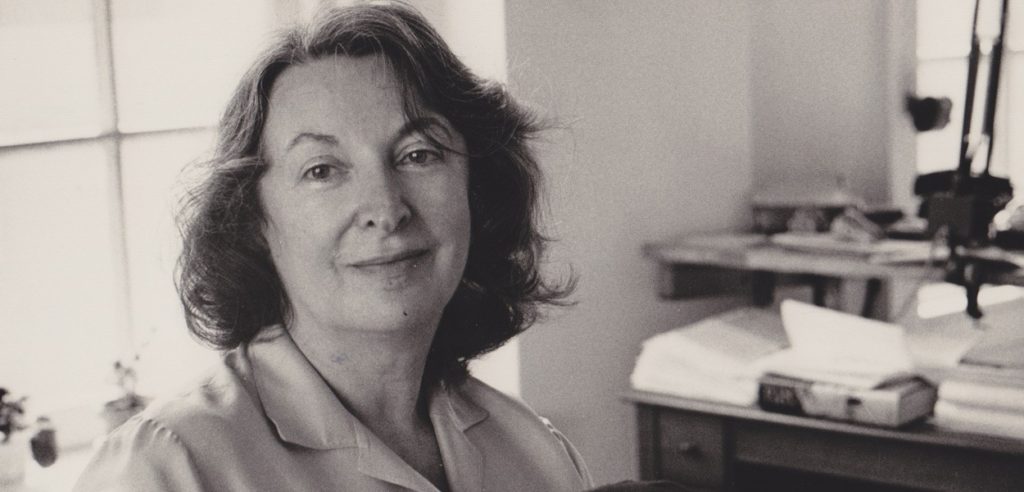
Pauline Kael in WHAT SHE SAID: THE ART OF PAULINE KAEL

What She Said: The Art of Pauline Kael is the remarkably thorough and insightful biodoc of the iconic film critic Pauline Kael and her drive for relevance. It’s coming up September 26 on Turner Classic Movies.

Documentarian Rob Garver has sourced What She Said is well-sourced with the memories of Kael’s colleagues, rivals and intimates. Garver’s portrait of Kael helps us understand her refusal to conform to social norms as she basically invented the role of a female film critic and what today we might call a national influencer on cinema.

Of course, one of Kael’s defining characteristics was her all-consuming love of movies, a trait shared by many in this film’s target audience. Fittingly, Garver keeps things lively by illustrating Kael’s story with clips from the movies she loved and hated. Garver’s artistry in composing this mosaic of evocative movie moments sets What She Said apart from the standard talking head biodocs.

Kael was astonishingly confident in her taste (which was not as snooty as many film writers). For the record, I think Kael was right to love Mean Streets, Band of Outsiders, Bonnie and Clyde, and, of course, The Godfather. It meant something to American film culture that she championed those films. She was, however, wrong to love Last Tango in Paris. She was also right to hate Limelight, Hiroshima Mon Amour and The Sound of Music. But Kael was just being a contrarian and off-base to hate Lawrence of Arabia and Shoah.

Kael was by necessity an intrepid self-promoter and filled with shameless contradictions. She famously dismissed the auteur theory but sponsored the bodies of work of auteurs Scorsese, Peckinpah, Coppola and Altman. She loved – even lived – to discover and support new talent.

Most of the people we like and admire possess at least some bit of selflessness and empathy. Kael’s daughter Gina James says that Kael turned her lack of self awareness into triumph. This observation, of course, cuts both ways.

I first screened What She Said: The Art of Pauline Kael for the 2019 San Francisco Jewish Film Festival. Again, TCM will air it on September 26, and you can rent it from Amazon, AppleTV, Vudu and YouTube.

BOB ROSS: HAPPY ACCIDENTS, BETRAYAL & GREED: improbability squared

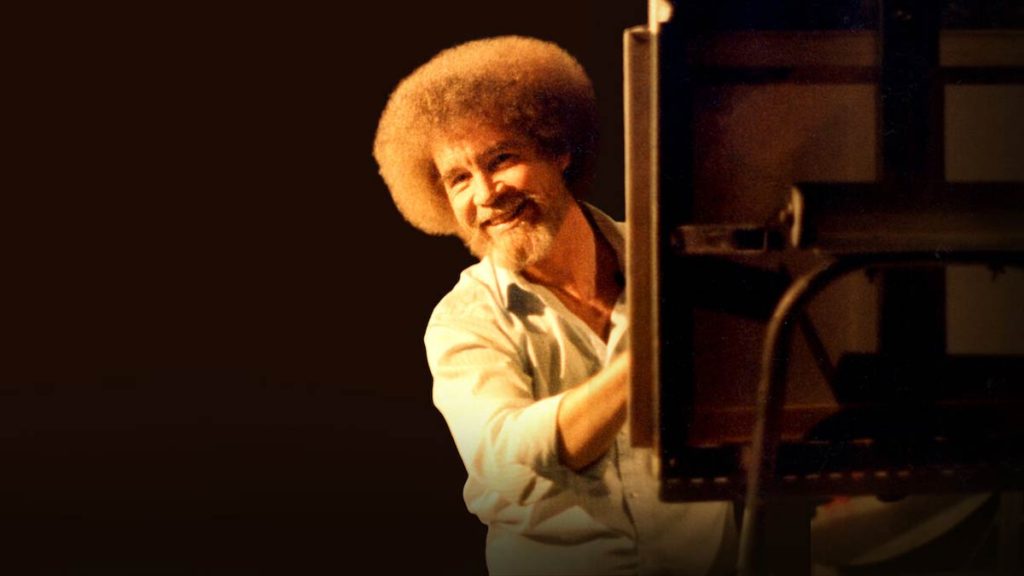
Photo caption: BOB ROSS: HAPPY ACCIDENTS, BETRAYAL & GREED. Photo courtesy of Netflix.

The documentary Bob Ross: Happy Accidents, Betrayal & Greed tells two improbable stories. The first is how Bob Ross, the soft-talking painting instructor on PBS, could become such a cultural phenomenon. It’s hard not to smile when thinking of the signature permanent adorning Ross, at once ridiculous and kind of innocent, and big enough to warrant its own zip code. [Come to think of it, can you imagine ANY personality who sounded like and looked like Ross, Julia Child or Fred Rogers starring on commercial TV?]

In any event, Bob Ross: Happy Accidents, Betrayal & Greed lets us glimpse the secret sauce that Ross used to make a mundane craft into something singular and indelible. By all accounts, Ross was a very sweet guy. The edgiest thing anyone says about him is that he could tell “ornery jokes”.

The Betrayal and Greed in the title relates to the bone-picking after his death to exploit his legacy. This is a sordid tale, in sharp juxtaposition to Ross’ own career and persona.

Bob Ross: Happy Accidents, Betrayal & Greed is streaming on Netflix.

SEARCHING FOR MR. RUGOFF: the best movie taste in any barbarian

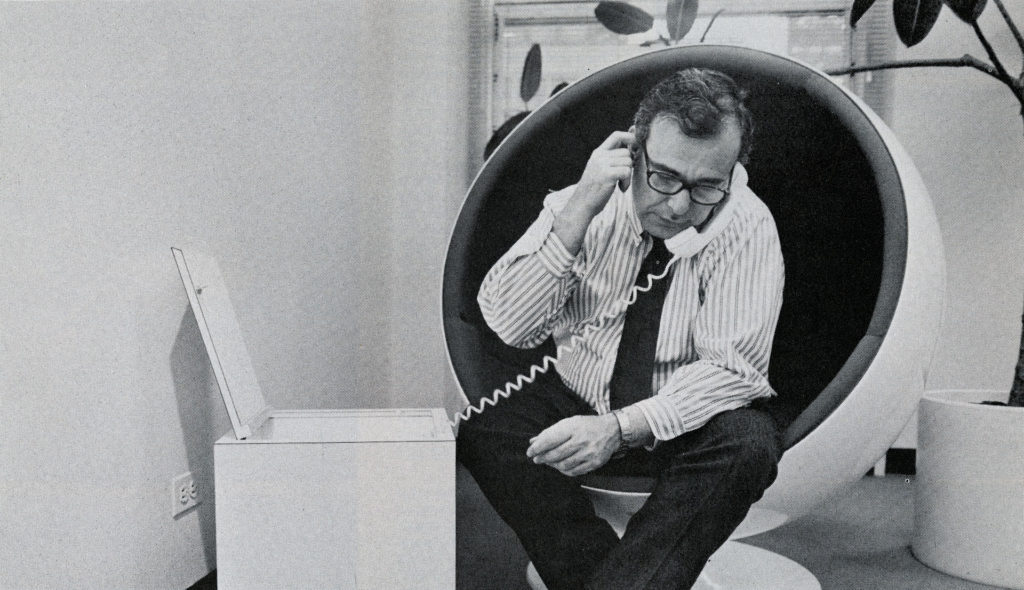
Photo caption: SEARCHING FOR MR. RUGOFF. Photo courtesy of Deutchman Company.

The documentary Searching for Mr. Rugoff is the story of a now-unknown giant in independent cinema. I was drawn to learn more about Donald Rugoff, whom I hadn’t heard of, because he was responsible for the US distribution of a slate of essential foreign and independent films that were the spine of American art house cinema:

  • Bruce Brown’s seminal surf movie Endless Summer (1965)
  • Milo Forman’s international breakthrough The Fireman’s Ball (1966)
  • Robert Downey, Sr.’s iconoclastic Putney Swope (1968)
  • Costa-Gavras’ double Oscar winning Z (1968) and State of Siege (1972)
  • The Mayles’ Rolling Stones-at-Altamont doc Gimme Shelter (1970)
  • De Sica’s The Garden of the Finzi-Continis (1970)
  • the great doc about a child faith healer grown up, Marjoe (1972)
  • one of the funniest movies I’ve ever seen, The Tall Blond Man with One Black Shoe (1972)
  • Bergman’s Scenes from a Marriage (1973)
  • Monty Python and the Holy Grail (1975)
  • Barbara Kopple’s Oscar winning Harlan County, USA (1976)
  • and more films by Ken Loach, Marcel Ophüls, Lina Wertmüller, Werner Herzog, Agnes Varda, François Truffaut and Satyajit Ray.

As we learn in Searching for Mr. Rugoff:

From 1965 to 1978 [Rugoff’s company] Cinema 5 received 25 Oscar nominations and 6 Oscars. 16 nominations were for foreign language films, 6 were for documentaries.

Ira Deutchman made this film when he heard that Rugoff, his first boss, had ended up buried in a pauper’s grave; (watch the movie to discover the truth on that).

However, Donald Rugoff was notoriously disheveled and unpleasant.  He always had two secretaries posted outside his office because of the high probability that one would quit at any time. He was so volatile that many of his associates incorrectly believed that he had a steel plate in his head that affected his behavior. His own son describes him as a “toxic figure” in the home.

So, there we have it – the guy with the best possible movie taste and the most elevated artistic sensibilities was personally a barbarian.

He was, however, also a mad genius of PT Barnum-like promotion. Until times changed and he wasn’t. Rugoff’s life was a wild ride – and it was critical to an important moment in cinema.

Searching for Mr. Rugoff is opening in person at and streaming from the Roxie. I streamed it from Laemmle.

RESPECT: struggling to take command of her own artistry

Jennifer Hudson in RESPECT

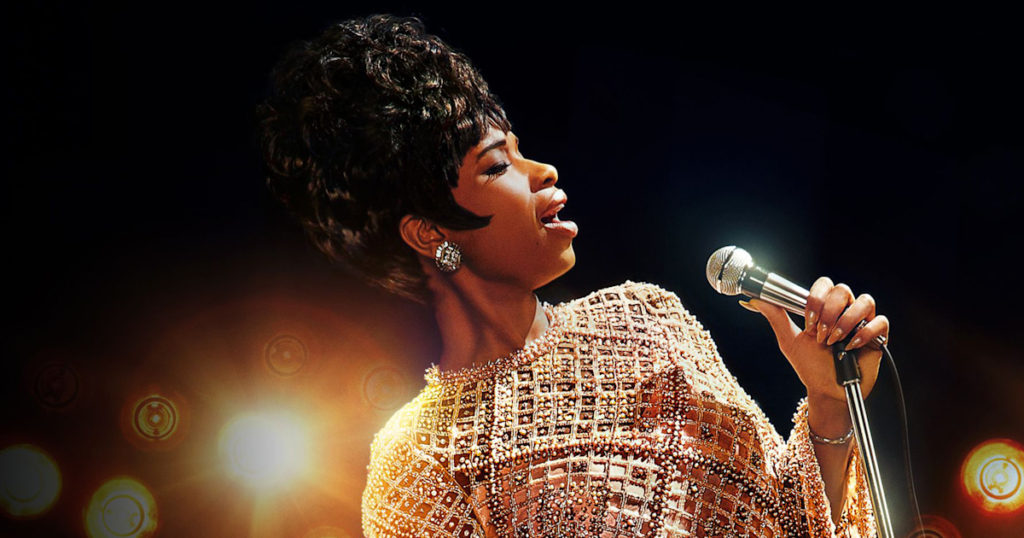
Aretha Franklin was, if anything, formidable, and Jennifer Hudson reaches formidability as Aretha in Respect. Hudson (handpicked by Aretha to star in her own biopic) is sensitive enough to play the ambitious but confidence-challenged young Aretha and brassy enough to soar as the diva that Aretha became.

Respect concentrates on three stages of Aretha’s life – her childhood in the 1950s, her uncertain career at Columbia Records in 1960-65 and her creative partnership with Jerry Wexler, beginning in 1967, that led to stardom. The film culminates with the1972 live gospel album that we can now watch in the 2019 film Amazing Grace.

The common thread in Respect is Aretha’s learning to push back on the attempts by men to control her artistically, financially and intimately. The film’s high point is Aretha finally getting the opportunity, in a Muscle Shoals recording session, to impose her own creativity on I Never Loved a Man (Like the Way I Love You); we’re able to watch the instant that Aretha transforms herself into an icon. Hudson also delivers killer versions of Respect, Amazing Grace, Natural Woman and (my personal favorite) Think.

During much of the film, 12-year-old actress Skye Dakota Turner, plays a ten-year-old Aretha (and she’s heartbreakingly great). Aretha’s formative years were startlingly unusual. For one thing, as the daughter of a celebrity minister dad and a celebrity gospel singer mom, she was unusually privileged for a black youngster in the 1950’s – she was spared poverty and grew up in a home where MLK himself, Dinah Washington and gospel music legend James Cleveland were frequent guests. On the other hand, her broken home was unhealthy enough that Aretha became pregnant at age 12, and again at age 14. She emerged well-connected – and severely traumatized.

Forest Whitaker is, as one would expect, excellent in the pivotal role of Franklin’s father, C.L. Franklin. The cast is uniformly excellent including Audra MacDonald as Aretha’s mom, Kimberly Scott as her grandmother, Marc Maron as Jerry Weinberg, Marlon Wayans as her seamy first husband, and Mary. J. Blige as Dinah Washington.

Respect is 2 hours, 25 minutes long, and could have been better if 15-20 minutes shorter. Nevertheless, it gives us a sound view of the factors that molded Aretha Franklin’s personality, and her struggles to take command of her own artistry.

ROADRUNNER: A FILM ABOUT ANTHONY BOURDAIN – bad ass romantic

Photo caption: ROADRUNNER: A FILM ABOUT ANTHONY BOURDAIN

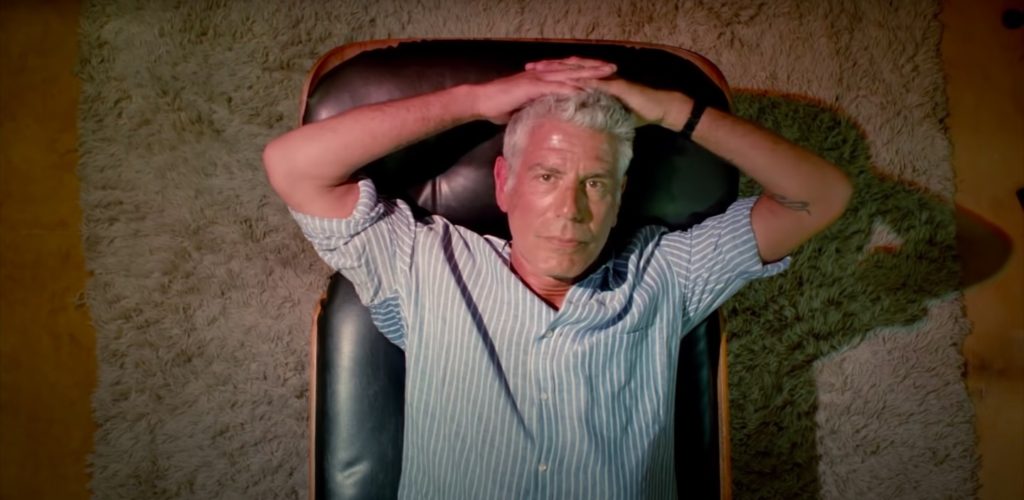
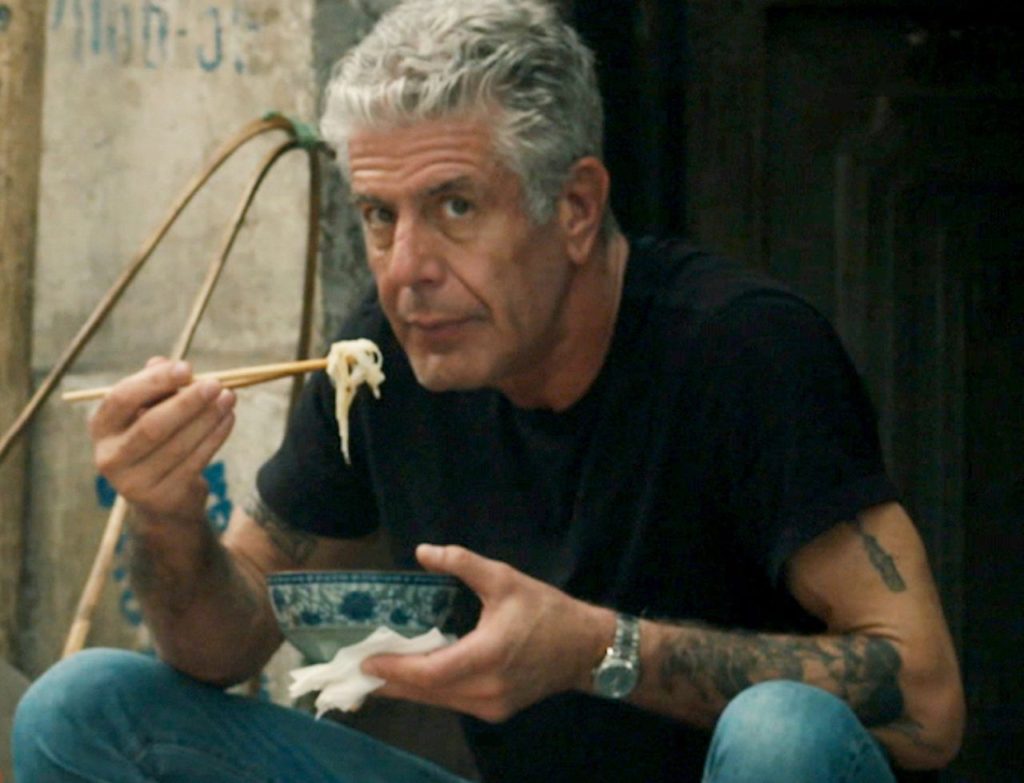
Roadrunner: A Film About Anthony Bourdain is an unusually profound, revealing and unsentimental biodoc. Rarely has a documentary revealed so much about such a complicated and ambiguous person. Roadrunner deliberately builds into a triumph for director Morgan Neville, Oscar-winner for 20 Feet from Stardom.

In Roadrunner, we hear from Bourdain’s brother, second wife and his close friends and associates. His friends were creatives – artists, musicians, writers, chefs. His work partners — agent, publisher, producers, TV crew – had all stayed with him for many years.

Bourdain attained overnight celebrity as the Bad Boy chef with his ribald and iconoclastic memoir Kitchen Confidential. That platform propelled him into his television career as a traveling professional foodie – and then as a professional traveler.

I didn’t know that, before his TV shows, Bourdain had not traveled outside the US except for boyhood visits to family in France. One friend observes that, “his travels were in his head“. Tony himself was allured by the chance to “have adventures while antisocial“. Bourdain’s brother said that Tony was “reborn” through travel.

ROADRUNNER: A FILM ABOUT ANTHONY BOURDAIN

Bourdain was so fun to watch because he was a kind of adult Holden Caulfield, perpetually aggrieved by phoniness in any form. The dark humor in his caustic observations was unfiltered. Yet, Bourdain was an unexpectedly shy man for such a bad ass. Often, when someone (including Bourdain himself) made an incisive statement, Tony would furtively glance directly into the camera – was this his “tell”?

His friends saw Bourdain, despite his overt cynicism, as a romantic . Romantics are always disappointed in – and sometimes betrayed by – reality.

Roadrunner: A Film About Anthony Bourdain does reveal what upset him on the night that he, cold sober, chose to kill himself. But it doesn’t label that disappointment as the simplistic reason for his suicide. Instead, Roadrunner thoughtfully documents his life as a “runner”, focusing his addictive personality on everything from heroin to jujitsu to evade his demons.

Ultimately, Roadrunner is about the people who loved Tony and his difficulty in accepting their love. The saddest scene in Roadrunner recounts when Tony dramatically summoned his producers and proclaimed that he needed to quit; he never anticipated that, far from pushing back, that they would be wholly supportive.

Bourdain was beloved by his fans (including me). If you need a dose of the sentimentality that Roadrunner eschews (and there’s nothing wrong with that), CNN-produced retrospectives are available in episodes 93 and 95 of Parts Unknown, which can be streamed from HBO Max.

[Note: Roadrunner has provoked some contretemps in the chattering class. A computer-simulated voice reads one of Bourdain’s emails as if it were Bourdain himself, and Neville chose not to invite Asia Argento, Bourdain’s last girlfriend, to participate as a talking head (although we see and hear plenty of her on film). In both cases, Neville was seeking the fundamental truth about Bourdain and made the absolutely best choices as a filmmaker. Ignore the hoohaw.]

One more thing – Neville went with the perfect ending for Roadrunner: A Film About Anthony Bourdain, so perfect that, now that I’ve seen it, I can’t imagine any better one. This is one of the Best Movies of 2021.

TRUMAN AND TENNESSEE: AN INTIMATE CONVERSATION: gay Southern geniuses, revealing themselves

Truman Capote (left) and Tennessee Williams in TRUMAN AND TENNESSEE: AN INTIMATE CONVERSATION. Photo courtesy of Frameline.

Truman and Tennessee: An Intimate Conversation brings us a double-barrelled biodoc of two literary giants, one who remade American theater and the American novel in the 1950s and 1960s. Truman Capote and Tennessee Williams were both gay men from the Deep South, who attained fame and descended into addiction. They also knew each other.

Truman and Tennessee tells their stories from their own letters and from being interviewed on TV by the likes of David Frost and Dick Cavett.

The words of Capote are voiced by Jim Parsons, and those of Williams by Zachary Quinto. There is no third-party “narration”. It’s an effective and increasingly popular documentary technique, used in, for example, I Am Not Your Negro.

The film’s structure allows us to harvest insights about each writer’s artistic process. There are plenty of nuggets like Tennessee Williams’ frustrations with the cinematic versions of his plays, all dumbed down to comply with the movie censorship of the day.

Truman and Tennessee: An Intimate Conversation can be streamed from Frameline through Thursday night, June 24, and opens in theaters on June 25.

BILLY GRAHAM: the need to pray with Presidents

Photo caption:BILLY GRAHAM. Photo courtesy of PBS American Experience.

The fine PBS documentary series American Experience brings us Billy Graham, an especially insightful look at back at the famed evangelist.

i hadn’t though much about Billy Graham lately. When I was growing up, Billy Graham was already a national institution and the most famous American religious leader – and the world’s most visible Protestant clergyman. Then, what happened?

Billy Graham traces Graham’s meteoric rise from Boy Wonder preacher to national stardom, taking evangelism from tent revivals in the rural Bible Belt to big city stadiums and television.

That story of Graham’s talent and ambition is interesting in itself, but Billy Graham examines both the strengths of his character and his vulnerability. Graham was rigorously disciplined in refusing to enrich himself and in his strict devotion to his marriage. Almost uniquely for TV preacher, Graham was never tainted by a financial or a sexual scandal and seemed impervious to hypocrisy.

But Billy Graham explores Graham’s yearning to become pastor to Presidents – both to promote his evangelism and as a manifestation of his own vanity. That paid off for Graham with his close relationship with Ike (and Ike and Billy’s impact on the nation’s public religiosity).

But then came Richard Nixon, who Graham was naive enough to think a soul mate. Being publicly anchored to Nixon made Graham’s position as an arbiter of national morality, well, untenable.

Graham’s career – through his consorting with politicians and his pioneering use of mass media – set the stage for the Moral Majority-type politicization of culturally conservative evangelicals. Notably, he intentionally took another path.

In his final act (which I had lost track of), Graham became an international peace campaigner. He mellowed into a more tolerant, less hell-fire theology and we glimpse him on a NYC stage at age 87. I was surprised to learn that Graham died in 2018 at age 99.

You can stream Billy Graham at American Experience.