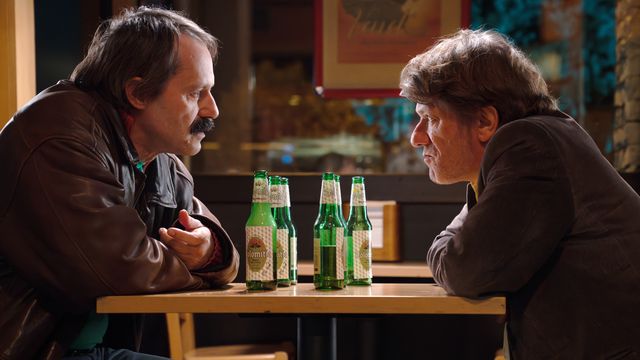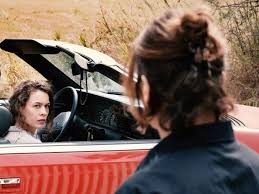
MIRRORS NO. 3: two enigmas explained

Photo caption: Paula Beer and Barbara Auer in MIRRORS NO. 3. Courtesy of 1-2 Special.

As Christian Petzold’s intimate psychodrama Mirrors No. 3, opens, we see Laura (Paula Beer) on a river overpass, and she looks so despondent that we wonder if she will jump to her death. But Laura, who is studying piano at university in Berlin, wanders off lethargically to meet her boyfriend for a couples day trip she would rather skip. Scattered and periodically catatonic, she is clearly suffering from clinical depression, but the boyfriend is too self absorbed to notice. When she cuts the trip short, he drives off the road; he is killed, but Laura suffers very minor injuries.

The accident happens near a house isolated in the countryside, and the middle-aged resident Batty (Barbara Auer) helps Laura to her house for medical treatment. Laura asks if she can stay instead of going to the hospital, and Betty kindly agrees, and makes her comfortable in an upstairs bedroom.

Betty goes out of her way to dote on Laura as she recuperates. The two quickly bond, and neither is in a hurry for Laura to move on. Betty seems to adopt Laura a little too eagerly than decency and generosity would require, which is an indication that something odd may be going on. When Betty has Laura cook dinner for Betty’s brusque husband Richard (Matthias Brandt) and her lumbering, uncommunicative son Max (Enno Trebs), increasing weirdness is evident.

Betty’s husband and son don’t live with her. Passersby occasionally stop and gawk at the house. Betty sometimes calls Laura by another name. Laura doesn’t show any interest in returning to her Berlin apartment and resuming her studies.

Barbara Auer and Paula Beer in MIRRORS NO. 3. Courtesy of 1-2 Special.

The audience is wondering what is going on with Betty’s family, but Laura isn’t – she’s found an emotional refuge. As the clues accumulate, we can guess the family’s back-story, but Laura doesn’t seek out the truth until it is blurted out, in a scene that becomes explosive.

Among cinema’s current auteurs, Petzold is unsurpassed in ending a movie and this one is perfect.

Along with his genius in observing human behavior and constructing psychodramas, Petzold is a master of movie sound. This is as far from a movie epic as you can get, but all his gifts are on display here.
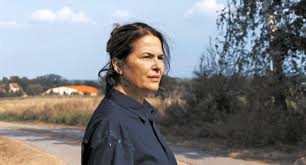
Barbara Auer in MIRRORS NO. 3. Courtesy of 1-2 Special.

This is a screenplay that works because of the exquisitely authentic and nuanced performances odf Paula Beer and Barbara Auer. All four actors have worked with Petzold before, and Beer is his current muse. In his previous film, Afire, three of them play starkly different roles: Trebs as a self-loathing intellectual brat, Brandt as his gregarious but very frank publisher and Beer is the playful sexpot who has been double-booked at his vacation rental.

The movie shares its European title, Miroires No. 3, with a Ravel piece for piano that is played in the film.

Mirrors No. 3 may not reach the heights of Petzold’s Phoenix or Afire, but it’s one of the best films of 2026 so far. Mirrors No. 3 is streaming on Amazon, AppleTV, YouTube and Fandango.
PRESSURE: a study in high-stakes decision-making

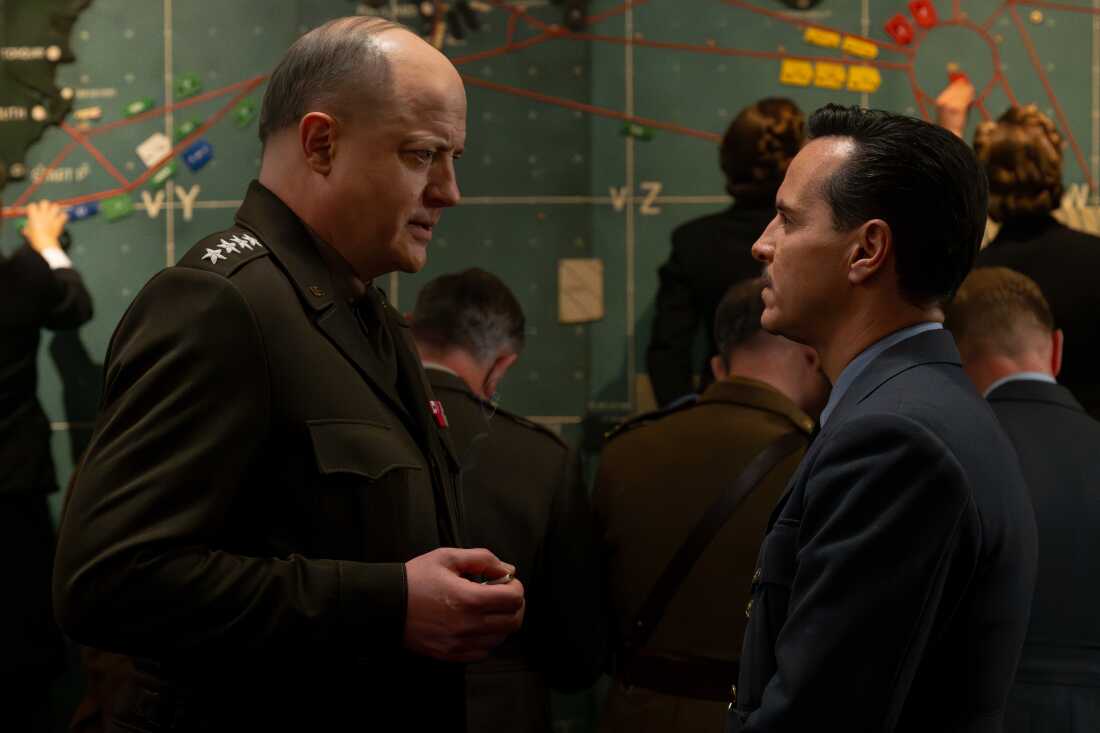
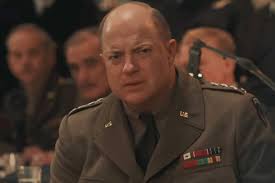
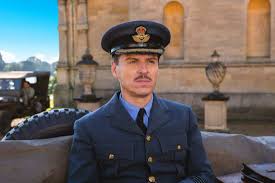
Photo caption: Brendan Fraser and Andrew Scott in PRESSURE. Credit: Alex Bailey/Focus Features/STUDIOCANAL © 2026 All Rights Reserved. Courtesy of Focus Features.

The superb historical drama Pressure is a study in high-stakes decision-making. Few human endeavors had higher stakes than the Allied invasion of Europe, upon which hinged millions of lives, the liberation of formerly free nations, and the defeat of the fascist and racist Nazi regime (whose worst crimes were yet to be publicized). And, after all the planning and investment in resources, the success of that invasion came down to secrecy and a weather report, made by human beings.

History’s most massive amphibious invasion would be logistically difficult and cost many lives, no matter how well things went. But it would certainly generate horrendous casualties and possibly even fail, if the Allies lost the element of surprise. The allies had gone to extraordinary lengths to mislead the Germans about the location of the D-Day landings. This spiderweb of secrecy, deception and misdirection couldn’t be maintained forever, and the clock was ticking.

While the Allies needed to launch D-Day as soon as possible, they also needed to wait for the right conditions. The landing required high tides and low-enough waves for landing craft, a moon-lit night for the airborne forces, along with good visibility and a high ceiling for air support. Missing the window for the moon and tides, would mean a two-week delay – with the threat of the secrecy unraveling.

Brandon Fraser in PRESSURE. Courtesy of Focus Features.

One man held the responsibility for the critical decision of when to deploy – General Dwight D, Eisenhower (Brendan Fraser). Eisenhower’s decision would pivot on the weather forecast by the British meteorologist British Captain James Stagg (Andrew Scott). Pressure is the harrowing moment-by-moment story of the crushing weight of this decision.

This is a true story, and Pressure is remarkably historically accurate. Some details are streamlined, but the truth of what happened is maintained. I fact-checked the two elements in the story that I wasn’t familiar with, and they turned out to be factual. As is the case with the best history, the historical events are humanized.

Director Anthony Maras co-wrote the screenplay with David Haig, based on Haig’s play. In his second feature, director Maras distills a complex story and maintains a blistering pace – only one-hour-and-forty minutes.

Brendan Fraser accurately captures the cauldron that Ike operates in, always burdened by the most immense responsibility, while being sniped at and undermined by rivals. Fraser’s Ike maintains control – and the appearance of control – while constantly second- and third-guessing himself.

Andrew Scott in PRESSURE. Courtesy of Focus Features.

Likewise, Andrew Scott is excellent as the apparently humorless Stagg, who kept his eye on the science despite overwhelming pressure to come ip with a more desirable answer. There were no weather satellites in 1944, and Stagg had to get a handle on the future volatile weather by manually tracking real-time reports from various weather stations in the North Atlantic. Scientists like Stagg don;t give final reports with 100% certainty, and Eisenhower had to act decisively despite that. (I had the experience of helping to make important public health decisions during the COVID pandemic; political and military leaders are comfortable making decisions based on, say, 75% certainty, while doctors and scientists often refuse to be definitive unless they have 100% proof.)

Despite overwhelming pressure to do otherwise, Stagg had the balls to stand firm with his scientifically-informed forecast, no matter how unpopular. (I related to Stagg, having, many times in my own real-life career, told very powerful people what they did not want to hear, even in the presence of pandering sycophants.)

Kerry Condon is excellent as Kay Summersby, Ike’s driver and personal assistant, and essentially his work wife. Condon just keeps showing up in movies with yet another distinctive performance (Three Billboards Outside Ebbing, Missouri, Ray Donovan, Better Call Saul, The Banshees of Inisherin, Train Dreams). This time she brings a historical character to life, and, once again, she’s one of the best elements of a movie.

Similarly, Damian Lewis nails the supreme confidence and insufferable narcissism of Field Marshal Bernard “Monty” Montgomery. Montgomery was incapable of being a team player, and his arrogance and disloyalty is depicted here.

I saw Pressure with The Wife, who is generally not a fan of war movies, and she was absorbed in impressed by the film. Pressure is now in theaters.

POWER BALLAD: what (and who) makes a hit song?

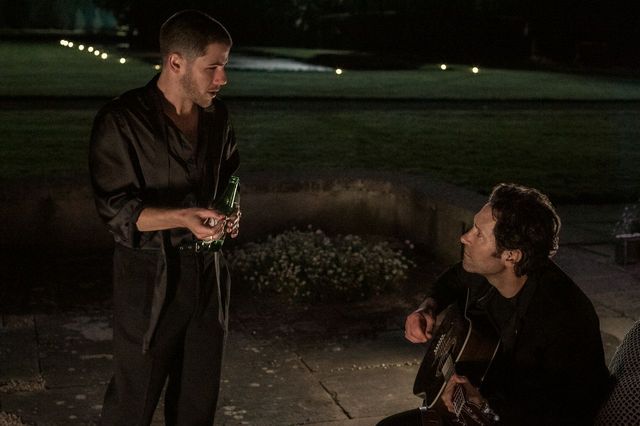
Photo caption: Nick Jonas and Paul Rudd in POWER BALLAD. Courtesy of Lionsgate

In the delightful Irish dramedy Power Ballad, the small-time wedding singer Rick (Paul Rudd) finds himself in an all-night jam with a no-longer-popular boy band star Danny (Nick Jonas). Weeks later, Danny revives his career with a monster hit. Did he steal the song from the Rick? And, if so, what can Rick do about it?

Power Ballad is the latest from John Carney, writer-director of Once, Sing Street and Flora and Son. Those three Feel Good movies all feature penniless Dubliners who discover themselves by harnessing their songwriting talents. Power Ballad includes those elements, but, here, Carney’s exploration of the creative process is more nuanced.

Sure, the core of the song is inspired by Rick’s most heartfelt reflections. But, Carney lets us see that it takes more than melody and lyrics to make a hit; Danny has the charisma and sense of performance that Rick doesn’t, along with the drive, discipline and appetite for grueling hard work that Rick can’t quite harness. And, having tasted the big-time success that Rick can only vaguely imagine, Danny is more desperate.

Carney avoids the potential cornball endings, and lands Power Ballad with an ingeniously satisfying resolution.

The original song in question, How to Write a Song (Without You), composed by Carney and his longtime collaborator Gary Clark, is very good and is plausible as a future jukebox classic. The performances of the real Billboard hits covered by Rick’s wedding band are very, very fun.

Paul Rudd, always so relatable, is very good as an American rocker who stepped off the fast track when he fell for an Irish girl on tour, and scrapes by modestly as a transplant in Dublin. He’s deeply in love with his wife and teenage daughter, who tolerate his very non-rock star Dad behaviors.

I was very impressed with Nick Jonas’ performance as Danny. Although he has 99 screen credits, they’ve almost all been Jonas Brothers videos, TV sitcoms and content in the Night at the Museum and Camp Rock franchises. Although he appeared in the shallow and clumsy (not Nick’s fault) 2019 version of Midway, he hasn’t played many complex adult characters. Although you might not think it a stretch for him to play a former boy bander, Jonas shows Danny to be surprisingly complicated, in the throes of his own identity crisis, an often weak man propelling himself forward with an ill-fitting, needy ambition.

I saw Power Ballad at the closing night of the SLO Film Fest, where it was very well-received. It also played at the SFFILM Festival. It opens in theaters this weekend, and it’s an audience-pleaser.

THE CHRISTOPHERS: twisty, watchable and disposable

Photo caption: Micaela Coel and Ian McKellan in THE CHRISTOPHERS. Courtesy of NEON.

Steven Soderbergh’s dramedy The Christophers deploys two fine British actors and the twistiest of plots to produce 100 minutes of watchable entertainment that is, ultimately, disposable.

Ian McKellan plays Julian, a famous British painter, the kind whose paintings sell for millions. Julian hasn’t produced great art for decades, and he holes up in his London apartment/studio with mementos of his fame amid the junk. He has a fatal illness that has limited his future to a few months at most. He also has two adult children who hate him for being a terrible father, and he despises them, too.

His kids, played hilariously by Jessica Gunning and James Corden, may be justifiably estranged, but they are incredibly despicable people determined to profit in Julian’s death. They know that Julian has locked away a series of unfinished paintings; if they can get a skilled art forger to finish them without Julian’s knowledge, they can “discover” them upon his demise and reap untold fortunes.

Now, the other great British actor arrives, Micaela Coel, who plays Lori, a talented painter who has abandoned her art career, but who is capable of the forgery. And she has a longtime personal grudge against Julian. The conspirators scheme to get Lori hired as Julian’s assistant giving her access to the unfinished art works.

Lori and Julian, so mismatched in age, gender, race and disposition, begin what soon evolves into a match of wits. Lori’s perceptions of Julian and his kids vacillate, and the plot morphs into one double-cross, then another, all the way to the neatly resolved ending. It’s all very clever.

The Christophers is the work of director Steven Soderbergh, who broke through in 1989 with the stunningly original Sex, Lies & Videotape and won the directing Oscar for Traffic, then was nominated for Erin Brockavich. He’s no longer choosing to make big movies like Traffic or Brockavich anymore, but his newer work is almost entertaining, like the goofy hillbilly heist Logan Lucky and the underrated thriller Kimi. I appreciate that Soderbergh has no pretensions – he is now just seeking to entertain, and that’s OK, because he does it so well.

You won’t be thinking about The Chrstophers afterward, but you’ll probably have fun watching it. The Christophers is streaming on Amazon, AppleTV, YouTube and Fandango.
IS GOD IS: an extraordinary new storyteller

Photo caption: Mallori Johnson and Kara Young in IS GOD IS. Courtesy of Amazon MGM Studios.

Wow. Once in a while, the emergence of an ingenious new storyteller can make a genre movie transcend its genre. That’s what writer-director Aleshea Harris has done in her first film, the entirely original and ever entertaining revenge thriller Is God Is.

Indeed, Is God Is follows the familiar arc of a revenge thriller. Two young adult twin sisters, Anaia (Mallori Johnson) and Racine (Kara Young) are living a hardscrabble, but fun-loving life. They have aged out of foster care, having been told that they were orphaned as toddlers when their mother died in a fire. Both sisters were seriously burned in the fire and Anaia’s face is severely scarred.

So, the sisters are shocked to receive a letter from their mother. When they visit her, they find that she was even more hideously maimed by the fire – and that she was intentionally set ablaze by their father (whom they don’t know). Steely-eyed behind a compression mask, the mother (Viveca A. Fox), demands that the twins hunt down their father and kill him.

Obviously, this is a lot for the gals to process. Nonetheless, they embark on the quest, with the more impulsive and feisty Racine more invested than the more thoughtful and sensitive Anaia.

Anaia: We ain’t killers. 

Racine: We come from a man who wanted to kill our mama  and a mama who wants to kill that man.

More than the one critic has written that Is God Is reflects Greek tragedy. Indeed, it’s like Sophocles wrote the ending of a Tarantino film.

Harris’ originality keeps us entertained and ever-guessing: :

  • The twins can communicate with each other telepathically and have whole nonverbal conversations that Harris has subtitled for the audience.
  • Harris makes us wait to meet the father, who, surprisingly doesn’t look or act like the sadistic monster that he is. For one thing, he is played by the ever-civil, well-spoken and charming Sterling K. Brown. What is truly terrifying about this villain is not his appearance or his energy, but his emotional callousness and his casual dismissiveness of human life.
  • As Racine and Anaia proceed on their quest, every character and situation they encounter is more bizarre than the next. Again, Harris’ work resembles Tarantino’s, but without the long speeches.

Aleshea Harris originally wrote Is God Is as a play and won the American Playwriting Fpundation’s Relentless Award. The movie Is God Is is cinematic enough that you can’t tell that the source material is a play. Harris’ subsequent play On Sugarland was a Pulitzer finalist.

Mallori Johnson and Kara Young are excellent as the leads. Besides Fox and Brown, the rest of the cast is packed with even more seasoned talent: Erica Alexander, Janelle Monae and Mykelti Williamson.

This is a violent movie, but the worst of the gore happens off-screen. I found the most chilling scene to be the making of a sandwich.

Now in theaters, Is God Is is the best movie that I’ve seen in 2026 so far.

TIME LIMIT: second-guessing the impossible

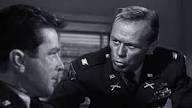
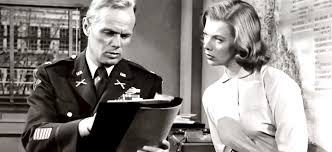
Photo caption: Richard Basehart and Richard Widmark in TIME LIMIT.

In the absorbing Korean War Era drama Time Limit, Major Harry Cargill (Richard Basehart) is charged with the capital offense of treason for, as the senior American officer in a North Korean POW camp, collaborating with the enemy. Colonel William Edwards (Richard Widmark) has the responsibility for investigating the case and then recommending a court martial. Since Cargill himself steadfastly admits the charges, all the surviving POWs share the same testimony and recordings of Cargill’s propaganda broadcasts exist, there doesn’t seem to any doubt that Cargill is headed for a trial for his life.

But some details seem fishy to Edwards, and he keeps probing for exculpatory evidence, despite resistance from Cargill himself, seemingly bent on martyring himself. There’s plenty of dramatic tension in this situation anyway, but the son of Edwards’ base commander, General Connors (Carl Benton Reid) died in the POW camp, and the general is fixated on swift justice..

Time Limit is a thinker, posing the philosophical question, when there are no good choices, does one choose most humane option, or follow the oath one has taken and go by the book? It takes Edwards a long time to drill into the truth, which poses its own question of moral and legal accountability (which may not be the same thing).

Time Limit has the look and feel of a play, which it is. Henry Denker adapted the screenplay from the play he co-wrote with Ralph Berkey. Time Limit is directed by Oscar-winning actor Karl Malden. It is his only feature film as a director (apart from filling in for 30 days on the Gary Cooper western The Hanging Tree).

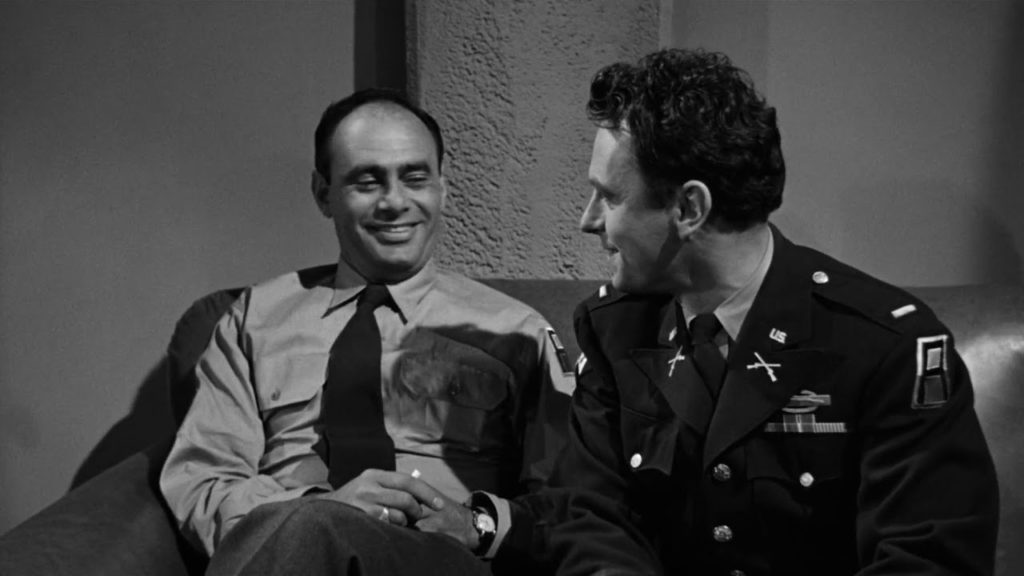
Martin Balsam and Rip Torn in TIME LIMIT

Widmark is very good as the brooding, high-principled and stubborn Edwards; so is Basehart as the traumatized Cargill. There are plenty of memorable performances in Time Limit:

  • Rip Torn is superb as a POW camp survivor, who initially masks his own trauma with a convincing confidence.
  • Martin Balsam as the seasoned non-com with a cynical, clear-eyed view of how things work in the military. He is also comfortable in the devious audacity that comes from being one of the sergeants who really run things in the Army, no matter what the officers think.
  • Dolores Michaels plays Corporal Jean Evans, Edwards’ perky office manager. It will not escape modern viewers that Cpl. Evans is always the smartest person in the room, although it’s clear that she will always stay as an admin because she is a woman. Her insights are explained by her being the daughter of a lawyer.
  • June Lockhart plays Cargill’s bewildered wife.
Richard Widmark and Dolores Michaels in TIME LIMIT.

Fresh off the experience of the Korean War, the topic of brainwashing was very topical in 1957. So was the situation of POWs, in an America where a huge majority of the adult males were WW II vets. Other movies of the period addressed this premise:

  • The Rack (1956):  A returning US army captain (Paul Newman) is court-martialed for collaborating with the enemy while a POW.  He was tortured, and The Rack explores what can be realistically expected of a prisoner under duress.  It’s a pretty good movie, and Wendell Corey and Walter Pidgeon co-star. The Rack occasionally plays on TCM and can be streamed on Amazon, AppleTV, YouTube and Fandango.
  • Act of Violence (1949): In the extremity of a Nazi prisoner of war camp, Frank (Van Heflin) was faced by a situation with no good choices; he knows (correctly) that few in 1949 America will be able to see his action in that context. I’ve tagged Act of Violence as “the single most underrated film noir“. Act of Violence regularly plays on Turner Class Movies and can be streamed on Watch TCM. 
  • Not to mention, of course, Stalag 17 (collaboration POW camps) and The Manchurian Candidate (North Korean brainwashing).

I watched it on TCM, where is occasionally plays, but you can find Time Limit on Amazon and AppleTV.

Rip Torn in TIME LIMIT

SIRAT: gripping, hypnotic and devastating

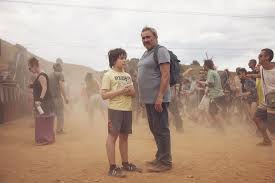
Photo caption: Bruno Nunez Arjuna  and Sergi Lopez in SIRAT. Courtesy of NEON.

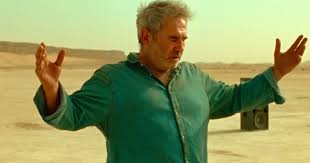
In the harrowing, and finally shattering, Sirat, the middle-aged Spaniard Luis (Sergi Lopez) and his 11-year old son Esteban (Bruno Nunez Arjuna) are looking for Esteban’s older sister, a young adult who they haven’t heard from for five months. Following up on a tip, they are passing out leaflets with her picture at a gathering of European ravers deep in the Moroccan desert.

They don’t find anyone who has seen her, but they hear about another rave coming up to the south, near Mauritania. Civil war has erupted, and the army arrives to evacuate EU citizens out of the country. A small contingent of ravers bolts the convoy, heading for the rumored next rave to the South, and Luis and Esteban, uninvited, follow.

The five ravers, adorned with an assortment of tattoos, piercings, and missing limbs between them, are driving two Mad Max-style trucks that they sleep in. They are nomads, happy to endure rough conditions if they can get high and sway to electric dance music. They’re not thrilled to have Luis and Esteban along, but a bond develops as the seven face the same hardships together.

And hardships abound, as the little convoy grinds through the vast desert. The only people they see are multitudes of refugees fleeing, significantly, in the opposite direction. It’s an unforgiving environment, where if they run out of water, fuel or food, or lose a vehicle, there is no recourse.

They must transverse a narrow, mountain track perched on the side of a cliff. It’s terrifying.

Beginning midway through Sirat, director and co-writer Oliver Laxe rocks us with some stunningly sudden and emotionally devastating events. These are not like the jump scares in the horror genre. These are from among the most shocking occurrences that real people experience in real life.

Sergi Lopez in SIRAT. Courtesy of NEON.

When writing about Sirat, many critics use the words hypnotic and mesmerizing. The story is gripping, but it is embedded in stunning landscapes – the desert itself is becomes a character. During the journey, the soundtrack mirrors the throbbing electronic music from the rave in the opening opening. In terms of audience engagement, Sirat is a triumph for Oliver Laxe.

The performance by Sergi Lopez is epic. Lopez makes Luis’ vulnerability, caginess, dread, terror, numbing grief and fatalistic determination all credible and heartfelt.

The ravers are played by non-actors, but they are so authentic and believable, you can’t tell.

Tonin Janvier and Jade Oukid in SIRAT. Courtesy of NEON.

As Luis and Esteban drive deeper in the forbidding expanse, we wonder, Is the missing daughter/sister safe or in danger? Is she even alive? Does she want to be found? Is Luis risking himself and Esteban for nothing? In the first half of Sirat, we’re asking ourselves whether Luis and Esteban wilI find her. In the second half, those questions become meaningless.

Besides the elements that make Sirat a psychological thriller, there’s a lot here to think about. We see human empathy creating a bond. We see wisdom, most cruelly acquired. Ultimately, Laxe may be asking, what does it really mean to have nothing to lose?

There might also be a comment on adventure tourism. YouTube is full of folks who travel to other lands to experience physical challenges and risky thrills. As seasoned and well-supplied as are the ravers, they are Europeans, and they are from a society in which there are always first responders. Where they have ventured, there are no first responders.

Sirat’s title appears 32 minutes into the running time, a trend I’ve noticed in other recent films. I’m not sure whether I think this practice is pretentious. The title is the name of the mythical bridge between heaven and hell. I’m not sure that there is a heaven in this movie, or even whether any of the characters is seeking heaven. It’s more like everyone is navigating through purgatory unaware of their proximity to hell.

The road on the precarious cliff-side in the trailer frightened me off from seeing Sirat in a theater; I have a fear of heights that precludes me from driving these roads in rel life, and I fear even watching it on screen will trigger a panic attack. Once Sirat started streaming, I knew I could watch it while protected by the fast-forward button on my remote.

Sirat is set n the endless, parched deserts of Morocco, but it was filmed in both Morocco and the Aragon region of Spain. 

This is one of the most-acclaimed recent films. Sirat won the Palme d’or at Cannes and was nominated for the Best International Film Oscar. Many of the 47 awards it has won have been for sound and music.

That being said, this is not a movie for everyone. The audience has to be ready for excruciating heartache and profound bleakness. Despite the sun-baked visuals and the exciting set pieces, this is a very dark film.

Sirat is available to stream from Amazon, AppleTV, YouTube and Fandango and is included with Hulu.

A GREAT AWAKENING: good religion and bad history

Photo caption: Jonathan Blair (center) in A GREAT AWAKENING. Courtesy of Sight and Sound Films.

A Great Awakening has two good stories to tell, but muddles a third. In 18th century England, and then America, George Whitefield (pronounced Whitfield) founded the Methodist denomination, along with John and Charles Wesley, and became the leading public evangelist in England and America. A charismatic orator who could draw crowds of thousands, he was an important figure in the first of what America historians call the Great Awakening. The life and times of George Whitefield is the first good story.

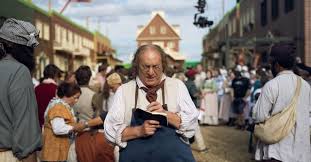
Here’s the second good story – the unlikely friendship between Whitefield and no less an American icon than Benjamin Franklin. Whitefield was drawn to Franklin’s genius and humor, and Franklin admired Whirefield’s passion and ability to attract the masses. The two shared a close personal bond, with the science-minded Franklin resisting Whitehead’s attempts to spiritualize him, and with Franklin’s needling Whitefield about using slaves to run his orphanage.

As near as I can tell, A Great Awakening accurately depicts the life of George Whitefield and the relationship between Whitefield and Franklin. But then, the movie takes on a key moment in American political history and tries to embed a soapy religiosity. Indeed, A Great Awakening comes from Sight & Sound Films, a Christian movie studio whose mission is telling faith-based stories.

John Paul Sneed (center) in A GREAT AWAKENING. Courtesy of Sight and Sound Films.

Here, A Great Awakening takes on a third story, Franklin’s participation in America’s Constitutional Convention, where the Founders battled each other to reach a compromise solution to the American nation’s framework of government. This was well after Whitefield’s death, and A Great Awakening has Franklin, remembering his old friend, and suggesting that every session of negotiations be opened with a prayer. A Great Awakening asserts that these morning prayers were instrumental in the final success of the Constitutional Convention.

Indeed, the notoriously nonreligious Franklin did propose a daily prayer. But no real historian credits the birth of the Constitution to a ritual prayer instead of the creative thinking and hard-fought compromises that finally satisfied the disparate States. Students of American government will note that this is why we have checks and balances, power divided between small States (the Senate) and populous States (the House of Representative) and a political boost to slave states (the heinous, since rescinded, three-fifths rule). So, as political history, A Great Awakening is just not credible, and is even misleading.

The cast is neither well-known or well-seasoned, with the leads sharing only seven screen credits between them. Whitefield is played by a co-writer of the movie, Jonathan Blair, who has the ringing voice and gleaming passion that Whitefield must have had. John Paul Sneed plays Franklin, as Franklin ages from his forties through his eighties.

A Great Awakening’s biggest flaw.however, is that all the actors deliver virtually every line with fervent passion. Admittedly, actual religious passion and actual political passion are important elements of these stories, but the emoting is just unrelenting. It’s like a compendium of auditions for a soap opera.

So, the hackneyed over-earnestness and the bit of Fake History sink this movie. A Great Awakening can be streamed on Amazon, AppleTV, YouTube and Fandango.
HEADS OR TAILS?: a spaghetti western goes off the rails

Photo caption: John C. Reilly in HEADS OR TAILS? Courtesy of Samuel Goldwyn Company.

Well, this was a disappointment. One of my personal favorite sub-genres is the Spaghetti Western. I really admired The Tale of King Crab, the first narrative by writer-directors Alessio Rigo de Righi and Matteo Zoppis, and I was delighted to see these guys riffing off Sergio Leone in a movie starring Nadia Tereszkiewicz, with her sexy magnetism and feral unpredictability, Allesandro Borghi of the acclaimed The Eight Mountains, and the always hilarious John C. Reilly. This looked really good.

Heads or Tails? begins with a bizarre, but historical event – Buffalo Bill Cody (John C. Reilly) putting on his Wild West Show, a live spectacle of cowboys and Indians, for an Italian audience circa 1900. Buffalo Bill lived through the most exciting phase of the Old West, having been a Pony Express rider, buffalo hunter and a scout in the Indian Wars. A remarkable showman and entrepreneur, he capitalized on his experiences by creating the Wild West Show, which entertained Easterners and Europeans with riding, roping, shooting, real life bison and an Indian “battle”. Indigenous cast members even included Sitting Bull. Of course, Cody himself knew that the show was filled with hokum, but he happily became rich by playing the role. The Wild West Show did tour Italy twice, once performing for the Pope.

A local aristocrat, a scummy wife-beater, has hosted Buffalo Bill’s performance, and afterwards, tries to further enrich himself with a crooked wager. Santino (Borghi), a dim but virile cattle worker, screws up the wager, and, the furious nobleman suspects that Santino has also been involved with his young wife Rosa (Tereszkiewicz). The aristocrat is killed, and Santino and Rosa go on the run.

At this point, Heads or Tails? leaves conventional Spaghetti Western territory, adds a heavy dose of surrealism, and becomes less coherent – and less watchable.

John C. Reilly, who captures Buffalo Bill’s performative bluster and worldly cynicism, is brilliant, but 80% of the story follows Rosa and Santino without Buffalo Bill.

I streamed Heads or Tails? on Amazon Prime, and most of the dialogue, except for Reilly’s, seemed dubbed in English. I found it off-putting, and didn’t understand it because Tereszkiewicz, who is French, speaks both Italian and English. Besides Amazon, you can also stream Heads or Tails? on AppleTV, YouTube and Fandango.
THE LAST ONE FOR THE ROAD: the party never ends

Photo caption: Filippo Scotti (center front) in THE LAST ONE FOR THE ROAD. Courtesy of Music Box Films.

In the genial Italian comedy The Last One for the Road, we get to meet two cheerful reprobates, whose only ambition is for their next drink. On the downside of middle age, Carlobianchi (Sergio Romano) and Doriano (Pierpaolo Capovilla) employ their wily charms to cadge free drinks from a bachelorette party and even impersonate a team of architects expert in historical preservation. Bill Clinton said he represented the folks who “work hard, follow the rules and pay their taxes“; Carlobianchi and Dori are not those people.

Carlobianchi and Dori have a close friend returning home after decades abroad, and they resolve to meet him at the airport. Because they’ve never been to any airports in the province of Venice, this precipitates a meandering road trip to find the right one. While crashing a college graduation party, the two meet a straitlaced architecture grad student Giulio (Filippo Scotti), and take him along.

Giulio protests that he has an important academic presentation the next day, but Carlobianchi and Dori insist on dragging him along on their hazy mission. Giulio really does need to loosen up, he’s blowing it with the young woman he likes by being just too uptight. Will the two old slackers succeed in debauching him? The road trip evolves into a semi-voluntary kidnapping. 

Sergio Romano and Pierpaolo Capovilla in THE LAST ONE FOR THE ROAD. Courtesy of Music Box Films.

The lengths that Carlobiachi and Dori will go to get another drink are funny; so is Giulio’s insistence that he is disembarking from their tour, despite never getting out of their car and calling an Uber, which any grown ass adult would do to “escape”.

The Last Round for the Road is a fun comic road trip, but there’s more here than it seems. The film begins with a factory worker’s entire work life rewarded with a Rolex, followed by a glimpse of how little that luxury watch really means to him. The industry of Carlobianchi and Dori’s old buddy Genio in masterminding a heist is not rewarded. Giulio’s passion for architecture and his academic discipline will surely pay off in professional success, but he takes notice that Carlobianchi and Dori, as aimless and irresponsible as they are, are enjoying a stress-free life. The party never ends.

The Last One for the Road, the second feature for director and co-writer Francesco Sossai, opens tomorrow at the Laemmle Royal in Los Angeles and releases more widely next weekend.